Graphical abstract template · Battery & energy storage guides · Anode and electrolyte materials
Anode and electrolyte materials
Anode and electrolyte materials on one page: hard carbon pyrolysed from biomass or resin and how it stores sodium, silicon nanoparticles held in yolk–shell and pomegranate carbon, a LiPF₆ carbonate electrolyte made in a glovebox, the HF that trace water makes from it, and the argyrodite solid electrolyte Li₆PS₅Cl. Every step and number is quoted from the cited papers.
Updated 15 cited papers45 editable layers

At a glance
- Category
- Battery & energy storage guides
- Method
- Anode and electrolyte materials
- Starting materials
- Biomass or resin precursors; Si nanoparticles and a carbon source; LiPF₆ in ethylene carbonate with dimethyl or diethyl carbonate; Li₂S, P₂S₅ and LiCl
- Product
- Hard carbon, yolk–shell and pomegranate Si–C anodes, a 1 M LiPF₆ carbonate electrolyte and argyrodite Li₆PS₅Cl
- Key result
- Structures and steps drawn by LabCanvas from the cited papers; pores, particles and molecules are drawn, not to scale, and no panel is a micrograph
- Figure
- 1920 × 1080 px (16:9), 45 editable layers, 6 generated objects
Step by step
- Making hard carbonHard carbon, so far the only commercially viable sodium-ion anode, is made by pyrolysing organic precursors, usually at 1000–1500 °C; in one reviewed example olive shells were pre-carbonised at 300 °C, then treated at high temperature under argon (Geng 2026). Industrially feasible precursors include resins, biomass and needle coke (Yang 2026)
- Where the sodium goesRandomly oriented, curved graphitic domains ("house of cards") with a (002) spacing over 0.37 nm, against 0.335 nm in graphite, and many nanopores and defects. In the widely accepted three-stage model Na is adsorbed on surfaces and defects in the high-potential sloping region, fills closed nanopores as quasi-metallic sodium in the low-voltage plateau, and deposits on the surface at ultra-low potential, with a risk of dendrites (Geng 2026). Closed-pore engineering targets the low initial Coulombic efficiency and the limited plateau capacity (Wu 2026)
- Silicon held in carbonSilicon has ten times the theoretical capacity of carbon anodes, but its volume change (~300%) degrades its structure and destabilises the SEI (Liu 2014). Yolk–shell: commercial Si nanoparticles sealed in thin carbon shells with designed void space, made mostly at room temperature; ~2800 mAh/g at C/10, 74% retention after 1000 cycles, Coulombic efficiency 99.84% (Liu 2012). Pomegranate: clusters of such particles sealed in micrometre-size carbon pouches: 97% retention after 1,000 cycles and 1,270 mAh/cm³ (Liu 2014)
- LiPF₆ in carbonates1 M LiPF₆ in ethylene carbonate/dimethyl carbonate (50/50, v/v), cells assembled in an argon-filled glovebox (Mou 2022); or 1 M LiPF₆ in EC : DEC (1 : 1) in a glovebox with < 0.1 ppm water and oxygen (Ahangari 2024). VC and FEC stabilise the SEI, improving its structure, density and mechanical strength (Zhang 2020), and are considered the most effective additives for Si-containing anodes (Stehle 2023)
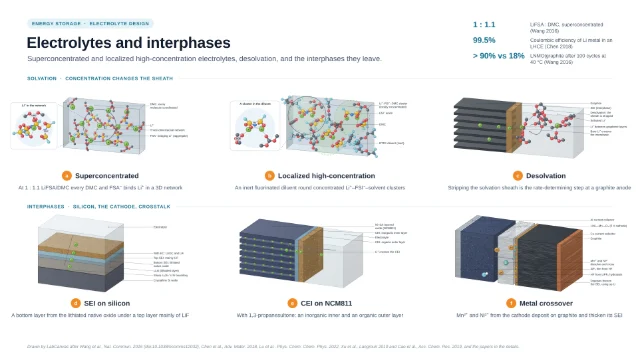
- Trace water makes HFTrace water, inevitably introduced in manufacturing, hydrolyses LiPF₆ to HF, which degrades the SEI and corrodes electrode materials (Peng 2026); PF₅ and HF from the decomposition and hydrolysis of LiPF₆ attack both the SEI on the anode and the CEI on the cathode (Han 2020)
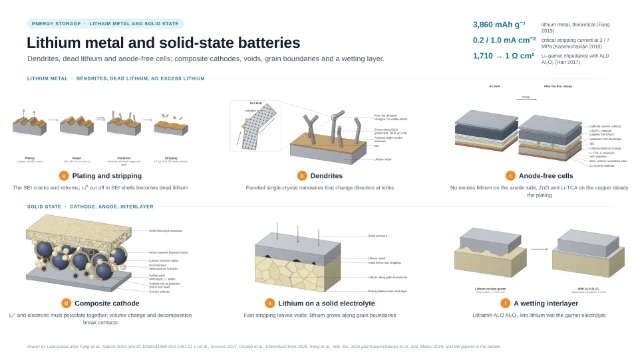
- A sulfide solid electrolyteLi₂S, P₂S₅ and LiCl sealed in a WC-coated jar under argon (H₂O, O₂ < 0.3 ppm), mixed at 110 rpm for 1 h instead of high-energy milling, and annealed for 10 h in sealed quartz tubes: pure cubic Li₆PS₅Cl at 500–550 °C, best at 550 °C with 4.96 mS/cm at 26.2 °C (Yu 2018). With moisture, argyrodites give off toxic H₂S and lose their high conductivity (Lee 2025). Garnet LLZO is the oxide alternative: hot-pressed Ga-LLZO reached 2.8 mS/cm in the bulk (Vema 2023)
Strengths
- Closed pores give the plateau capacity without touching the electrolyte (Geng 2026)
- In yolk–shell silicon the SEI on the shell surface stays stable (Liu 2012)
- Direct annealing of the mixed precursors avoids intensive ball milling (Yu 2018)
Limitations
- Graphite stores very little sodium: the larger Na⁺ cannot intercalate effectively between its ordered layers (Geng 2026)
- Nanosized silicon has a low volumetric capacity (Liu 2014)
- Argyrodites give off toxic H₂S with moisture (Lee 2025)
Papers this template follows
- Geng et al., “Beyond Isolated Optimization: A Holistic Review Across the Pre-Mid Post-Treatment Chain for Hard Carbon in Sodium-Ion Battery”, Nano-Micro Lett. 2026. doi:10.1007/s40820-026-02248-yprimary
- Wu et al., “Unlocking High-Energy Sodium-Ion Batteries via Chemically Engineered Closed Pores in Hard Carbon”, Small 2026. doi:10.1002/smll.76093primary
- Yang et al., “Hard Carbon Anodes for Sodium-Ion Batteries: Industrial Precursors, Structural Regulation, and Future Prospects”, Small 2026. doi:10.1002/smll.74334primary
- Liu et al., “A yolk-shell design for stabilized and scalable Li-ion battery alloy anodes”, Nano Lett. 2012. doi:10.1021/nl3014814primary
- Liu et al., “A pomegranate-inspired nanoscale design for large-volume-change lithium battery anodes”, Nat. Nanotechnol. 2014. doi:10.1038/nnano.2014.6primary
- Mou et al., “Scalable Advanced Li(Ni₀.₈Co₀.₁Mn₀.₁)O₂ Cathode Materials from a Slug Flow Continuous Process”, ACS Omega 2022. doi:10.1021/acsomega.2c05521primary
- Ahangari et al., “Advancing Lithium-Ion Batteries’ Electrochemical Performance: Ultrathin Alumina Coating on Li(Ni₀.₈Co₀.₁Mn₀.₁)O₂ Cathode Materials”, Micromachines 2024. doi:10.3390/mi15070894primary
- Zhang et al., “Operando Electrochemical Atomic Force Microscopy of Solid-Electrolyte Interphase Formation on Graphite Anodes: The Evolution of SEI Morphology and Mechanical Properties”, ACS Appl. Mater. Interfaces 2020. doi:10.1021/acsami.0c11190primary
- Stehle et al., “The Optimal Amount of Lithium Difluorophosphate as an Additive for Si-Dominant Anodes in an Application-Oriented Setup”, ChemSusChem 2023. doi:10.1002/cssc.202301153primary
- Peng et al., “Water-Scavenging Suspended Mediator in Electrolytes for Silicon-Based Lithium-Ion Batteries with High-Nickel Cathode”, Molecules 2026. doi:10.3390/molecules31050863primary
- Han et al., “Dual-Functional Electrolyte Additives toward Long-Cycling Lithium-Ion Batteries: Ecofriendly Designed Carbonate Derivatives”, ACS Appl. Mater. Interfaces 2020. doi:10.1021/acsami.0c04372primary
- Yu et al., “Facile Synthesis toward the Optimal Structure-Conductivity Characteristics of the Argyrodite Li₆PS₅Cl Solid-State Electrolyte”, ACS Appl. Mater. Interfaces 2018. doi:10.1021/acsami.8b07476primary
- Lee et al., “Fluoride-rich Sulfide Solid Electrolyte With Ultrahigh Air Stability for All-Solid-State Batteries”, Small 2025. doi:10.1002/smll.202411349primary
- Vema et al., “Clarifying the Dopant Local Structure and Effect on Ionic Conductivity in Garnet Solid-State Electrolytes for Lithium-Ion Batteries”, Chem. Mater. 2023. doi:10.1021/acs.chemmater.3c01831primary
- Lyu, He & Liu, “PEO-LITFSI-SiO₂-SN System Promotes the Application of Polymer Electrolytes in All-Solid-State Lithium-ion Batteries”, ChemistryOpen 2020. doi:10.1002/open.202000107further reading
Drawn by LabCanvas after Geng et al., Nano-Micro Lett. 2026 (doi:10.1007/s40820-026-02248-y), Liu et al., Nano Lett. 2012, Liu et al., Nat. Nanotechnol. 2014, Mou et al., ACS Omega 2022 and Peng et al., Molecules 2026, and the papers in the details.
How templates are written and checked: editorial guidelines.
Questions
What does the “Anode and electrolyte materials” template show?
Anode and electrolyte materials on one page: hard carbon pyrolysed from biomass or resin and how it stores sodium, silicon nanoparticles held in yolk–shell and pomegranate carbon, a LiPF₆ carbonate electrolyte made in a glovebox, the HF that trace water makes from it, and the argyrodite solid electrolyte Li₆PS₅Cl. Every step and number is quoted from the cited papers.
What are the steps shown in “Anode and electrolyte materials”?
1. Making hard carbon: Hard carbon, so far the only commercially viable sodium-ion anode, is made by pyrolysing organic precursors, usually at 1000–1500 °C; in one reviewed example olive shells were pre-carbonised at 300 °C, then treated at high temperature under argon (Geng 2026). Industrially feasible precursors include resins, biomass and needle coke (Yang 2026). 2. Where the sodium goes: Randomly oriented, curved graphitic domains ("house of cards") with a (002) spacing over 0.37 nm, against 0.335 nm in graphite, and many nanopores and defects. In the widely accepted three-stage model Na is adsorbed on surfaces and defects in the high-potential sloping region, fills closed nanopores as quasi-metallic sodium in the low-voltage plateau, and deposits on the surface at ultra-low potential, with a risk of dendrites (Geng 2026). Closed-pore engineering targets the low initial Coulombic efficiency and the limited plateau capacity (Wu 2026). 3. Silicon held in carbon: Silicon has ten times the theoretical capacity of carbon anodes, but its volume change (~300%) degrades its structure and destabilises the SEI (Liu 2014). Yolk–shell: commercial Si nanoparticles sealed in thin carbon shells with designed void space, made mostly at room temperature; ~2800 mAh/g at C/10, 74% retention after 1000 cycles, Coulombic efficiency 99.84% (Liu 2012). Pomegranate: clusters of such particles sealed in micrometre-size carbon pouches: 97% retention after 1,000 cycles and 1,270 mAh/cm³ (Liu 2014). 4. LiPF₆ in carbonates: 1 M LiPF₆ in ethylene carbonate/dimethyl carbonate (50/50, v/v), cells assembled in an argon-filled glovebox (Mou 2022); or 1 M LiPF₆ in EC : DEC (1 : 1) in a glovebox with < 0.1 ppm water and oxygen (Ahangari 2024). VC and FEC stabilise the SEI, improving its structure, density and mechanical strength (Zhang 2020), and are considered the most effective additives for Si-containing anodes (Stehle 2023). 5. Trace water makes HF: Trace water, inevitably introduced in manufacturing, hydrolyses LiPF₆ to HF, which degrades the SEI and corrodes electrode materials (Peng 2026); PF₅ and HF from the decomposition and hydrolysis of LiPF₆ attack both the SEI on the anode and the CEI on the cathode (Han 2020). 6. A sulfide solid electrolyte: Li₂S, P₂S₅ and LiCl sealed in a WC-coated jar under argon (H₂O, O₂ < 0.3 ppm), mixed at 110 rpm for 1 h instead of high-energy milling, and annealed for 10 h in sealed quartz tubes: pure cubic Li₆PS₅Cl at 500–550 °C, best at 550 °C with 4.96 mS/cm at 26.2 °C (Yu 2018). With moisture, argyrodites give off toxic H₂S and lose their high conductivity (Lee 2025). Garnet LLZO is the oxide alternative: hot-pressed Ga-LLZO reached 2.8 mS/cm in the bulk (Vema 2023).
What are the starting materials and the product?
Starting materials: Biomass or resin precursors; Si nanoparticles and a carbon source; LiPF₆ in ethylene carbonate with dimethyl or diethyl carbonate; Li₂S, P₂S₅ and LiCl. Product: Hard carbon, yolk–shell and pomegranate Si–C anodes, a 1 M LiPF₆ carbonate electrolyte and argyrodite Li₆PS₅Cl.
Which papers is “Anode and electrolyte materials” based on?
Geng et al., “Beyond Isolated Optimization: A Holistic Review Across the Pre-Mid Post-Treatment Chain for Hard Carbon in Sodium-Ion Battery”, Nano-Micro Lett. 2026 (doi:10.1007/s40820-026-02248-y); Wu et al., “Unlocking High-Energy Sodium-Ion Batteries via Chemically Engineered Closed Pores in Hard Carbon”, Small 2026 (doi:10.1002/smll.76093); Yang et al., “Hard Carbon Anodes for Sodium-Ion Batteries: Industrial Precursors, Structural Regulation, and Future Prospects”, Small 2026 (doi:10.1002/smll.74334); Liu et al., “A yolk-shell design for stabilized and scalable Li-ion battery alloy anodes”, Nano Lett. 2012 (doi:10.1021/nl3014814); Liu et al., “A pomegranate-inspired nanoscale design for large-volume-change lithium battery anodes”, Nat. Nanotechnol. 2014 (doi:10.1038/nnano.2014.6); Mou et al., “Scalable Advanced Li(Ni₀.₈Co₀.₁Mn₀.₁)O₂ Cathode Materials from a Slug Flow Continuous Process”, ACS Omega 2022 (doi:10.1021/acsomega.2c05521); Ahangari et al., “Advancing Lithium-Ion Batteries’ Electrochemical Performance: Ultrathin Alumina Coating on Li(Ni₀.₈Co₀.₁Mn₀.₁)O₂ Cathode Materials”, Micromachines 2024 (doi:10.3390/mi15070894); Zhang et al., “Operando Electrochemical Atomic Force Microscopy of Solid-Electrolyte Interphase Formation on Graphite Anodes: The Evolution of SEI Morphology and Mechanical Properties”, ACS Appl. Mater. Interfaces 2020 (doi:10.1021/acsami.0c11190); Stehle et al., “The Optimal Amount of Lithium Difluorophosphate as an Additive for Si-Dominant Anodes in an Application-Oriented Setup”, ChemSusChem 2023 (doi:10.1002/cssc.202301153); Peng et al., “Water-Scavenging Suspended Mediator in Electrolytes for Silicon-Based Lithium-Ion Batteries with High-Nickel Cathode”, Molecules 2026 (doi:10.3390/molecules31050863); Han et al., “Dual-Functional Electrolyte Additives toward Long-Cycling Lithium-Ion Batteries: Ecofriendly Designed Carbonate Derivatives”, ACS Appl. Mater. Interfaces 2020 (doi:10.1021/acsami.0c04372); Yu et al., “Facile Synthesis toward the Optimal Structure-Conductivity Characteristics of the Argyrodite Li₆PS₅Cl Solid-State Electrolyte”, ACS Appl. Mater. Interfaces 2018 (doi:10.1021/acsami.8b07476); Lee et al., “Fluoride-rich Sulfide Solid Electrolyte With Ultrahigh Air Stability for All-Solid-State Batteries”, Small 2025 (doi:10.1002/smll.202411349); Vema et al., “Clarifying the Dopant Local Structure and Effect on Ionic Conductivity in Garnet Solid-State Electrolytes for Lithium-Ion Batteries”, Chem. Mater. 2023 (doi:10.1021/acs.chemmater.3c01831); Lyu, He & Liu, “PEO-LITFSI-SiO₂-SN System Promotes the Application of Polymer Electrolytes in All-Solid-State Lithium-ion Batteries”, ChemistryOpen 2020 (doi:10.1002/open.202000107).
Can I edit the “Anode and electrolyte materials” template?
Yes. Open it in the LabCanvas editor: all 45 layers are editable, including 6 generated objects (structures, plots, equipment) with their own settings. Change the text, colours and layout, then export PNG, TIFF, SVG or PDF.
Do I need an account to use this template?
Not to view it here. To open and edit it, sign in to LabCanvas or create a free account (the free plan keeps up to 3 designs). Downloading the figure is part of LabCanvas Pro (US$19 a month or US$199 a year).