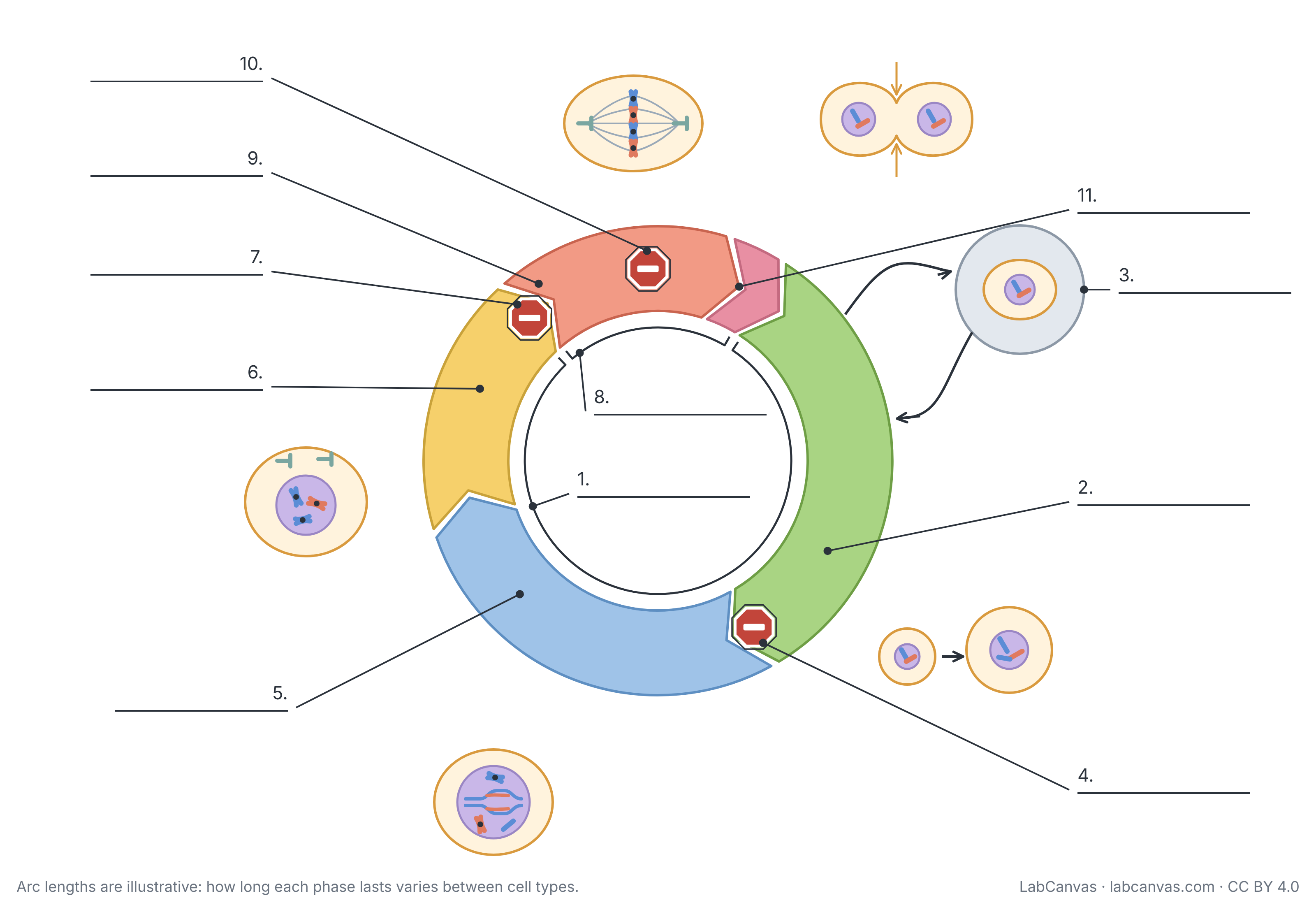
Cell cycle diagram (labelled)
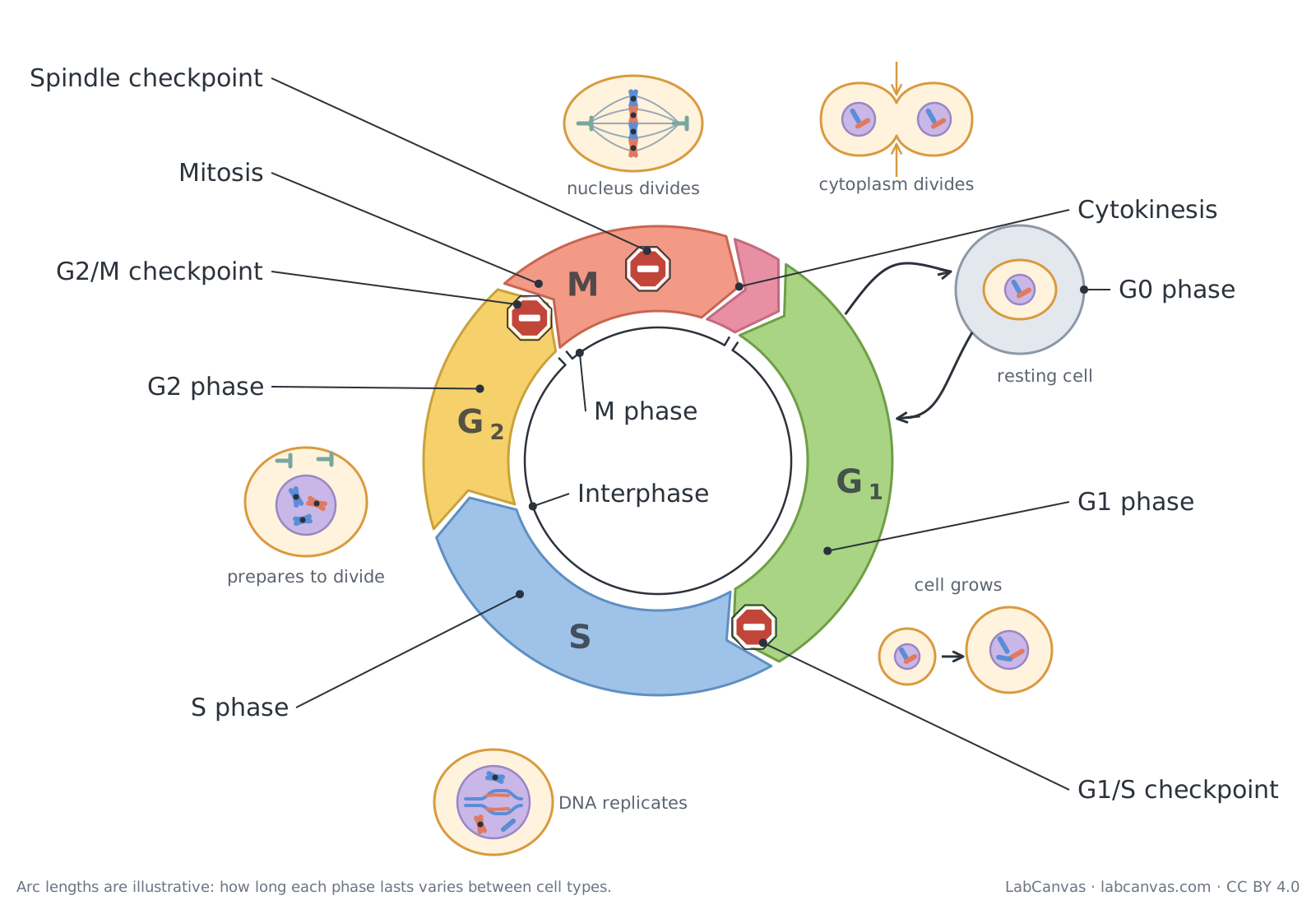
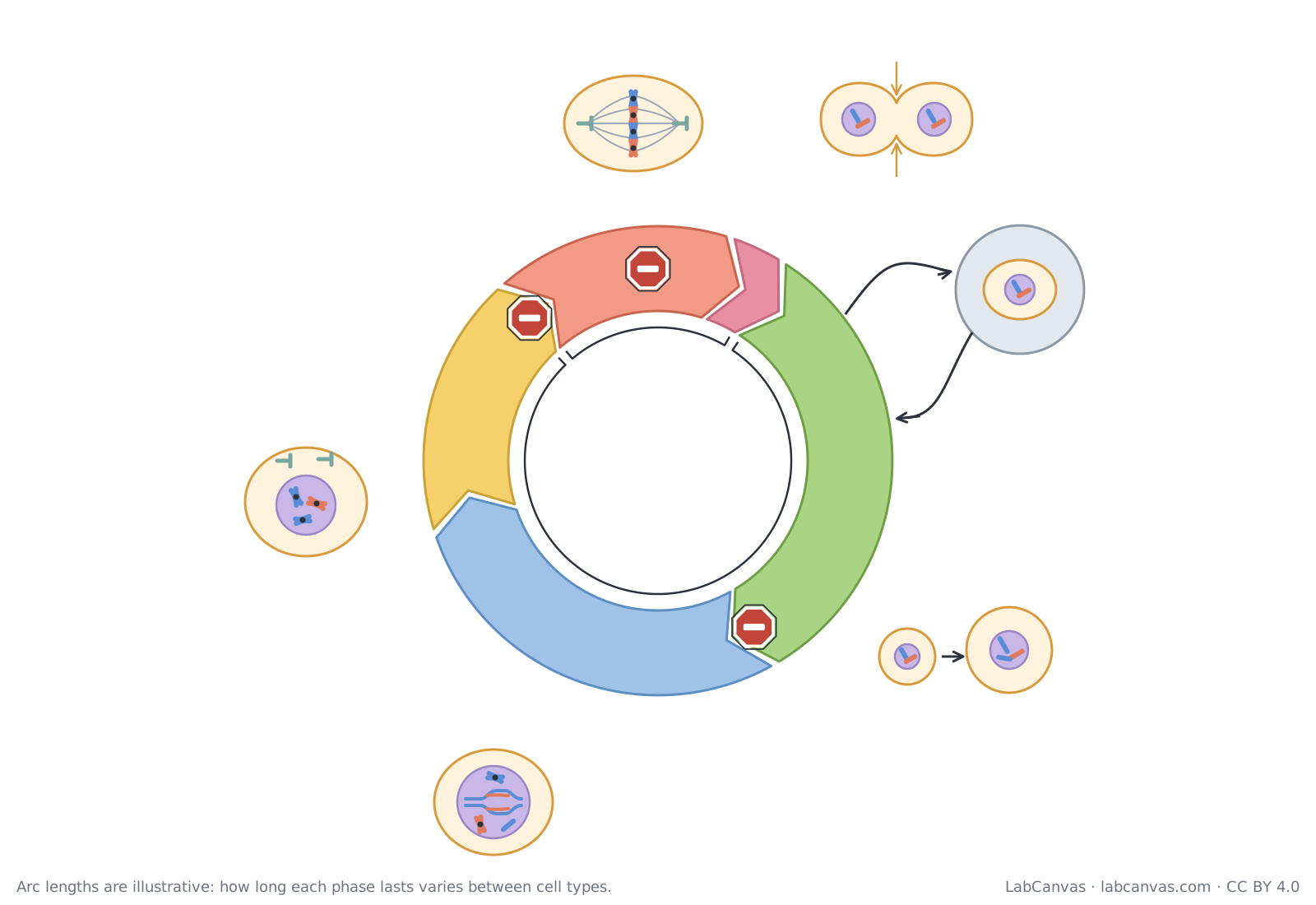
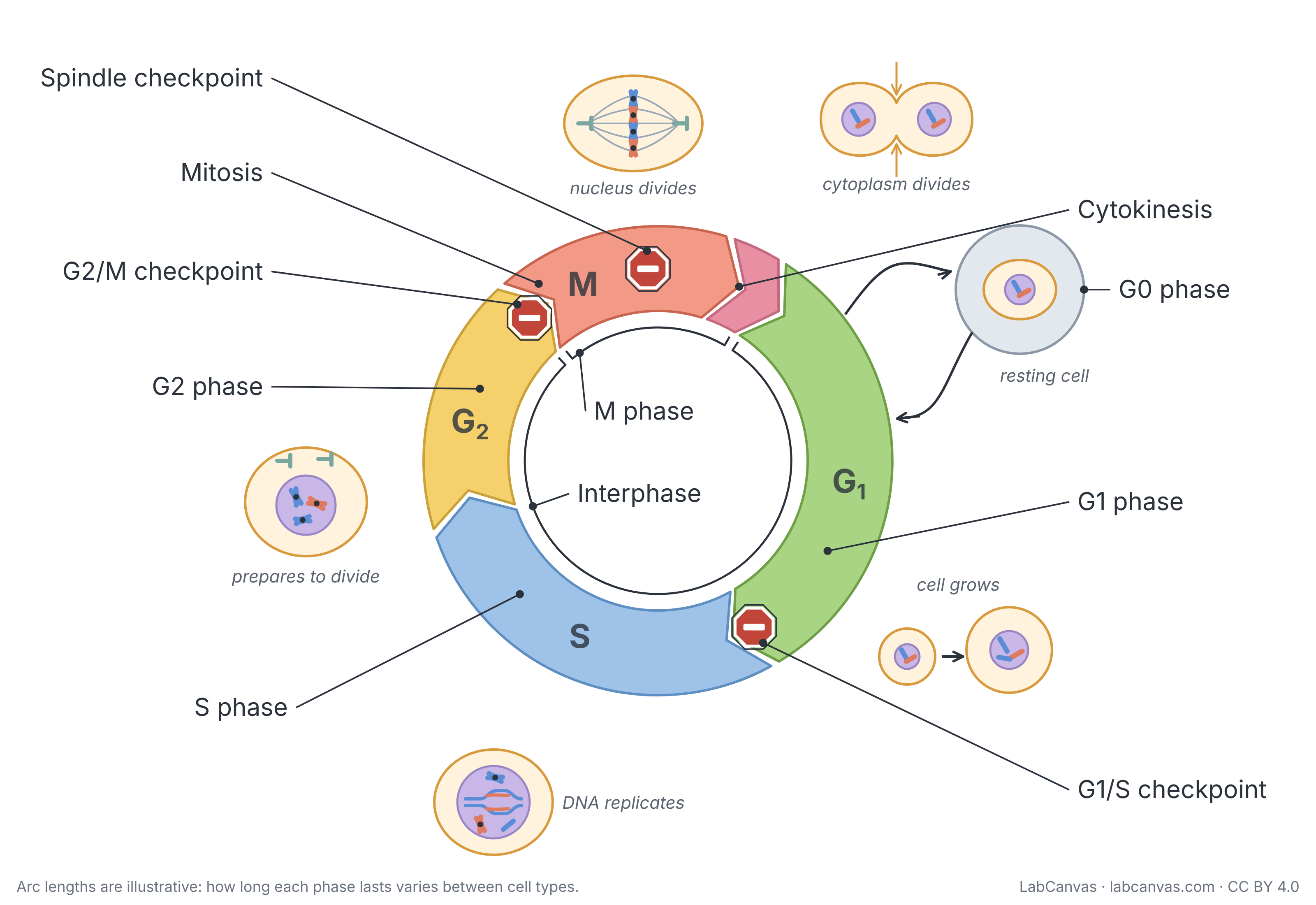
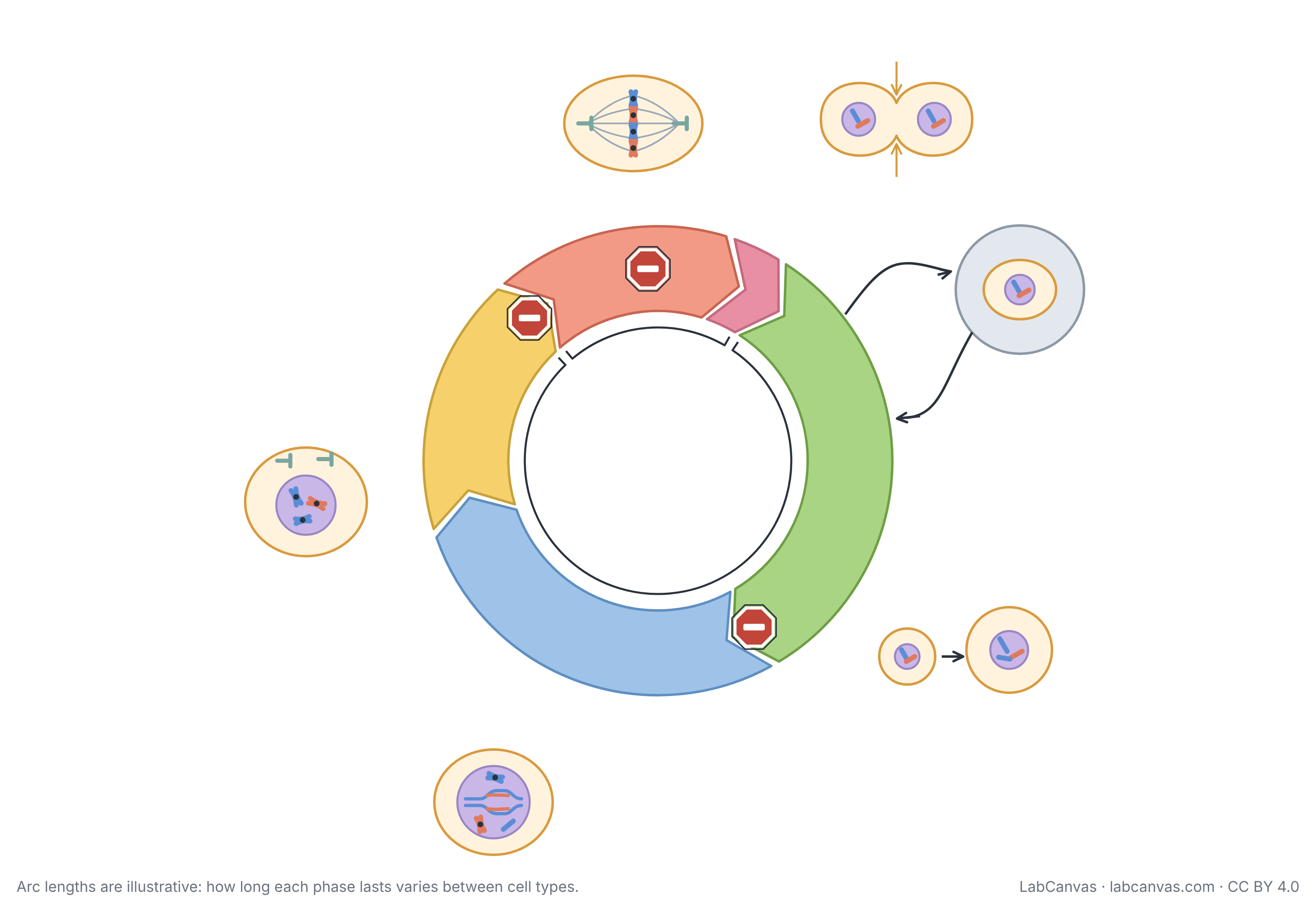
The cell cycle is the ordered series of events in which a cell grows, copies its DNA and divides into two daughter cells. It has two main parts: interphase, made of G1 (growth), S (DNA replication) and G2 (preparation for division), and the M phase, made of mitosis (division of the nucleus) and cytokinesis (division of the cytoplasm). Cells that stop dividing leave G1 for a resting state called G0, and checkpoints at G1/S, G2/M and in metaphase (the spindle checkpoint) only let the cycle continue when the cell is ready.
Last updated
Download the cell cycle diagram
Free to use in homework, teaching, slides, posters and publications under CC BY 4.0. Please credit: Cell cycle diagram by LabCanvas (labcanvas.com), CC BY 4.0
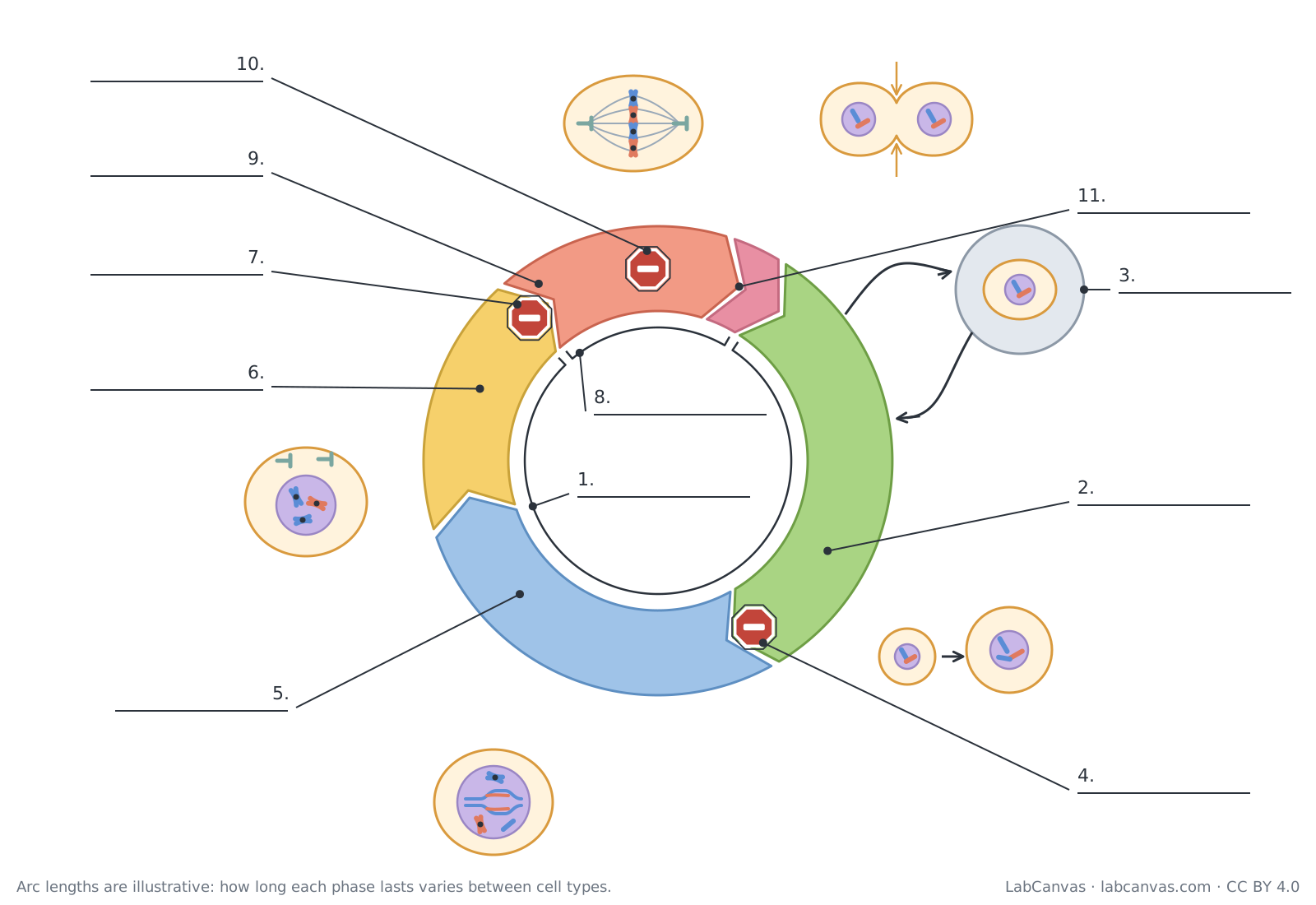
Parts of the cell cycle and what they do
| # | Part | What it is or does |
|---|---|---|
| 1 | Interphase | The long stretch between divisions (G1, S and G2): the cell grows, does its normal work and copies its DNA. |
| 2 | G1 phase (first gap) | The cell grows, makes proteins and organelles, and builds up the energy and materials it needs to copy its DNA. |
| 3 | G0 phase | A resting state outside the cycle: the cell keeps working but is not preparing to divide; some cells return to G1 later, others never do. |
| 4 | G1/S checkpoint | Checks cell size, energy reserves, signals from outside and DNA damage before the cell commits to copying its DNA. |
| 5 | S phase (synthesis) | DNA replication: every chromosome is copied into two identical sister chromatids joined at the centromere; animal cells also duplicate the centrosome. |
| 6 | G2 phase (second gap) | The cell replenishes its energy and makes the proteins needed to move chromosomes, getting ready for mitosis. |
| 7 | G2/M checkpoint | Lets the cell enter mitosis only if all the DNA has been copied correctly and is not damaged. |
| 8 | M phase (mitotic phase) | The division part of the cycle: mitosis followed by cytokinesis. |
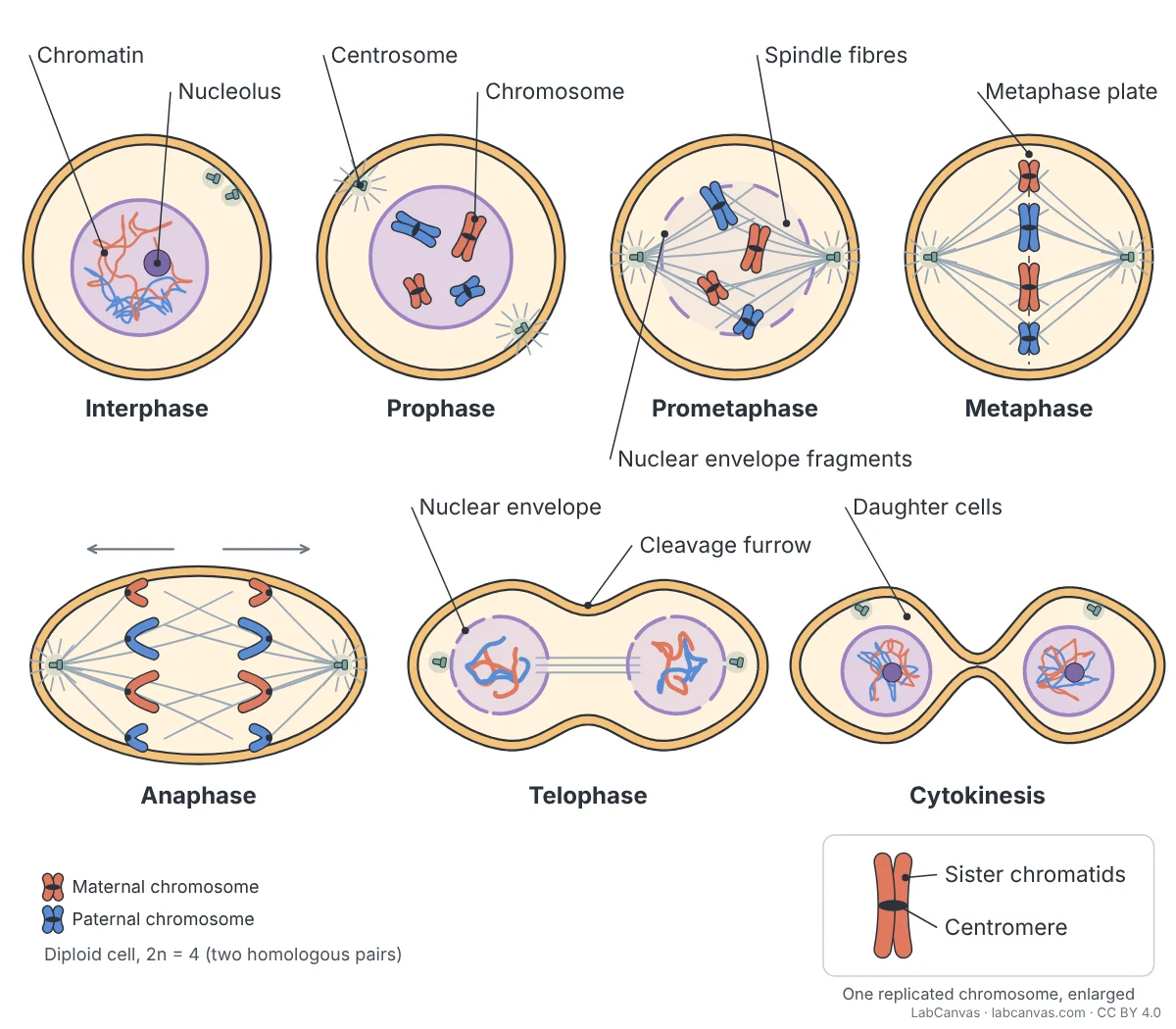
| 9 | Mitosis | Division of the nucleus (prophase, prometaphase, metaphase, anaphase, telophase): the sister chromatids are pulled apart so each new nucleus gets one full set of chromosomes. |
| 10 | Spindle checkpoint (M checkpoint) | Near the end of metaphase, checks that every pair of sister chromatids is attached to spindle microtubules before anaphase separates them. |
| 11 | Cytokinesis | Division of the cytoplasm into two daughter cells: a cleavage furrow in animal cells, a cell plate in plant cells. |
How to label a cell cycle diagram
- Draw the wheelDraw a thick ring and mark the direction of travel with arrows (clockwise is the usual convention). This one circle is one complete cycle, from one division to the next.
- Split it into interphase and M phaseGive interphase most of the ring and the M phase a smaller arc. The sizes are only illustrative: how long each phase lasts varies between cell types.
- Divide interphase into G1, S and G2Going round in order after division: G1 (growth), then S (DNA replication), then G2 (preparation for division).
- Divide the M phaseMark mitosis (division of the nucleus) first and cytokinesis (division of the cytoplasm) at the end, just before the arrow returns to G1.
- Add G0Draw a side branch out of G1 to a resting state labelled G0, with an arrow back into G1 for cells that can re-enter the cycle.
- Mark the three checkpointsPut a stop mark at the G1/S boundary, at the G2/M boundary and inside mitosis at metaphase (the spindle checkpoint).
- Label and checkLabel each part with a straight leader line, then check the order: G1 → S → G2 → mitosis → cytokinesis → back to G1.
Phases of the cell cycle at a glance
| Phase | Part of | What happens |
|---|---|---|
| G1 | Interphase | Cell grows, makes proteins and organelles, stores energy; G1/S checkpoint at the end |
| S | Interphase | DNA is replicated: each chromosome becomes two sister chromatids; centrosome duplicated (animal cells) |
| G2 | Interphase | Energy replenished, proteins for chromosome movement made; G2/M checkpoint at the end |
| Mitosis | M phase | Nucleus divides; sister chromatids separate to opposite poles; spindle checkpoint at metaphase |
| Cytokinesis | M phase | Cytoplasm divides, producing two genetically identical daughter cells |
| G0 | Outside the cycle | Cell is not preparing to divide; it may re-enter G1 or stay in G0 permanently |
What the cell is doing in each phase
Interphase is not a resting stage. During G1 the cell is metabolically active: it grows and makes the proteins and other building blocks it will need. In S phase the DNA is copied, so each chromosome now has two identical sister chromatids held together at the centromere; in animal cells the centrosome, which later organises the spindle, is duplicated too. In G2 the cell makes the proteins needed to move chromosomes and prepares for division.
The M phase then divides the cell in two. Mitosis (karyokinesis) separates the copied chromosomes into two nuclei, and cytokinesis splits the cytoplasm, giving two daughter cells with the same genetic information as the parent cell.
Cell cycle checkpoints and cancer
Checkpoints are control points where the cycle can be stopped until conditions are right. The G1/S checkpoint checks cell size, energy reserves, growth signals and DNA damage; passing it commits the cell to dividing. The G2/M checkpoint checks that the DNA has been copied completely and without damage. The spindle (M) checkpoint, near the end of metaphase, checks that every pair of sister chromatids is attached to the spindle, because separating them in anaphase cannot be undone.
The cycle is driven forward by positive regulators (cyclins and cyclin-dependent kinases, Cdks) and held back by negative regulators such as the retinoblastoma protein (Rb), p53 and p21. Cancer is uncontrolled cell division: mutations that turn proto-oncogenes into overactive oncogenes, or that disable tumour suppressor genes such as p53, let damaged cells slip past the checkpoints and keep dividing.
Cell cycle vs mitosis
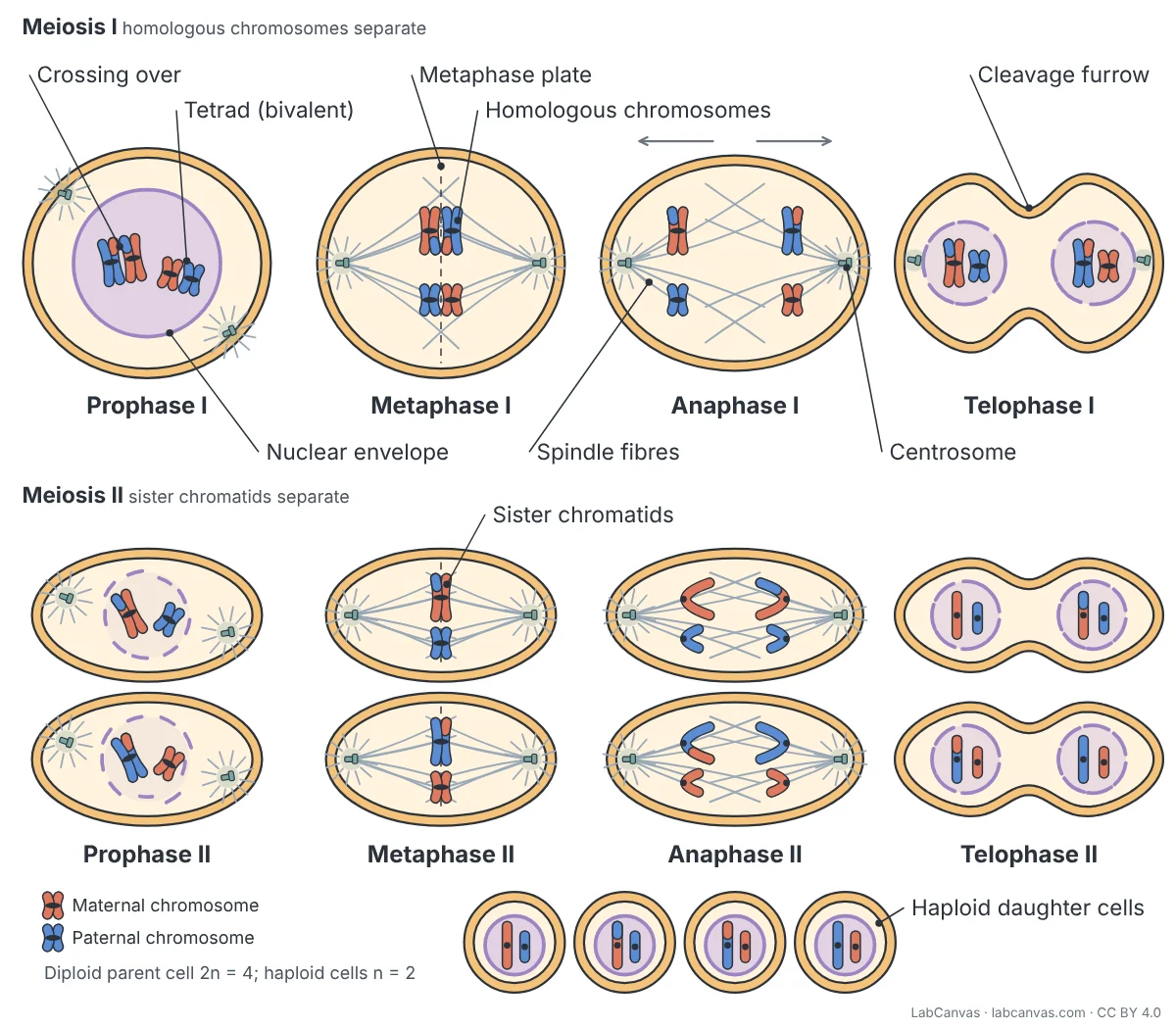
Mitosis is only one part of the cell cycle. The cell cycle is the whole loop from one division to the next (G1, S, G2, mitosis and cytokinesis), while mitosis is just the division of the nucleus. See the mitosis diagram for its stages, and the meiosis diagram for the different division that makes gametes.
Quick quiz
1. In which phase is DNA replicated?
- G1
- S
- G2
- Cytokinesis
Answer: b) S. S stands for synthesis: each chromosome is copied into two sister chromatids.
2. What is the correct order of the cell cycle?
- G1 → G2 → S → M
- S → G1 → G2 → M
- G1 → S → G2 → M
- M → S → G1 → G2
Answer: c) G1 → S → G2 → M. After division a cell grows (G1), copies its DNA (S), prepares (G2) and divides (M).
3. What does the spindle checkpoint check?
- That the cell is big enough
- That all chromosomes are attached to spindle microtubules
- That the DNA has been replicated
- That the cytoplasm has divided
Answer: b) That all chromosomes are attached to spindle microtubules. It acts near the end of metaphase, before anaphase separates the sister chromatids.
4. A nerve cell that no longer divides is in which phase?
- G0
- G2
- S
- Metaphase
Answer: a) G0. Cells that leave the cycle and stop preparing to divide are in G0.
5. Which two stages make up the M phase?
- G1 and G2
- Interphase and mitosis
- Mitosis and cytokinesis
- S phase and cytokinesis
Answer: c) Mitosis and cytokinesis. Mitosis divides the nucleus and cytokinesis divides the cytoplasm.
Frequently asked questions
How do you draw the cell cycle?
Draw a ring with arrows going one way round. Give interphase most of the ring and divide it into G1, S and G2 in that order, then give the M phase a smaller arc split into mitosis and then cytokinesis. Add G0 as a branch off G1, and mark the G1/S, G2/M and spindle (metaphase) checkpoints.
What are the phases of the cell cycle in order?
G1 (growth), S (DNA synthesis), G2 (preparation for division), then the M phase: mitosis (prophase, prometaphase, metaphase, anaphase, telophase) followed by cytokinesis. G1, S and G2 together make up interphase.
What is the G0 phase?
G0 is a resting state outside the cycle. Cells in G0 carry on with their normal work but are not preparing to divide. Some can be signalled to re-enter G1; others, such as mature heart muscle cells and nerve cells, stay in G0 permanently.
What are the three checkpoints of the cell cycle?
The G1/S checkpoint at the end of G1, the G2/M checkpoint at the end of G2, and the spindle (M) checkpoint near the end of metaphase in mitosis.
Which phase of the cell cycle is the longest?
Interphase. Cells spend most of the cycle in G1, S and G2, which is why the interphase arc is drawn much larger than the M phase. The exact time in each phase varies between cell types.
Is the cell cycle the same as mitosis?
No. Mitosis is only the division of the nucleus. The cell cycle also includes interphase (G1, S and G2) and cytokinesis.
What happens to DNA during the cell cycle?
DNA is copied once in S phase, so each chromosome becomes two sister chromatids. In mitosis the sister chromatids are separated, so each daughter cell ends up with one complete copy.
Sources
- OpenStax Biology 2e, 10.2 The Cell Cycle
- OpenStax Biology 2e, 10.3 Control of the Cell Cycle
- OpenStax Biology 2e, 10.4 Cancer and the Cell Cycle
Facts on this page follow these introductory textbooks (OpenStax, CC BY 4.0). The diagram is a simplified illustration; organelles are not drawn to scale.
More free diagrams
Make your own science diagrams
LabCanvas is a browser workspace for scientific figures, slides and posters, with adjustable cells, organelles and molecules.
Edit this diagram