Plant cell diagram with labels
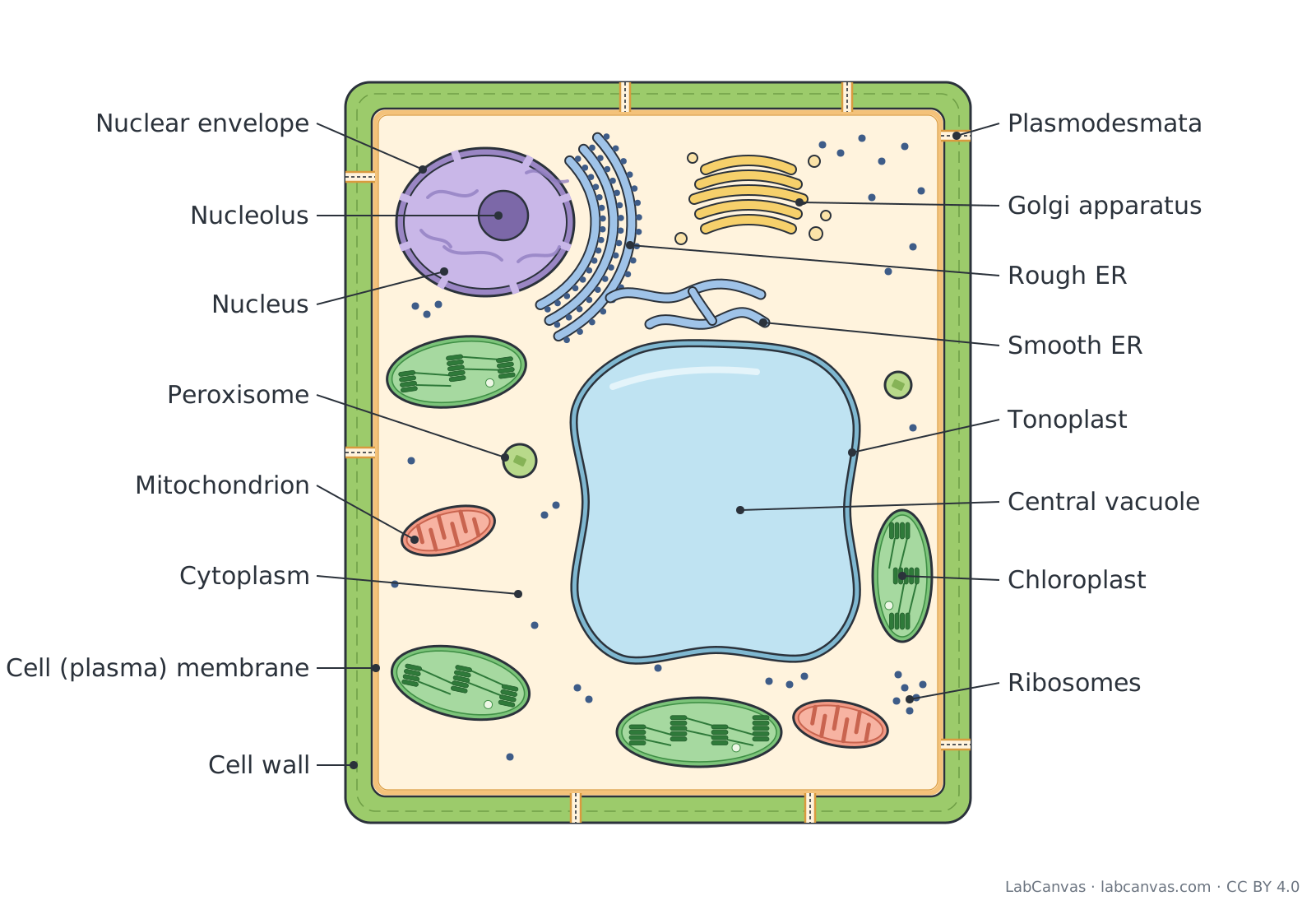
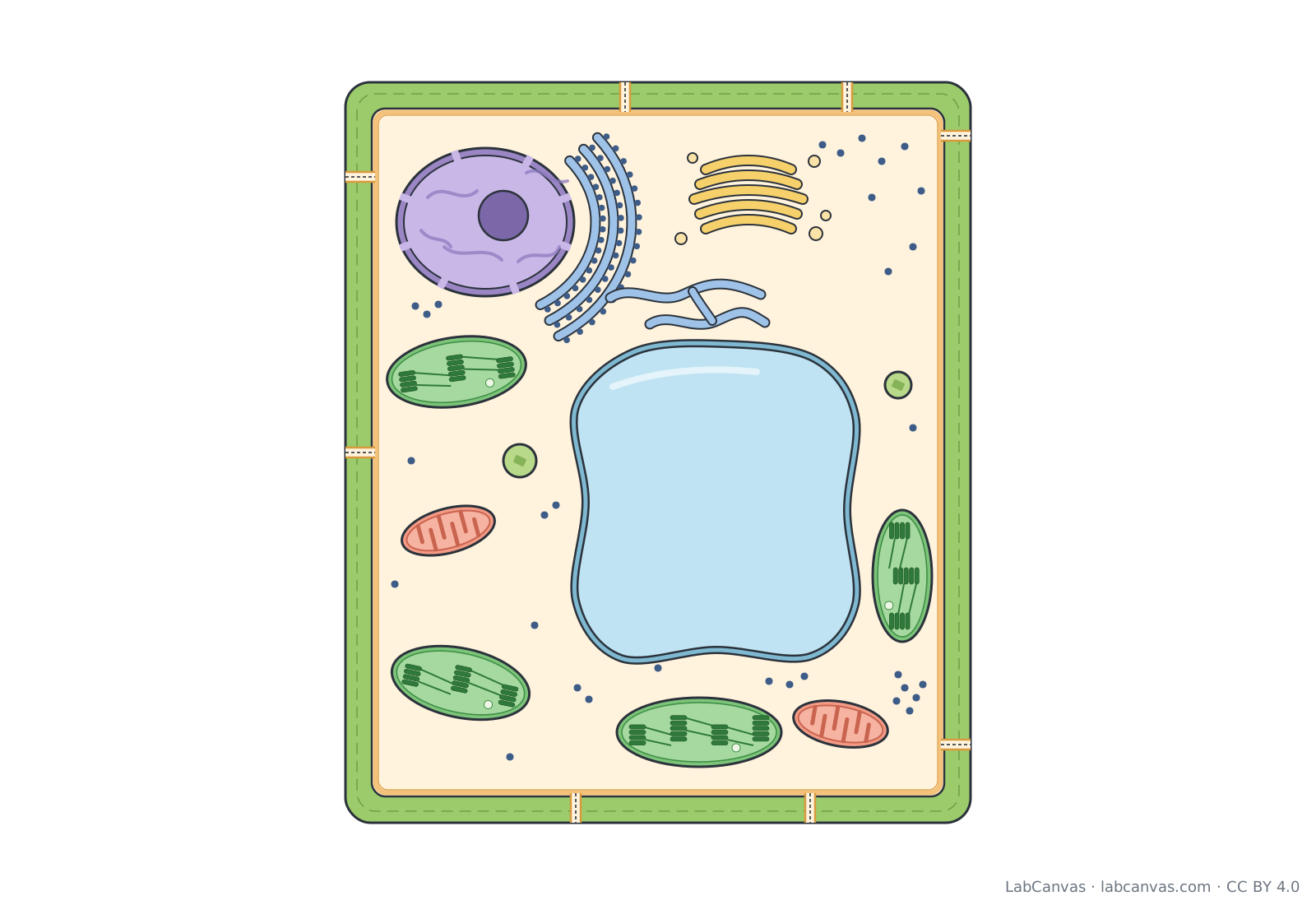
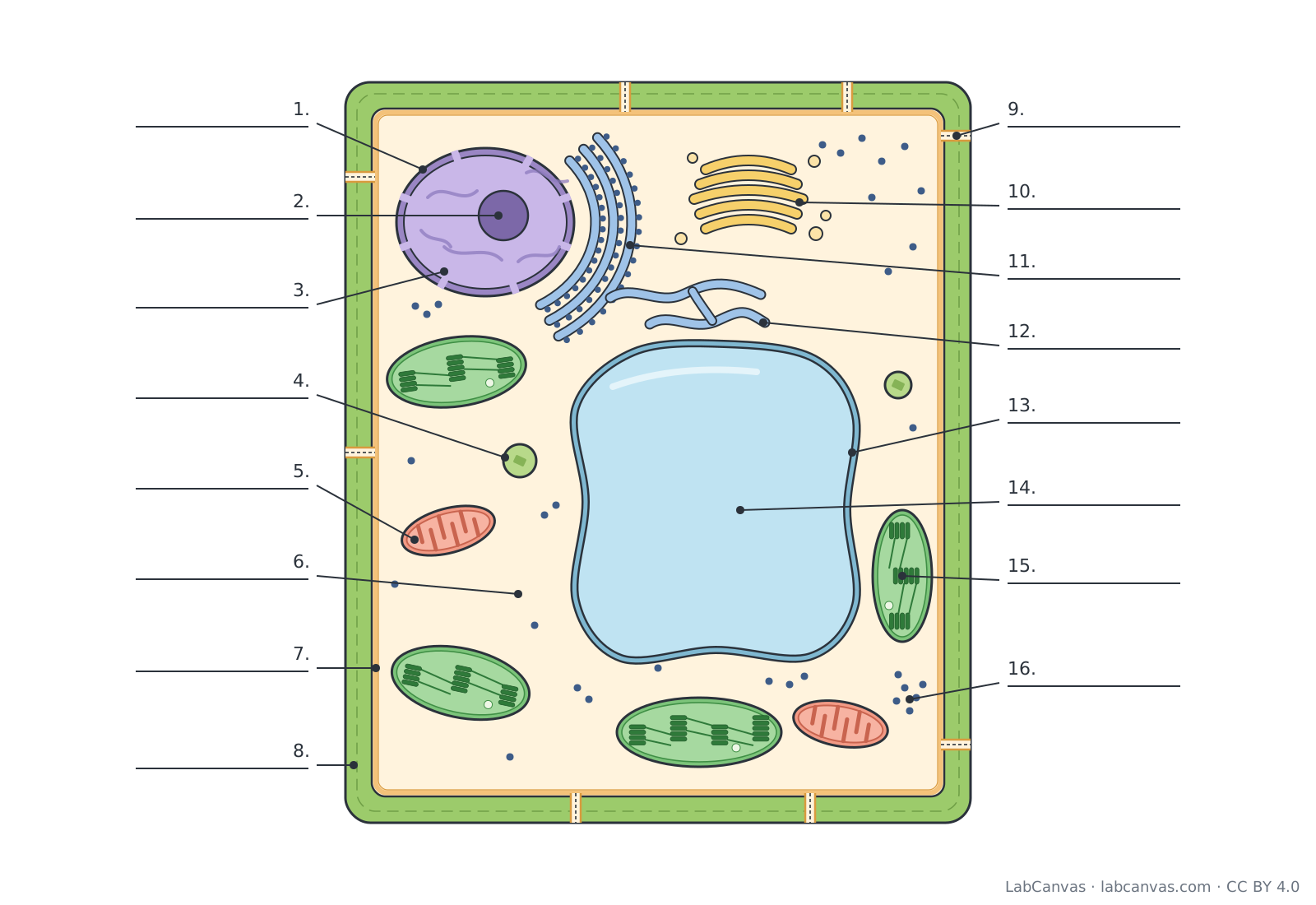
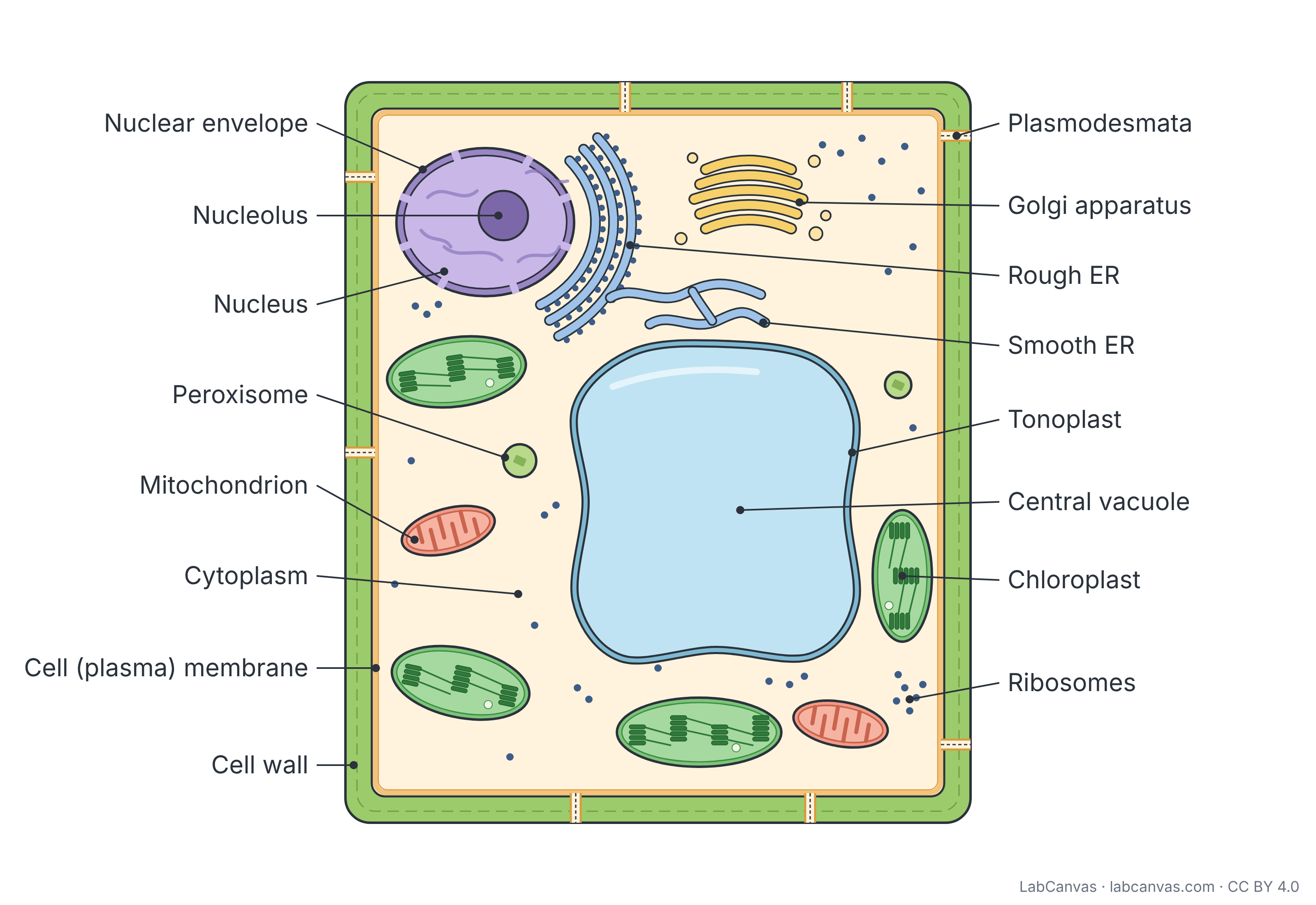
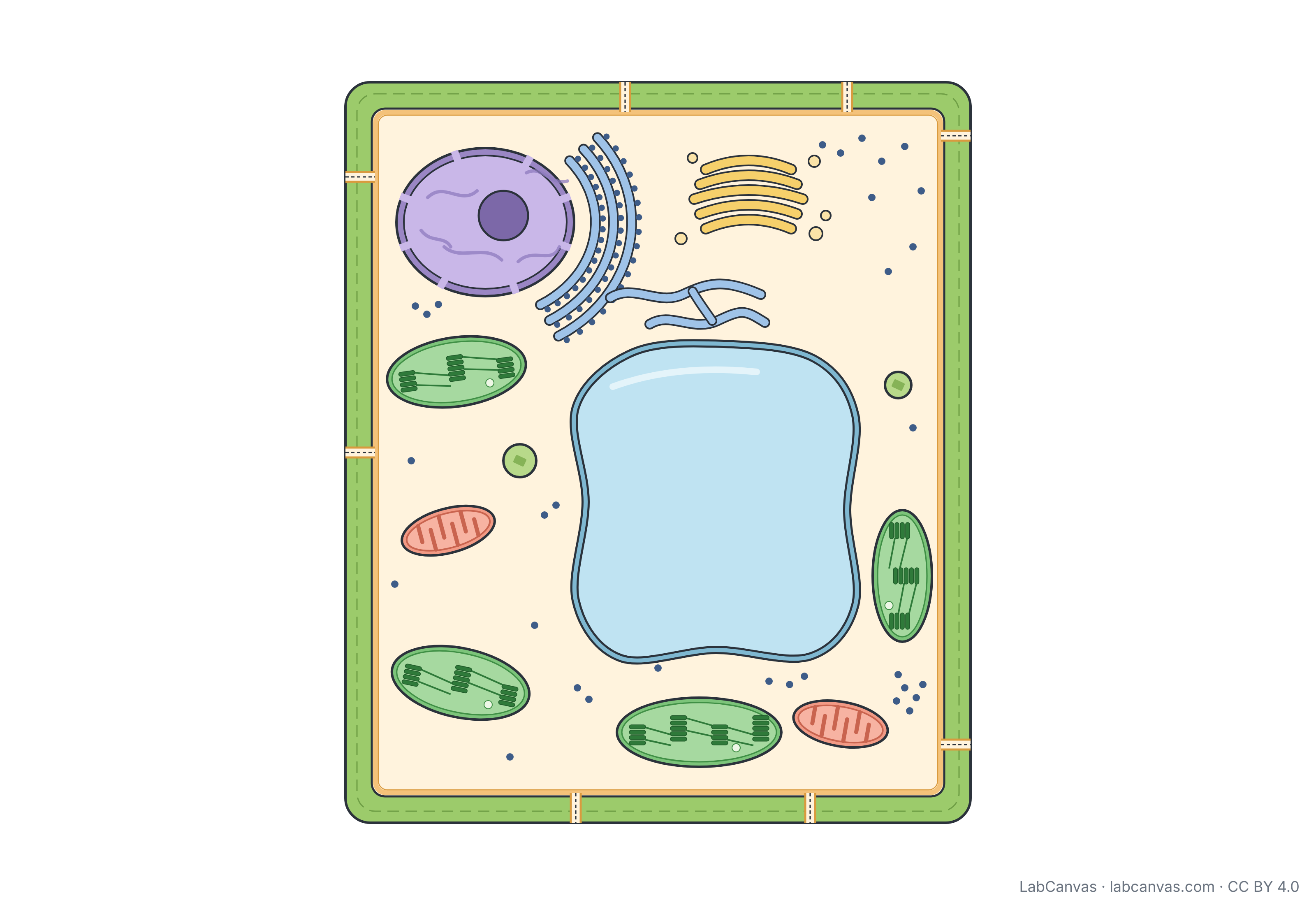
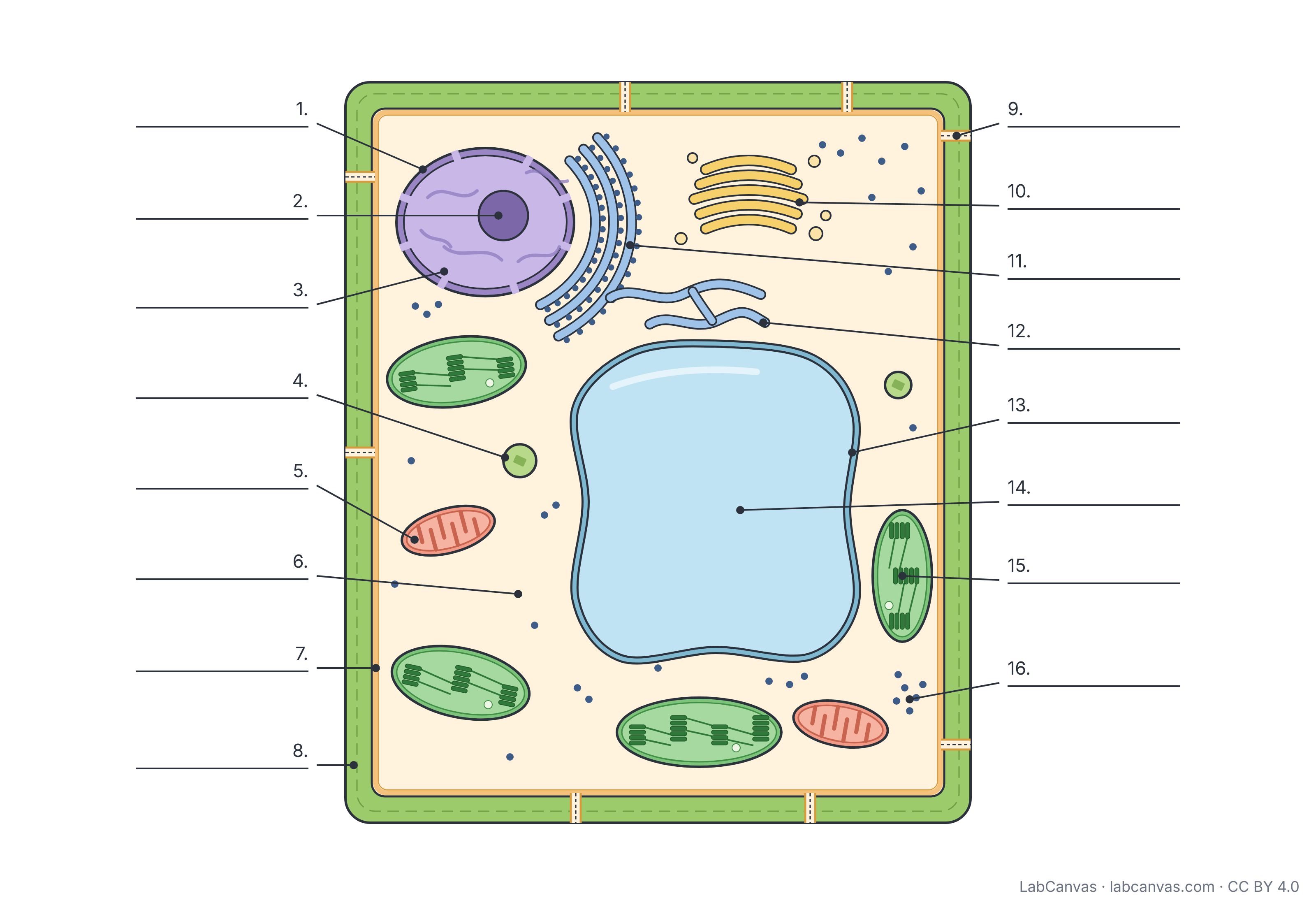
A plant cell is a eukaryotic cell with three structures animal cells lack: a rigid cellulose cell wall, chloroplasts for photosynthesis and a large central vacuole. It also has the organelles all eukaryotic cells share, including a nucleus, endoplasmic reticulum, Golgi apparatus, mitochondria, ribosomes and peroxisomes. This free diagram labels 16 parts and comes unlabelled and as a numbered worksheet with an answer key.
Last updated
Download the plant cell diagram
Free to use in homework, teaching, slides, posters and publications under CC BY 4.0. Please credit: Plant cell diagram by LabCanvas (labcanvas.com), CC BY 4.0
Parts of the plant cell and what they do
| # | Part | What it is or does |
|---|---|---|
| 1 | Nuclear envelope | Double membrane around the nucleus; nuclear pores in it control which molecules, such as RNA, pass in and out. |
| 2 | Nucleolus | Dense region inside the nucleus where ribosomal RNA is made and ribosome subunits are assembled. |
| 3 | Nucleus | Holds the cell's DNA (as chromatin) and directs the making of ribosomes and proteins. |
| 4 | Peroxisome | Small single-membrane organelle whose enzymes break down fatty acids and amino acids and destroy hydrogen peroxide. |
| 5 | Mitochondrion | Double-membrane organelle that carries out cellular respiration and makes most of the cell's ATP. |
| 6 | Cytoplasm | Everything between the plasma membrane and the nuclear envelope: the fluid cytosol plus the organelles in it. |
| 7 | Cell (plasma) membrane | Phospholipid bilayer with proteins that controls what enters and leaves the cell; lies just inside the cell wall. |
| 8 | Cell wall | Rigid layer outside the membrane, made mainly of cellulose, that protects the cell, supports it and gives it shape. |
| 9 | Plasmodesmata | Channels through the cell walls that join the cytoplasm of neighbouring plant cells so materials can pass between them. |
| 10 | Golgi apparatus | Stack of flattened sacs that modifies, sorts and packages proteins and lipids into vesicles for delivery. |
| 11 | Rough ER | Endoplasmic reticulum studded with ribosomes; makes and modifies proteins and makes phospholipids for membranes. |
| 12 | Smooth ER | Tubular ER without ribosomes; makes lipids, carbohydrates and steroid hormones, detoxifies some chemicals and stores calcium ions. |
| 13 | Tonoplast | The membrane that surrounds the central vacuole and controls what moves between the vacuole and the cytoplasm. |
| 14 | Central vacuole | Large fluid-filled sac that stores water and solutes; when full, it presses the cell against its wall and keeps the plant firm. |
| 15 | Chloroplast | Double-membrane organelle where photosynthesis happens; contains chlorophyll in stacked thylakoids (grana) surrounded by stroma. |
| 16 | Ribosomes | Tiny particles of RNA and protein that build proteins; free in the cytoplasm or attached to the rough ER. |
How to label a plant cell diagram
- Start at the outsideLabel the thick outer layer as the cell wall, the thin line just inside it as the cell (plasma) membrane, and the channels through the wall as plasmodesmata.
- Find the biggest structuresThe large clear sac in the middle is the central vacuole; its outline is the tonoplast. The round body pushed to one side is the nucleus.
- Label inside the nucleusMark the dark spot as the nucleolus and the double outline with pores as the nuclear envelope.
- Follow the endomembrane systemThe ribosome-dotted sacs next to the nucleus are the rough ER, the smooth tubes beyond them are the smooth ER, and the curved stack with vesicles is the Golgi apparatus.
- Tell the energy organelles apartGreen ovals with stacks of discs (grana) are chloroplasts; smaller ovals with folded inner membranes (cristae) are mitochondria.
- Finish with the small partsLabel a small round body as a peroxisome, the tiny dots as ribosomes and the space around the organelles as the cytoplasm. Check your answers against the key.
Plant cell vs animal cell
| Feature | Plant cell | Animal cell |
|---|---|---|
| Cell wall | Yes, mainly cellulose | No |
| Chloroplasts | Yes, for photosynthesis | No |
| Vacuole | One large central vacuole | No large central vacuole |
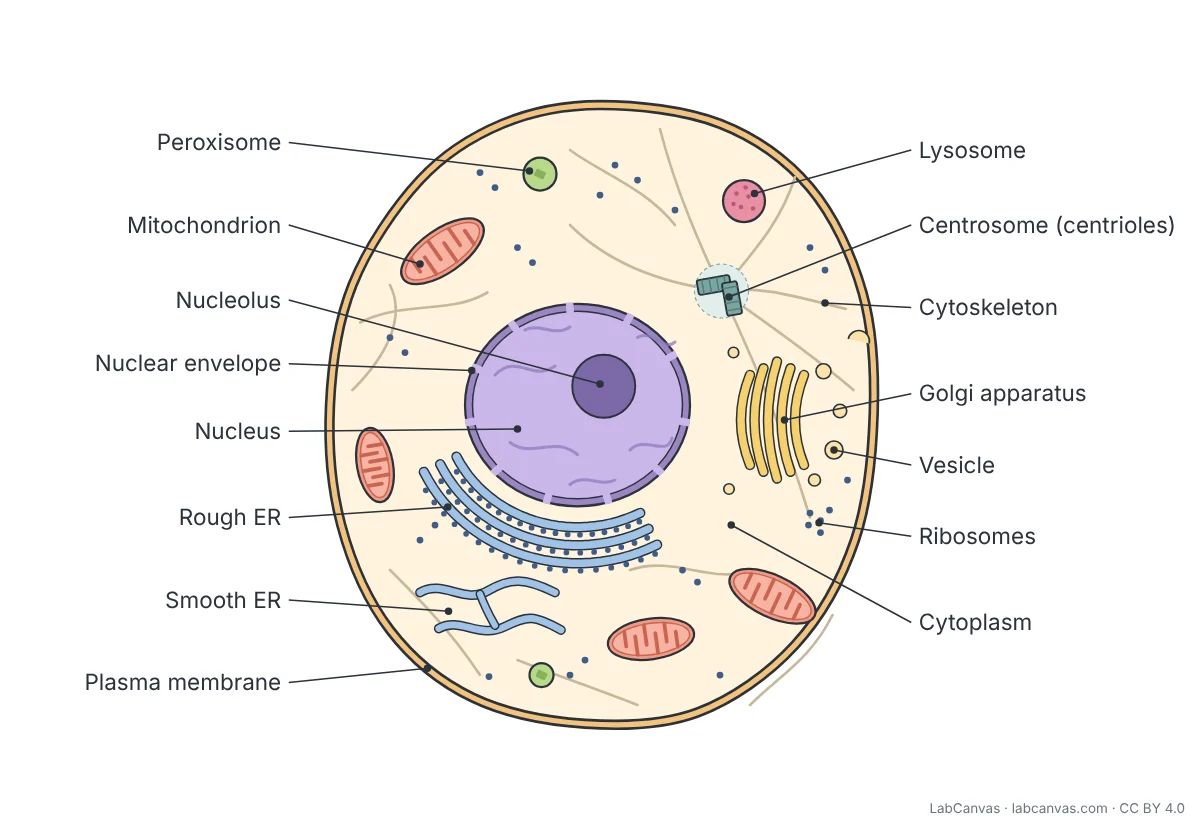
| Centrosome with centrioles | No centrioles | Yes |
| Lysosomes | Not usually described; the central vacuole does much of the breakdown work | Yes |
| Links between neighbouring cells | Plasmodesmata | Gap junctions (and tight junctions, desmosomes) |
| Usual shape | Fixed, often box-like | Rounded or irregular |
| Nucleus, ER, Golgi, ribosomes, mitochondria, peroxisomes, plasma membrane, cytoskeleton | Yes | Yes |
Organelles only in plant cells
Three structures set plant cells apart. The cell wall, made mainly of the polysaccharide cellulose, sits outside the plasma membrane and protects and supports the cell. Chloroplasts carry out photosynthesis: inside their double membrane, stacks of thylakoids called grana hold chlorophyll, surrounded by a fluid called the stroma. The central vacuole, bounded by the tonoplast, regulates the cell's water content; when it is full it pushes the cytoplasm against the wall, and when a plant loses water the vacuoles shrink and the plant wilts.
Plant cells are also linked by plasmodesmata, channels through neighbouring cell walls that connect their cytoplasm.
Prokaryotic vs eukaryotic cells
All cells have a plasma membrane, cytoplasm, ribosomes and DNA. Prokaryotic cells (bacteria and archaea) keep their DNA in a region called the nucleoid and have no nucleus or other membrane-bound organelles. Eukaryotic cells, including plant, animal and fungal cells, have a true nucleus surrounded by a nuclear envelope and many membrane-bound organelles, and they are usually much larger.
Why plant cells have both chloroplasts and mitochondria
Chloroplasts capture light energy and store it in sugars. Mitochondria then release the energy in those sugars as ATP through cellular respiration, which every plant cell needs, including root cells that never see light. Both organelles have two membranes and their own DNA and ribosomes, evidence that they descend from bacteria taken up by an ancestral cell (endosymbiosis).
Quick quiz
1. Which structure is found in plant cells but not in animal cells?
- Mitochondrion
- Cell wall
- Ribosome
- Golgi apparatus
Answer: b) Cell wall. Plant cells have a cellulose cell wall; animal cells have only a plasma membrane at their surface.
2. Where does photosynthesis take place?
- Mitochondrion
- Nucleolus
- Chloroplast
- Central vacuole
Answer: c) Chloroplast. Chloroplasts contain chlorophyll in their thylakoids and carry out photosynthesis.
3. What is the tonoplast?
- The membrane around the central vacuole
- A stack of thylakoids
- A channel through the cell wall
- The outer layer of the nucleus
Answer: a) The membrane around the central vacuole. The tonoplast is the membrane that bounds the central vacuole.
4. What connects the cytoplasm of neighbouring plant cells?
- Gap junctions
- Plasmodesmata
- Centrioles
- Nuclear pores
Answer: b) Plasmodesmata. Plasmodesmata pass through the cell walls and link the cytoplasm of adjacent plant cells.
5. Which organelle sorts and packages proteins into vesicles?
- Smooth ER
- Peroxisome
- Golgi apparatus
- Nucleolus
Answer: c) Golgi apparatus. The Golgi apparatus modifies, sorts and packages proteins and lipids for delivery.
Frequently asked questions
What are the parts of a plant cell?
A typical plant cell has a cell wall, plasmodesmata, a cell (plasma) membrane, cytoplasm, a nucleus with a nucleolus and nuclear envelope, rough and smooth endoplasmic reticulum, a Golgi apparatus, ribosomes, mitochondria, peroxisomes, chloroplasts and a large central vacuole surrounded by the tonoplast.
Do plant cells have mitochondria?
Yes. Plant cells have mitochondria as well as chloroplasts. Chloroplasts make sugars by photosynthesis, and mitochondria break those sugars down in cellular respiration to make ATP.
What are three differences between plant and animal cells?
Plant cells have a cellulose cell wall, chloroplasts and a large central vacuole, which animal cells lack. Animal cells have a centrosome with centrioles and lysosomes, which are not found in typical plant cells.
What does the cell wall do in a plant cell?
The cell wall is a rigid layer made mainly of cellulose. It protects the cell, gives it structural support and keeps its shape, and it resists the pressure of the full central vacuole.
What is the function of the central vacuole?
The central vacuole stores water and dissolved substances and regulates the cell's water content. A full vacuole presses the cell against its wall, which keeps leaves and stems firm; when it loses water the plant wilts.
Do plant cells have a nucleus?
Yes. Plant cells are eukaryotic, so their DNA is held in a nucleus surrounded by a double nuclear envelope. In mature plant cells the large central vacuole often pushes the nucleus to one side.
Do plant cells have centrioles?
Most plant cells, including those of flowering plants, have no centrioles. They still build a spindle of microtubules to separate chromosomes when they divide.
Sources
- OpenStax Biology 2e, 4.3 Eukaryotic Cells (CC BY 4.0)
- OpenStax Biology 2e, 4.4 The Endomembrane System and Proteins (CC BY 4.0)
- OpenStax Biology 2e, 4.5 The Cytoskeleton (CC BY 4.0)
- OpenStax Biology 2e, 4.6 Connections between Cells and Cellular Activities (CC BY 4.0)
- OpenStax Biology 2e, 4.2 Prokaryotic Cells (CC BY 4.0)
Facts on this page follow these introductory textbooks (OpenStax, CC BY 4.0). The diagram is a simplified illustration; organelles are not drawn to scale.
More free diagrams
Make your own science diagrams
LabCanvas is a browser workspace for scientific figures, slides and posters, with adjustable cells, organelles and molecules.
Edit this diagram