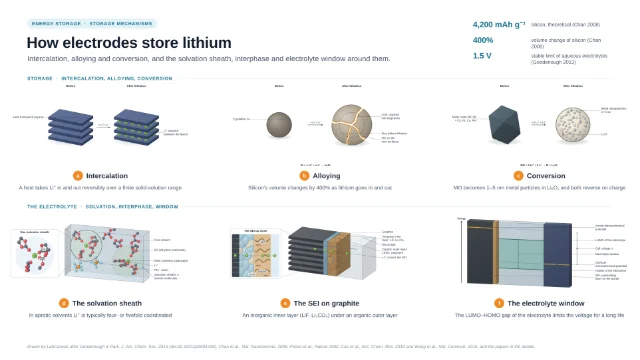
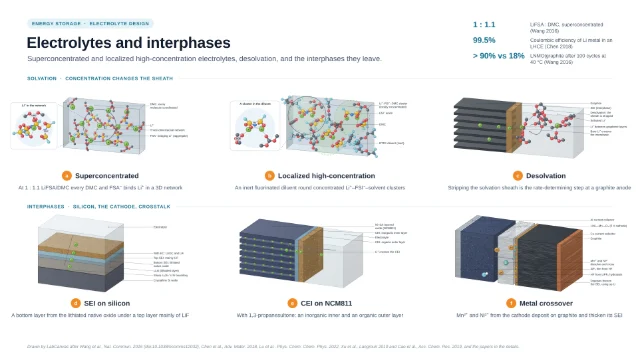
Graphical abstract template · Battery & energy storage guides · Workflow pictograms
A battery’s life in pictograms: make, build, test, use and recycle
A battery’s life in 24 editable pictograms: six steps to make the materials, six to build the cell, six ways to test it and six for its use and recycling. Every pictogram is a live generator that can be restyled flat, outline or 3D in your colours; the details describe each stage with its references.
Updated 15 cited papers68 editable layers

At a glance
- Category
- Battery & energy storage guides
- Method
- Workflow pictograms
- Product
- A four-stage battery workflow built from 24 restylable pictograms
- Key result
- Pictograms drawn by LabCanvas; the captions only name the steps, and every pictogram can be restyled or swapped from the Batteries & energy pictogram set
- Figure
- 1920 × 1080 px (16:9), 68 editable layers, 24 generated objects
Step by step
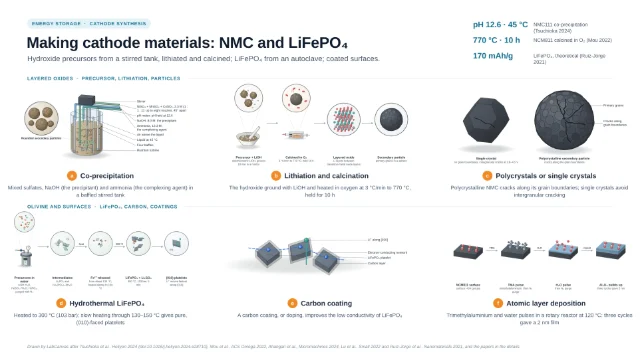
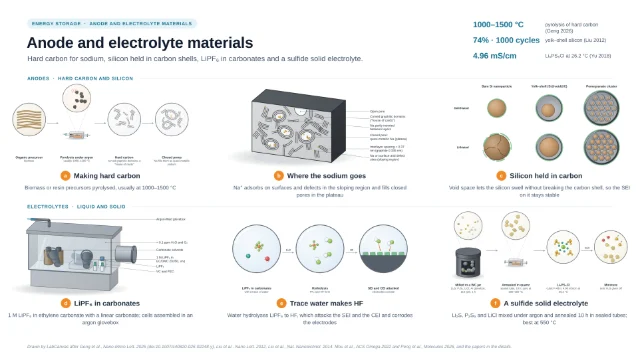
- Make the materialsNMC hydroxide precursors are co-precipitated in a stirred tank, NaOH the precipitant and ammonia the complexing agent (Tsuchioka 2024), then ground with LiOH and calcined in oxygen at 770 °C for 10 h (Mou 2022); a cathode host framework takes the working cation in and out reversibly (Goodenough 2013); LiFePO₄ offers a theoretical 170 mAh/g at 3.5 V (Ruiz-Jorge 2021); the electrolyte is 1 M LiPF₆ in carbonates, and cells are assembled in an argon-filled glovebox (Mou 2022)
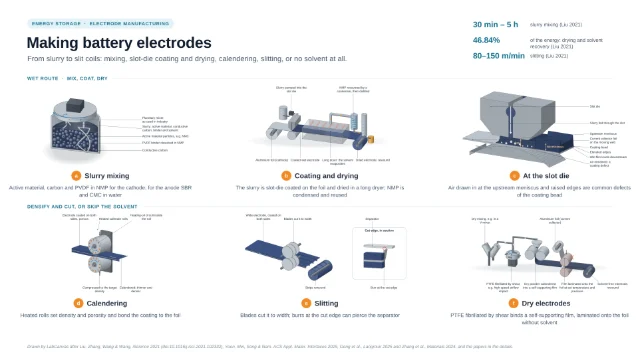
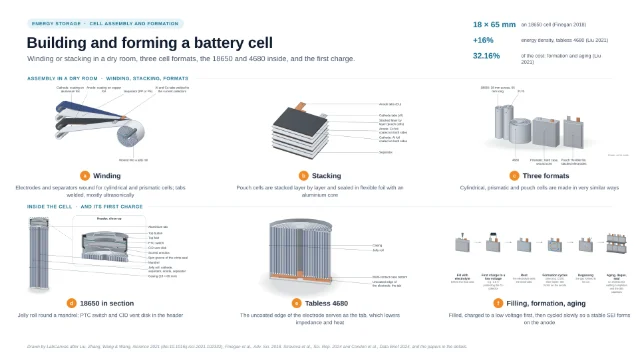
- Build the cellThe active material, conductive additive and binder are mixed into a slurry, slot-die coated on the current collector and dried, calendered and slit; in a dry room the electrodes and separators are wound or stacked, the cell is filled with electrolyte, and formation cycles it slowly at first so a stable SEI forms on the anode (Liu 2021)
- Test itEIS perturbs a cell with a small sinusoidal signal over a wide range of frequencies (Lazanas 2023); an operando cell lets a conventional powder diffractometer follow the electrodes (Shen 2014); synchrotron X-ray CT imaged 18650 cells during thermal runaway (Finegan 2015); a reference electrode measures each electrode on its own (Minter 2018); heat accumulation starts with SEI decomposition at 80–110 °C (Nan 2026)
- Use and recycleAn EV battery pack sits underneath the vehicle, its case part of the underbody structure (Kim 2025) and a battery management system balances, protects and manages it (Venkatasatish 2024); containerised storage enables a modular design, easy transport and rapid installation (Lekbir 2026); retired EV batteries keep 70–80% of their capacity for second-life storage (Kamath 2020); spent batteries are discharged in NaCl solution or shredded under cryogenic nitrogen, and hydrometallurgy leaches the black mass (Abe 2024)
Papers this template follows
- Tsuchioka et al., “Method for predicting the size of Ni₁/₃Mn₁/₃Co₁/₃(OH)₂ particles precipitated in a stirred-tank semi-batch crystallizer using CFD and particle agglomeration models”, Heliyon 2024. doi:10.1016/j.heliyon.2024.e28710primary
- Mou et al., “Scalable Advanced Li(Ni₀.₈Co₀.₁Mn₀.₁)O₂ Cathode Materials from a Slug Flow Continuous Process”, ACS Omega 2022. doi:10.1021/acsomega.2c05521primary
- Goodenough & Park, “The Li-ion rechargeable battery: a perspective”, J. Am. Chem. Soc. 2013. doi:10.1021/ja3091438primary
- Ruiz-Jorge et al., “Effect of the Heating Rate to Prevent the Generation of Iron Oxides during the Hydrothermal Synthesis of LiFePO₄”, Nanomaterials 2021. doi:10.3390/nano11092412primary
- Liu, Zhang, Wang & Wang, “Current and future lithium-ion battery manufacturing”, iScience 2021. doi:10.1016/j.isci.2021.102332primary
- Lazanas & Prodromidis, “Electrochemical Impedance Spectroscopy-A Tutorial”, ACS Meas. Sci. Au 2023. doi:10.1021/acsmeasuresciau.2c00070primary
- Shen et al., “An electrochemical cell for in operando studies of lithium/sodium batteries using a conventional x-ray powder diffractometer”, Rev. Sci. Instrum. 2014. doi:10.1063/1.4896198primary
- Finegan et al., “In-operando high-speed tomography of lithium-ion batteries during thermal runaway”, Nat. Commun. 2015. doi:10.1038/ncomms7924primary
- Minter et al., “Three-electrode Coin Cell Preparation and Electrodeposition Analytics for Lithium-ion Batteries”, J. Vis. Exp. 2018. doi:10.3791/57735primary
- Nan et al., “Materials design for thermally improved safety in lithium-ion batteries”, Chem. Sci. 2026. doi:10.1039/d5sc08060fprimary
- Kim et al., “Numerical and experimental approaches for mechanical durability assessment of an EV battery pack case”, Materials 2025. doi:10.3390/ma18245683primary
- Venkatasatish & Dhanamjayulu, “Design and implementation of an inductor based cell balancing circuit with reduced switches for lithium-ion batteries”, Sci. Rep. 2024. doi:10.1038/s41598-024-80096-9primary
- Lekbir et al., “Second-life lithium-ion batteries for circular energy systems: a techno-economic and environmental pathway to affordable grid-connected renewable storage”, Glob. Chall. 2026. doi:10.1002/gch2.70150primary
- Kamath et al., “Evaluating the cost and carbon footprint of second-life electric vehicle batteries in residential and utility-level applications”, Waste Manag. 2020. doi:10.1016/j.wasman.2020.05.034primary
- Abe et al., “Cathode active materials using rare metals recovered from waste lithium-ion batteries: a review”, Heliyon 2024. doi:10.1016/j.heliyon.2024.e28145primary
Drawn by LabCanvas after Liu, Zhang, Wang & Wang, iScience 2021 (doi:10.1016/j.isci.2021.102332), Tsuchioka et al., Heliyon 2024, Mou et al., ACS Omega 2022 and Lazanas & Prodromidis, ACS Meas. Sci. Au 2023, and the papers in the details.
How templates are written and checked: editorial guidelines.
Questions
What does the “A battery’s life in pictograms: make, build, test, use and recycle” template show?
A battery’s life in 24 editable pictograms: six steps to make the materials, six to build the cell, six ways to test it and six for its use and recycling. Every pictogram is a live generator that can be restyled flat, outline or 3D in your colours; the details describe each stage with its references.
What are the steps shown in “A battery’s life in pictograms: make, build, test, use and recycle”?
1. Make the materials: NMC hydroxide precursors are co-precipitated in a stirred tank, NaOH the precipitant and ammonia the complexing agent (Tsuchioka 2024), then ground with LiOH and calcined in oxygen at 770 °C for 10 h (Mou 2022); a cathode host framework takes the working cation in and out reversibly (Goodenough 2013); LiFePO₄ offers a theoretical 170 mAh/g at 3.5 V (Ruiz-Jorge 2021); the electrolyte is 1 M LiPF₆ in carbonates, and cells are assembled in an argon-filled glovebox (Mou 2022). 2. Build the cell: The active material, conductive additive and binder are mixed into a slurry, slot-die coated on the current collector and dried, calendered and slit; in a dry room the electrodes and separators are wound or stacked, the cell is filled with electrolyte, and formation cycles it slowly at first so a stable SEI forms on the anode (Liu 2021). 3. Test it: EIS perturbs a cell with a small sinusoidal signal over a wide range of frequencies (Lazanas 2023); an operando cell lets a conventional powder diffractometer follow the electrodes (Shen 2014); synchrotron X-ray CT imaged 18650 cells during thermal runaway (Finegan 2015); a reference electrode measures each electrode on its own (Minter 2018); heat accumulation starts with SEI decomposition at 80–110 °C (Nan 2026). 4. Use and recycle: An EV battery pack sits underneath the vehicle, its case part of the underbody structure (Kim 2025) and a battery management system balances, protects and manages it (Venkatasatish 2024); containerised storage enables a modular design, easy transport and rapid installation (Lekbir 2026); retired EV batteries keep 70–80% of their capacity for second-life storage (Kamath 2020); spent batteries are discharged in NaCl solution or shredded under cryogenic nitrogen, and hydrometallurgy leaches the black mass (Abe 2024).
Which papers is “A battery’s life in pictograms: make, build, test, use and recycle” based on?
Tsuchioka et al., “Method for predicting the size of Ni₁/₃Mn₁/₃Co₁/₃(OH)₂ particles precipitated in a stirred-tank semi-batch crystallizer using CFD and particle agglomeration models”, Heliyon 2024 (doi:10.1016/j.heliyon.2024.e28710); Mou et al., “Scalable Advanced Li(Ni₀.₈Co₀.₁Mn₀.₁)O₂ Cathode Materials from a Slug Flow Continuous Process”, ACS Omega 2022 (doi:10.1021/acsomega.2c05521); Goodenough & Park, “The Li-ion rechargeable battery: a perspective”, J. Am. Chem. Soc. 2013 (doi:10.1021/ja3091438); Ruiz-Jorge et al., “Effect of the Heating Rate to Prevent the Generation of Iron Oxides during the Hydrothermal Synthesis of LiFePO₄”, Nanomaterials 2021 (doi:10.3390/nano11092412); Liu, Zhang, Wang & Wang, “Current and future lithium-ion battery manufacturing”, iScience 2021 (doi:10.1016/j.isci.2021.102332); Lazanas & Prodromidis, “Electrochemical Impedance Spectroscopy-A Tutorial”, ACS Meas. Sci. Au 2023 (doi:10.1021/acsmeasuresciau.2c00070); Shen et al., “An electrochemical cell for in operando studies of lithium/sodium batteries using a conventional x-ray powder diffractometer”, Rev. Sci. Instrum. 2014 (doi:10.1063/1.4896198); Finegan et al., “In-operando high-speed tomography of lithium-ion batteries during thermal runaway”, Nat. Commun. 2015 (doi:10.1038/ncomms7924); Minter et al., “Three-electrode Coin Cell Preparation and Electrodeposition Analytics for Lithium-ion Batteries”, J. Vis. Exp. 2018 (doi:10.3791/57735); Nan et al., “Materials design for thermally improved safety in lithium-ion batteries”, Chem. Sci. 2026 (doi:10.1039/d5sc08060f); Kim et al., “Numerical and experimental approaches for mechanical durability assessment of an EV battery pack case”, Materials 2025 (doi:10.3390/ma18245683); Venkatasatish & Dhanamjayulu, “Design and implementation of an inductor based cell balancing circuit with reduced switches for lithium-ion batteries”, Sci. Rep. 2024 (doi:10.1038/s41598-024-80096-9); Lekbir et al., “Second-life lithium-ion batteries for circular energy systems: a techno-economic and environmental pathway to affordable grid-connected renewable storage”, Glob. Chall. 2026 (doi:10.1002/gch2.70150); Kamath et al., “Evaluating the cost and carbon footprint of second-life electric vehicle batteries in residential and utility-level applications”, Waste Manag. 2020 (doi:10.1016/j.wasman.2020.05.034); Abe et al., “Cathode active materials using rare metals recovered from waste lithium-ion batteries: a review”, Heliyon 2024 (doi:10.1016/j.heliyon.2024.e28145).
Can I edit the “A battery’s life in pictograms: make, build, test, use and recycle” template?
Yes. Open it in the LabCanvas editor: all 68 layers are editable, including 24 generated objects (structures, plots, equipment) with their own settings. Change the text, colours and layout, then export PNG, TIFF, SVG or PDF.
Do I need an account to use this template?
Not to view it here. To open and edit it, sign in to LabCanvas or create a free account (the free plan keeps up to 3 designs). Downloading the figure is part of LabCanvas Pro (US$19 a month or US$199 a year).