Graphical abstract template · Battery & energy storage guides · Sodium-ion and potassium-ion
Sodium-ion and potassium-ion batteries
Beyond lithium on one page: a sodium-ion cell with aluminium foil on both electrodes, hard carbon and where it stores sodium, a P2 layered oxide, a Prussian blue analogue and a NASICON phosphate cathode, and potassium entering graphite in stages. Every caption and number is quoted from the cited papers.
Updated 9 cited papers45 editable layers

At a glance
- Category
- Battery & energy storage guides
- Method
- Sodium-ion and potassium-ion
- Product
- Sodium-ion cells, hard carbon, layered-oxide, Prussian blue and NASICON cathodes, and potassium–graphite compounds
- Key result
- Cells, pores and crystal structures drawn by LabCanvas after the cited papers; atom counts, layer spacings and pore sizes are drawn, not to scale. Luo 2015 and Jian 2015 assign the potassium stages differently; the drawing follows Luo 2015
- Figure
- 1920 × 1080 px (16:9), 45 editable layers, 6 generated objects
Step by step
- A sodium-ion cellSodium is widely available and its chemistry is like lithium’s; layered transition-metal oxides, phosphates and organic compounds serve as sodium-ion cathodes, carbonaceous materials among the anodes (Hwang 2017). Sodium does not alloy with aluminium, so cheaper aluminium replaces copper on the anode; one current-collector metal eases recycling and lets the cells be stored at 0 V (Joy 2024)
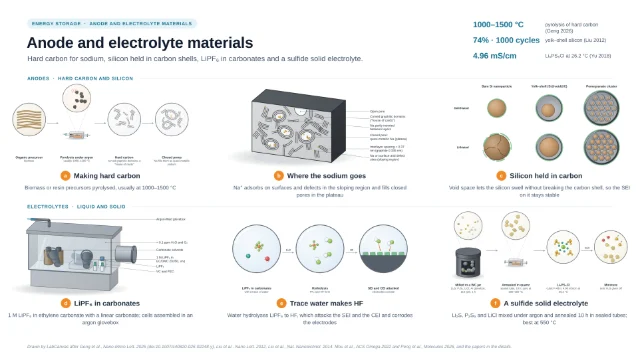
- Hard carbonHard carbon stores sodium two ways: a sloping region (2.0–0.1 V vs Na/Na⁺) from adsorption at surfaces and defects, and a plateau below 0.1 V from closed-pore filling and pseudo-graphitic intercalation; hard carbons that deliver 300–400 mAh/g need pseudo-graphitic domains with d = 0.36–0.40 nm and closed pores under 1 nm (Zhou 2025)
- P2 layered oxideO3 layered oxides stack their oxygen layers ABCABC with Na⁺ in octahedral sites; their high sodium content (x > 0.7) gives high capacity, but Na⁺ diffuses slowly and multi-step phase transitions follow. P2 oxides stack ABBA with Na⁺ in trigonal prismatic sites, a larger interlayer spacing and faster ion transport; less sodium (x ≈ 2/3) limits capacity, and P2 → O2 or P2 → Z transitions occur at high voltage (Dong 2026)
- Prussian blue analoguePrussian blue analogues have 3D open frameworks with large interstitial space for fast Na⁺ insertion and extraction (Yuan 2024); Fe sits on the carbon end of each cyanide, Mn, Ni or Co on the nitrogen end. Fe(CN)₆ vacancies and coordinated water distort the lattice, promote electrolyte decomposition and lower conductivity; controlling them improves the cathodes (Joy 2024; Ma 2017)
- NASICON phosphateNASICON NaₓM₂(PO₄)₃ (M = V, Ti) has a stable 3D framework: each MO₆ octahedron shares corners with three PO₄ tetrahedra in [M₂(PO₄)₃] lantern units, leaving Na1 and Na2 sites joined by conduction paths. Phosphates are thermally stable thanks to the P–O bond, but polyanionic cathodes conduct electrons and ions poorly; coatings, doping and nanostructuring help (Joy 2024)
- Potassium in graphitePotassium inserts electrochemically into graphite from a nonaqueous electrolyte with a reversible capacity of 273 mAh/g; ex situ XRD showed KC₃₆, KC₂₄ and KC₈ forming in turn, and a nongraphitic soft carbon cycled and ran at high rates much better than graphite (Jian 2015). From experiments and calculations a three-step staging was proposed, C → KC₂₄ (stage III) → KC₁₆ (stage II) → KC₈ (stage I), with 207 mAh/g in graphite (Luo 2015). K-ion cells need no scarce or toxic elements, the low K/K⁺ potential gives voltages competitive with Li-ion, and K⁺ diffuses faster in electrolytes (Hosaka 2020)
Strengths
- Aluminium on both electrodes lets sodium-ion cells be stored at 0 V (Joy 2024)
- P2 oxides have faster ion transport (Dong 2026)
- K-ion cells need no scarce or toxic elements (Hosaka 2020)
Limitations
- Less sodium (x ≈ 2/3) limits the capacity of P2 oxides (Dong 2026)
- Polyanionic cathodes conduct electrons and ions poorly (Joy 2024)
- Graphite showed relatively fast capacity fading with potassium (Jian 2015)
Papers this template follows
- Hwang et al., “Sodium-ion batteries: present and future”, Chem. Soc. Rev. 2017. doi:10.1039/c6cs00776gprimary
- Joy et al., “A comprehensive review on strategies for enhancing the performance of polyanionic-based sodium-ion battery cathodes”, ACS Omega 2024. doi:10.1021/acsomega.4c02709primary
- Zhou & Shen, “From sodium storage mechanism to design of high-capacity carbon-based anode: a review”, Materials 2025. doi:10.3390/ma18102248primary
- Dong et al., “Toward general design of Mn-based layered oxide cathodes for sodium-ion batteries: from thermodynamic principles to entropy engineering”, Molecules 2026. doi:10.3390/molecules31050836primary
- Yuan et al., “Research progress of Prussian blue and its analogs as high-performance cathode nanomaterials for sodium-ion batteries”, Small Methods 2024. doi:10.1002/smtd.202301372primary
- Ma et al., “Energy storage materials derived from Prussian blue analogues”, Sci. Bull. 2017. doi:10.1016/j.scib.2017.01.030primary
- Jian et al., “Carbon electrodes for K-ion batteries”, J. Am. Chem. Soc. 2015. doi:10.1021/jacs.5b06809primary
- Luo et al., “Potassium ion batteries with graphitic materials”, Nano Lett. 2015. doi:10.1021/acs.nanolett.5b03667primary
- Hosaka et al., “Research development on K-ion batteries”, Chem. Rev. 2020. doi:10.1021/acs.chemrev.9b00463primary
Drawn by LabCanvas after Hwang et al., Chem. Soc. Rev. 2017 (doi:10.1039/c6cs00776g), Joy et al., ACS Omega 2024, Zhou & Shen, Materials 2025, Dong et al., Molecules 2026 and Yuan et al., Small Methods 2024, and the papers in the details.
How templates are written and checked: editorial guidelines.
Questions
What does the “Sodium-ion and potassium-ion batteries” template show?
Beyond lithium on one page: a sodium-ion cell with aluminium foil on both electrodes, hard carbon and where it stores sodium, a P2 layered oxide, a Prussian blue analogue and a NASICON phosphate cathode, and potassium entering graphite in stages. Every caption and number is quoted from the cited papers.
What are the steps shown in “Sodium-ion and potassium-ion batteries”?
1. A sodium-ion cell: Sodium is widely available and its chemistry is like lithium’s; layered transition-metal oxides, phosphates and organic compounds serve as sodium-ion cathodes, carbonaceous materials among the anodes (Hwang 2017). Sodium does not alloy with aluminium, so cheaper aluminium replaces copper on the anode; one current-collector metal eases recycling and lets the cells be stored at 0 V (Joy 2024). 2. Hard carbon: Hard carbon stores sodium two ways: a sloping region (2.0–0.1 V vs Na/Na⁺) from adsorption at surfaces and defects, and a plateau below 0.1 V from closed-pore filling and pseudo-graphitic intercalation; hard carbons that deliver 300–400 mAh/g need pseudo-graphitic domains with d = 0.36–0.40 nm and closed pores under 1 nm (Zhou 2025). 3. P2 layered oxide: O3 layered oxides stack their oxygen layers ABCABC with Na⁺ in octahedral sites; their high sodium content (x > 0.7) gives high capacity, but Na⁺ diffuses slowly and multi-step phase transitions follow. P2 oxides stack ABBA with Na⁺ in trigonal prismatic sites, a larger interlayer spacing and faster ion transport; less sodium (x ≈ 2/3) limits capacity, and P2 → O2 or P2 → Z transitions occur at high voltage (Dong 2026). 4. Prussian blue analogue: Prussian blue analogues have 3D open frameworks with large interstitial space for fast Na⁺ insertion and extraction (Yuan 2024); Fe sits on the carbon end of each cyanide, Mn, Ni or Co on the nitrogen end. Fe(CN)₆ vacancies and coordinated water distort the lattice, promote electrolyte decomposition and lower conductivity; controlling them improves the cathodes (Joy 2024; Ma 2017). 5. NASICON phosphate: NASICON NaₓM₂(PO₄)₃ (M = V, Ti) has a stable 3D framework: each MO₆ octahedron shares corners with three PO₄ tetrahedra in [M₂(PO₄)₃] lantern units, leaving Na1 and Na2 sites joined by conduction paths. Phosphates are thermally stable thanks to the P–O bond, but polyanionic cathodes conduct electrons and ions poorly; coatings, doping and nanostructuring help (Joy 2024). 6. Potassium in graphite: Potassium inserts electrochemically into graphite from a nonaqueous electrolyte with a reversible capacity of 273 mAh/g; ex situ XRD showed KC₃₆, KC₂₄ and KC₈ forming in turn, and a nongraphitic soft carbon cycled and ran at high rates much better than graphite (Jian 2015). From experiments and calculations a three-step staging was proposed, C → KC₂₄ (stage III) → KC₁₆ (stage II) → KC₈ (stage I), with 207 mAh/g in graphite (Luo 2015). K-ion cells need no scarce or toxic elements, the low K/K⁺ potential gives voltages competitive with Li-ion, and K⁺ diffuses faster in electrolytes (Hosaka 2020).
Which papers is “Sodium-ion and potassium-ion batteries” based on?
Hwang et al., “Sodium-ion batteries: present and future”, Chem. Soc. Rev. 2017 (doi:10.1039/c6cs00776g); Joy et al., “A comprehensive review on strategies for enhancing the performance of polyanionic-based sodium-ion battery cathodes”, ACS Omega 2024 (doi:10.1021/acsomega.4c02709); Zhou & Shen, “From sodium storage mechanism to design of high-capacity carbon-based anode: a review”, Materials 2025 (doi:10.3390/ma18102248); Dong et al., “Toward general design of Mn-based layered oxide cathodes for sodium-ion batteries: from thermodynamic principles to entropy engineering”, Molecules 2026 (doi:10.3390/molecules31050836); Yuan et al., “Research progress of Prussian blue and its analogs as high-performance cathode nanomaterials for sodium-ion batteries”, Small Methods 2024 (doi:10.1002/smtd.202301372); Ma et al., “Energy storage materials derived from Prussian blue analogues”, Sci. Bull. 2017 (doi:10.1016/j.scib.2017.01.030); Jian et al., “Carbon electrodes for K-ion batteries”, J. Am. Chem. Soc. 2015 (doi:10.1021/jacs.5b06809); Luo et al., “Potassium ion batteries with graphitic materials”, Nano Lett. 2015 (doi:10.1021/acs.nanolett.5b03667); Hosaka et al., “Research development on K-ion batteries”, Chem. Rev. 2020 (doi:10.1021/acs.chemrev.9b00463).
Can I edit the “Sodium-ion and potassium-ion batteries” template?
Yes. Open it in the LabCanvas editor: all 45 layers are editable, including 6 generated objects (structures, plots, equipment) with their own settings. Change the text, colours and layout, then export PNG, TIFF, SVG or PDF.
Do I need an account to use this template?
Not to view it here. To open and edit it, sign in to LabCanvas or create a free account (the free plan keeps up to 3 designs). Downloading the figure is part of LabCanvas Pro (US$19 a month or US$199 a year).