Graphical abstract template · Nanomaterial guides · Physical and gas-phase routes
Physical and gas-phase routes to nanoparticles
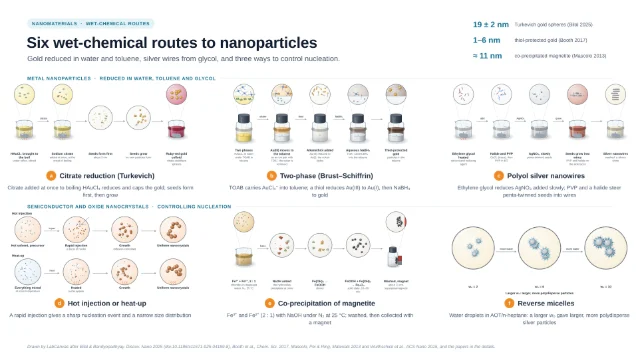
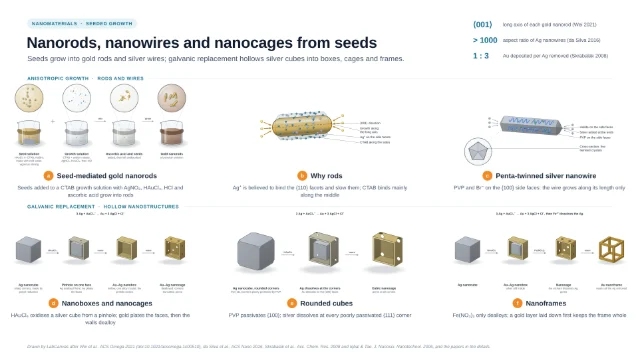
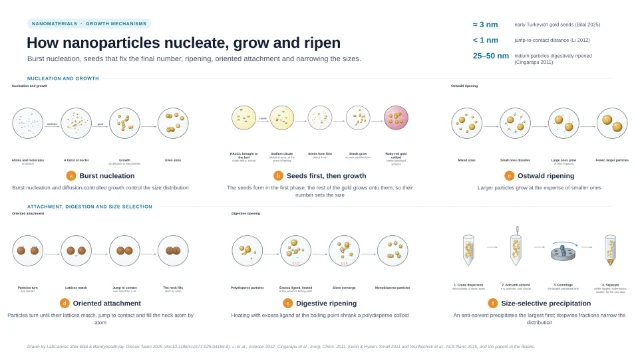
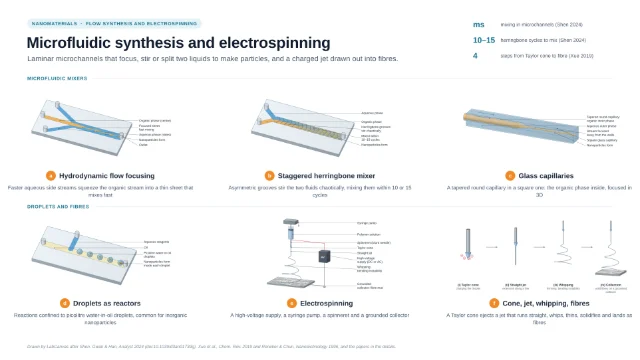
Six physical and gas-phase processes for making or coating particles: laser ablation in liquid and its plasma-to-colloid sequence, the temperature zones of flame spray pyrolysis, a magnetron gas-aggregation cluster source with a mass filter, spray drying of a droplet into a glassy microparticle, and the trimethylaluminium–water cycle of atomic layer deposition. Each caption quotes the cited papers.
Updated 12 cited papers45 editable layers

At a glance
- Category
- Nanomaterial guides
- Method
- Physical and gas-phase routes
- Starting materials
- A bulk metal target in a liquid; a precursor solution in an organic solvent; a sputter target; a liquid formulation; trimethylaluminium and water vapour
- Product
- Ligand-free colloids, oxide nanoparticles and aggregates, size-selected clusters, glassy microparticles and conformal alumina coatings
- Key result
- Set-ups and sequences drawn by LabCanvas from the cited papers; sizes are drawn, not to scale, and no panel is a micrograph
- Figure
- 1920 × 1080 px (16:9), 45 editable layers, 6 generated objects
Step by step
- Laser ablation in liquidA pulsed laser is aimed perpendicular to a bulk metal target submerged in liquid, from the top or from the side (Subhan 2022); the colloids are ligand-free (Khairani 2023; Molina-Prados 2026)
- Plasma to colloidAbsorption makes superheated plasma at 4000–6000 K that expands with a shockwave and is quenched and confined by the liquid; a cavitation bubble expands and collapses, and as it collapses the nanoparticles are released into the liquid as a colloid (Subhan 2022). Production is typically in the mg/h range, with work toward g/h (Khairani 2023)
- Flame spray pyrolysisA precursor solution is atomised into fine droplets and ignited with an auxiliary flame; near the capillary tip the flame core reaches 3500–2500 °C, the precursor vaporises and primary particles nucleate; they coagulate and sinter at 1700–600 °C, stick into agglomerates below 600 °C and bind into aggregates at 400–200 °C; a pilot plant makes several kg/h (Dimitriou 2023). One step and continuous, it also makes core–shell particles and nanorods (Teoh 2010)
- Gas aggregation sourceA magnetron in a tubular vacuum chamber ignites a plasma and supplies the material; supersaturated metal vapour condenses by homogeneous nucleation and a co-axial gas flow carries the particles through an orifice into another chamber; a shorter aggregation zone keeps the particles smaller, and they reach the substrate at subsonic speed, landing softly (Choukourov 2017). Clusters are size-selected with a lateral time-of-flight mass filter (Tankard 2024; Lu 2020)
- Spray dryingA liquid formulation is atomised into microdroplets that meet a dry, heated gas stream; the droplets dry rapidly and their polysaccharides form glasses that encapsulate the vaccine; the powders held less than 1 % moisture with glass transitions near 80 °C (Randolph 2025)
- Atomic layer depositionALD of alumina is a two-part, self-limiting cycle: surface hydroxyls react with trimethylaluminium vapour, then with water vapour; each cycle deposits about 2.3 Å of Al₂O₃ and regenerates the hydroxyls; in a fluidised bed, tens to thousands of cycles give 2–500 nm (Randolph 2025). On TiO₂ (P25) powder, ALD SiO₂ grows as conformal sub-nanometre layers and Pt as 1–2 nm islands (Benz 2020)
Strengths
- Laser ablation gives ligand-free colloids (Khairani 2023)
- Flame spray pyrolysis is one step and continuous (Teoh 2010)
- A fluidised bed gives highly conformal, uniform ALD coatings (Randolph 2025)
Limitations
- Laser ablation in liquid is typically in the mg/h range (Khairani 2023)
Uses
- Spray-dried vaccine microparticles coated by ALD (Randolph 2025; Witeof 2022)
Papers this template follows
- Subhan, Mourad & Al-Douri, “Influence of laser process parameters, liquid medium, and external field on the synthesis of colloidal metal nanoparticles using pulsed laser ablation in liquid: a review”, Nanomaterials 2022. doi:10.3390/nano12132144primary
- Khairani et al., “Green nanoparticle synthesis at scale: a perspective on overcoming the limits of pulsed laser ablation in liquids for high-throughput production”, Phys. Chem. Chem. Phys. 2023. doi:10.1039/d3cp01214jprimary
- Dimitriou et al., “Advanced flame spray pyrolysis (FSP) technologies for engineering multifunctional nanostructures and nanodevices”, Nanomaterials 2023. doi:10.3390/nano13233006primary
- Teoh, Amal & Mädler, “Flame spray pyrolysis: an enabling technology for nanoparticles design and fabrication”, Nanoscale 2010. doi:10.1039/c0nr00017eprimary
- Choukourov et al., “Advances and challenges in the field of plasma polymer nanoparticles”, Beilstein J. Nanotechnol. 2017. doi:10.3762/bjnano.8.200primary
- Tankard et al., “Stable mass-selected AuTiOx nanoparticles for CO oxidation”, Phys. Chem. Chem. Phys. 2024. doi:10.1039/d4cp00211cprimary
- Randolph et al., “Superior immune responses from thermostable, single-administration rabies vaccines prepared using atomic layer deposition”, J. Pharm. Sci. 2025. doi:10.1016/j.xphs.2025.103936primary
- Benz et al., “Synthesis of a rationally designed multi-component photocatalyst Pt:SiO₂:TiO₂(P25) with improved activity for dye degradation by atomic layer deposition”, Nanomaterials 2020. doi:10.3390/nano10081496primary
- Molina-Prados et al., “Beam shaping techniques for pulsed laser ablation in liquids: unlocking tunable control of nanoparticle synthesis in liquids”, Beilstein J. Nanotechnol. 2026. doi:10.3762/bjnano.17.22further reading
- Vahl et al., “Single target sputter deposition of alloy nanoparticles with adjustable composition via a gas aggregation cluster source”, Nanotechnology 2017. doi:10.1088/1361-6528/aa66effurther reading
- Lu et al., “Beam generation and structural optimization of size-selected Au923 clusters”, Nanoscale Adv. 2020. doi:10.1039/d0na00304bfurther reading
- Witeof et al., “Atomic-layer deposition processes applied to phage λ and a phage-like particle platform yield thermostable, single-shot vaccines”, J. Pharm. Sci. 2022. doi:10.1016/j.xphs.2022.01.013further reading
Drawn by LabCanvas after Subhan, Mourad & Al-Douri, Nanomaterials 2022 (doi:10.3390/nano12132144), Dimitriou et al., Nanomaterials 2023, Randolph et al., J. Pharm. Sci. 2025 and Khairani et al., Phys. Chem. Chem. Phys. 2023, and the papers in the details.
How templates are written and checked: editorial guidelines.
Questions
What does the “Physical and gas-phase routes to nanoparticles” template show?
Six physical and gas-phase processes for making or coating particles: laser ablation in liquid and its plasma-to-colloid sequence, the temperature zones of flame spray pyrolysis, a magnetron gas-aggregation cluster source with a mass filter, spray drying of a droplet into a glassy microparticle, and the trimethylaluminium–water cycle of atomic layer deposition. Each caption quotes the cited papers.
What are the steps shown in “Physical and gas-phase routes to nanoparticles”?
1. Laser ablation in liquid: A pulsed laser is aimed perpendicular to a bulk metal target submerged in liquid, from the top or from the side (Subhan 2022); the colloids are ligand-free (Khairani 2023; Molina-Prados 2026). 2. Plasma to colloid: Absorption makes superheated plasma at 4000–6000 K that expands with a shockwave and is quenched and confined by the liquid; a cavitation bubble expands and collapses, and as it collapses the nanoparticles are released into the liquid as a colloid (Subhan 2022). Production is typically in the mg/h range, with work toward g/h (Khairani 2023). 3. Flame spray pyrolysis: A precursor solution is atomised into fine droplets and ignited with an auxiliary flame; near the capillary tip the flame core reaches 3500–2500 °C, the precursor vaporises and primary particles nucleate; they coagulate and sinter at 1700–600 °C, stick into agglomerates below 600 °C and bind into aggregates at 400–200 °C; a pilot plant makes several kg/h (Dimitriou 2023). One step and continuous, it also makes core–shell particles and nanorods (Teoh 2010). 4. Gas aggregation source: A magnetron in a tubular vacuum chamber ignites a plasma and supplies the material; supersaturated metal vapour condenses by homogeneous nucleation and a co-axial gas flow carries the particles through an orifice into another chamber; a shorter aggregation zone keeps the particles smaller, and they reach the substrate at subsonic speed, landing softly (Choukourov 2017). Clusters are size-selected with a lateral time-of-flight mass filter (Tankard 2024; Lu 2020). 5. Spray drying: A liquid formulation is atomised into microdroplets that meet a dry, heated gas stream; the droplets dry rapidly and their polysaccharides form glasses that encapsulate the vaccine; the powders held less than 1 % moisture with glass transitions near 80 °C (Randolph 2025). 6. Atomic layer deposition: ALD of alumina is a two-part, self-limiting cycle: surface hydroxyls react with trimethylaluminium vapour, then with water vapour; each cycle deposits about 2.3 Å of Al₂O₃ and regenerates the hydroxyls; in a fluidised bed, tens to thousands of cycles give 2–500 nm (Randolph 2025). On TiO₂ (P25) powder, ALD SiO₂ grows as conformal sub-nanometre layers and Pt as 1–2 nm islands (Benz 2020).
What are the starting materials and the product?
Starting materials: A bulk metal target in a liquid; a precursor solution in an organic solvent; a sputter target; a liquid formulation; trimethylaluminium and water vapour. Product: Ligand-free colloids, oxide nanoparticles and aggregates, size-selected clusters, glassy microparticles and conformal alumina coatings.
Which papers is “Physical and gas-phase routes to nanoparticles” based on?
Subhan, Mourad & Al-Douri, “Influence of laser process parameters, liquid medium, and external field on the synthesis of colloidal metal nanoparticles using pulsed laser ablation in liquid: a review”, Nanomaterials 2022 (doi:10.3390/nano12132144); Khairani et al., “Green nanoparticle synthesis at scale: a perspective on overcoming the limits of pulsed laser ablation in liquids for high-throughput production”, Phys. Chem. Chem. Phys. 2023 (doi:10.1039/d3cp01214j); Dimitriou et al., “Advanced flame spray pyrolysis (FSP) technologies for engineering multifunctional nanostructures and nanodevices”, Nanomaterials 2023 (doi:10.3390/nano13233006); Teoh, Amal & Mädler, “Flame spray pyrolysis: an enabling technology for nanoparticles design and fabrication”, Nanoscale 2010 (doi:10.1039/c0nr00017e); Choukourov et al., “Advances and challenges in the field of plasma polymer nanoparticles”, Beilstein J. Nanotechnol. 2017 (doi:10.3762/bjnano.8.200); Tankard et al., “Stable mass-selected AuTiOx nanoparticles for CO oxidation”, Phys. Chem. Chem. Phys. 2024 (doi:10.1039/d4cp00211c); Randolph et al., “Superior immune responses from thermostable, single-administration rabies vaccines prepared using atomic layer deposition”, J. Pharm. Sci. 2025 (doi:10.1016/j.xphs.2025.103936); Benz et al., “Synthesis of a rationally designed multi-component photocatalyst Pt:SiO₂:TiO₂(P25) with improved activity for dye degradation by atomic layer deposition”, Nanomaterials 2020 (doi:10.3390/nano10081496); Molina-Prados et al., “Beam shaping techniques for pulsed laser ablation in liquids: unlocking tunable control of nanoparticle synthesis in liquids”, Beilstein J. Nanotechnol. 2026 (doi:10.3762/bjnano.17.22); Vahl et al., “Single target sputter deposition of alloy nanoparticles with adjustable composition via a gas aggregation cluster source”, Nanotechnology 2017 (doi:10.1088/1361-6528/aa66ef); Lu et al., “Beam generation and structural optimization of size-selected Au923 clusters”, Nanoscale Adv. 2020 (doi:10.1039/d0na00304b); Witeof et al., “Atomic-layer deposition processes applied to phage λ and a phage-like particle platform yield thermostable, single-shot vaccines”, J. Pharm. Sci. 2022 (doi:10.1016/j.xphs.2022.01.013).
Can I edit the “Physical and gas-phase routes to nanoparticles” template?
Yes. Open it in the LabCanvas editor: all 45 layers are editable, including 6 generated objects (structures, plots, equipment) with their own settings. Change the text, colours and layout, then export PNG, TIFF, SVG or PDF.
Do I need an account to use this template?
Not to view it here. To open and edit it, sign in to LabCanvas or create a free account (the free plan keeps up to 3 designs). Downloading the figure is part of LabCanvas Pro (US$19 a month or US$199 a year).