Graphical abstract template · Nanomaterial guides · Shape control · Bottom-up
Shape control of metal nanocrystals
Why metal nanocrystals come out as cubes, cuboctahedra, octahedra, bipyramids, decahedra, icosahedra, wires or plates: single-crystal seeds take the shape set by the growth rates along ⟨111⟩ and ⟨100⟩, capping agents such as PVP, bromide and citrate pick the facet that is exposed, and twinned or faulted seeds grow into bipyramids, multiply twinned particles, wires and plates. After Xia et al. 2009.
Updated 4 cited papers47 editable layers

At a glance
- Category
- Nanomaterial guides
- Method
- Shape control
- Approach
- Bottom-up
- Starting materials
- Seeds of silver, gold, palladium or platinum: single crystals, singly twinned, multiply twinned or with stacking faults
- Product
- Cubes, cuboctahedra, octahedra, right bipyramids, decahedra, icosahedra, pentagonal wires and triangular plates
- Key result
- Crystals drawn by LabCanvas from the geometry of each shape; sizes, truncation and the number of atoms are settings, and no panel is a micrograph
- Figure
- 1920 × 1080 px (16:9), 47 editable layers, 8 generated objects
Step by step
- Single-crystal seedsFrom single-crystal seeds, octahedra, cuboctahedra or cubes form depending on the relative growth rates along ⟨111⟩ and ⟨100⟩; with uniaxial growth, cubic seeds give rectangular bars (Xia 2009)
- Capping agentsA capping agent changes the order of free energies of the facets and thus their relative growth rates; the plane with a slower addition rate is exposed more (Xia 2009)
- PVP and bromide on {100}PVP binds most strongly to {100} of Ag and Pd: atoms add to the poorly passivated {111} facets, giving nanocubes larger than 25 nm; Br⁻ on {100} of Ag, Au, Pd and Pt gives smaller cubes (below 25 nm), bars and octagonal rods (Xia 2009)
- Citrate on {111}Citrate binds most strongly to {111}, at least for Pd, favouring octahedra, icosahedra and decahedra (Xia 2009)
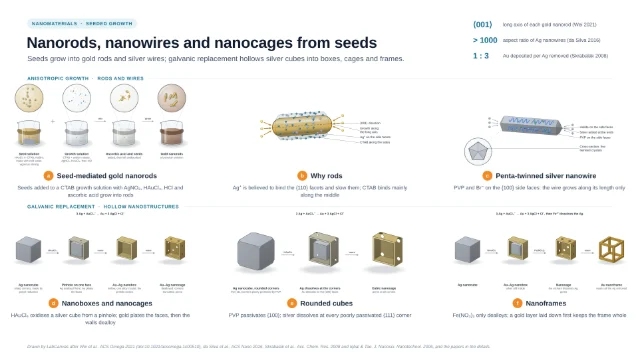
- Twinned seedsSingly twinned seeds give right bipyramids enclosed by {100} facets (two right tetrahedra base to base); multiply twinned seeds give icosahedra, decahedra and pentagonal rods or wires, depending on whether the side {100} planes are stabilised (Xia 2009). With Br⁻ and high-molecular-weight PVP capping the {100} side faces, penta-twinned silver wires grow along their length only (da Silva 2016)
- PlatesSeeds with stacking faults grow into thin plates with {111} top and bottom faces: hexagonal, then triangular as the {111} facets leave the sides (Xia 2009)
Papers this template follows
- Xia et al., “Shape-controlled synthesis of metal nanocrystals: simple chemistry meets complex physics?”, Angew. Chem. Int. Ed. 2009. doi:10.1002/anie.200802248primary
- da Silva et al., “Facile synthesis of sub-20 nm silver nanowires through a bromide-mediated polyol method”, ACS Nano 2016. doi:10.1021/acsnano.6b03806primary
- Mendoza-Cruz et al., “Experimental high-resolution observation of the truncated double-icosahedron structure: a stable twinned shell in alloyed Au–Ag core@shell nanoparticles”, Nano Lett. 2024. doi:10.1021/acs.nanolett.3c04435further reading
- Skrabalak et al., “Gold nanocages: synthesis, properties, and applications”, Acc. Chem. Res. 2008. doi:10.1021/ar800018vfurther reading
Drawn by LabCanvas after Xia et al., Angew. Chem. Int. Ed. 2009 (doi:10.1002/anie.200802248) and da Silva et al., ACS Nano 2016, and the papers in the details.
How templates are written and checked: editorial guidelines.
Questions
What does the “Shape control of metal nanocrystals” template show?
Why metal nanocrystals come out as cubes, cuboctahedra, octahedra, bipyramids, decahedra, icosahedra, wires or plates: single-crystal seeds take the shape set by the growth rates along ⟨111⟩ and ⟨100⟩, capping agents such as PVP, bromide and citrate pick the facet that is exposed, and twinned or faulted seeds grow into bipyramids, multiply twinned particles, wires and plates. After Xia et al. 2009.
What are the steps shown in “Shape control of metal nanocrystals”?
1. Single-crystal seeds: From single-crystal seeds, octahedra, cuboctahedra or cubes form depending on the relative growth rates along ⟨111⟩ and ⟨100⟩; with uniaxial growth, cubic seeds give rectangular bars (Xia 2009). 2. Capping agents: A capping agent changes the order of free energies of the facets and thus their relative growth rates; the plane with a slower addition rate is exposed more (Xia 2009). 3. PVP and bromide on {100}: PVP binds most strongly to {100} of Ag and Pd: atoms add to the poorly passivated {111} facets, giving nanocubes larger than 25 nm; Br⁻ on {100} of Ag, Au, Pd and Pt gives smaller cubes (below 25 nm), bars and octagonal rods (Xia 2009). 4. Citrate on {111}: Citrate binds most strongly to {111}, at least for Pd, favouring octahedra, icosahedra and decahedra (Xia 2009). 5. Twinned seeds: Singly twinned seeds give right bipyramids enclosed by {100} facets (two right tetrahedra base to base); multiply twinned seeds give icosahedra, decahedra and pentagonal rods or wires, depending on whether the side {100} planes are stabilised (Xia 2009). With Br⁻ and high-molecular-weight PVP capping the {100} side faces, penta-twinned silver wires grow along their length only (da Silva 2016). 6. Plates: Seeds with stacking faults grow into thin plates with {111} top and bottom faces: hexagonal, then triangular as the {111} facets leave the sides (Xia 2009).
What are the starting materials and the product?
Starting materials: Seeds of silver, gold, palladium or platinum: single crystals, singly twinned, multiply twinned or with stacking faults. Product: Cubes, cuboctahedra, octahedra, right bipyramids, decahedra, icosahedra, pentagonal wires and triangular plates.
Which papers is “Shape control of metal nanocrystals” based on?
Xia et al., “Shape-controlled synthesis of metal nanocrystals: simple chemistry meets complex physics?”, Angew. Chem. Int. Ed. 2009 (doi:10.1002/anie.200802248); da Silva et al., “Facile synthesis of sub-20 nm silver nanowires through a bromide-mediated polyol method”, ACS Nano 2016 (doi:10.1021/acsnano.6b03806); Mendoza-Cruz et al., “Experimental high-resolution observation of the truncated double-icosahedron structure: a stable twinned shell in alloyed Au–Ag core@shell nanoparticles”, Nano Lett. 2024 (doi:10.1021/acs.nanolett.3c04435); Skrabalak et al., “Gold nanocages: synthesis, properties, and applications”, Acc. Chem. Res. 2008 (doi:10.1021/ar800018v).
Can I edit the “Shape control of metal nanocrystals” template?
Yes. Open it in the LabCanvas editor: all 47 layers are editable, including 8 generated objects (structures, plots, equipment) with their own settings. Change the text, colours and layout, then export PNG, TIFF, SVG or PDF.
Do I need an account to use this template?
Not to view it here. To open and edit it, sign in to LabCanvas or create a free account (the free plan keeps up to 3 designs). Downloading the figure is part of LabCanvas Pro (US$19 a month or US$199 a year).