Graphical abstract template · Nanomaterial guides · Wet-chemical routes · Bottom-up
Six wet-chemical routes to nanoparticles
Six wet-chemical syntheses on one page, each drawn step by step: citrate reduction of gold (Turkevich), the Brust–Schiffrin two-phase synthesis of thiol-protected gold, silver nanowires by the polyol route, hot injection against heat-up for semiconductor nanocrystals, co-precipitation of magnetite and reverse micelles. The steps and numbers are the ones the cited papers report.
Updated 15 cited papers45 editable layers

At a glance
- Category
- Nanomaterial guides
- Method
- Wet-chemical routes
- Approach
- Bottom-up
- Starting materials
- HAuCl₄ and sodium citrate; HAuCl₄, TOAB, an alkanethiol and NaBH₄; AgNO₃, PVP and a chloride or bromide in ethylene glycol; TOP:Se and a cadmium precursor; FeCl₃ and FeCl₂ with NaOH; AgNO₃ and ascorbic acid in AOT reverse micelles
- Product
- Citrate-capped gold spheres, thiol-protected gold particles, silver nanowires, CdSe nanocrystals, magnetite nanoparticles and silver nanoparticles
- Key result
- Steps drawn by LabCanvas from the cited procedures; liquid colours, particle counts and vessel sizes that no paper fixes are settings, and no panel is a micrograph
- Figure
- 1920 × 1080 px (16:9), 45 editable layers, 6 generated objects
Step by step
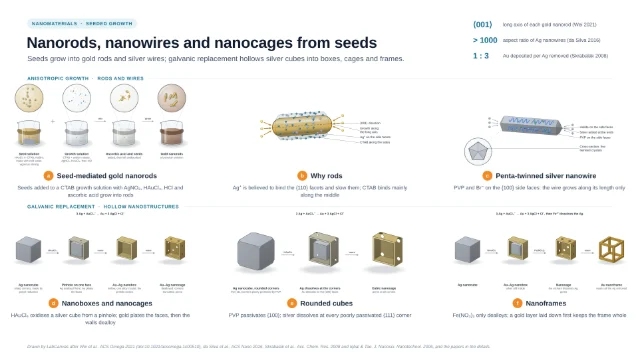
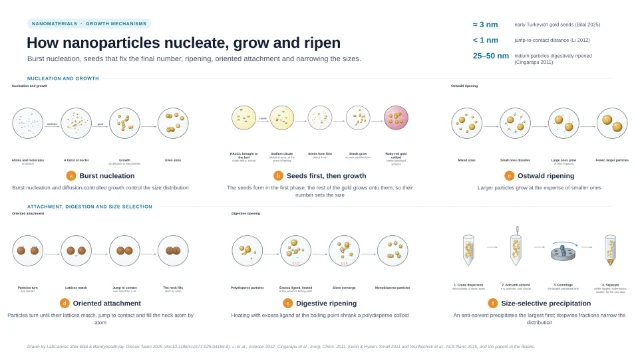
- Citrate reduction (Turkevich)0.25 mM HAuCl₄ brought to a vigorous boil under reflux, 500 mM sodium citrate swiftly added at its onset (2.5 mM final); after 15 min of reflux the colloid is ruby red: spheres of 19 ± 2 nm with the plasmon peak at 519 nm. Citrate is both the reducing agent and the ligand, and seeds of about 3 nm form early (Bilal 2025). The seeds form in the first phase and the remaining gold is distributed onto them, so their number sets the final size (Wuithschick 2015)
- Two-phase (Brust–Schiffrin)TOAB in toluene takes [AuCl₄]⁻ out of the water as an ion pair; an alkanethiol reduces Au(III) to Au(I); aqueous NaBH₄ is carried into the toluene by TOA⁺, where Au(I) is reduced to Au(0) particles. The thiol-to-gold ratio tunes the mean diameter across 1–6 nm, and the particles can be dried and taken up again in organic solvents without aggregating (Booth 2017). The method gives 2–6 nm particles and nanoclusters below 2 nm (Dou 2020)
- Polyol silver nanowiresEthylene glycol is the solvent and the reducing agent, AgNO₃ the silver source, PVP the capping agent and CuCl₂ a source of chloride ions that regulate growth; AgNO₃ : PVP of 1 : 4 gave wires 3.3–4.7 µm long and about 86 nm wide (Naz 2021). With Br⁻ and high-molecular-weight PVP capping the {100} side faces and AgNO₃ added slowly by syringe pump, penta-twinned wires grow along their length only: under 20 nm wide, aspect ratios over 1000 (da Silva 2016)
- Hot injection or heat-upTOP:Se injected rapidly at 370 °C through a large needle: a sharp nucleation event that narrows the size distribution; CdSe of about 2–2.5 nm if cooled at once, about 3 nm after 3 min and about 4 nm after 5 min. In a heat-up reaction both precursors are already in the flask, heated to 240 °C at about 10 °C/min (Manthiram 2013). Burst nucleation and diffusion-controlled growth are the main factors controlling the size distribution (Kwon & Hyeon 2011)
- Co-precipitation of magnetiteFeCl₃·6H₂O and FeCl₂·4H₂O (Fe³⁺ : Fe²⁺ = 2 : 1) in degassed water at 25 °C under N₂, NaOH added slowly or fast. The hydroxides precipitate very fast, Fe(OH)₃ turns into FeOOH more slowly, and FeOOH and Fe(OH)₂ react in the solid state to magnetite within 10–30 min; washed and separated with a magnet: about 11 nm and superparamagnetic over a pH window of 10.0–13.0 (Mascolo 2013)
- Reverse micellesAgNO₃ and ascorbic acid in AOT/n-heptane reverse micelles with w₀ = [water]/[AOT] of 2, 6 and 10 at room temperature: the particles were spherical, slightly larger than the micelles, and grew larger and more polydisperse as w₀ rose (Singha 2013). Reaction, nucleation and growth proceed through exchange between the micelles (Jain & Mehra 2004); a more flexible surfactant film gives bigger, more polydisperse particles (Tojo 2011)
Strengths
- Citrate is both the reducing agent and the ligand (Bilal 2025)
- Thiol-protected gold can be dried and redispersed without aggregating (Booth 2017)
- Co-precipitation gives magnetite at room temperature (Mascolo 2013)
Limitations
- Insoluble Au(I) thiolates are not readily reduced by NaBH₄; [AuBr₄]⁻ avoids them (Booth 2017)
- A larger w₀ gives more polydisperse particles (Singha 2013)
Papers this template follows
- Bilal & Bandyopadhyay, “Controlled growth of citrate-stabilized gold nanoparticles using a semi-continuous seed-mediated route”, Discov. Nano 2025. doi:10.1186/s11671-025-04189-8primary
- Wuithschick et al., “Turkevich in new robes: key questions answered for the most common gold nanoparticle synthesis”, ACS Nano 2015. doi:10.1021/acsnano.5b01579primary
- Booth et al., “The significance of bromide in the Brust–Schiffrin synthesis of thiol protected gold nanoparticles”, Chem. Sci. 2017. doi:10.1039/c7sc03266hprimary
- Naz et al., “High-yield synthesis of silver nanowires for transparent conducting PET films”, Beilstein J. Nanotechnol. 2021. doi:10.3762/bjnano.12.51primary
- da Silva et al., “Facile synthesis of sub-20 nm silver nanowires through a bromide-mediated polyol method”, ACS Nano 2016. doi:10.1021/acsnano.6b03806primary
- Manthiram et al., “Seeded synthesis of CdSe/CdS rod and tetrapod nanocrystals”, J. Vis. Exp. 2013. doi:10.3791/50731primary
- Mascolo, Pei & Ring, “Room temperature co-precipitation synthesis of magnetite nanoparticles in a large pH window with different bases”, Materials 2013. doi:10.3390/ma6125549primary
- Singha, Barman & Sahu, “A facile synthesis of high optical quality silver nanoparticles by ascorbic acid reduction in reverse micelles at room temperature”, J. Colloid Interface Sci. 2013. doi:10.1016/j.jcis.2013.09.009primary
- Turkevich, Stevenson & Hillier, “A study of the nucleation and growth processes in the synthesis of colloidal gold”, Discuss. Faraday Soc. 1951. doi:10.1039/DF9511100055method origin
- Dou et al., “From understanding the roles of tetraoctylammonium bromide in the two-phase Brust–Schiffrin method to tuning the size of gold nanoclusters”, Nanoscale 2020. doi:10.1039/d0nr04439cfurther reading
- Liu et al., “Biobased polymers enabling the synthesis of ultralong silver nanowires and other nanostructures”, Nano Lett. 2024. doi:10.1021/acs.nanolett.4c04130further reading
- Kim et al., “Superparamagnetism of Cu₂Se nanoparticles”, J. Nanosci. Nanotechnol. 2012. doi:10.1166/jnn.2012.6298further reading
- Kwon & Hyeon, “Formation mechanisms of uniform nanocrystals via hot-injection and heat-up methods”, Small 2011. doi:10.1002/smll.201002022further reading
- Jain & Mehra, “Monte Carlo models for nanoparticle formation in two microemulsion systems”, Langmuir 2004. doi:10.1021/la049624zfurther reading
- Tojo, de Dios & Barroso, “Surfactant effects on microemulsion-based nanoparticle synthesis”, Materials 2011. doi:10.3390/ma4010055further reading
Drawn by LabCanvas after Bilal & Bandyopadhyay, Discov. Nano 2025 (doi:10.1186/s11671-025-04189-8), Booth et al., Chem. Sci. 2017, Mascolo, Pei & Ring, Materials 2013 and Wuithschick et al., ACS Nano 2015, and the papers in the details.
How templates are written and checked: editorial guidelines.
Questions
What does the “Six wet-chemical routes to nanoparticles” template show?
Six wet-chemical syntheses on one page, each drawn step by step: citrate reduction of gold (Turkevich), the Brust–Schiffrin two-phase synthesis of thiol-protected gold, silver nanowires by the polyol route, hot injection against heat-up for semiconductor nanocrystals, co-precipitation of magnetite and reverse micelles. The steps and numbers are the ones the cited papers report.
What are the steps shown in “Six wet-chemical routes to nanoparticles”?
1. Citrate reduction (Turkevich): 0.25 mM HAuCl₄ brought to a vigorous boil under reflux, 500 mM sodium citrate swiftly added at its onset (2.5 mM final); after 15 min of reflux the colloid is ruby red: spheres of 19 ± 2 nm with the plasmon peak at 519 nm. Citrate is both the reducing agent and the ligand, and seeds of about 3 nm form early (Bilal 2025). The seeds form in the first phase and the remaining gold is distributed onto them, so their number sets the final size (Wuithschick 2015). 2. Two-phase (Brust–Schiffrin): TOAB in toluene takes [AuCl₄]⁻ out of the water as an ion pair; an alkanethiol reduces Au(III) to Au(I); aqueous NaBH₄ is carried into the toluene by TOA⁺, where Au(I) is reduced to Au(0) particles. The thiol-to-gold ratio tunes the mean diameter across 1–6 nm, and the particles can be dried and taken up again in organic solvents without aggregating (Booth 2017). The method gives 2–6 nm particles and nanoclusters below 2 nm (Dou 2020). 3. Polyol silver nanowires: Ethylene glycol is the solvent and the reducing agent, AgNO₃ the silver source, PVP the capping agent and CuCl₂ a source of chloride ions that regulate growth; AgNO₃ : PVP of 1 : 4 gave wires 3.3–4.7 µm long and about 86 nm wide (Naz 2021). With Br⁻ and high-molecular-weight PVP capping the {100} side faces and AgNO₃ added slowly by syringe pump, penta-twinned wires grow along their length only: under 20 nm wide, aspect ratios over 1000 (da Silva 2016). 4. Hot injection or heat-up: TOP:Se injected rapidly at 370 °C through a large needle: a sharp nucleation event that narrows the size distribution; CdSe of about 2–2.5 nm if cooled at once, about 3 nm after 3 min and about 4 nm after 5 min. In a heat-up reaction both precursors are already in the flask, heated to 240 °C at about 10 °C/min (Manthiram 2013). Burst nucleation and diffusion-controlled growth are the main factors controlling the size distribution (Kwon & Hyeon 2011). 5. Co-precipitation of magnetite: FeCl₃·6H₂O and FeCl₂·4H₂O (Fe³⁺ : Fe²⁺ = 2 : 1) in degassed water at 25 °C under N₂, NaOH added slowly or fast. The hydroxides precipitate very fast, Fe(OH)₃ turns into FeOOH more slowly, and FeOOH and Fe(OH)₂ react in the solid state to magnetite within 10–30 min; washed and separated with a magnet: about 11 nm and superparamagnetic over a pH window of 10.0–13.0 (Mascolo 2013). 6. Reverse micelles: AgNO₃ and ascorbic acid in AOT/n-heptane reverse micelles with w₀ = [water]/[AOT] of 2, 6 and 10 at room temperature: the particles were spherical, slightly larger than the micelles, and grew larger and more polydisperse as w₀ rose (Singha 2013). Reaction, nucleation and growth proceed through exchange between the micelles (Jain & Mehra 2004); a more flexible surfactant film gives bigger, more polydisperse particles (Tojo 2011).
What are the starting materials and the product?
Starting materials: HAuCl₄ and sodium citrate; HAuCl₄, TOAB, an alkanethiol and NaBH₄; AgNO₃, PVP and a chloride or bromide in ethylene glycol; TOP:Se and a cadmium precursor; FeCl₃ and FeCl₂ with NaOH; AgNO₃ and ascorbic acid in AOT reverse micelles. Product: Citrate-capped gold spheres, thiol-protected gold particles, silver nanowires, CdSe nanocrystals, magnetite nanoparticles and silver nanoparticles.
Which papers is “Six wet-chemical routes to nanoparticles” based on?
Bilal & Bandyopadhyay, “Controlled growth of citrate-stabilized gold nanoparticles using a semi-continuous seed-mediated route”, Discov. Nano 2025 (doi:10.1186/s11671-025-04189-8); Wuithschick et al., “Turkevich in new robes: key questions answered for the most common gold nanoparticle synthesis”, ACS Nano 2015 (doi:10.1021/acsnano.5b01579); Booth et al., “The significance of bromide in the Brust–Schiffrin synthesis of thiol protected gold nanoparticles”, Chem. Sci. 2017 (doi:10.1039/c7sc03266h); Naz et al., “High-yield synthesis of silver nanowires for transparent conducting PET films”, Beilstein J. Nanotechnol. 2021 (doi:10.3762/bjnano.12.51); da Silva et al., “Facile synthesis of sub-20 nm silver nanowires through a bromide-mediated polyol method”, ACS Nano 2016 (doi:10.1021/acsnano.6b03806); Manthiram et al., “Seeded synthesis of CdSe/CdS rod and tetrapod nanocrystals”, J. Vis. Exp. 2013 (doi:10.3791/50731); Mascolo, Pei & Ring, “Room temperature co-precipitation synthesis of magnetite nanoparticles in a large pH window with different bases”, Materials 2013 (doi:10.3390/ma6125549); Singha, Barman & Sahu, “A facile synthesis of high optical quality silver nanoparticles by ascorbic acid reduction in reverse micelles at room temperature”, J. Colloid Interface Sci. 2013 (doi:10.1016/j.jcis.2013.09.009); Turkevich, Stevenson & Hillier, “A study of the nucleation and growth processes in the synthesis of colloidal gold”, Discuss. Faraday Soc. 1951 (doi:10.1039/DF9511100055); Dou et al., “From understanding the roles of tetraoctylammonium bromide in the two-phase Brust–Schiffrin method to tuning the size of gold nanoclusters”, Nanoscale 2020 (doi:10.1039/d0nr04439c); Liu et al., “Biobased polymers enabling the synthesis of ultralong silver nanowires and other nanostructures”, Nano Lett. 2024 (doi:10.1021/acs.nanolett.4c04130); Kim et al., “Superparamagnetism of Cu₂Se nanoparticles”, J. Nanosci. Nanotechnol. 2012 (doi:10.1166/jnn.2012.6298); Kwon & Hyeon, “Formation mechanisms of uniform nanocrystals via hot-injection and heat-up methods”, Small 2011 (doi:10.1002/smll.201002022); Jain & Mehra, “Monte Carlo models for nanoparticle formation in two microemulsion systems”, Langmuir 2004 (doi:10.1021/la049624z); Tojo, de Dios & Barroso, “Surfactant effects on microemulsion-based nanoparticle synthesis”, Materials 2011 (doi:10.3390/ma4010055).
Can I edit the “Six wet-chemical routes to nanoparticles” template?
Yes. Open it in the LabCanvas editor: all 45 layers are editable, including 6 generated objects (structures, plots, equipment) with their own settings. Change the text, colours and layout, then export PNG, TIFF, SVG or PDF.
Do I need an account to use this template?
Not to view it here. To open and edit it, sign in to LabCanvas or create a free account (the free plan keeps up to 3 designs). Downloading the figure is part of LabCanvas Pro (US$19 a month or US$199 a year).