Graphical abstract template · Drug discovery & proteins · Structure prediction
AlphaFold: a predicted structure and how sure it is
From a sequence and its alignment to a 3D model coloured by confidence: per-residue pLDDT, the predicted aligned error between domains, and AlphaFold 3 complexes with ligands. The AlphaFold Database opened with over 360,000 predicted structures across 21 proteomes.
Updated 4 cited papers63 editable layers

At a glance
- Category
- Drug discovery & proteins
- Method
- Structure prediction
- Starting materials
- An amino acid sequence and its multiple sequence alignment
- Product
- A 3D model with per-residue confidence (pLDDT) and pairwise error (PAE)
- Key result
- Confidence bands as in the AlphaFold Database (Varadi 2022). Alignment, structure, PAE and pLDDT traces are synthetic examples
- Figure
- 1920 × 1080 px (16:9), 63 editable layers, 5 generated objects
Step by step
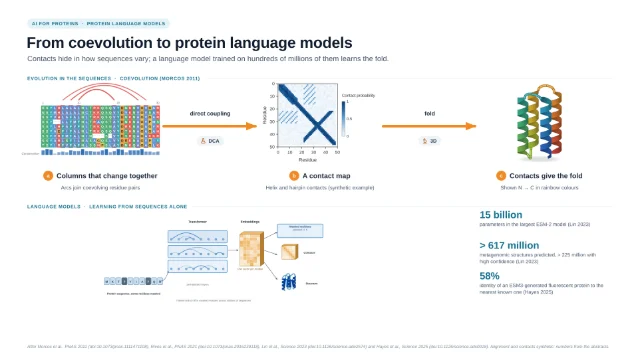
- AlignmentHomologous sequences found in genetic databases; coevolving columns carry contact information
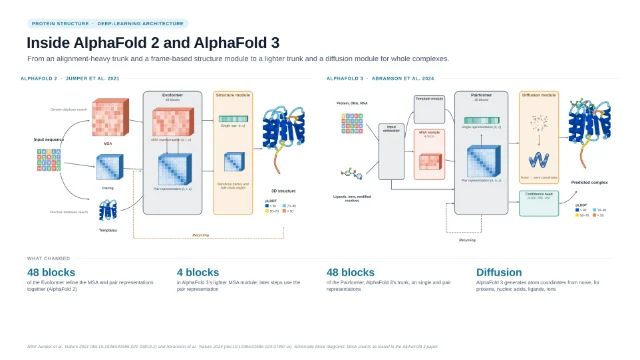
- PredictionAlphaFold 2 predicts structures with atomic accuracy competitive with experiment in most CASP14 cases (Jumper 2021)
- ConfidencepLDDT per residue: above 90 very high, below 50 very low (often disordered)
- DomainsThe PAE map shows which parts are placed confidently relative to each other
- ComplexesAlphaFold 3 predicts complexes with nucleic acids, small molecules, ions and modified residues (Abramson 2024)
Strengths
- Structures for almost any sequence, in minutes
- Confidence scores say which parts to trust
- Open database of predictions
Limitations
- Low pLDDT regions are often disordered, not wrong folds
- One static state per prediction; dynamics and alternative states are missed
Uses
- Drug target structures
- Experimental model building (cryo-EM, crystallography)
- Protein design checks
Papers this template follows
- Jumper et al., “Highly accurate protein structure prediction with AlphaFold”, Nature 2021. doi:10.1038/s41586-021-03819-2primary
- Varadi et al., “AlphaFold Protein Structure Database: massively expanding the structural coverage of protein-sequence space with high-accuracy models”, Nucleic Acids Res. 2022. doi:10.1093/nar/gkab1061primary
- Abramson et al., “Accurate structure prediction of biomolecular interactions with AlphaFold 3”, Nature 2024. doi:10.1038/s41586-024-07487-wprimary
- Mariani et al., “lDDT: a local superposition-free score for comparing protein structures and models using distance difference tests”, Bioinformatics 2013. doi:10.1093/bioinformatics/btt473method origin
After Jumper et al., Nature 2021 (doi:10.1038/s41586-021-03819-2), Varadi et al., Nucleic Acids Res. 2022 (doi:10.1093/nar/gkab1061) and Abramson et al., Nature 2024 (doi:10.1038/s41586-024-07487-w). Structures, alignment, PAE and pLDDT are synthetic examples; numbers from the papers.
How templates are written and checked: editorial guidelines.
Questions
What does the “AlphaFold: a predicted structure and how sure it is” template show?
From a sequence and its alignment to a 3D model coloured by confidence: per-residue pLDDT, the predicted aligned error between domains, and AlphaFold 3 complexes with ligands. The AlphaFold Database opened with over 360,000 predicted structures across 21 proteomes.
What are the steps shown in “AlphaFold: a predicted structure and how sure it is”?
1. Alignment: Homologous sequences found in genetic databases; coevolving columns carry contact information. 2. Prediction: AlphaFold 2 predicts structures with atomic accuracy competitive with experiment in most CASP14 cases (Jumper 2021). 3. Confidence: pLDDT per residue: above 90 very high, below 50 very low (often disordered). 4. Domains: The PAE map shows which parts are placed confidently relative to each other. 5. Complexes: AlphaFold 3 predicts complexes with nucleic acids, small molecules, ions and modified residues (Abramson 2024).
What are the starting materials and the product?
Starting materials: An amino acid sequence and its multiple sequence alignment. Product: A 3D model with per-residue confidence (pLDDT) and pairwise error (PAE).
Which papers is “AlphaFold: a predicted structure and how sure it is” based on?
Jumper et al., “Highly accurate protein structure prediction with AlphaFold”, Nature 2021 (doi:10.1038/s41586-021-03819-2); Varadi et al., “AlphaFold Protein Structure Database: massively expanding the structural coverage of protein-sequence space with high-accuracy models”, Nucleic Acids Res. 2022 (doi:10.1093/nar/gkab1061); Abramson et al., “Accurate structure prediction of biomolecular interactions with AlphaFold 3”, Nature 2024 (doi:10.1038/s41586-024-07487-w); Mariani et al., “lDDT: a local superposition-free score for comparing protein structures and models using distance difference tests”, Bioinformatics 2013 (doi:10.1093/bioinformatics/btt473).
Can I edit the “AlphaFold: a predicted structure and how sure it is” template?
Yes. Open it in the LabCanvas editor: all 63 layers are editable, including 5 generated objects (structures, plots, equipment) with their own settings. Change the text, colours and layout, then export PNG, TIFF, SVG or PDF.
Do I need an account to use this template?
Not to view it here. To open and edit it, sign in to LabCanvas or create a free account (the free plan keeps up to 3 designs). Downloading the figure is part of LabCanvas Pro (US$19 a month or US$199 a year).