Graphical abstract template · Graphene synthesis · Modified Hummers' method · Top-down
Graphene oxide: synthesis and characterization
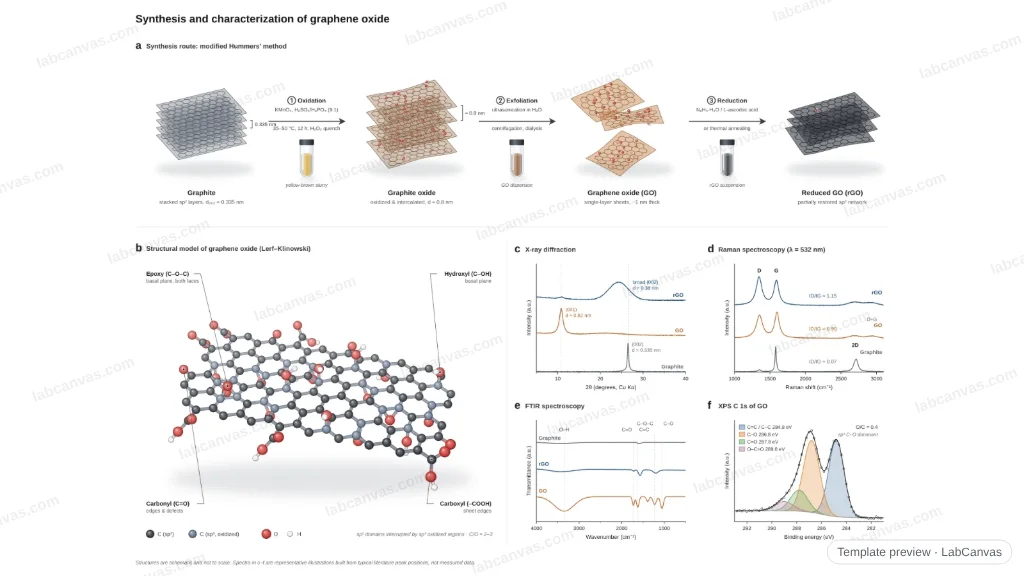
A six-panel figure on graphene oxide: the modified Hummers' route from graphite through graphite oxide and GO to reduced GO, the Lerf–Klinowski structural model with its oxygen groups, and representative XRD, Raman, FTIR and XPS C 1s spectra comparing graphite, GO and rGO.
Updated 3 cited papers1388 editable layers
At a glance
- Category
- Graphene synthesis
- Method
- Modified Hummers' method
- Approach
- Top-down
- Starting materials
- Graphite flakes
- Product
- Graphene oxide sheets (~1 nm thick) and reduced graphene oxide
- Key result
- Interlayer spacing grows from 0.335 nm (graphite) to ≈ 0.8 nm (GO); I(D)/I(G) rises on oxidation and again on reduction
- Figure
- 1600 × 1170 px (16:9), 1388 editable layers
Step by step
- OxidationKMnO₄ in H₂SO₄/H₃PO₄ (9:1), 35–50 °C, 12 h; H₂O₂ quench
- ExfoliationUltrasonication in water, centrifugation, dialysis
- ReductionHydrazine hydrate or L-ascorbic acid, or thermal annealing
Uses
- Characterization figures for GO and rGO papers
- Teaching the structure of graphene oxide
Papers this template follows
- Hummers & Offeman, “Preparation of graphitic oxide”, J. Am. Chem. Soc. 1958. doi:10.1021/ja01539a017method origin
- Marcano et al., “Improved synthesis of graphene oxide”, ACS Nano 2010. doi:10.1021/nn1006368primary
- Lerf et al., “Structure of graphite oxide revisited”, J. Phys. Chem. B 1998. doi:10.1021/jp9731821further reading
Spectra are representative illustrations built from typical literature peak positions, not measured data.
How templates are written and checked: editorial guidelines.
Questions
What does the “Graphene oxide: synthesis and characterization” template show?
A six-panel figure on graphene oxide: the modified Hummers' route from graphite through graphite oxide and GO to reduced GO, the Lerf–Klinowski structural model with its oxygen groups, and representative XRD, Raman, FTIR and XPS C 1s spectra comparing graphite, GO and rGO.
What are the steps shown in “Graphene oxide: synthesis and characterization”?
1. Oxidation: KMnO₄ in H₂SO₄/H₃PO₄ (9:1), 35–50 °C, 12 h; H₂O₂ quench. 2. Exfoliation: Ultrasonication in water, centrifugation, dialysis. 3. Reduction: Hydrazine hydrate or L-ascorbic acid, or thermal annealing.
What are the starting materials and the product?
Starting materials: Graphite flakes. Product: Graphene oxide sheets (~1 nm thick) and reduced graphene oxide.
Which papers is “Graphene oxide: synthesis and characterization” based on?
Hummers & Offeman, “Preparation of graphitic oxide”, J. Am. Chem. Soc. 1958 (doi:10.1021/ja01539a017); Marcano et al., “Improved synthesis of graphene oxide”, ACS Nano 2010 (doi:10.1021/nn1006368); Lerf et al., “Structure of graphite oxide revisited”, J. Phys. Chem. B 1998 (doi:10.1021/jp9731821).
Can I edit the “Graphene oxide: synthesis and characterization” template?
Yes. Open it in the LabCanvas editor: all 1388 layers are editable. Change the text, colours and layout, then export PNG, TIFF, SVG or PDF.
Do I need an account to use this template?
Not to view it here. To open and edit it, sign in to LabCanvas or create a free account (the free plan keeps one design of each kind). Downloading the figure is part of LabCanvas Pro (US$19 a month or US$199 a year).