Graphical abstract template · Graphene synthesis · Mechanical exfoliation · Top-down
Mechanical exfoliation with adhesive tape
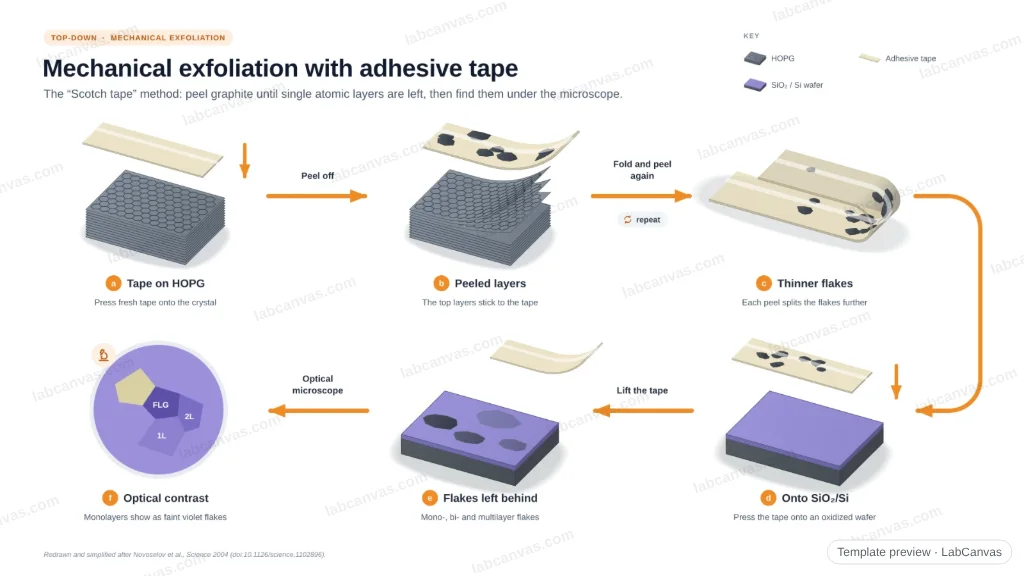
Graphene was first isolated by peeling graphite with ordinary adhesive tape. Repeated peeling thins the flakes on the tape, which is then pressed onto an oxidized silicon wafer, where single layers are spotted by their faint optical contrast and confirmed by Raman spectroscopy or AFM.
Updated 5 cited papers73 editable layers
At a glance
- Category
- Graphene synthesis
- Method
- Mechanical exfoliation
- Approach
- Top-down
- Starting materials
- Highly oriented pyrolytic graphite (HOPG) or natural graphite flakes
- Product
- Pristine mono-, bi- and few-layer graphene flakes on SiO₂/Si
- Typical size
- Micrometre-sized flakes, randomly placed
- Key result
- Highest: pristine crystals with very high carrier mobility
- Scalability
- Very low: manual, with random flake size and position
- Figure
- 1920 × 1080 px (16:9), 73 editable layers, 18 generated objects
Step by step
- Press adhesive tape onto HOPGThe tape picks up the top graphite layers
- Peel, fold and peel againRepeated cleavage thins the flakes on the tape
- Press the tape onto SiO₂/SiAn oxidized wafer (about 300 nm SiO₂) makes thin flakes visible
- Lift the tapeFlakes of different thickness stay on the wafer
- Identify monolayersOptical contrast under the microscope; confirm by Raman spectroscopy or AFM
Strengths
- Pristine, highest-quality crystals
- Simple and cheap: tape, graphite and a microscope
- Works for most layered crystals (hBN, MoS₂…)
Limitations
- Not scalable; few monolayers per sample
- Random flake size, shape and position
- Tape residues can contaminate the flakes
Uses
- Fundamental physics and device prototypes
- Van der Waals heterostructures
- Reference samples for characterization
Papers this template follows
- Novoselov et al., “Electric field effect in atomically thin carbon films”, Science 2004. doi:10.1126/science.1102896primary
- Blake et al., “Making graphene visible”, Appl. Phys. Lett. 2007. doi:10.1063/1.2768624further reading
- Sumdani et al., “Recent advances of the graphite exfoliation processes and structural modification of graphene: a review”, J. Nanopart. Res. 2021. doi:10.1007/s11051-021-05371-6review
- Sun et al., “Synthesis of wafer-scale graphene with chemical vapor deposition for electronic device applications”, Adv. Mater. Technol. 2021. doi:10.1002/admt.202000744review
- Macedo et al., “Bioelectronics and interfaces using monolayer graphene”, ChemElectroChem 2019.review
Redrawn and simplified after Novoselov et al., Science 2004 (doi:10.1126/science.1102896).
How templates are written and checked: editorial guidelines.
Questions
What does the “Mechanical exfoliation with adhesive tape” template show?
Graphene was first isolated by peeling graphite with ordinary adhesive tape. Repeated peeling thins the flakes on the tape, which is then pressed onto an oxidized silicon wafer, where single layers are spotted by their faint optical contrast and confirmed by Raman spectroscopy or AFM.
What are the steps shown in “Mechanical exfoliation with adhesive tape”?
1. Press adhesive tape onto HOPG: The tape picks up the top graphite layers. 2. Peel, fold and peel again: Repeated cleavage thins the flakes on the tape. 3. Press the tape onto SiO₂/Si: An oxidized wafer (about 300 nm SiO₂) makes thin flakes visible. 4. Lift the tape: Flakes of different thickness stay on the wafer. 5. Identify monolayers: Optical contrast under the microscope; confirm by Raman spectroscopy or AFM.
What are the starting materials and the product?
Starting materials: Highly oriented pyrolytic graphite (HOPG) or natural graphite flakes. Product: Pristine mono-, bi- and few-layer graphene flakes on SiO₂/Si.
Which papers is “Mechanical exfoliation with adhesive tape” based on?
Novoselov et al., “Electric field effect in atomically thin carbon films”, Science 2004 (doi:10.1126/science.1102896); Blake et al., “Making graphene visible”, Appl. Phys. Lett. 2007 (doi:10.1063/1.2768624); Sumdani et al., “Recent advances of the graphite exfoliation processes and structural modification of graphene: a review”, J. Nanopart. Res. 2021 (doi:10.1007/s11051-021-05371-6); Sun et al., “Synthesis of wafer-scale graphene with chemical vapor deposition for electronic device applications”, Adv. Mater. Technol. 2021 (doi:10.1002/admt.202000744); Macedo et al., “Bioelectronics and interfaces using monolayer graphene”, ChemElectroChem 2019.
Can I edit the “Mechanical exfoliation with adhesive tape” template?
Yes. Open it in the LabCanvas editor: all 73 layers are editable, including 18 generated objects (structures, plots, equipment) with their own settings. Change the text, colours and layout, then export PNG, TIFF, SVG or PDF.
Do I need an account to use this template?
Not to view it here. To open and edit it, sign in to LabCanvas or create a free account (the free plan keeps one design of each kind). Downloading the figure is part of LabCanvas Pro (US$19 a month or US$199 a year).