Graphical abstract template · Graphene synthesis · Liquid-phase exfoliation · Top-down
Liquid-phase exfoliation of graphite
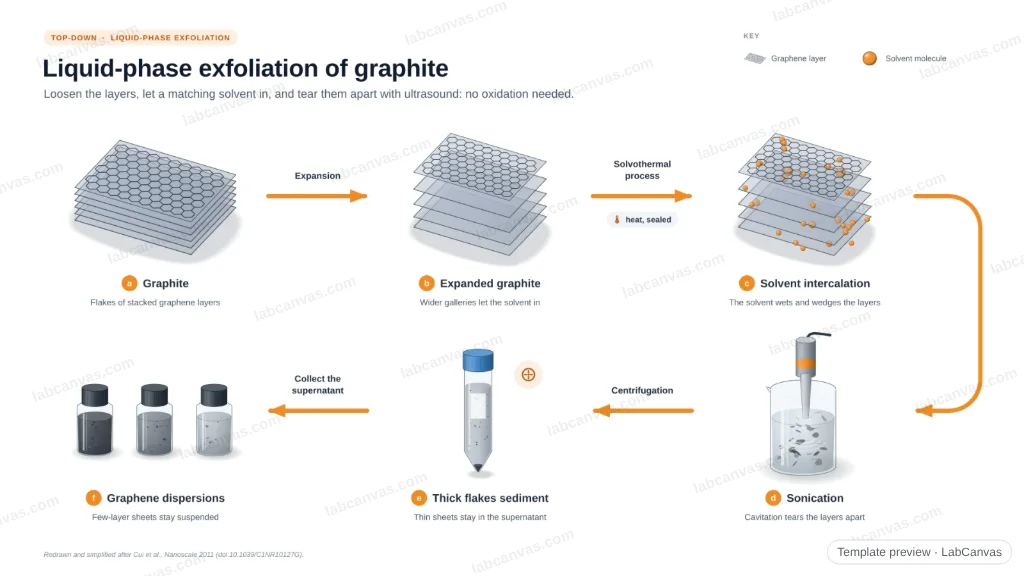
Graphite is split into thin sheets directly in a liquid. The layers are first loosened by expansion and solvothermal intercalation, then torn apart by ultrasound in a solvent whose surface energy matches graphene, such as NMP. Centrifugation removes the thick flakes and leaves stable dispersions of few-layer graphene.
Updated 3 cited papers56 editable layers
At a glance
- Category
- Graphene synthesis
- Method
- Liquid-phase exfoliation
- Approach
- Top-down
- Starting materials
- Graphite flakes or expanded graphite
- Product
- Dispersions of few-layer and monolayer graphene in a solvent
- Typical size
- Sub-micrometre to a few micrometres, mostly few-layer
- Key result
- Unoxidized basal plane; edge defects and small flakes from sonication
- Scalability
- Medium to high: simple liquid processing
- Figure
- 1920 × 1080 px (16:9), 56 editable layers, 12 generated objects
Step by step
- ExpansionLoosen the stack so that solvent can enter (e.g. expanded graphite)
- Solvothermal intercalationHeat with a polar solvent in a sealed vessel; the solvent wets and enters the galleries
- SonicationBath or probe ultrasound in NMP or a similar solvent cleaves the layers
- CentrifugationThick, unexfoliated flakes sediment; thin sheets stay in the supernatant
- Collect the dispersionsStable graphene dispersions for inks, films and composites
Strengths
- No oxidation: conductive, pristine sheets
- Simple, solution-processable
- Works for many layered materials
Limitations
- Low concentration (about 0.01 mg/mL in the first reports)
- Small, polydisperse flakes; monolayer yield of about 1 wt%
- High-boiling solvents such as NMP are hard to remove
Uses
- Conductive inks and coatings
- Polymer composites
- Thin films and electrodes
Papers this template follows
- Cui et al., “Liquid-phase exfoliation, functionalization and applications of graphene”, Nanoscale 2011. doi:10.1039/C1NR10127Gprimary
- Hernandez et al., “High-yield production of graphene by liquid-phase exfoliation of graphite”, Nat. Nanotechnol. 2008. doi:10.1038/nnano.2008.215method origin
- Sumdani et al., “Recent advances of the graphite exfoliation processes and structural modification of graphene: a review”, J. Nanopart. Res. 2021. doi:10.1007/s11051-021-05371-6review
Redrawn and simplified after Cui et al., Nanoscale 2011 (doi:10.1039/C1NR10127G).
How templates are written and checked: editorial guidelines.
Questions
What does the “Liquid-phase exfoliation of graphite” template show?
Graphite is split into thin sheets directly in a liquid. The layers are first loosened by expansion and solvothermal intercalation, then torn apart by ultrasound in a solvent whose surface energy matches graphene, such as NMP. Centrifugation removes the thick flakes and leaves stable dispersions of few-layer graphene.
What are the steps shown in “Liquid-phase exfoliation of graphite”?
1. Expansion: Loosen the stack so that solvent can enter (e.g. expanded graphite). 2. Solvothermal intercalation: Heat with a polar solvent in a sealed vessel; the solvent wets and enters the galleries. 3. Sonication: Bath or probe ultrasound in NMP or a similar solvent cleaves the layers. 4. Centrifugation: Thick, unexfoliated flakes sediment; thin sheets stay in the supernatant. 5. Collect the dispersions: Stable graphene dispersions for inks, films and composites.
What are the starting materials and the product?
Starting materials: Graphite flakes or expanded graphite. Product: Dispersions of few-layer and monolayer graphene in a solvent.
Which papers is “Liquid-phase exfoliation of graphite” based on?
Cui et al., “Liquid-phase exfoliation, functionalization and applications of graphene”, Nanoscale 2011 (doi:10.1039/C1NR10127G); Hernandez et al., “High-yield production of graphene by liquid-phase exfoliation of graphite”, Nat. Nanotechnol. 2008 (doi:10.1038/nnano.2008.215); Sumdani et al., “Recent advances of the graphite exfoliation processes and structural modification of graphene: a review”, J. Nanopart. Res. 2021 (doi:10.1007/s11051-021-05371-6).
Can I edit the “Liquid-phase exfoliation of graphite” template?
Yes. Open it in the LabCanvas editor: all 56 layers are editable, including 12 generated objects (structures, plots, equipment) with their own settings. Change the text, colours and layout, then export PNG, TIFF, SVG or PDF.
Do I need an account to use this template?
Not to view it here. To open and edit it, sign in to LabCanvas or create a free account (the free plan keeps one design of each kind). Downloading the figure is part of LabCanvas Pro (US$19 a month or US$199 a year).