Graphical abstract template · Graphene research · Laser and flash synthesis · Bottom-up
Laser-induced and flash graphene
Two fast, solvent-free ways to graphene. A pulsed CO₂ laser converts the surface of a polyimide film into porous graphene that can be written straight into micro-supercapacitor electrodes; a sub-second electrical flash through coal, carbon black or plastic waste turns it into gram-scale turbostratic graphene.
Updated 3 cited papers45 editable layers

At a glance
- Category
- Graphene research
- Method
- Laser and flash synthesis
- Approach
- Bottom-up
- Starting materials
- Polyimide (Kapton) film for LIG; coal, petroleum coke, biochar, carbon black, food waste, rubber tyres or mixed plastic waste for flash graphene
- Product
- Patterned porous graphene on the film (LIG); bulk turbostratic graphene (flash graphene)
- Key result
- Drawings by LabCanvas; numbers quoted from the papers
- Figure
- 1920 × 1080 px (16:9), 45 editable layers, 6 generated objects
Step by step
- WriteA pulsed CO₂ infrared laser photothermally converts the sp³ carbon of commercial polymer films into sp² carbon: porous graphene with three-dimensional networks, made in one step in air (Lin et al. 2014)
- StructureAn unusual ultra-polycrystalline lattice of pentagons and heptagons, which calculations partly link to its enhanced capacitance (Lin et al. 2014)
- DevicesWritten directly on the polyimide as interdigitated electrodes that are also their own current collectors, LIG makes in-plane micro-supercapacitors (tested in aqueous 1 M H₂SO₄ and in an ionic liquid) with specific capacitances above 4 mF cm⁻² and power densities of about 9 mW cm⁻²; one-step processing in air suits roll-to-roll manufacturing (Lin et al. 2014)
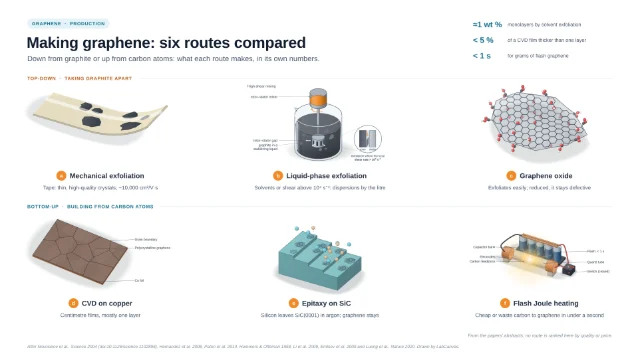
- FlashFlash Joule heating turns inexpensive carbon into gram-scale graphene in less than a second, with no furnace, solvents or reactive gases (Luong et al. 2020)
- YieldFrom high-carbon sources such as carbon black, anthracitic coal or calcined coke, 80–90 % yield at over 99 % carbon purity, with no purification (Luong et al. 2020)
- ProductTurbostratic flash graphene with a weak or absent Raman D band; its disordered stacking lets it exfoliate quickly when mixed into composites; the electricity costs about 7.2 kJ per gram (Luong et al. 2020)
Strengths
- LIG is made and patterned in one step in air (Lin et al. 2014)
- Flash graphene comes from cheap or waste carbon in under a second (Luong et al. 2020)
Limitations
- LIG is porous and ultra-polycrystalline, not a single crystal (Lin et al. 2014)
- Flash graphene is turbostratic bulk material, not a film (Luong et al. 2020)
Uses
- Polymer-written electronics and energy storage (LIG; Lin et al. 2014)
- Composites of plastics, metals, plywood and concrete (flash graphene; Luong et al. 2020)
Papers this template follows
- Lin et al., “Laser-induced porous graphene films from commercial polymers”, Nat. Commun. 2014. doi:10.1038/ncomms6714primary
- Luong et al., “Gram-scale bottom-up flash graphene synthesis”, Nature 2020. doi:10.1038/s41586-020-1938-0primary
- Ye, James & Tour, “Laser-induced graphene: from discovery to translation”, Adv. Mater. 2019. doi:10.1002/adma.201803621review
After Lin et al., Nat. Commun. 2014 (doi:10.1038/ncomms6714), Ye, James & Tour, Adv. Mater. 2019 and Luong et al., Nature 2020 (doi:10.1038/s41586-020-1938-0). Drawn by LabCanvas.
How templates are written and checked: editorial guidelines.
Questions
What does the “Laser-induced and flash graphene” template show?
Two fast, solvent-free ways to graphene. A pulsed CO₂ laser converts the surface of a polyimide film into porous graphene that can be written straight into micro-supercapacitor electrodes; a sub-second electrical flash through coal, carbon black or plastic waste turns it into gram-scale turbostratic graphene.
What are the steps shown in “Laser-induced and flash graphene”?
1. Write: A pulsed CO₂ infrared laser photothermally converts the sp³ carbon of commercial polymer films into sp² carbon: porous graphene with three-dimensional networks, made in one step in air (Lin et al. 2014). 2. Structure: An unusual ultra-polycrystalline lattice of pentagons and heptagons, which calculations partly link to its enhanced capacitance (Lin et al. 2014). 3. Devices: Written directly on the polyimide as interdigitated electrodes that are also their own current collectors, LIG makes in-plane micro-supercapacitors (tested in aqueous 1 M H₂SO₄ and in an ionic liquid) with specific capacitances above 4 mF cm⁻² and power densities of about 9 mW cm⁻²; one-step processing in air suits roll-to-roll manufacturing (Lin et al. 2014). 4. Flash: Flash Joule heating turns inexpensive carbon into gram-scale graphene in less than a second, with no furnace, solvents or reactive gases (Luong et al. 2020). 5. Yield: From high-carbon sources such as carbon black, anthracitic coal or calcined coke, 80–90 % yield at over 99 % carbon purity, with no purification (Luong et al. 2020). 6. Product: Turbostratic flash graphene with a weak or absent Raman D band; its disordered stacking lets it exfoliate quickly when mixed into composites; the electricity costs about 7.2 kJ per gram (Luong et al. 2020).
What are the starting materials and the product?
Starting materials: Polyimide (Kapton) film for LIG; coal, petroleum coke, biochar, carbon black, food waste, rubber tyres or mixed plastic waste for flash graphene. Product: Patterned porous graphene on the film (LIG); bulk turbostratic graphene (flash graphene).
Which papers is “Laser-induced and flash graphene” based on?
Lin et al., “Laser-induced porous graphene films from commercial polymers”, Nat. Commun. 2014 (doi:10.1038/ncomms6714); Luong et al., “Gram-scale bottom-up flash graphene synthesis”, Nature 2020 (doi:10.1038/s41586-020-1938-0); Ye, James & Tour, “Laser-induced graphene: from discovery to translation”, Adv. Mater. 2019 (doi:10.1002/adma.201803621).
Can I edit the “Laser-induced and flash graphene” template?
Yes. Open it in the LabCanvas editor: all 45 layers are editable, including 6 generated objects (structures, plots, equipment) with their own settings. Change the text, colours and layout, then export PNG, TIFF, SVG or PDF.
Do I need an account to use this template?
Not to view it here. To open and edit it, sign in to LabCanvas or create a free account (the free plan keeps up to 3 designs). Downloading the figure is part of LabCanvas Pro (US$19 a month or US$199 a year).