MOF-5 (IRMOF-1): structure, synthesis and properties
MOF-5, also called IRMOF-1, is the prototypical metal–organic framework, Zn₄O(BDC)₃: octahedral Zn₄O(CO₂)₆ clusters joined by terephthalate (1,4-benzenedicarboxylate, BDC) linkers into a cubic net with cavities about 12 and 15 Å across. First reported by Li, Eddaoudi, O’Keeffe and Yaghi in Nature in 1999, it stays crystalline when its pores are emptied and heated to 300 °C, and with careful air-free handling reaches a BET surface area of about 3,800 m² g⁻¹.
Last updated
MOF-5 at a glance
| Formula | Zn₄O(BDC)₃, BDC = 1,4-benzenedicarboxylate (terephthalate) |
|---|---|
| Other names | IRMOF-1 (the first of the isoreticular MOF series) |
| Molar mass | 769.9 g mol⁻¹ (calculated from the formula) |
| Metal node (SBU) | Octahedral Zn₄O(CO₂)₆ cluster: four ZnO₄ tetrahedra sharing one central oxygen |
| Organic linker | Terephthalate (BDC²⁻), from terephthalic acid H₂BDC |
| Topology | pcu (primitive cubic): each cluster linked to six others |
| Crystal system | Cubic, space group Fm-3m, a ≈ 25.8 Å (eight formula units per cell) |
| Cluster spacing | 12.9 Å between neighbouring Zn₄O clusters |
| Pores | Alternating cavities about 12 and 15 Å across (Rowsell et al. 2005) |
| Surface area | Langmuir 2,900 m² g⁻¹ (Li et al. 1999); BET about 3,800 m² g⁻¹ when made and kept air-free (Kaye et al. 2007) |
| Density | About 0.6 g cm⁻³ (calculated from the cubic cell) |
| Thermal stability | Crystalline when fully desolvated and heated up to 300 °C (Li et al. 1999) |
| Water stability | Poor: degrades in humid air, so it is stored and handled dry (Kaye et al. 2007) |
| First reported | Li, Eddaoudi, O’Keeffe and Yaghi, Nature 402, 276 (1999) |
MOF-5 structure diagram
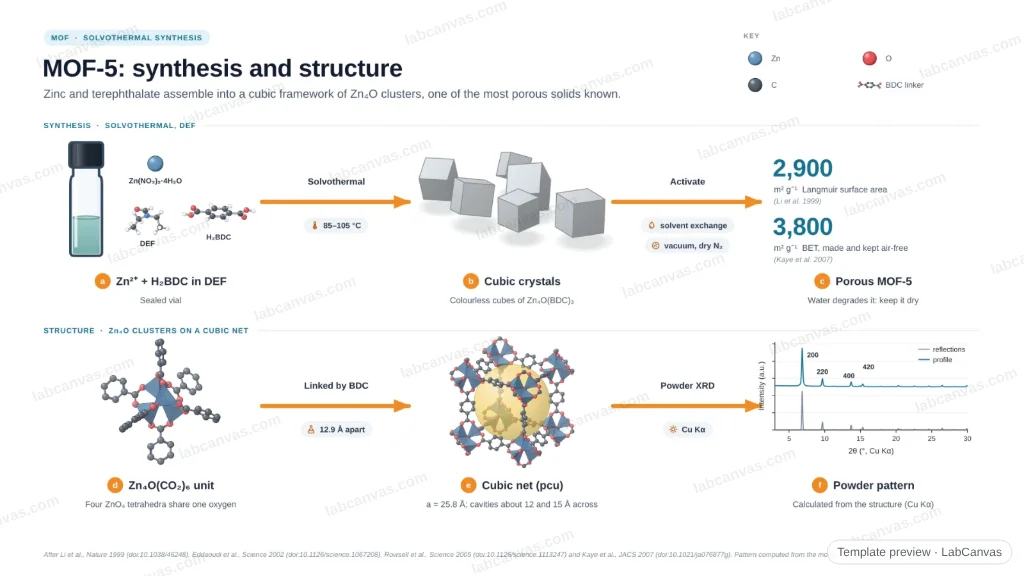
MOF-5 crystal structure (high-resolution SVG)
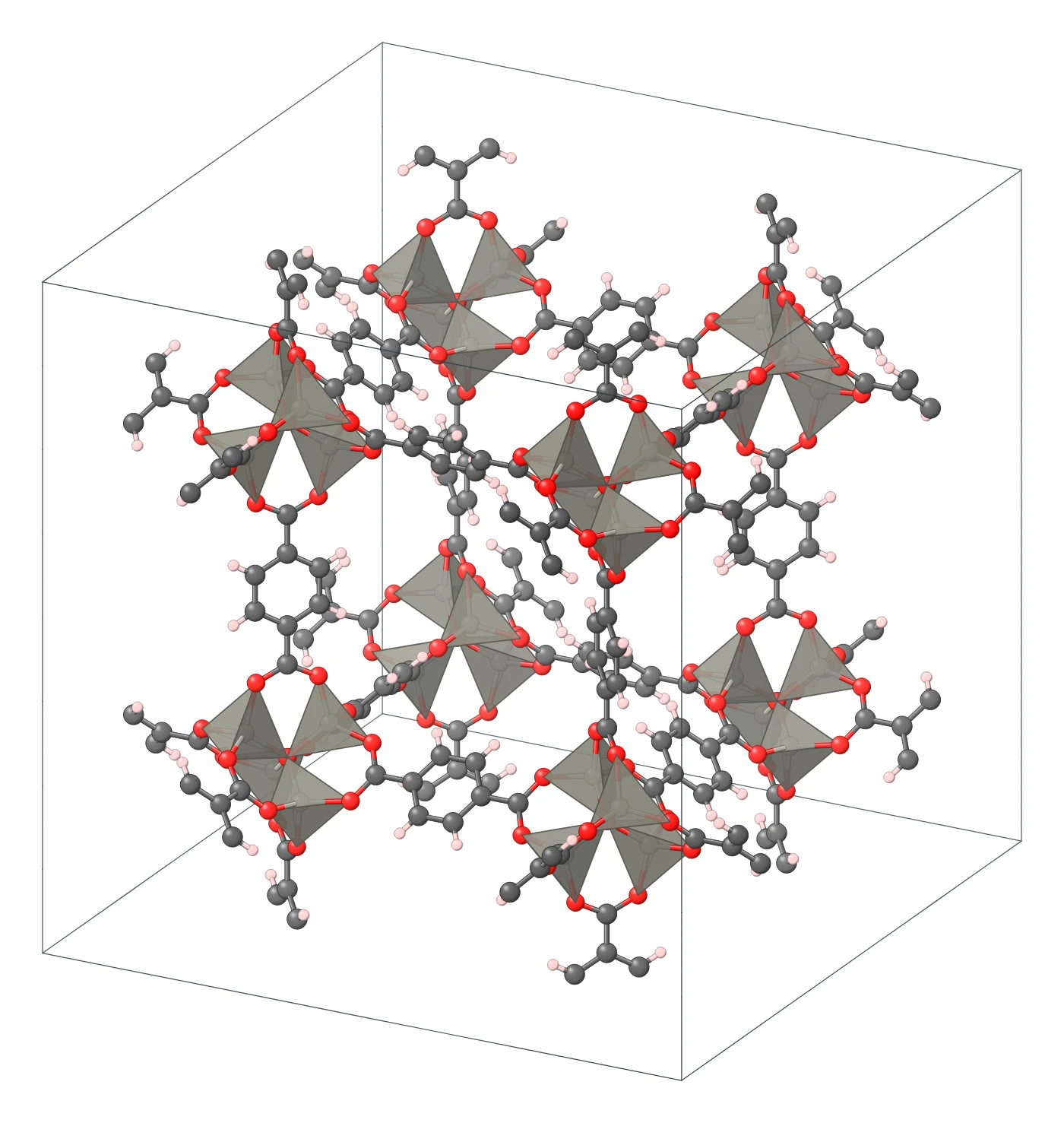
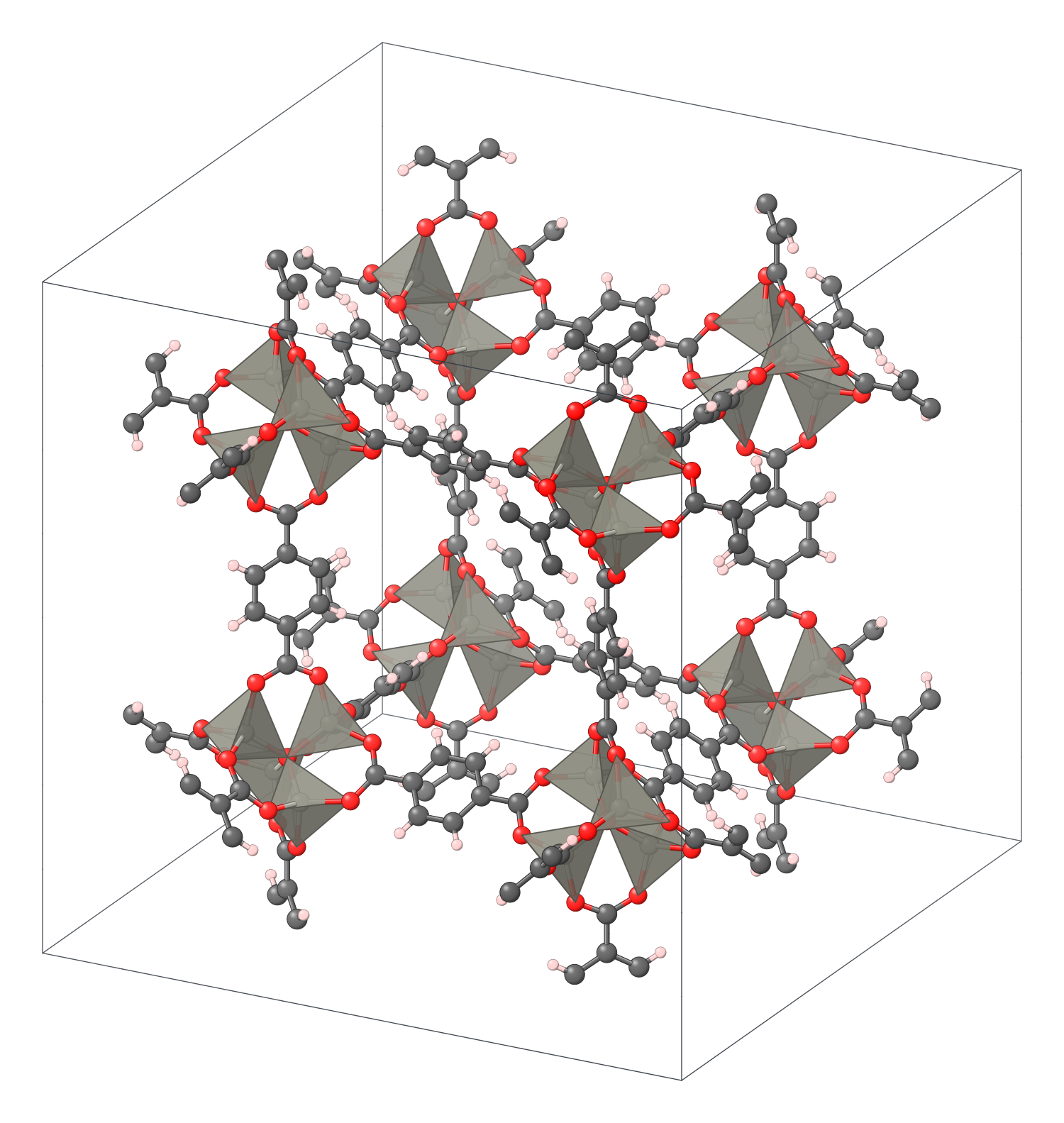
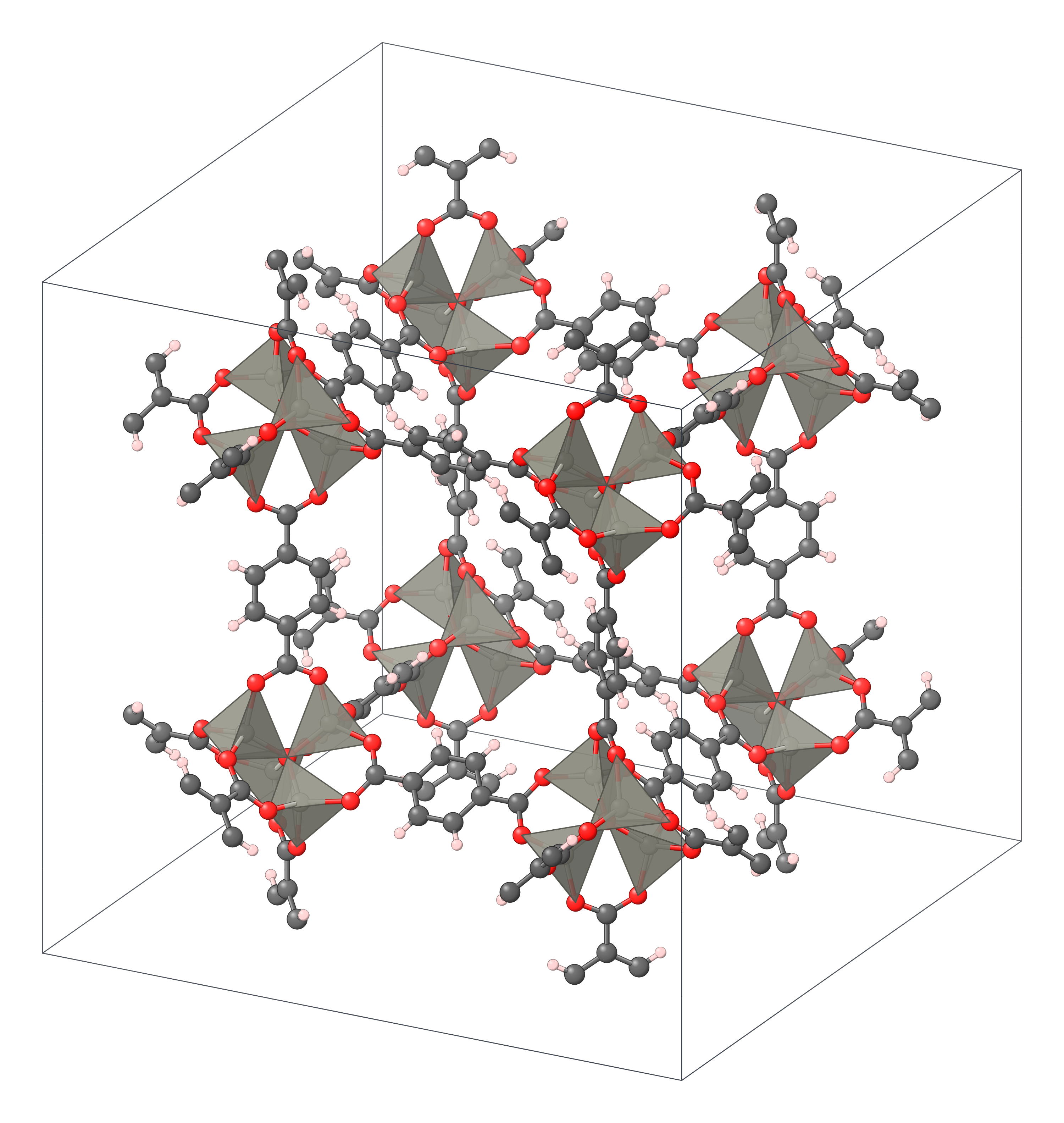
MOF-5 in 3D (interactive)
Loading the 3D model…
MOF-5 structure explained
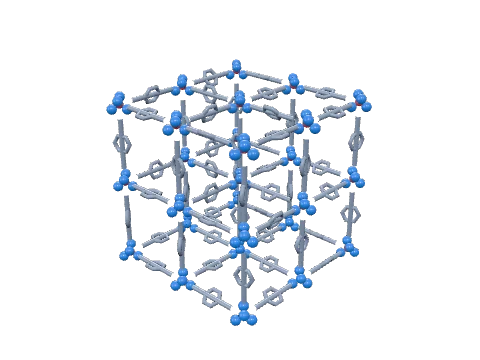
MOF-5 is built from two parts. The node is a Zn₄O cluster: one oxygen atom at the centre of a tetrahedron of four zinc atoms, each zinc also bound to three carboxylate oxygens. Six carboxylate groups cap the cluster, so it acts as an octahedral connector, the Zn₄O(CO₂)₆ secondary building unit (SBU).
The linker is terephthalate (BDC²⁻), a benzene ring with a carboxylate at each end. Each linker bridges two clusters, and each cluster takes six linkers, pointing along ±x, ±y and ±z. The result is the simplest three-dimensional net, pcu (primitive cubic): clusters at the corners of cubes 12.9 Å on a side, linkers along the edges.
The flat benzene rings face into some cavities and turn their edges to others, so the cubic cavities are not all equal: they alternate between about 12 Å and 15 Å across (Rowsell et al. 2005). Eight of these small cubes make up the crystallographic unit cell (cubic, Fm-3m, a ≈ 25.8 Å).
How MOF-5 is made
- Solvothermal synthesis. Zinc nitrate tetrahydrate and terephthalic acid are dissolved in N,N-diethylformamide (DEF) and heated in a closed vessel at about 85–105 °C (Eddaoudi et al. 2002). As the acid is slowly deprotonated, Zn₄O clusters form and colourless cubic crystals grow.
- Washing and solvent exchange. The crystals are washed and the DEF in the pores is exchanged for a more volatile solvent.
- Activation. The solvent is removed under vacuum, emptying the pores. MOF-5 reacts with water, so this and everything after it is done dry; crystals prepared and handled without air reach a BET surface area of about 3,800 m² g⁻¹ (Kaye et al. 2007).
Why MOF-5 matters
Before 1999, most open coordination frameworks collapsed when their guest solvent was removed. MOF-5 was reported as a framework that “remains crystalline … and stable when fully desolvated and when heated up to 300 °C” (Li et al. 1999), with a higher apparent surface area and pore volume than most zeolites. It showed that rigid clusters joined by rigid linkers give permanent porosity.
It also started reticular chemistry. Keeping the Zn₄O cluster and the pcu net but swapping BDC for longer or functionalised linkers gave the isoreticular series (IRMOFs), whose pore size and chemistry could be set by design; MOF-5 is IRMOF-1 (Eddaoudi et al. 2002).
Uses and research areas
- Gas storage. MOF-5 is a reference material for hydrogen and methane storage studies; how it is prepared and handled strongly changes its measured hydrogen uptake (Kaye et al. 2007), and the IRMOF series was designed with methane storage in mind (Eddaoudi et al. 2002).
- Adsorption science. X-ray studies located where argon and nitrogen sit in its pores (Rowsell et al. 2005), making it a model system for gas–framework interactions.
- Teaching and figures. Its simple cubic net makes it the standard example of a MOF in textbooks, reviews and graphical abstracts.
- Limitation. Its sensitivity to moisture rules it out where water is present; water-stable frameworks such as UiO-66 or ZIF-8 are used instead.
How to draw the MOF-5 structure
For a paper, slide or poster, show the three levels: the Zn₄O(CO₂)₆ cluster (often drawn as a blue tetrahedron or octahedron), one BDC linker, and a 2 × 2 × 2 block of the cubic net with a sphere marking a pore. The 2D figure above has all three and opens as an editable LabCanvas figure; the 3D model opens in the LabCanvas 3D Studio, where you can switch the clusters between atoms and polyhedra, change the linker, add guest molecules and export a high-resolution image.
MOF-5 compared with other well-known MOFs
| MOF | Formula | Metal node | Linker | Net | First report |
|---|---|---|---|---|---|
| MOF-5 (IRMOF-1) | Zn₄O(BDC)₃ | Zn₄O cluster | Terephthalate | pcu | Li et al., Nature 1999 |
| HKUST-1 | Cu₃(BTC)₂ | Cu₂ paddlewheel | Trimesate (BTC) | tbo | Chui et al., Science 1999 |
| ZIF-8 | Zn(mIm)₂ | Single Zn²⁺ (tetrahedral) | 2-Methylimidazolate | sod | Park et al., PNAS 2006 |
| UiO-66 | Zr₆O₄(OH)₄(BDC)₆ | Zr₆ cluster | Terephthalate | fcu | Cavka et al., JACS 2008 |
More on LabCanvas
- MOF-5: synthesis and structure: Editable figure template
- More MOF figure templates: Ready-made, cited figures to edit
- Crystal structure figure software compared: VESTA, Mercury, CrystalMaker, Avogadro and LabCanvas
- XRD Scherrer crystallite size calculator: Free tool
- Molar mass calculator: Free tool
- Journal figure size guide: Column widths and resolutions for 38 journals
- 3D models gallery: Turn MOFs, COFs and more in 3D
Frequently asked questions
What is MOF-5?
MOF-5 (IRMOF-1) is a metal–organic framework made of Zn₄O clusters joined by terephthalate linkers into a porous cubic network. Reported in 1999 by the Yaghi group, it is the classic example of a MOF with permanent porosity.
What is the chemical formula of MOF-5?
Zn₄O(BDC)₃, where BDC is 1,4-benzenedicarboxylate (terephthalate). Its molar mass is about 769.9 g/mol.
Why is MOF-5 called IRMOF-1?
It is the first member of the isoreticular MOF (IRMOF) series: frameworks with the same Zn₄O clusters and cubic net but different linkers, which changes the pore size and chemistry (Eddaoudi et al., Science 2002).
What is the surface area of MOF-5?
The first report gave a Langmuir surface area of 2,900 m²/g. Crystals made and handled without exposure to air reach a BET surface area of about 3,800 m²/g (Kaye et al., JACS 2007).
What is the topology of MOF-5?
pcu, the primitive cubic net: every Zn₄O cluster is linked to six others along the cube edges, 12.9 Å apart.
How big are the pores in MOF-5?
The cubic cavities alternate between about 12 Å and 15 Å across, because the flat benzene rings of the linkers face into some cavities and turn their edges to the others.
Is MOF-5 stable in water?
No. MOF-5 degrades in humid air and loses its porosity, so it must be stored and handled dry. It is thermally stable, though: it stays crystalline when emptied and heated to 300 °C.
How is MOF-5 synthesised?
Solvothermally: zinc nitrate and terephthalic acid in N,N-diethylformamide (DEF) heated in a closed vessel at about 85–105 °C, then washed, solvent-exchanged and activated under vacuum.
How can I draw MOF-5 for a paper or presentation?
Open the MOF-5 figure on this page in LabCanvas (free) to edit the cluster, linker and cubic net, or open the 3D model in the LabCanvas 3D Studio and export a render.
References
- H. Li, M. Eddaoudi, M. O’Keeffe, O. M. Yaghi. Design and synthesis of an exceptionally stable and highly porous metal-organic framework. Nature 1999, 402, 276–279. doi:10.1038/46248
- M. Eddaoudi et al.. Systematic design of pore size and functionality in isoreticular MOFs and their application in methane storage. Science 2002, 295, 469–472. doi:10.1126/science.1067208
- J. L. C. Rowsell et al.. Gas adsorption sites in a large-pore metal-organic framework. Science 2005, 309, 1350–1354. doi:10.1126/science.1113247
- S. S. Kaye, A. Dailly, O. M. Yaghi, J. R. Long. Impact of preparation and handling on the hydrogen storage properties of Zn₄O(1,4-benzenedicarboxylate)₃ (MOF-5). J. Am. Chem. Soc. 2007, 129, 14176–14177. doi:10.1021/ja076877g
- S. S.-Y. Chui et al.. A chemically functionalizable nanoporous material [Cu₃(TMA)₂(H₂O)₃]ₙ. Science 1999, 283, 1148–1150. doi:10.1126/science.283.5405.1148
- K. S. Park et al.. Exceptional chemical and thermal stability of zeolitic imidazolate frameworks. Proc. Natl. Acad. Sci. USA 2006, 103, 10186–10191. doi:10.1073/pnas.0602439103
- J. H. Cavka et al.. A new zirconium inorganic building brick forming metal organic frameworks with exceptional stability. J. Am. Chem. Soc. 2008, 130, 13850–13851. doi:10.1021/ja8057953
Draw MOF-5 for your paper or slides
LabCanvas is a browser workspace for scientific figures: framework clusters, linkers and nets, crystal structures in 2D and 3D, graphs and posters, all editable.
Edit the MOF-5 figure