Graphical abstract template · Metal–organic frameworks · Solvothermal synthesis · Bottom-up
MOF-5: synthesis and structure
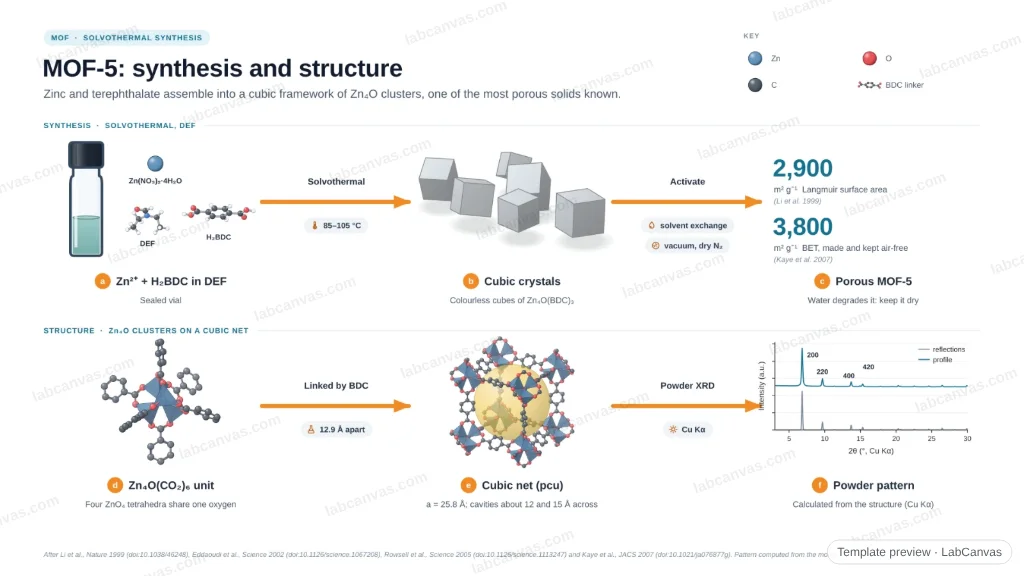
MOF-5 (IRMOF-1) is the prototypical metal–organic framework. Zinc nitrate and terephthalic acid heated in N,N-diethylformamide give colourless cubic crystals of Zn₄O(BDC)₃: octahedral Zn₄O(CO₂)₆ clusters joined by benzene links into a cubic net with cavities about 12 and 15 Å across. Emptied carefully and kept dry, it is one of the most porous solids known.
Updated 4 cited papers86 editable layers
At a glance
- Category
- Metal–organic frameworks
- Method
- Solvothermal synthesis
- Approach
- Bottom-up
- Starting materials
- Zinc nitrate tetrahydrate and terephthalic acid (H₂BDC) in N,N-diethylformamide (DEF)
- Product
- Colourless cubic crystals of Zn₄O(BDC)₃ (cubic, Fm-3m, a ≈ 25.8 Å)
- Key result
- Langmuir surface area 2,900 m² g⁻¹ (Li et al. 1999); BET 3,800 m² g⁻¹ when prepared and handled without air (Kaye et al. 2007)
- Figure
- 1920 × 1080 px (16:9), 86 editable layers, 12 generated objects
Step by step
- SolvothermalZn(NO₃)₂·4H₂O and H₂BDC in DEF, heated in a closed vessel at 85–105 °C (Eddaoudi et al. 2002)
- CrystalsCubic crystals grow as the acid is deprotonated and Zn₄O clusters form
- ActivationSolvent exchanged, then removed under vacuum; handled dry, since water degrades the framework (Kaye et al. 2007)
- StructureZn₄O(CO₂)₆ octahedra on a cubic (pcu) net, 12.9 Å apart; alternating cavities about 12 and 15 Å across (Rowsell et al. 2005)
Strengths
- Very high porosity from a simple, cheap linker
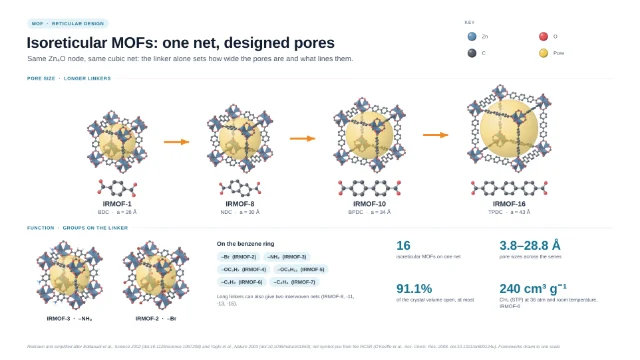
- The parent of the isoreticular IRMOF series
- Large single crystals
Limitations
- Sensitive to moisture: water attacks the Zn–carboxylate bonds
- Surface area depends strongly on handling
Uses
- Hydrogen and methane storage
- A model for reticular design
- Teaching MOF structure
Papers this template follows
- Li et al., “Design and synthesis of an exceptionally stable and highly porous metal-organic framework”, Nature 1999. doi:10.1038/46248primary
- Eddaoudi et al., “Systematic Design of Pore Size and Functionality in Isoreticular MOFs and Their Application in Methane Storage”, Science 2002. doi:10.1126/science.1067208method origin
- Rowsell et al., “Gas Adsorption Sites in a Large-Pore Metal-Organic Framework”, Science 2005. doi:10.1126/science.1113247further reading
- Kaye et al., “Impact of Preparation and Handling on the Hydrogen Storage Properties of Zn₄O(1,4-benzenedicarboxylate)₃ (MOF-5)”, J. Am. Chem. Soc. 2007. doi:10.1021/ja076877gfurther reading
After Li et al., Nature 1999 (doi:10.1038/46248), Eddaoudi et al., Science 2002 (doi:10.1126/science.1067208), Rowsell et al., Science 2005 (doi:10.1126/science.1113247) and Kaye et al., JACS 2007 (doi:10.1021/ja076877g). Pattern computed from the model.
How templates are written and checked: editorial guidelines.
Questions
What does the “MOF-5: synthesis and structure” template show?
MOF-5 (IRMOF-1) is the prototypical metal–organic framework. Zinc nitrate and terephthalic acid heated in N,N-diethylformamide give colourless cubic crystals of Zn₄O(BDC)₃: octahedral Zn₄O(CO₂)₆ clusters joined by benzene links into a cubic net with cavities about 12 and 15 Å across. Emptied carefully and kept dry, it is one of the most porous solids known.
What are the steps shown in “MOF-5: synthesis and structure”?
1. Solvothermal: Zn(NO₃)₂·4H₂O and H₂BDC in DEF, heated in a closed vessel at 85–105 °C (Eddaoudi et al. 2002). 2. Crystals: Cubic crystals grow as the acid is deprotonated and Zn₄O clusters form. 3. Activation: Solvent exchanged, then removed under vacuum; handled dry, since water degrades the framework (Kaye et al. 2007). 4. Structure: Zn₄O(CO₂)₆ octahedra on a cubic (pcu) net, 12.9 Å apart; alternating cavities about 12 and 15 Å across (Rowsell et al. 2005).
What are the starting materials and the product?
Starting materials: Zinc nitrate tetrahydrate and terephthalic acid (H₂BDC) in N,N-diethylformamide (DEF). Product: Colourless cubic crystals of Zn₄O(BDC)₃ (cubic, Fm-3m, a ≈ 25.8 Å).
Which papers is “MOF-5: synthesis and structure” based on?
Li et al., “Design and synthesis of an exceptionally stable and highly porous metal-organic framework”, Nature 1999 (doi:10.1038/46248); Eddaoudi et al., “Systematic Design of Pore Size and Functionality in Isoreticular MOFs and Their Application in Methane Storage”, Science 2002 (doi:10.1126/science.1067208); Rowsell et al., “Gas Adsorption Sites in a Large-Pore Metal-Organic Framework”, Science 2005 (doi:10.1126/science.1113247); Kaye et al., “Impact of Preparation and Handling on the Hydrogen Storage Properties of Zn₄O(1,4-benzenedicarboxylate)₃ (MOF-5)”, J. Am. Chem. Soc. 2007 (doi:10.1021/ja076877g).
Can I edit the “MOF-5: synthesis and structure” template?
Yes. Open it in the LabCanvas editor: all 86 layers are editable, including 12 generated objects (structures, plots, equipment) with their own settings. Change the text, colours and layout, then export PNG, TIFF, SVG or PDF.
Do I need an account to use this template?
Not to view it here. To open and edit it, sign in to LabCanvas or create a free account (the free plan keeps one design of each kind). Downloading the figure is part of LabCanvas Pro (US$19 a month or US$199 a year).