Graphical abstract template · Graphene research · Functionalisation
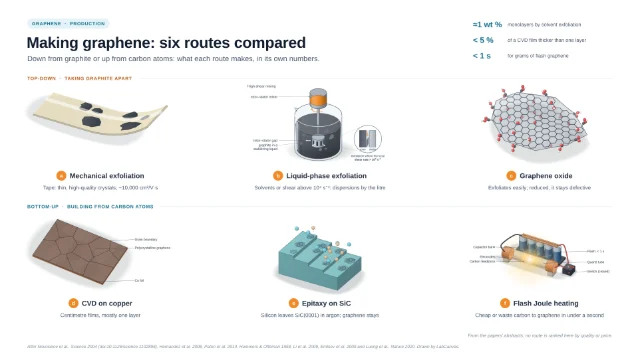
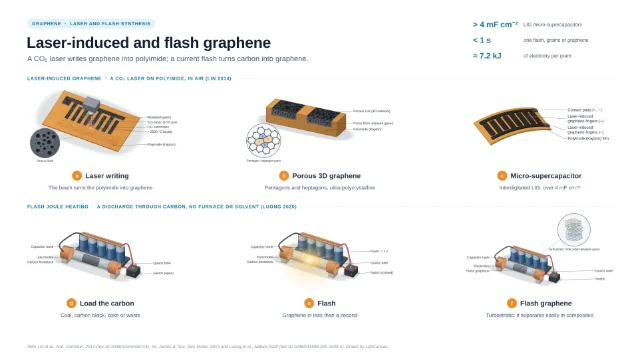
Functionalised graphene and 3D forms
Graphene chemistry and architecture in six panels: covalent nitrophenyl groups, fluorographene and noncovalent pyrenebutyrate on the sheet, and graphene foam grown on nickel, a graphene aerogel and crumpled graphene balls in 3D.
Updated 8 cited papers43 editable layers

At a glance
- Category
- Graphene research
- Method
- Functionalisation
- Starting materials
- Graphene, graphene oxide, nickel foam template
- Product
- Functionalised sheets and 3D graphene materials
- Key result
- Sheets and molecules drawn in 3D at real proportions: the C–C bond 1.42 Å, molecules built from their SMILES; foams, gels and balls are drawn schematically and not to scale
- Figure
- 1920 × 1080 px (16:9), 43 editable layers, 6 generated objects
Step by step
- Covalent: aryl groupsNitrophenyl groups added to the surface by covalent C–C bonds (Bekyarova et al. 2009)
- FluorographeneA fluorine atom on every carbon (Nair et al. 2010)
- Noncovalent: π stackingPyrenebutyrate stacked on the sheet, a noncovalent functionalisation that makes the sheets water-soluble (Xu et al. 2008); flat aromatic molecules drawn 3.35 Å above the sheet
- Graphene foamTemplate-directed CVD coats the struts of nickel foam with graphene; with the nickel etched away an interconnected, flexible graphene network remains (Chen et al. 2011)
- AerogelGO sheets cross-linked by sol–gel chemistry, supercritically dried and thermally reduced (Worsley et al. 2010)
- Crumpled ballsMade by capillary compression in rapidly evaporating aerosol droplets; held by folded, π–π stacked ridges (Luo et al. 2011)
Strengths
- Covalent groups anchor firmly; noncovalent ones leave the lattice intact
- 3D forms keep graphene’s surface accessible in a bulk material
Limitations
- Covalent bonding turns sp² carbons into sp³
- Pore sizes and densities of the 3D forms are drawn, not measured
Uses
- Dispersions and inks
- Sensors and biomedicine
- Electrodes, sorbents and composites
Papers this template follows
- Bekyarova et al., “Chemical modification of epitaxial graphene: spontaneous grafting of aryl groups”, J. Am. Chem. Soc. 2009. doi:10.1021/ja8057327primary
- Nair et al., “Fluorographene: a two-dimensional counterpart of Teflon”, Small 2010. doi:10.1002/smll.201001555primary
- Xu et al., “Flexible graphene films via the filtration of water-soluble noncovalent functionalized graphene sheets”, J. Am. Chem. Soc. 2008. doi:10.1021/ja800745yprimary
- Chen et al., “Three-dimensional flexible and conductive interconnected graphene networks grown by chemical vapour deposition”, Nat. Mater. 2011. doi:10.1038/nmat3001primary
- Worsley et al., “Synthesis of graphene aerogel with high electrical conductivity”, J. Am. Chem. Soc. 2010. doi:10.1021/ja1072299primary
- Luo et al., “Compression and aggregation-resistant particles of crumpled soft sheets”, ACS Nano 2011. doi:10.1021/nn203115uprimary
- Elias et al., “Control of graphene's properties by reversible hydrogenation: evidence for graphane”, Science 2009. doi:10.1126/science.1167130further reading
- Georgakilas et al., “Functionalization of graphene: covalent and non-covalent approaches, derivatives and applications”, Chem. Rev. 2012. doi:10.1021/cr3000412further reading
Drawn by LabCanvas at real proportions after Bekyarova et al., JACS 2009, Nair et al., Small 2010, Xu et al., JACS 2008, Chen et al., Nat. Mater. 2011 (doi:10.1038/nmat3001), Worsley et al., JACS 2010, Luo et al., ACS Nano 2011, and the papers in the details.
How templates are written and checked: editorial guidelines.
Questions
What does the “Functionalised graphene and 3D forms” template show?
Graphene chemistry and architecture in six panels: covalent nitrophenyl groups, fluorographene and noncovalent pyrenebutyrate on the sheet, and graphene foam grown on nickel, a graphene aerogel and crumpled graphene balls in 3D.
What are the steps shown in “Functionalised graphene and 3D forms”?
1. Covalent: aryl groups: Nitrophenyl groups added to the surface by covalent C–C bonds (Bekyarova et al. 2009). 2. Fluorographene: A fluorine atom on every carbon (Nair et al. 2010). 3. Noncovalent: π stacking: Pyrenebutyrate stacked on the sheet, a noncovalent functionalisation that makes the sheets water-soluble (Xu et al. 2008); flat aromatic molecules drawn 3.35 Å above the sheet. 4. Graphene foam: Template-directed CVD coats the struts of nickel foam with graphene; with the nickel etched away an interconnected, flexible graphene network remains (Chen et al. 2011). 5. Aerogel: GO sheets cross-linked by sol–gel chemistry, supercritically dried and thermally reduced (Worsley et al. 2010). 6. Crumpled balls: Made by capillary compression in rapidly evaporating aerosol droplets; held by folded, π–π stacked ridges (Luo et al. 2011).
What are the starting materials and the product?
Starting materials: Graphene, graphene oxide, nickel foam template. Product: Functionalised sheets and 3D graphene materials.
Which papers is “Functionalised graphene and 3D forms” based on?
Bekyarova et al., “Chemical modification of epitaxial graphene: spontaneous grafting of aryl groups”, J. Am. Chem. Soc. 2009 (doi:10.1021/ja8057327); Nair et al., “Fluorographene: a two-dimensional counterpart of Teflon”, Small 2010 (doi:10.1002/smll.201001555); Xu et al., “Flexible graphene films via the filtration of water-soluble noncovalent functionalized graphene sheets”, J. Am. Chem. Soc. 2008 (doi:10.1021/ja800745y); Chen et al., “Three-dimensional flexible and conductive interconnected graphene networks grown by chemical vapour deposition”, Nat. Mater. 2011 (doi:10.1038/nmat3001); Worsley et al., “Synthesis of graphene aerogel with high electrical conductivity”, J. Am. Chem. Soc. 2010 (doi:10.1021/ja1072299); Luo et al., “Compression and aggregation-resistant particles of crumpled soft sheets”, ACS Nano 2011 (doi:10.1021/nn203115u); Elias et al., “Control of graphene's properties by reversible hydrogenation: evidence for graphane”, Science 2009 (doi:10.1126/science.1167130); Georgakilas et al., “Functionalization of graphene: covalent and non-covalent approaches, derivatives and applications”, Chem. Rev. 2012 (doi:10.1021/cr3000412).
Can I edit the “Functionalised graphene and 3D forms” template?
Yes. Open it in the LabCanvas editor: all 43 layers are editable, including 6 generated objects (structures, plots, equipment) with their own settings. Change the text, colours and layout, then export PNG, TIFF, SVG or PDF.
Do I need an account to use this template?
Not to view it here. To open and edit it, sign in to LabCanvas or create a free account (the free plan keeps up to 3 designs). Downloading the figure is part of LabCanvas Pro (US$19 a month or US$199 a year).