Graphical abstract template · Graphene research · Synthesis routes
More ways to make graphene
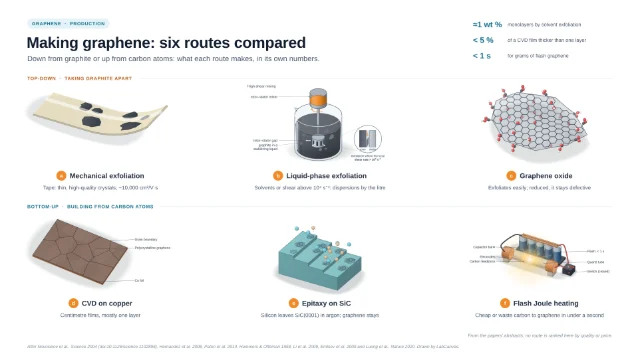
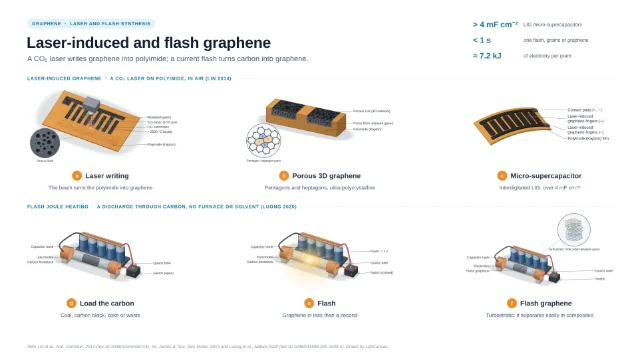
Six more routes to graphene: hot-wall against cold-wall CVD, plasma-enhanced CVD of vertical graphene, wafer-scale single crystals on Ge(110), nanoribbons by unzipping nanotubes, six ways to reduce graphene oxide, and graphite intercalation stages for exfoliation.
Updated 10 cited papers45 editable layers

At a glance
- Category
- Graphene research
- Method
- Synthesis routes
- Starting materials
- Methane and Cu foil, H-terminated Ge(110) on Si, multiwalled nanotubes, graphene oxide, graphite
- Product
- CVD films, vertical graphene, single crystals, nanoribbons, rGO and exfoliated flakes
- Key result
- Reactors, crystals, ribbons and stacks drawn in 3D after the cited papers; sizes drawn, not to scale
- Figure
- 1920 × 1080 px (16:9), 45 editable layers, 6 generated objects
Step by step
- Hot wall or cold wallHot-wall CVD heats Cu foil to about 1000 °C in a quartz tube furnace and can take a few hours; resistive-heating cold-wall CVD heats only the foil and made graphene of comparable quality 100 times faster and at 99 % lower cost, a run taking about 20 min against typically more than 70 min (Bointon et al. 2015)
- Plasma CVDIn microwave PECVD on Si(100), higher temperatures and plasma powers promoted vertical graphene and lowering them gave planar graphene (Meškinis et al. 2022); plasma power sets how much vertical graphene branches, temperature the thickness of each flake and time its height (Ma et al. 2019)
- Single crystal on Ge(110)The twofold symmetry of hydrogen-terminated Ge(110) aligns many seeds in one direction and they merge into single-crystal monolayer graphene; the weak interaction allows etch-free dry transfer and reuse of the Ge (Lee et al. 2014)
- Unzipping nanotubesA solution-based oxidative process cuts the side walls of multiwalled nanotubes lengthwise into nanoribbons in nearly 100 % yield; the ribbons are highly water-soluble and chemical reduction restores their conductivity (Kosynkin et al. 2009)
- Reducing GOChemical and thermal reduction are the most used at industrial scale; chemically reduced rGO typically reaches O/C 0.1–0.2 and 10–100 S/cm; plasma reduction at room temperature removes about as much oxygen as thermal reduction at 1000 °C (Li et al. 2024)
- Intercalation stagesA stage-n compound has one intercalant layer in every n-th interlayer; low-stage (≤ 2) compounds are key to high-yield exfoliation (Zhang et al. 2023); stage-2 LiC₁₂ exfoliated to bilayer graphene with 78 % selectivity (Zhu et al. 2024)
Strengths
- Cold-wall CVD saves time and cost (Bointon et al. 2015)
- Single crystals without grain boundaries (Lee et al. 2014)
- Ribbons and flakes in bulk from solution routes
Limitations
- Each route trades quality against scale
- Reduced GO keeps residual oxygen (Li et al. 2024)
Uses
- Choosing a production route
- Electrodes from vertical graphene and rGO
- Wafer-scale electronics
Papers this template follows
- Bointon, Barnes, Russo & Craciun, “High quality monolayer graphene synthesized by resistive heating cold wall chemical vapor deposition”, Adv. Mater. 2015. doi:10.1002/adma.201501600primary
- Meškinis et al., “The direct growth of planar and vertical graphene on Si(100) via microwave plasma chemical vapor deposition: synthesis conditions effects”, RSC Adv. 2022. doi:10.1039/d2ra02370aprimary
- Lee et al., “Wafer-scale growth of single-crystal monolayer graphene on reusable hydrogen-terminated germanium”, Science 2014. doi:10.1126/science.1252268primary
- Kosynkin et al., “Longitudinal unzipping of carbon nanotubes to form graphene nanoribbons”, Nature 2009. doi:10.1038/nature07872primary
- Li, Han, Qiu & Qian, “Plasma-assisted preparation of reduced graphene oxide and its applications in energy storage”, Nanomaterials 2024. doi:10.3390/nano14231922primary
- Zhang et al., “Producing bilayer graphene oxide via wedge ion-assisted anodic exfoliation: implications for energy and electronics”, ACS Appl. Nano Mater. 2023. doi:10.1021/acsanm.3c03284primary
- Ma et al., “Experimental investigation on vertically oriented graphene grown in a plasma-enhanced chemical vapor deposition process”, ACS Appl. Mater. Interfaces 2019. doi:10.1021/acsami.9b00896further reading
- Zhu et al., “Scalable synthesis of bilayer graphene at ambient temperature”, J. Am. Chem. Soc. 2024. doi:10.1021/jacs.4c00975further reading
- Mitra & Katiyar, “A review on flash sintering of graphene oxide films: mechanism and recent advances in the field”, Chem. Asian J. 2023. doi:10.1002/asia.202300369further reading
- Xu et al., “Ultrafast epitaxial growth of metre-sized single-crystal graphene on industrial Cu foil”, Sci. Bull. 2017. doi:10.1016/j.scib.2017.07.005further reading
Drawn by LabCanvas after Bointon et al., Adv. Mater. 2015 (doi:10.1002/adma.201501600), Meškinis et al., RSC Adv. 2022, Lee et al., Science 2014, Kosynkin et al., Nature 2009, Li et al., Nanomaterials 2024, Zhang et al., ACS Appl. Nano Mater. 2023, and the papers in the details.
How templates are written and checked: editorial guidelines.
Questions
What does the “More ways to make graphene” template show?
Six more routes to graphene: hot-wall against cold-wall CVD, plasma-enhanced CVD of vertical graphene, wafer-scale single crystals on Ge(110), nanoribbons by unzipping nanotubes, six ways to reduce graphene oxide, and graphite intercalation stages for exfoliation.
What are the steps shown in “More ways to make graphene”?
1. Hot wall or cold wall: Hot-wall CVD heats Cu foil to about 1000 °C in a quartz tube furnace and can take a few hours; resistive-heating cold-wall CVD heats only the foil and made graphene of comparable quality 100 times faster and at 99 % lower cost, a run taking about 20 min against typically more than 70 min (Bointon et al. 2015). 2. Plasma CVD: In microwave PECVD on Si(100), higher temperatures and plasma powers promoted vertical graphene and lowering them gave planar graphene (Meškinis et al. 2022); plasma power sets how much vertical graphene branches, temperature the thickness of each flake and time its height (Ma et al. 2019). 3. Single crystal on Ge(110): The twofold symmetry of hydrogen-terminated Ge(110) aligns many seeds in one direction and they merge into single-crystal monolayer graphene; the weak interaction allows etch-free dry transfer and reuse of the Ge (Lee et al. 2014). 4. Unzipping nanotubes: A solution-based oxidative process cuts the side walls of multiwalled nanotubes lengthwise into nanoribbons in nearly 100 % yield; the ribbons are highly water-soluble and chemical reduction restores their conductivity (Kosynkin et al. 2009). 5. Reducing GO: Chemical and thermal reduction are the most used at industrial scale; chemically reduced rGO typically reaches O/C 0.1–0.2 and 10–100 S/cm; plasma reduction at room temperature removes about as much oxygen as thermal reduction at 1000 °C (Li et al. 2024). 6. Intercalation stages: A stage-n compound has one intercalant layer in every n-th interlayer; low-stage (≤ 2) compounds are key to high-yield exfoliation (Zhang et al. 2023); stage-2 LiC₁₂ exfoliated to bilayer graphene with 78 % selectivity (Zhu et al. 2024).
What are the starting materials and the product?
Starting materials: Methane and Cu foil, H-terminated Ge(110) on Si, multiwalled nanotubes, graphene oxide, graphite. Product: CVD films, vertical graphene, single crystals, nanoribbons, rGO and exfoliated flakes.
Which papers is “More ways to make graphene” based on?
Bointon, Barnes, Russo & Craciun, “High quality monolayer graphene synthesized by resistive heating cold wall chemical vapor deposition”, Adv. Mater. 2015 (doi:10.1002/adma.201501600); Meškinis et al., “The direct growth of planar and vertical graphene on Si(100) via microwave plasma chemical vapor deposition: synthesis conditions effects”, RSC Adv. 2022 (doi:10.1039/d2ra02370a); Lee et al., “Wafer-scale growth of single-crystal monolayer graphene on reusable hydrogen-terminated germanium”, Science 2014 (doi:10.1126/science.1252268); Kosynkin et al., “Longitudinal unzipping of carbon nanotubes to form graphene nanoribbons”, Nature 2009 (doi:10.1038/nature07872); Li, Han, Qiu & Qian, “Plasma-assisted preparation of reduced graphene oxide and its applications in energy storage”, Nanomaterials 2024 (doi:10.3390/nano14231922); Zhang et al., “Producing bilayer graphene oxide via wedge ion-assisted anodic exfoliation: implications for energy and electronics”, ACS Appl. Nano Mater. 2023 (doi:10.1021/acsanm.3c03284); Ma et al., “Experimental investigation on vertically oriented graphene grown in a plasma-enhanced chemical vapor deposition process”, ACS Appl. Mater. Interfaces 2019 (doi:10.1021/acsami.9b00896); Zhu et al., “Scalable synthesis of bilayer graphene at ambient temperature”, J. Am. Chem. Soc. 2024 (doi:10.1021/jacs.4c00975); Mitra & Katiyar, “A review on flash sintering of graphene oxide films: mechanism and recent advances in the field”, Chem. Asian J. 2023 (doi:10.1002/asia.202300369); Xu et al., “Ultrafast epitaxial growth of metre-sized single-crystal graphene on industrial Cu foil”, Sci. Bull. 2017 (doi:10.1016/j.scib.2017.07.005).
Can I edit the “More ways to make graphene” template?
Yes. Open it in the LabCanvas editor: all 45 layers are editable, including 6 generated objects (structures, plots, equipment) with their own settings. Change the text, colours and layout, then export PNG, TIFF, SVG or PDF.
Do I need an account to use this template?
Not to view it here. To open and edit it, sign in to LabCanvas or create a free account (the free plan keeps up to 3 designs). Downloading the figure is part of LabCanvas Pro (US$19 a month or US$199 a year).