Graphical abstract template · Materials graphical abstracts · Graphical abstract
Sodium-ion batteries: abundant sodium, stored in hard carbon
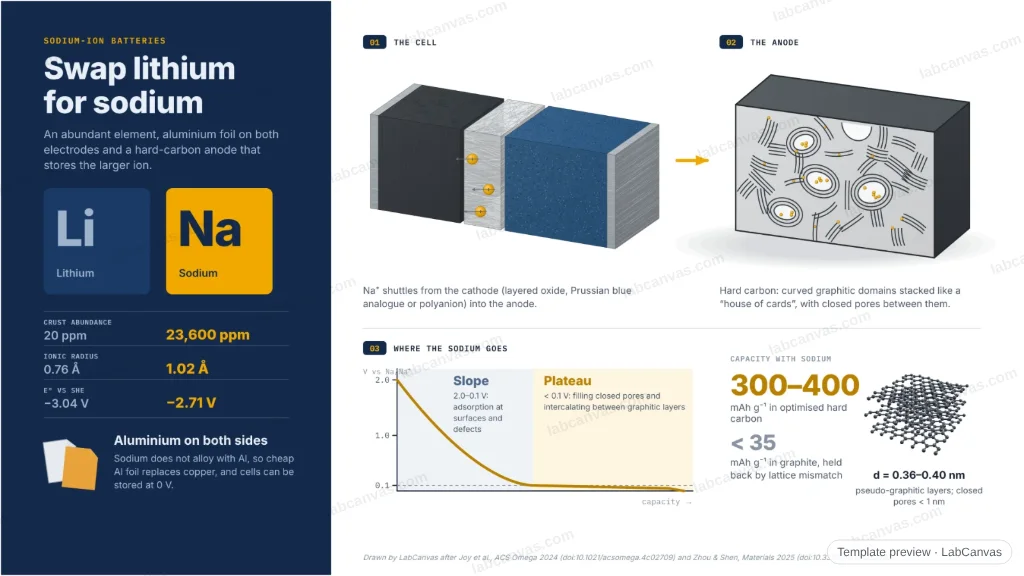
A split graphical abstract: a navy band makes the case for sodium against lithium (abundance, ion size, potential and the aluminium current collector), and the white field follows the sodium ion from the cell into hard carbon, where a sloping region of adsorption and a low-voltage plateau of pore filling and intercalation store it.
Updated 2 cited papers69 editable layers
At a glance
- Category
- Materials graphical abstracts
- Method
- Graphical abstract
- Starting materials
- Sodium: 23,600 ppm of the crust against 20 ppm for lithium
- Product
- A sodium-ion cell with a hard-carbon anode
- Key result
- Abundance 23,600 vs 20 ppm; ionic radius 1.02 vs 0.76 Å; E° −2.71 vs −3.04 V (Joy et al. 2024); hard carbon 300–400 mAh/g vs < 35 mAh/g for Na in graphite; slope 2.0–0.1 V, plateau < 0.1 V (Zhou & Shen 2025)
- Figure
- 1920 × 1080 px (16:9), 69 editable layers, 3 generated objects
Step by step
- Why sodiumCrustal abundance 23,600 ppm (Na) vs 20 ppm (Li); Na⁺ is larger (1.02 vs 0.76 Å) and its potential higher (−2.71 vs −3.04 V vs SHE) (Joy et al. 2024)
- Aluminium on both sidesSodium does not alloy with aluminium, so aluminium replaces copper; cells can be stored at 0 V (Joy et al. 2024)
- The cellNa⁺ moves between a layered-oxide, Prussian-blue-analogue or polyanionic cathode and the anode (Joy et al. 2024)
- Not graphite: hard carbonGraphite gives < 35 mAh/g with sodium; hard carbon, Stevens and Dahn's "house of cards", gives 300–400 mAh/g (Zhou & Shen 2025)
- Slope, then plateauFrom 2.0 to 0.1 V sodium adsorbs at surfaces and defects; below 0.1 V it fills closed pores (< 1 nm) and intercalates into pseudo-graphitic domains (d = 0.36–0.40 nm) (Zhou & Shen 2025)
Uses
- Graphical abstracts on sodium-ion batteries and hard carbon anodes
- Talks on post-lithium energy storage
- Teaching sodium storage mechanisms
Papers this template follows
- Joy et al., “A comprehensive review on strategies for enhancing the performance of polyanionic-based sodium-ion battery cathodes”, ACS Omega 2024. doi:10.1021/acsomega.4c02709review
- Zhou & Shen, “From sodium storage mechanism to design of high-capacity carbon-based anode: a review”, Materials 2025. doi:10.3390/ma18102248review
Drawn by LabCanvas after Joy et al., ACS Omega 2024 (doi:10.1021/acsomega.4c02709) and Zhou & Shen, Materials 2025 (doi:10.3390/ma18102248).
How templates are written and checked: editorial guidelines.
Questions
What does the “Sodium-ion batteries: abundant sodium, stored in hard carbon” template show?
A split graphical abstract: a navy band makes the case for sodium against lithium (abundance, ion size, potential and the aluminium current collector), and the white field follows the sodium ion from the cell into hard carbon, where a sloping region of adsorption and a low-voltage plateau of pore filling and intercalation store it.
What are the steps shown in “Sodium-ion batteries: abundant sodium, stored in hard carbon”?
1. Why sodium: Crustal abundance 23,600 ppm (Na) vs 20 ppm (Li); Na⁺ is larger (1.02 vs 0.76 Å) and its potential higher (−2.71 vs −3.04 V vs SHE) (Joy et al. 2024). 2. Aluminium on both sides: Sodium does not alloy with aluminium, so aluminium replaces copper; cells can be stored at 0 V (Joy et al. 2024). 3. The cell: Na⁺ moves between a layered-oxide, Prussian-blue-analogue or polyanionic cathode and the anode (Joy et al. 2024). 4. Not graphite: hard carbon: Graphite gives < 35 mAh/g with sodium; hard carbon, Stevens and Dahn's "house of cards", gives 300–400 mAh/g (Zhou & Shen 2025). 5. Slope, then plateau: From 2.0 to 0.1 V sodium adsorbs at surfaces and defects; below 0.1 V it fills closed pores (< 1 nm) and intercalates into pseudo-graphitic domains (d = 0.36–0.40 nm) (Zhou & Shen 2025).
What are the starting materials and the product?
Starting materials: Sodium: 23,600 ppm of the crust against 20 ppm for lithium. Product: A sodium-ion cell with a hard-carbon anode.
Which papers is “Sodium-ion batteries: abundant sodium, stored in hard carbon” based on?
Joy et al., “A comprehensive review on strategies for enhancing the performance of polyanionic-based sodium-ion battery cathodes”, ACS Omega 2024 (doi:10.1021/acsomega.4c02709); Zhou & Shen, “From sodium storage mechanism to design of high-capacity carbon-based anode: a review”, Materials 2025 (doi:10.3390/ma18102248).
Can I edit the “Sodium-ion batteries: abundant sodium, stored in hard carbon” template?
Yes. Open it in the LabCanvas editor: all 69 layers are editable, including 3 generated objects (structures, plots, equipment) with their own settings. Change the text, colours and layout, then export PNG, TIFF, SVG or PDF.
Do I need an account to use this template?
Not to view it here. To open and edit it, sign in to LabCanvas or create a free account (the free plan keeps up to 3 designs). Downloading the figure is part of LabCanvas Pro (US$19 a month or US$199 a year).