Graphical abstract template · Materials graphical abstracts · Graphical abstract
Supercapacitor electrodes: zooming in on ions in carbon pores
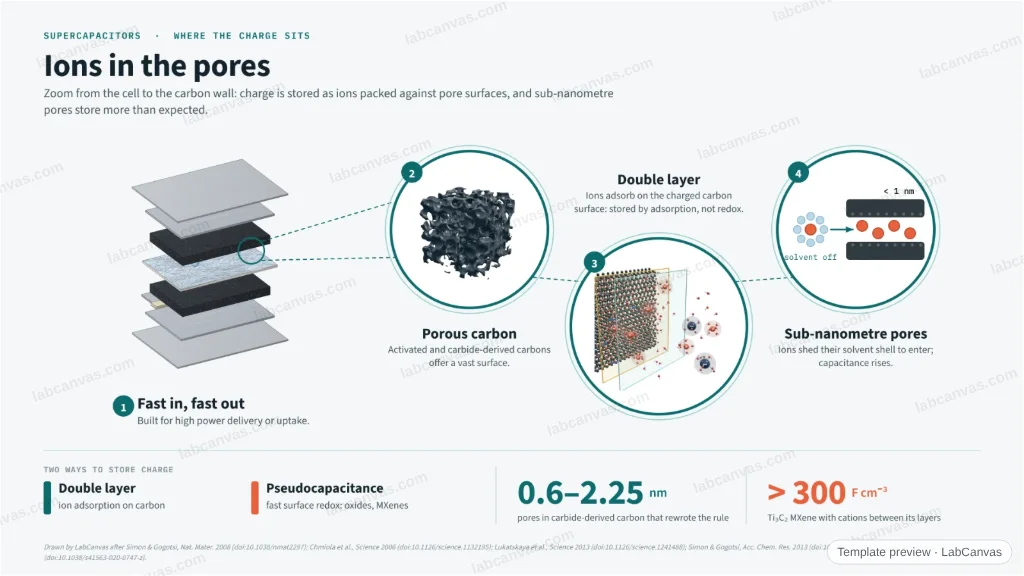
A zoom-in cascade from a supercapacitor cell to the porous carbon of its electrode, the double layer of ions on a charged wall, and a sub-nanometre pore where ions shed their solvent. A footer compares the two ways to store charge, ion adsorption and fast surface redox, with the pore sizes that changed the field and the volumetric capacitance of MXene.
Updated 5 cited papers90 editable layers
At a glance
- Category
- Materials graphical abstracts
- Method
- Graphical abstract
- Starting materials
- A supercapacitor cell with porous carbon electrodes
- Product
- Charge stored as ions on pore walls or by fast surface redox
- Key result
- Average pore sizes 0.6–2.25 nm in carbide-derived carbon (Chmiola et al. 2006); more than 300 F cm⁻³ for Ti3C2 MXene with intercalated cations (Lukatskaya et al. 2013)
- Figure
- 1920 × 1080 px (16:9), 90 editable layers, 1 generated objects
Step by step
- The cellElectrochemical capacitors deliver or take up energy at high power (Simon & Gogotsi 2008)
- Porous carbonActivated, carbide-derived and templated carbons with high surface areas make the electrodes (Simon & Gogotsi 2013)
- Double layerIons adsorb on the charged carbon surface: the double-layer capacitor (Simon & Gogotsi 2008)
- Sub-nanometre poresIn pores smaller than the solvated ions, ions shed their solvent and capacitance rises; carbide-derived carbons with pores of 0.6–2.25 nm showed it (Chmiola et al. 2006; Simon & Gogotsi 2008)
- Fast surface redoxPseudocapacitive oxides, nitrides, polymers and MXenes add redox charge; cations intercalated in Ti3C2 give more than 300 F cm⁻³ (Simon & Gogotsi 2008, 2020; Lukatskaya et al. 2013)
Uses
- Graphical abstracts on supercapacitor electrode materials
- Talks on double-layer and pseudocapacitive storage
- Teaching ion desolvation in nanopores
Papers this template follows
- Simon & Gogotsi, “Materials for electrochemical capacitors”, Nat. Mater. 2008. doi:10.1038/nmat2297review
- Chmiola et al., “Anomalous increase in carbon capacitance at pore sizes less than 1 nanometer”, Science 2006. doi:10.1126/science.1132195primary
- Lukatskaya et al., “Cation intercalation and high volumetric capacitance of two-dimensional titanium carbide”, Science 2013. doi:10.1126/science.1241488primary
- Simon & Gogotsi, “Capacitive energy storage in nanostructured carbon-electrolyte systems”, Acc. Chem. Res. 2013. doi:10.1021/ar200306breview
- Simon & Gogotsi, “Perspectives for electrochemical capacitors and related devices”, Nat. Mater. 2020. doi:10.1038/s41563-020-0747-zreview
Drawn by LabCanvas after Simon & Gogotsi, Nat. Mater. 2008 (doi:10.1038/nmat2297); Chmiola et al., Science 2006 (doi:10.1126/science.1132195); Lukatskaya et al., Science 2013 (doi:10.1126/science.1241488); Simon & Gogotsi, Acc. Chem. Res. 2013 (doi:10.1021/ar200306b) and Nat. Mater. 2020 (doi:10.1038/s41563-020-0747-z).
How templates are written and checked: editorial guidelines.
Questions
What does the “Supercapacitor electrodes: zooming in on ions in carbon pores” template show?
A zoom-in cascade from a supercapacitor cell to the porous carbon of its electrode, the double layer of ions on a charged wall, and a sub-nanometre pore where ions shed their solvent. A footer compares the two ways to store charge, ion adsorption and fast surface redox, with the pore sizes that changed the field and the volumetric capacitance of MXene.
What are the steps shown in “Supercapacitor electrodes: zooming in on ions in carbon pores”?
1. The cell: Electrochemical capacitors deliver or take up energy at high power (Simon & Gogotsi 2008). 2. Porous carbon: Activated, carbide-derived and templated carbons with high surface areas make the electrodes (Simon & Gogotsi 2013). 3. Double layer: Ions adsorb on the charged carbon surface: the double-layer capacitor (Simon & Gogotsi 2008). 4. Sub-nanometre pores: In pores smaller than the solvated ions, ions shed their solvent and capacitance rises; carbide-derived carbons with pores of 0.6–2.25 nm showed it (Chmiola et al. 2006; Simon & Gogotsi 2008). 5. Fast surface redox: Pseudocapacitive oxides, nitrides, polymers and MXenes add redox charge; cations intercalated in Ti3C2 give more than 300 F cm⁻³ (Simon & Gogotsi 2008, 2020; Lukatskaya et al. 2013).
What are the starting materials and the product?
Starting materials: A supercapacitor cell with porous carbon electrodes. Product: Charge stored as ions on pore walls or by fast surface redox.
Which papers is “Supercapacitor electrodes: zooming in on ions in carbon pores” based on?
Simon & Gogotsi, “Materials for electrochemical capacitors”, Nat. Mater. 2008 (doi:10.1038/nmat2297); Chmiola et al., “Anomalous increase in carbon capacitance at pore sizes less than 1 nanometer”, Science 2006 (doi:10.1126/science.1132195); Lukatskaya et al., “Cation intercalation and high volumetric capacitance of two-dimensional titanium carbide”, Science 2013 (doi:10.1126/science.1241488); Simon & Gogotsi, “Capacitive energy storage in nanostructured carbon-electrolyte systems”, Acc. Chem. Res. 2013 (doi:10.1021/ar200306b); Simon & Gogotsi, “Perspectives for electrochemical capacitors and related devices”, Nat. Mater. 2020 (doi:10.1038/s41563-020-0747-z).
Can I edit the “Supercapacitor electrodes: zooming in on ions in carbon pores” template?
Yes. Open it in the LabCanvas editor: all 90 layers are editable, including 1 generated objects (structures, plots, equipment) with their own settings. Change the text, colours and layout, then export PNG, TIFF, SVG or PDF.
Do I need an account to use this template?
Not to view it here. To open and edit it, sign in to LabCanvas or create a free account (the free plan keeps up to 3 designs). Downloading the figure is part of LabCanvas Pro (US$19 a month or US$199 a year).