Graphical abstract template · Materials graphical abstracts · Graphical abstract
Tough hydrogels: sacrificial bonds that break so the gel does not
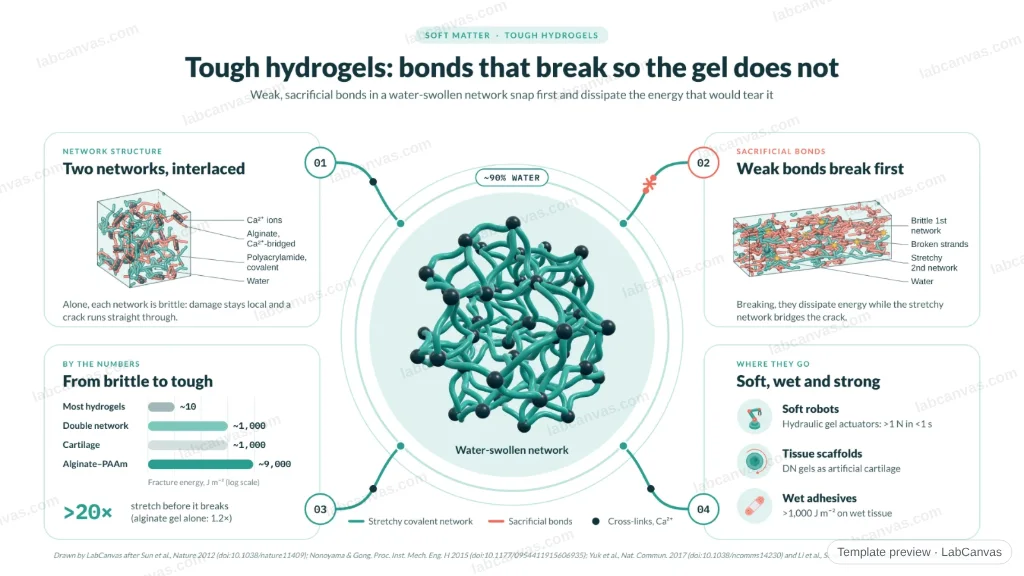
A radial graphical abstract on tough hydrogels: a live 3D water-swollen polymer network at the hub, with four satellites on its structure, the sacrificial-bond mechanism, the numbers and the uses. Ordinary gels are brittle; double-network and ionic–covalent hybrid gels add weak bonds that break first and dissipate energy, lifting the fracture energy from about 10 to about 9,000 J m⁻².
Updated 5 cited papers89 editable layers
At a glance
- Category
- Materials graphical abstracts
- Method
- Graphical abstract
- Starting materials
- A water-swollen polymer network, about 90% water
- Product
- A tough, highly stretchable hydrogel
- Key result
- Alginate–polyacrylamide: about 90% water, stretch beyond 20 (17 with a notch), fracture energy about 9,000 J m⁻², against about 10 J m⁻² for most hydrogels (Sun et al., Nature 2012)
- Figure
- 1920 × 1080 px (16:9), 89 editable layers, 5 generated objects
Step by step
- Network structureTwo interlaced networks: alginate held by Ca²⁺ ionic cross-links and polyacrylamide held by covalent cross-links, about 90% water
- Sacrificial bondsUnder stretch the weak bonds (the brittle first network, or the ionic cross-links) break first and dissipate energy while the stretchy network bridges the crack; ionic cross-links can re-zip
- The numbersFracture energy about 10 J m⁻² for most hydrogels, about 1,000 for double-network gels and cartilage, about 9,000 for alginate–polyacrylamide, which stretches beyond 20 times its length
- UsesHydraulic soft actuators and robots, scaffolds and artificial soft tissues, tough adhesives for wet surfaces
Uses
- Soft actuators and robots
- Tissue-engineering scaffolds and artificial cartilage
- Tough adhesives for wet tissue
- Teaching soft-matter toughening
Papers this template follows
- Sun et al., “Highly stretchable and tough hydrogels”, Nature 2012. doi:10.1038/nature11409primary
- Nonoyama & Gong, “Double-network hydrogel and its potential biomedical application: A review”, Proc. Inst. Mech. Eng. H 2015. doi:10.1177/0954411915606935review
- Nonoyama & Gong, “Tough Double Network Hydrogel and Its Biomedical Applications”, Annu. Rev. Chem. Biomol. Eng. 2021. doi:10.1146/annurev-chembioeng-101220-080338review
- Yuk et al., “Hydraulic hydrogel actuators and robots optically and sonically camouflaged in water”, Nat. Commun. 2017. doi:10.1038/ncomms14230further reading
- Li et al., “Tough adhesives for diverse wet surfaces”, Science 2017. doi:10.1126/science.aah6362further reading
Drawn by LabCanvas after Sun et al., Nature 2012 (doi:10.1038/nature11409); Nonoyama & Gong, Proc. Inst. Mech. Eng. H 2015 (doi:10.1177/0954411915606935); Yuk et al., Nat. Commun. 2017 (doi:10.1038/ncomms14230) and Li et al., Science 2017 (doi:10.1126/science.aah6362).
How templates are written and checked: editorial guidelines.
Questions
What does the “Tough hydrogels: sacrificial bonds that break so the gel does not” template show?
A radial graphical abstract on tough hydrogels: a live 3D water-swollen polymer network at the hub, with four satellites on its structure, the sacrificial-bond mechanism, the numbers and the uses. Ordinary gels are brittle; double-network and ionic–covalent hybrid gels add weak bonds that break first and dissipate energy, lifting the fracture energy from about 10 to about 9,000 J m⁻².
What are the steps shown in “Tough hydrogels: sacrificial bonds that break so the gel does not”?
1. Network structure: Two interlaced networks: alginate held by Ca²⁺ ionic cross-links and polyacrylamide held by covalent cross-links, about 90% water. 2. Sacrificial bonds: Under stretch the weak bonds (the brittle first network, or the ionic cross-links) break first and dissipate energy while the stretchy network bridges the crack; ionic cross-links can re-zip. 3. The numbers: Fracture energy about 10 J m⁻² for most hydrogels, about 1,000 for double-network gels and cartilage, about 9,000 for alginate–polyacrylamide, which stretches beyond 20 times its length. 4. Uses: Hydraulic soft actuators and robots, scaffolds and artificial soft tissues, tough adhesives for wet surfaces.
What are the starting materials and the product?
Starting materials: A water-swollen polymer network, about 90% water. Product: A tough, highly stretchable hydrogel.
Which papers is “Tough hydrogels: sacrificial bonds that break so the gel does not” based on?
Sun et al., “Highly stretchable and tough hydrogels”, Nature 2012 (doi:10.1038/nature11409); Nonoyama & Gong, “Double-network hydrogel and its potential biomedical application: A review”, Proc. Inst. Mech. Eng. H 2015 (doi:10.1177/0954411915606935); Nonoyama & Gong, “Tough Double Network Hydrogel and Its Biomedical Applications”, Annu. Rev. Chem. Biomol. Eng. 2021 (doi:10.1146/annurev-chembioeng-101220-080338); Yuk et al., “Hydraulic hydrogel actuators and robots optically and sonically camouflaged in water”, Nat. Commun. 2017 (doi:10.1038/ncomms14230); Li et al., “Tough adhesives for diverse wet surfaces”, Science 2017 (doi:10.1126/science.aah6362).
Can I edit the “Tough hydrogels: sacrificial bonds that break so the gel does not” template?
Yes. Open it in the LabCanvas editor: all 89 layers are editable, including 5 generated objects (structures, plots, equipment) with their own settings. Change the text, colours and layout, then export PNG, TIFF, SVG or PDF.
Do I need an account to use this template?
Not to view it here. To open and edit it, sign in to LabCanvas or create a free account (the free plan keeps up to 3 designs). Downloading the figure is part of LabCanvas Pro (US$19 a month or US$199 a year).