Graphical abstract template · Materials graphical abstracts · Graphical abstract
Fibre-reinforced composites: from layup to strength
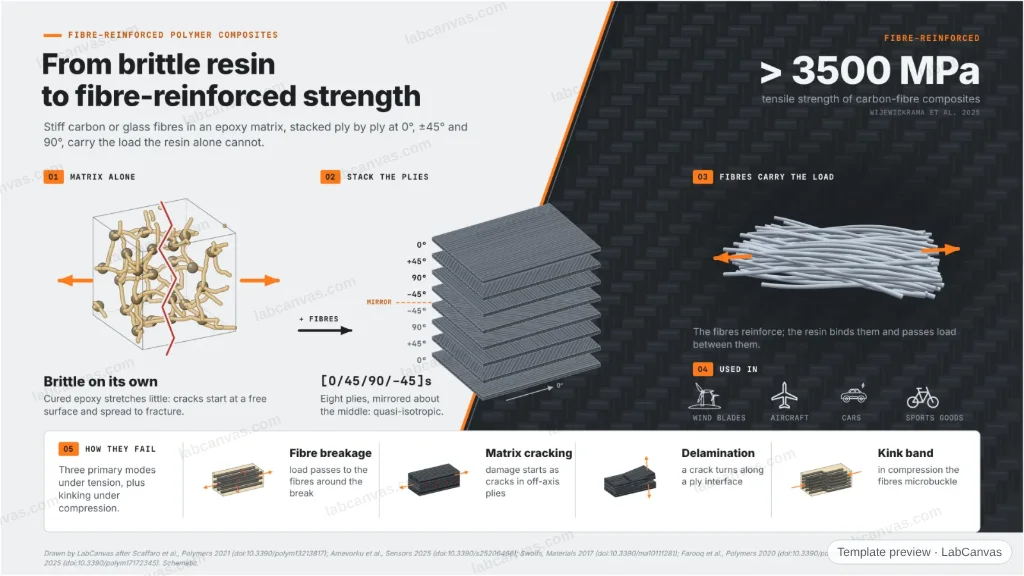
A split-screen graphical abstract: on one side a brittle epoxy matrix that cracks, on the other stiff carbon fibres that carry the load. An exploded quasi-isotropic laminate, plies at 0°, 45°, 90° and −45°, spans the divide, and a strip along the bottom shows how laminates fail: fibre breakage, matrix cracking, delamination and kinking.
Updated 9 cited papers87 editable layers
At a glance
- Category
- Materials graphical abstracts
- Method
- Graphical abstract
- Starting materials
- Carbon or glass fibres and an epoxy resin (unidirectional prepreg plies)
- Product
- A quasi-isotropic laminate [0/45/90/−45]s whose fibres carry the load
- Key result
- Carbon-fibre composites reach tensile strengths above 3500 MPa (Wijewickrama et al., Polymers 2025)
- Figure
- 1920 × 1080 px (16:9), 87 editable layers, 8 generated objects
Step by step
- The matrix aloneCured epoxy is brittle with low elongation; cracks start at free surfaces and spread to fracture (Farooq et al. 2020)
- Stack the pliesUnidirectional plies at 0°, +45°, 90° and −45°, mirrored about the mid-plane: an eight-ply quasi-isotropic layup (Gupta & Rajagopal 2018)
- Fibres carry the loadThe fibres are the main load-carrying member (Khan et al. 2023); the resin binds them, protects them and passes load between them (Scaffaro et al. 2021; Kennedy et al. 2024)
- UsesWind-turbine blades, aircraft, cars and sporting goods (Swolfs 2017; Scaffaro et al. 2021; Elgnemi et al. 2021)
- How they failFibre breakage, matrix cracking and delamination under tension (Amevorku et al. 2025); microbuckling and kinking under compression (Swolfs 2017)
Uses
- Wind-turbine blades
- Aircraft structures
- Car parts
- Sporting goods
- Teaching composite mechanics
Papers this template follows
- Scaffaro, Di Bartolo & Dintcheva, “Matrix and Filler Recycling of Carbon and Glass Fiber-Reinforced Polymer Composites: A Review”, Polymers 2021. doi:10.3390/polym13213817review
- Amevorku, Amoateng-Mensah, Rijal & Sundaresan, “Classification and Clustering of Fiber Break Events in Thermoset CFRP Using Acoustic Emission and Machine Learning”, Sensors 2025. doi:10.3390/s25206466primary
- Swolfs, “Perspective for Fibre-Hybrid Composites in Wind Energy Applications”, Materials 2017. doi:10.3390/ma10111281review
- Farooq, Teuwen & Dransfeld, “Toughening of Epoxy Systems with Interpenetrating Polymer Network (IPN): A Review”, Polymers 2020. doi:10.3390/polym12091908review
- Wijewickrama, Jeewantha, Perera, Alajarmeh & Epaarachchi, “Fiber-Reinforced Composites Used in the Manufacture of Marine Decks: A Review”, Polymers 2025. doi:10.3390/polym17172345review
- Kennedy, Jeen Robert, Malkiya Rasalin Prince, Hikku & Kaliraj, “A comprehensive overview of the fabrication and testing methods of FRP composite pipes”, MethodsX 2024. doi:10.1016/j.mex.2024.102990review
- Gupta & Rajagopal, “Effect of ply orientation and through-thickness position of delamination on the reflection of fundamental symmetric S0 Lamb mode in GFRP composite plate structures”, Ultrasonics 2018. doi:10.1016/j.ultras.2018.06.007primary
- Khan, Junaedi, Alshahrani, Wagih, Lubineau & Sebaey, “Enhanced Open-Hole Strength and Toughness of Sandwich Carbon-Kevlar Woven Composite Laminates”, Polymers 2023. doi:10.3390/polym15102276further reading
- Elgnemi, Jun, Songmene & Samuel, “Milling Performance of CFRP Composite and Atomised Vegetable Oil as a Function of Fiber Orientation”, Materials 2021. doi:10.3390/ma14082062further reading
Drawn by LabCanvas after Scaffaro et al., Polymers 2021 (doi:10.3390/polym13213817); Amevorku et al., Sensors 2025 (doi:10.3390/s25206466); Swolfs, Materials 2017 (doi:10.3390/ma10111281); Farooq et al., Polymers 2020 (doi:10.3390/polym12091908); Wijewickrama et al., Polymers 2025 (doi:10.3390/polym17172345). Schematic.
How templates are written and checked: editorial guidelines.
Questions
What does the “Fibre-reinforced composites: from layup to strength” template show?
A split-screen graphical abstract: on one side a brittle epoxy matrix that cracks, on the other stiff carbon fibres that carry the load. An exploded quasi-isotropic laminate, plies at 0°, 45°, 90° and −45°, spans the divide, and a strip along the bottom shows how laminates fail: fibre breakage, matrix cracking, delamination and kinking.
What are the steps shown in “Fibre-reinforced composites: from layup to strength”?
1. The matrix alone: Cured epoxy is brittle with low elongation; cracks start at free surfaces and spread to fracture (Farooq et al. 2020). 2. Stack the plies: Unidirectional plies at 0°, +45°, 90° and −45°, mirrored about the mid-plane: an eight-ply quasi-isotropic layup (Gupta & Rajagopal 2018). 3. Fibres carry the load: The fibres are the main load-carrying member (Khan et al. 2023); the resin binds them, protects them and passes load between them (Scaffaro et al. 2021; Kennedy et al. 2024). 4. Uses: Wind-turbine blades, aircraft, cars and sporting goods (Swolfs 2017; Scaffaro et al. 2021; Elgnemi et al. 2021). 5. How they fail: Fibre breakage, matrix cracking and delamination under tension (Amevorku et al. 2025); microbuckling and kinking under compression (Swolfs 2017).
What are the starting materials and the product?
Starting materials: Carbon or glass fibres and an epoxy resin (unidirectional prepreg plies). Product: A quasi-isotropic laminate [0/45/90/−45]s whose fibres carry the load.
Which papers is “Fibre-reinforced composites: from layup to strength” based on?
Scaffaro, Di Bartolo & Dintcheva, “Matrix and Filler Recycling of Carbon and Glass Fiber-Reinforced Polymer Composites: A Review”, Polymers 2021 (doi:10.3390/polym13213817); Amevorku, Amoateng-Mensah, Rijal & Sundaresan, “Classification and Clustering of Fiber Break Events in Thermoset CFRP Using Acoustic Emission and Machine Learning”, Sensors 2025 (doi:10.3390/s25206466); Swolfs, “Perspective for Fibre-Hybrid Composites in Wind Energy Applications”, Materials 2017 (doi:10.3390/ma10111281); Farooq, Teuwen & Dransfeld, “Toughening of Epoxy Systems with Interpenetrating Polymer Network (IPN): A Review”, Polymers 2020 (doi:10.3390/polym12091908); Wijewickrama, Jeewantha, Perera, Alajarmeh & Epaarachchi, “Fiber-Reinforced Composites Used in the Manufacture of Marine Decks: A Review”, Polymers 2025 (doi:10.3390/polym17172345); Kennedy, Jeen Robert, Malkiya Rasalin Prince, Hikku & Kaliraj, “A comprehensive overview of the fabrication and testing methods of FRP composite pipes”, MethodsX 2024 (doi:10.1016/j.mex.2024.102990); Gupta & Rajagopal, “Effect of ply orientation and through-thickness position of delamination on the reflection of fundamental symmetric S0 Lamb mode in GFRP composite plate structures”, Ultrasonics 2018 (doi:10.1016/j.ultras.2018.06.007); Khan, Junaedi, Alshahrani, Wagih, Lubineau & Sebaey, “Enhanced Open-Hole Strength and Toughness of Sandwich Carbon-Kevlar Woven Composite Laminates”, Polymers 2023 (doi:10.3390/polym15102276); Elgnemi, Jun, Songmene & Samuel, “Milling Performance of CFRP Composite and Atomised Vegetable Oil as a Function of Fiber Orientation”, Materials 2021 (doi:10.3390/ma14082062).
Can I edit the “Fibre-reinforced composites: from layup to strength” template?
Yes. Open it in the LabCanvas editor: all 87 layers are editable, including 8 generated objects (structures, plots, equipment) with their own settings. Change the text, colours and layout, then export PNG, TIFF, SVG or PDF.
Do I need an account to use this template?
Not to view it here. To open and edit it, sign in to LabCanvas or create a free account (the free plan keeps up to 3 designs). Downloading the figure is part of LabCanvas Pro (US$19 a month or US$199 a year).