Graphical abstract template · MOF guides · Activation and shaping
Activating and shaping MOFs
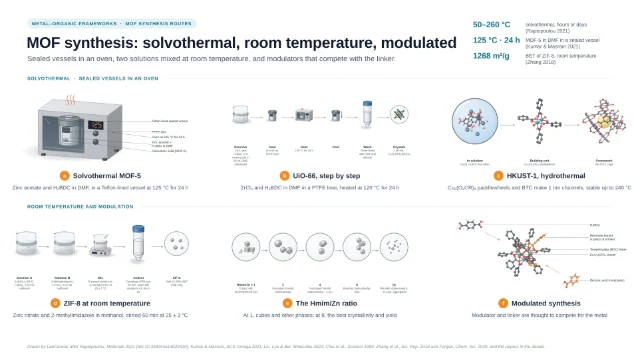
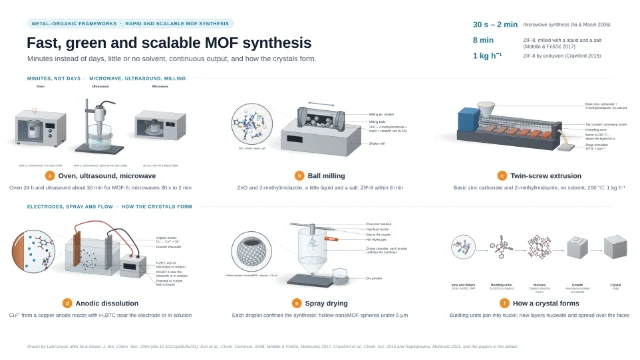
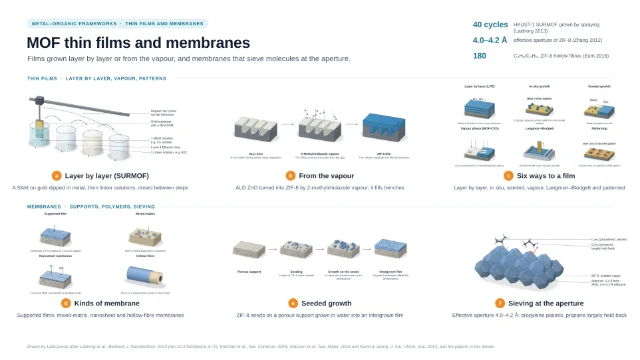
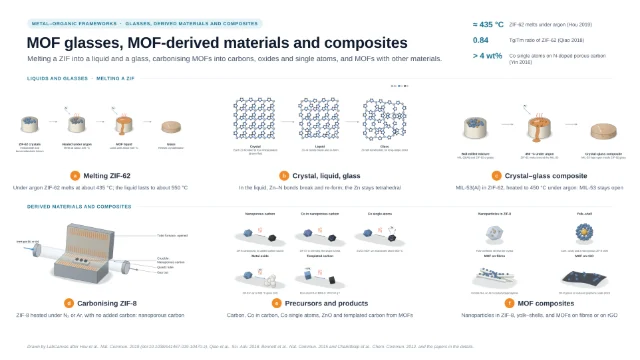
MOF activation and shaping on one page: solvent exchange followed by heating under vacuum, the three ways to empty the pores (vacuum, supercritical CO₂, freeze-drying), pore collapse as the solvent leaves, and the shaped forms (pellets, extrudates, granules, sol–gel and 3D-printed monoliths), what lies inside them and a dense sol–gel monolith. Every step and number is quoted from the cited papers.
Updated 10 cited papers45 editable layers

At a glance
- Category
- MOF guides
- Method
- Activation and shaping
- Starting materials
- As-synthesised MOF crystals with solvent-filled pores; exchange solvents, supercritical CO₂; binders such as polyvinyl butyral
- Product
- Activated MOF powders, pellets, extrudates, granules and sol–gel or 3D-printed monoliths
- Key result
- Ovens, vessels, pores and shaped bodies drawn by LabCanvas from the cited papers; sizes, counts and colours that no paper fixes are settings, and no panel is a micrograph or an isotherm
- Figure
- 1920 × 1080 px (16:9), 45 editable layers, 6 generated objects
Step by step
- Exchange, then vacuumOn heating, ZIF-4 first releases the framework-templating N,N-dimethylformamide (DMF), which does not make the framework collapse (Bennett 2015). Solvent exchange is fast: minutes rather than days suit many MOFs, and with a very low surface tension solvent such as n-hexane or perfluoropentane, MOFs that had failed to activate reach their predicted surface areas (Ma 2017). As-made ZIF-62 crystals, for example, were washed with DMF and dichloromethane and dried in a vacuum oven at 150 °C for 24 h (Hou 2019)
- Three ways to empty poresMonolithic and powdered MOFs were fully activated by heating under vacuum before their porosity was measured (Madden 2021). Processing four MOFs with liquid and supercritical CO₂ raised their gas-accessible surface area substantially, in some cases by up to 1200%; preliminary evidence points to inhibited mesopore collapse as the reason (Nelson 2009). Freeze-drying significantly increased the permanent porosity and hydrogen uptake of 4,4-connected MOFs (Ma 2009)
- Pore collapseRemoving the synthesis solvent from the pores without damaging the framework is often a challenge; supercritical CO₂ activates the solvent-filled pores mildly and efficiently (Farha & Hupp 2010). MOFs that had failed to activate reached their predicted surface areas after exchange into a very low surface tension solvent such as n-hexane or perfluoropentane (Ma 2017)
- Five shaped formsShaping MOF powders into bodies of the desired size, shape, density and mechanical stability keeps pressure drops low and volumetric capacity high in adsorption columns (Madden 2021). Shaped MIL-100(Fe) granules with a 5% polyvinyl butyral binder had less surface area, pore volume and water uptake than the powder, but more mechanical strength and faster adsorption (Chen 2024). 3D-printed (robocast) MOF-74(Ni) and UTSA-16(Co) monoliths held 80 and 85 wt% MOF and took up 79% and 87% of the CO₂ of the powders at 5000 ppm CO₂ and 25 °C (Thakkar 2017)
- Inside the bodyExtrudates made at low pressure have low bulk densities because of large voids; in powder pressing the crystals are prone to collapse under high pressure, leaving crumple zones of amorphous material: dense pellets with much less porosity (Madden 2021). High-pressure pelletisation or binders are conventionally used to shape MOF powders but have been shown to decrease the material’s efficacy significantly (Hou 2019)
- A sol–gel monolithMonolithic HKUST-1 has a bulk density of 1.06 g cm⁻³, the powder 0.5 g cm⁻³: in the sol–gel synthesis the crystallites pack closely (Madden 2021). A sol–gel monolithic MOF, packed and densified, reached a methane capacity of 259 cm³(STP) cm⁻³, the highest then reported for conformed-shape porous solids, and was at least 130% harder than conventional MOF counterparts (Tian 2018)
Strengths
- Supercritical CO₂ raised gas-accessible surface areas, in some cases by up to 1200% (Nelson 2009)
- Binder-shaped granules gained mechanical strength and faster adsorption (Chen 2024)
- A sol–gel monolith was at least 130% harder than conventional MOF counterparts (Tian 2018)
Limitations
- Removing the synthesis solvent without damaging the framework is often a challenge (Farha & Hupp 2010)
- Pressing at high pressure leaves amorphous crumple zones and much less porosity (Madden 2021)
- Pelletisation or binders have been shown to decrease a MOF’s efficacy significantly (Hou 2019)
Papers this template follows
- Bennett et al., “Hybrid glasses from strong and fragile metal-organic framework liquids”, Nat. Commun. 2015. doi:10.1038/ncomms9079primary
- Ma et al., “Rapid guest exchange and ultra-low surface tension solvents optimize metal-organic framework activation”, Angew. Chem. Int. Ed. 2017. doi:10.1002/anie.201709187primary
- Hou et al., “Metal-organic framework crystal-glass composites”, Nat. Commun. 2019. doi:10.1038/s41467-019-10470-zprimary
- Madden et al., “Monolithic metal-organic frameworks for carbon dioxide separation”, Faraday Discuss. 2021. doi:10.1039/d1fd00017aprimary
- Nelson et al., “Supercritical processing as a route to high internal surface areas and permanent microporosity in metal-organic framework materials”, J. Am. Chem. Soc. 2009. doi:10.1021/ja808853qprimary
- Ma et al., “Freeze drying significantly increases permanent porosity and hydrogen uptake in 4,4-connected metal-organic frameworks”, Angew. Chem. Int. Ed. 2009. doi:10.1002/anie.200904983primary
- Farha & Hupp, “Rational design, synthesis, purification, and activation of metal-organic framework materials”, Acc. Chem. Res. 2010. doi:10.1021/ar1000617primary
- Chen et al., “Development of shaped MIL-100(Fe) granules for high-performing adsorption desalination: from formulation optimization to system test”, Chem Bio Eng. 2024. doi:10.1021/cbe.4c00008primary
- Thakkar et al., “3D-printed metal-organic framework monoliths for gas adsorption processes”, ACS Appl. Mater. Interfaces 2017. doi:10.1021/acsami.7b11626primary
- Tian et al., “A sol-gel monolithic metal-organic framework with enhanced methane uptake”, Nat. Mater. 2018. doi:10.1038/nmat5050primary
Drawn by LabCanvas after Farha & Hupp, Acc. Chem. Res. 2010 (doi:10.1021/ar1000617), Nelson et al., J. Am. Chem. Soc. 2009, Ma et al., Angew. Chem. Int. Ed. 2017 and Ma et al., Angew. Chem. Int. Ed. 2009, and the papers in the details.
How templates are written and checked: editorial guidelines.
Questions
What does the “Activating and shaping MOFs” template show?
MOF activation and shaping on one page: solvent exchange followed by heating under vacuum, the three ways to empty the pores (vacuum, supercritical CO₂, freeze-drying), pore collapse as the solvent leaves, and the shaped forms (pellets, extrudates, granules, sol–gel and 3D-printed monoliths), what lies inside them and a dense sol–gel monolith. Every step and number is quoted from the cited papers.
What are the steps shown in “Activating and shaping MOFs”?
1. Exchange, then vacuum: On heating, ZIF-4 first releases the framework-templating N,N-dimethylformamide (DMF), which does not make the framework collapse (Bennett 2015). Solvent exchange is fast: minutes rather than days suit many MOFs, and with a very low surface tension solvent such as n-hexane or perfluoropentane, MOFs that had failed to activate reach their predicted surface areas (Ma 2017). As-made ZIF-62 crystals, for example, were washed with DMF and dichloromethane and dried in a vacuum oven at 150 °C for 24 h (Hou 2019). 2. Three ways to empty pores: Monolithic and powdered MOFs were fully activated by heating under vacuum before their porosity was measured (Madden 2021). Processing four MOFs with liquid and supercritical CO₂ raised their gas-accessible surface area substantially, in some cases by up to 1200%; preliminary evidence points to inhibited mesopore collapse as the reason (Nelson 2009). Freeze-drying significantly increased the permanent porosity and hydrogen uptake of 4,4-connected MOFs (Ma 2009). 3. Pore collapse: Removing the synthesis solvent from the pores without damaging the framework is often a challenge; supercritical CO₂ activates the solvent-filled pores mildly and efficiently (Farha & Hupp 2010). MOFs that had failed to activate reached their predicted surface areas after exchange into a very low surface tension solvent such as n-hexane or perfluoropentane (Ma 2017). 4. Five shaped forms: Shaping MOF powders into bodies of the desired size, shape, density and mechanical stability keeps pressure drops low and volumetric capacity high in adsorption columns (Madden 2021). Shaped MIL-100(Fe) granules with a 5% polyvinyl butyral binder had less surface area, pore volume and water uptake than the powder, but more mechanical strength and faster adsorption (Chen 2024). 3D-printed (robocast) MOF-74(Ni) and UTSA-16(Co) monoliths held 80 and 85 wt% MOF and took up 79% and 87% of the CO₂ of the powders at 5000 ppm CO₂ and 25 °C (Thakkar 2017). 5. Inside the body: Extrudates made at low pressure have low bulk densities because of large voids; in powder pressing the crystals are prone to collapse under high pressure, leaving crumple zones of amorphous material: dense pellets with much less porosity (Madden 2021). High-pressure pelletisation or binders are conventionally used to shape MOF powders but have been shown to decrease the material’s efficacy significantly (Hou 2019). 6. A sol–gel monolith: Monolithic HKUST-1 has a bulk density of 1.06 g cm⁻³, the powder 0.5 g cm⁻³: in the sol–gel synthesis the crystallites pack closely (Madden 2021). A sol–gel monolithic MOF, packed and densified, reached a methane capacity of 259 cm³(STP) cm⁻³, the highest then reported for conformed-shape porous solids, and was at least 130% harder than conventional MOF counterparts (Tian 2018).
What are the starting materials and the product?
Starting materials: As-synthesised MOF crystals with solvent-filled pores; exchange solvents, supercritical CO₂; binders such as polyvinyl butyral. Product: Activated MOF powders, pellets, extrudates, granules and sol–gel or 3D-printed monoliths.
Which papers is “Activating and shaping MOFs” based on?
Bennett et al., “Hybrid glasses from strong and fragile metal-organic framework liquids”, Nat. Commun. 2015 (doi:10.1038/ncomms9079); Ma et al., “Rapid guest exchange and ultra-low surface tension solvents optimize metal-organic framework activation”, Angew. Chem. Int. Ed. 2017 (doi:10.1002/anie.201709187); Hou et al., “Metal-organic framework crystal-glass composites”, Nat. Commun. 2019 (doi:10.1038/s41467-019-10470-z); Madden et al., “Monolithic metal-organic frameworks for carbon dioxide separation”, Faraday Discuss. 2021 (doi:10.1039/d1fd00017a); Nelson et al., “Supercritical processing as a route to high internal surface areas and permanent microporosity in metal-organic framework materials”, J. Am. Chem. Soc. 2009 (doi:10.1021/ja808853q); Ma et al., “Freeze drying significantly increases permanent porosity and hydrogen uptake in 4,4-connected metal-organic frameworks”, Angew. Chem. Int. Ed. 2009 (doi:10.1002/anie.200904983); Farha & Hupp, “Rational design, synthesis, purification, and activation of metal-organic framework materials”, Acc. Chem. Res. 2010 (doi:10.1021/ar1000617); Chen et al., “Development of shaped MIL-100(Fe) granules for high-performing adsorption desalination: from formulation optimization to system test”, Chem Bio Eng. 2024 (doi:10.1021/cbe.4c00008); Thakkar et al., “3D-printed metal-organic framework monoliths for gas adsorption processes”, ACS Appl. Mater. Interfaces 2017 (doi:10.1021/acsami.7b11626); Tian et al., “A sol-gel monolithic metal-organic framework with enhanced methane uptake”, Nat. Mater. 2018 (doi:10.1038/nmat5050).
Can I edit the “Activating and shaping MOFs” template?
Yes. Open it in the LabCanvas editor: all 45 layers are editable, including 6 generated objects (structures, plots, equipment) with their own settings. Change the text, colours and layout, then export PNG, TIFF, SVG or PDF.
Do I need an account to use this template?
Not to view it here. To open and edit it, sign in to LabCanvas or create a free account (the free plan keeps up to 3 designs). Downloading the figure is part of LabCanvas Pro (US$19 a month or US$199 a year).