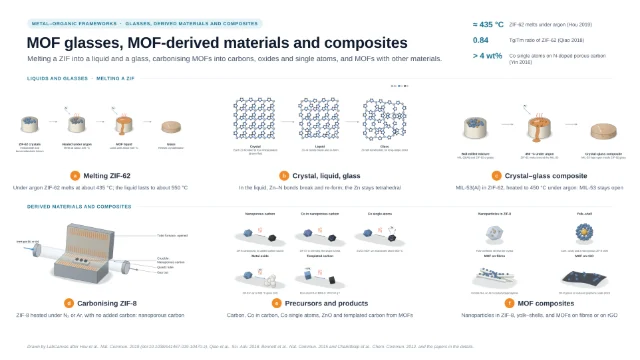
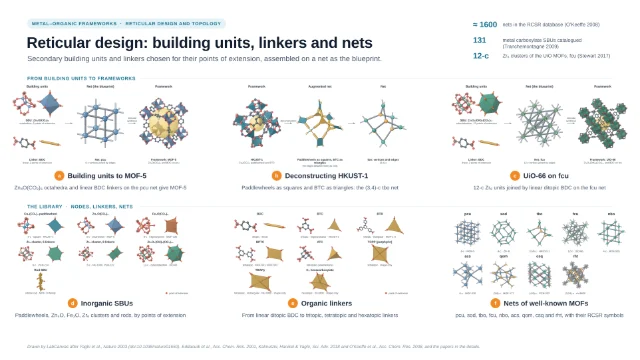
Graphical abstract template · MOF guides · Isoreticular design
Isoreticular expansion, interpenetration, MTV MOFs
Isoreticular design on one page: the IRMOF series from MOF-5 to IRMOF-16, IRMOF-74-I to -XI with apertures up to 98 Å, HKUST-1 and MOF-399 on the tbo net, interpenetrated IRMOF-9 against IRMOF-10, ways to prevent or use interpenetration, and multivariate MOF-5 with several functional groups on one backbone. Every statement and number is quoted from the cited papers.
Updated 23 cited papers45 editable layers

At a glance
- Category
- MOF guides
- Method
- Isoreticular design
- Product
- Isoreticular series of frameworks, interpenetrated and non-interpenetrated pairs, and multivariate MOFs
- Key result
- Frameworks, links and nets drawn by LabCanvas from the cited structures; the IRMOF-74 channels and the tbo linkers are to scale, other sizes are schematic, and no panel is a refined structure
- Figure
- 1920 × 1080 px (16:9), 45 editable layers, 6 generated objects
Step by step
- The IRMOF seriesMOF-5 was functionalized with –Br, –NH₂, –OC₃H₇, –OC₅H₁₁, –C₂H₄ and –C₄H₄ and expanded with biphenyl, tetrahydropyrene, pyrene and terphenyl struts: an isoreticular series, one with the same framework topology, of 16 highly crystalline materials with pores from 3.8 to 28.8 Å and open space up to 91.1% of the crystal volume (Eddaoudi 2002). IRMOF-1 is MOF-5 (Boyd 2017); IRMOF-8 is Zn₄O(ndc)₃ (Feldblyum 2012); IRMOF-10 is the non-interpenetrated Zn₄O(BPDC)₃ (Wang 2014); IRMOF-16, Zn₄O(TPDC)₃, has pores up to 28.8 Å (Kalmutzki 2018)
- IRMOF-74-I to -XIExpanding the link of MOF-74 from one phenylene ring (I) to two to seven, nine and eleven (II to XI) gave IRMOF-74-I to -XI, with pore apertures from 14 to 98 Å; all are noninterpenetrated and stable up to 300 °C, and the apertures of oligoethylene glycol-functionalized IRMOF-74-VII and -IX are large enough for natural proteins to enter the pores (Deng 2012). IRMOF-74-XI has 85 × 98 Å pores, the largest 1D pores in MOFs reported by 2018 (Kalmutzki 2018)
- HKUST-1 to MOF-399MOF-399, Cu₃(BBC)₂ on the tbo net, has a unit cell volume 17 times that of the first reported material isoreticular to it, 94% porosity and a density of 0.126 g cm⁻³ (Furukawa 2011); BBC is 4,4′,4″-[benzene-1,3,5-triyl-tris(benzene-4,1-diyl)]tribenzoate (Furukawa 2010). ZJU-35 and ZJU-36 have the same tbo topology as HKUST-1, with pores of 14.4 and 16.5 Å against 10.8 Å in HKUST-1 (Kong 2013); HKUST-1 joins [Cu₂(O₂CR)₄] units by benzene-1,3,5-tricarboxylate (Chui 1999)
- IRMOF-9 or IRMOF-10Zn₄O(BPDC)₃ forms interpenetrated IRMOF-9 or non-interpenetrated IRMOF-10 (Wang 2014). Independent nets interpenetrate in many polymeric, hydrogen-bonded and coordination structures (Batten & Robson 1998); interpenetration greatly reduces the pore size and the available space in a MOF (Shekhah 2009), and catenation diminishes porosity (Farha 2010). IRMOF-8 typically shows only 1000–2000 m² g⁻¹ where more than 4000 m² g⁻¹ is expected, from near-complete interpenetration (Feldblyum 2013). In simulations, catenated MOFs were more selective for CO₂ over CH₄ than their non-catenated counterparts (Babarao 2009)
- Preventing or using itThe steric bulk of a doped linker switched IRMOF-9 to IRMOF-10 (Wang 2014); strut-impervious scaffolds give noncatenated MOFs (Farha 2010). Room-temperature synthesis suppressed interpenetration in IRMOF-8 (Feldblyum 2012); higher temperatures and concentrations favour it (Zhang 2009); liquid-phase epitaxy on an organic template suppressed the second framework (Shekhah 2009). Interpenetration in PCN-6 can lead to higher hydrogen uptake (Zhao 2011); MOF-14, Cu₃(BTB)₂, is a pair of interwoven frameworks that reinforce each other, with pores 16.4 Å across (Chen 2001)
- Multivariate MOF-518 MTV-MOF-5 structures were made from BDC and eight of its derivatives, with up to eight distinct functionalities in one phase; the backbone is ordered but the distribution of the functional groups is disordered, and MTV-MOF-5-EHI is up to 400% more selective for CO₂ over CO than its best same-link counterparts (Deng 2010). Solid-state NMR with simulations told apart random, alternating and cluster apportionments of the groups (Kong 2013). Mixing –H, –NH₂ and –C₄H₄ on BTB helped bring in –NO₂, and multivariate MOF-177 took up 25% more hydrogen (Zhang 2015). With mixed metals, porphyrin MOFs with well-mixed SBUs performed better than the sum of their parts in a photo-oxidation (Liu 2016); MOF-74 took up to ten kinds of divalent metal in one crystal (Wang 2014)
Strengths
- IRMOF-74-VII and -IX have apertures large enough for natural proteins (Deng 2012)
- MOF-14’s interwoven frameworks reinforce each other (Chen 2001)
- Catenated MOFs were more selective for CO₂ over CH₄ in simulations (Babarao 2009)
Limitations
- In the Zn₄O-based IRMOF series, accessible porosity is often limited by interpenetration or by pore collapse when guests are removed (Feldblyum 2013)
- Interpenetration greatly reduces the pore size and the available space (Shekhah 2009)
- In MTV-MOF-5 the distribution of the functional groups is disordered (Deng 2010)
Papers this template follows
- Eddaoudi et al., “Systematic design of pore size and functionality in isoreticular MOFs and their application in methane storage”, Science 2002. doi:10.1126/science.1067208primary
- Boyd et al., “Force-field prediction of materials properties in metal-organic frameworks”, J. Phys. Chem. Lett. 2017. doi:10.1021/acs.jpclett.6b02532primary
- Feldblyum, Wong-Foy & Matzger, “Non-interpenetrated IRMOF-8: synthesis, activation, and gas sorption”, Chem. Commun. 2012. doi:10.1039/c2cc34689cprimary
- Wang et al., “Functional metal-organic frameworks via ligand doping: influences of ligand charge and steric demand”, Inorg. Chem. 2014. doi:10.1021/ic402015qprimary
- Kalmutzki, Hanikel & Yaghi, “Secondary building units as the turning point in the development of the reticular chemistry of MOFs”, Sci. Adv. 2018. doi:10.1126/sciadv.aat9180primary
- Deng et al., “Large-pore apertures in a series of metal-organic frameworks”, Science 2012. doi:10.1126/science.1220131primary
- Furukawa et al., “Isoreticular expansion of metal-organic frameworks with triangular and square building units and the lowest calculated density for porous crystals”, Inorg. Chem. 2011. doi:10.1021/ic201376tprimary
- Furukawa et al., “Ultrahigh porosity in metal-organic frameworks”, Science 2010. doi:10.1126/science.1192160primary
- Kong et al., “Expanded organic building units for the construction of highly porous metal-organic frameworks”, Chem. Eur. J. 2013. doi:10.1002/chem.201302515primary
- Chui et al., “A chemically functionalizable nanoporous material”, Science 1999. doi:10.1126/science.283.5405.1148primary
- Batten & Robson, “Interpenetrating nets: ordered, periodic entanglement”, Angew. Chem. Int. Ed. 1998. doi:10.1002/(SICI)1521-3773(19980619)37:11<1460::AID-ANIE1460>3.0.CO;2-Zprimary
- Shekhah et al., “Controlling interpenetration in metal-organic frameworks by liquid-phase epitaxy”, Nat. Mater. 2009. doi:10.1038/nmat2445primary
- Farha et al., “Control over catenation in metal-organic frameworks via rational design of the organic building block”, J. Am. Chem. Soc. 2010. doi:10.1021/ja909519eprimary
- Feldblyum et al., “Interpenetration, porosity, and high-pressure gas adsorption in Zn₄O(2,6-naphthalene dicarboxylate)₃”, Langmuir 2013. doi:10.1021/la401323tprimary
- Babarao, Jiang & Sandler, “Molecular simulations for adsorptive separation of CO₂/CH₄ mixture in metal-exposed, catenated, and charged metal-organic frameworks”, Langmuir 2009. doi:10.1021/la803074gprimary
- Zhang et al., “Temperature and concentration control over interpenetration in a metal-organic material”, J. Am. Chem. Soc. 2009. doi:10.1021/ja906911qprimary
- Zhao et al., “Tuning the topology and functionality of metal-organic frameworks by ligand design”, Acc. Chem. Res. 2011. doi:10.1021/ar100112yprimary
- Chen et al., “Interwoven metal-organic framework on a periodic minimal surface with extra-large pores”, Science 2001. doi:10.1126/science.1056598primary
- Deng et al., “Multiple functional groups of varying ratios in metal-organic frameworks”, Science 2010. doi:10.1126/science.1181761primary
- Kong et al., “Mapping of functional groups in metal-organic frameworks”, Science 2013. doi:10.1126/science.1238339primary
- Zhang et al., “Introduction of functionality, selection of topology, and enhancement of gas adsorption in multivariate metal-organic framework-177”, J. Am. Chem. Soc. 2015. doi:10.1021/ja512311aprimary
- Liu, Cong & Deng, “Deciphering the spatial arrangement of metals and correlation to reactivity in multivariate metal-organic frameworks”, J. Am. Chem. Soc. 2016. doi:10.1021/jacs.6b08724primary
- Wang et al., “Synthesis and characterization of metal-organic framework-74 containing 2, 4, 6, 8, and 10 different metals”, Inorg. Chem. 2014. doi:10.1021/ic500434aprimary
Drawn by LabCanvas after Eddaoudi et al., Science 2002 (doi:10.1126/science.1067208), Deng et al., Science 2012, Furukawa et al., Inorg. Chem. 2011, Wang et al., Inorg. Chem. 2014 and Feldblyum et al., Langmuir 2013, and the papers in the details.
How templates are written and checked: editorial guidelines.
Questions
What does the “Isoreticular expansion, interpenetration, MTV MOFs” template show?
Isoreticular design on one page: the IRMOF series from MOF-5 to IRMOF-16, IRMOF-74-I to -XI with apertures up to 98 Å, HKUST-1 and MOF-399 on the tbo net, interpenetrated IRMOF-9 against IRMOF-10, ways to prevent or use interpenetration, and multivariate MOF-5 with several functional groups on one backbone. Every statement and number is quoted from the cited papers.
What are the steps shown in “Isoreticular expansion, interpenetration, MTV MOFs”?
1. The IRMOF series: MOF-5 was functionalized with –Br, –NH₂, –OC₃H₇, –OC₅H₁₁, –C₂H₄ and –C₄H₄ and expanded with biphenyl, tetrahydropyrene, pyrene and terphenyl struts: an isoreticular series, one with the same framework topology, of 16 highly crystalline materials with pores from 3.8 to 28.8 Å and open space up to 91.1% of the crystal volume (Eddaoudi 2002). IRMOF-1 is MOF-5 (Boyd 2017); IRMOF-8 is Zn₄O(ndc)₃ (Feldblyum 2012); IRMOF-10 is the non-interpenetrated Zn₄O(BPDC)₃ (Wang 2014); IRMOF-16, Zn₄O(TPDC)₃, has pores up to 28.8 Å (Kalmutzki 2018). 2. IRMOF-74-I to -XI: Expanding the link of MOF-74 from one phenylene ring (I) to two to seven, nine and eleven (II to XI) gave IRMOF-74-I to -XI, with pore apertures from 14 to 98 Å; all are noninterpenetrated and stable up to 300 °C, and the apertures of oligoethylene glycol-functionalized IRMOF-74-VII and -IX are large enough for natural proteins to enter the pores (Deng 2012). IRMOF-74-XI has 85 × 98 Å pores, the largest 1D pores in MOFs reported by 2018 (Kalmutzki 2018). 3. HKUST-1 to MOF-399: MOF-399, Cu₃(BBC)₂ on the tbo net, has a unit cell volume 17 times that of the first reported material isoreticular to it, 94% porosity and a density of 0.126 g cm⁻³ (Furukawa 2011); BBC is 4,4′,4″-[benzene-1,3,5-triyl-tris(benzene-4,1-diyl)]tribenzoate (Furukawa 2010). ZJU-35 and ZJU-36 have the same tbo topology as HKUST-1, with pores of 14.4 and 16.5 Å against 10.8 Å in HKUST-1 (Kong 2013); HKUST-1 joins [Cu₂(O₂CR)₄] units by benzene-1,3,5-tricarboxylate (Chui 1999). 4. IRMOF-9 or IRMOF-10: Zn₄O(BPDC)₃ forms interpenetrated IRMOF-9 or non-interpenetrated IRMOF-10 (Wang 2014). Independent nets interpenetrate in many polymeric, hydrogen-bonded and coordination structures (Batten & Robson 1998); interpenetration greatly reduces the pore size and the available space in a MOF (Shekhah 2009), and catenation diminishes porosity (Farha 2010). IRMOF-8 typically shows only 1000–2000 m² g⁻¹ where more than 4000 m² g⁻¹ is expected, from near-complete interpenetration (Feldblyum 2013). In simulations, catenated MOFs were more selective for CO₂ over CH₄ than their non-catenated counterparts (Babarao 2009). 5. Preventing or using it: The steric bulk of a doped linker switched IRMOF-9 to IRMOF-10 (Wang 2014); strut-impervious scaffolds give noncatenated MOFs (Farha 2010). Room-temperature synthesis suppressed interpenetration in IRMOF-8 (Feldblyum 2012); higher temperatures and concentrations favour it (Zhang 2009); liquid-phase epitaxy on an organic template suppressed the second framework (Shekhah 2009). Interpenetration in PCN-6 can lead to higher hydrogen uptake (Zhao 2011); MOF-14, Cu₃(BTB)₂, is a pair of interwoven frameworks that reinforce each other, with pores 16.4 Å across (Chen 2001). 6. Multivariate MOF-5: 18 MTV-MOF-5 structures were made from BDC and eight of its derivatives, with up to eight distinct functionalities in one phase; the backbone is ordered but the distribution of the functional groups is disordered, and MTV-MOF-5-EHI is up to 400% more selective for CO₂ over CO than its best same-link counterparts (Deng 2010). Solid-state NMR with simulations told apart random, alternating and cluster apportionments of the groups (Kong 2013). Mixing –H, –NH₂ and –C₄H₄ on BTB helped bring in –NO₂, and multivariate MOF-177 took up 25% more hydrogen (Zhang 2015). With mixed metals, porphyrin MOFs with well-mixed SBUs performed better than the sum of their parts in a photo-oxidation (Liu 2016); MOF-74 took up to ten kinds of divalent metal in one crystal (Wang 2014).
Which papers is “Isoreticular expansion, interpenetration, MTV MOFs” based on?
Eddaoudi et al., “Systematic design of pore size and functionality in isoreticular MOFs and their application in methane storage”, Science 2002 (doi:10.1126/science.1067208); Boyd et al., “Force-field prediction of materials properties in metal-organic frameworks”, J. Phys. Chem. Lett. 2017 (doi:10.1021/acs.jpclett.6b02532); Feldblyum, Wong-Foy & Matzger, “Non-interpenetrated IRMOF-8: synthesis, activation, and gas sorption”, Chem. Commun. 2012 (doi:10.1039/c2cc34689c); Wang et al., “Functional metal-organic frameworks via ligand doping: influences of ligand charge and steric demand”, Inorg. Chem. 2014 (doi:10.1021/ic402015q); Kalmutzki, Hanikel & Yaghi, “Secondary building units as the turning point in the development of the reticular chemistry of MOFs”, Sci. Adv. 2018 (doi:10.1126/sciadv.aat9180); Deng et al., “Large-pore apertures in a series of metal-organic frameworks”, Science 2012 (doi:10.1126/science.1220131); Furukawa et al., “Isoreticular expansion of metal-organic frameworks with triangular and square building units and the lowest calculated density for porous crystals”, Inorg. Chem. 2011 (doi:10.1021/ic201376t); Furukawa et al., “Ultrahigh porosity in metal-organic frameworks”, Science 2010 (doi:10.1126/science.1192160); Kong et al., “Expanded organic building units for the construction of highly porous metal-organic frameworks”, Chem. Eur. J. 2013 (doi:10.1002/chem.201302515); Chui et al., “A chemically functionalizable nanoporous material”, Science 1999 (doi:10.1126/science.283.5405.1148); Batten & Robson, “Interpenetrating nets: ordered, periodic entanglement”, Angew. Chem. Int. Ed. 1998 (doi:10.1002/(SICI)1521-3773(19980619)37:11<1460::AID-ANIE1460>3.0.CO;2-Z); Shekhah et al., “Controlling interpenetration in metal-organic frameworks by liquid-phase epitaxy”, Nat. Mater. 2009 (doi:10.1038/nmat2445); Farha et al., “Control over catenation in metal-organic frameworks via rational design of the organic building block”, J. Am. Chem. Soc. 2010 (doi:10.1021/ja909519e); Feldblyum et al., “Interpenetration, porosity, and high-pressure gas adsorption in Zn₄O(2,6-naphthalene dicarboxylate)₃”, Langmuir 2013 (doi:10.1021/la401323t); Babarao, Jiang & Sandler, “Molecular simulations for adsorptive separation of CO₂/CH₄ mixture in metal-exposed, catenated, and charged metal-organic frameworks”, Langmuir 2009 (doi:10.1021/la803074g); Zhang et al., “Temperature and concentration control over interpenetration in a metal-organic material”, J. Am. Chem. Soc. 2009 (doi:10.1021/ja906911q); Zhao et al., “Tuning the topology and functionality of metal-organic frameworks by ligand design”, Acc. Chem. Res. 2011 (doi:10.1021/ar100112y); Chen et al., “Interwoven metal-organic framework on a periodic minimal surface with extra-large pores”, Science 2001 (doi:10.1126/science.1056598); Deng et al., “Multiple functional groups of varying ratios in metal-organic frameworks”, Science 2010 (doi:10.1126/science.1181761); Kong et al., “Mapping of functional groups in metal-organic frameworks”, Science 2013 (doi:10.1126/science.1238339); Zhang et al., “Introduction of functionality, selection of topology, and enhancement of gas adsorption in multivariate metal-organic framework-177”, J. Am. Chem. Soc. 2015 (doi:10.1021/ja512311a); Liu, Cong & Deng, “Deciphering the spatial arrangement of metals and correlation to reactivity in multivariate metal-organic frameworks”, J. Am. Chem. Soc. 2016 (doi:10.1021/jacs.6b08724); Wang et al., “Synthesis and characterization of metal-organic framework-74 containing 2, 4, 6, 8, and 10 different metals”, Inorg. Chem. 2014 (doi:10.1021/ic500434a).
Can I edit the “Isoreticular expansion, interpenetration, MTV MOFs” template?
Yes. Open it in the LabCanvas editor: all 45 layers are editable, including 6 generated objects (structures, plots, equipment) with their own settings. Change the text, colours and layout, then export PNG, TIFF, SVG or PDF.
Do I need an account to use this template?
Not to view it here. To open and edit it, sign in to LabCanvas or create a free account (the free plan keeps up to 3 designs). Downloading the figure is part of LabCanvas Pro (US$19 a month or US$199 a year).