Graphical abstract template · MOF guides · Glasses, derived materials and composites
MOF glasses, MOF-derived materials and composites
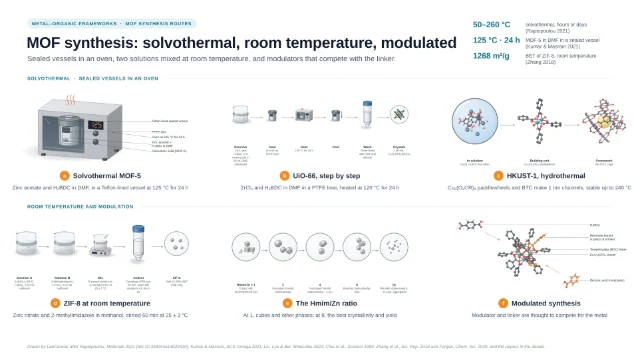
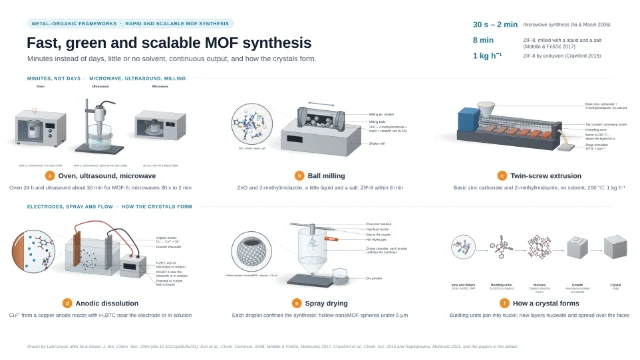
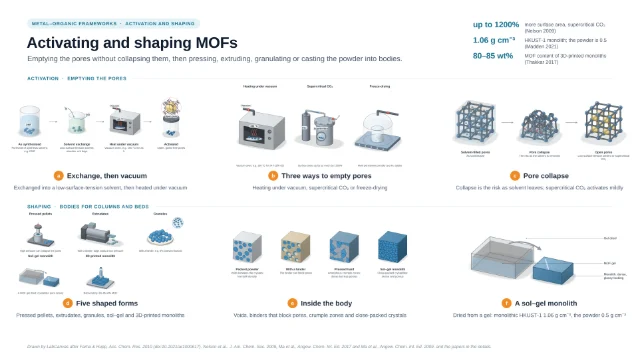
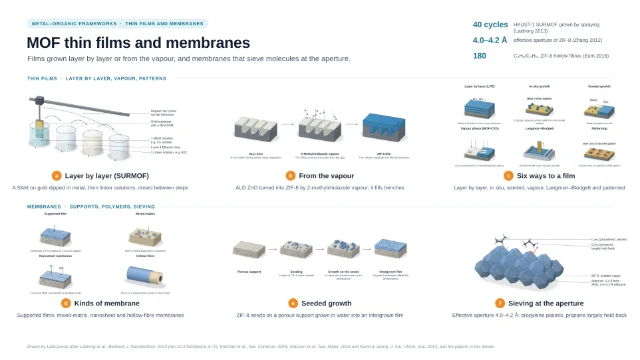
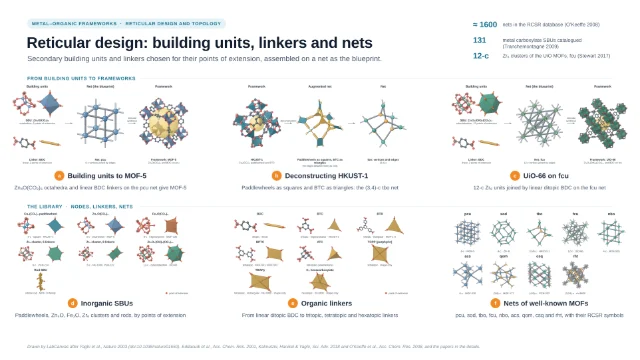
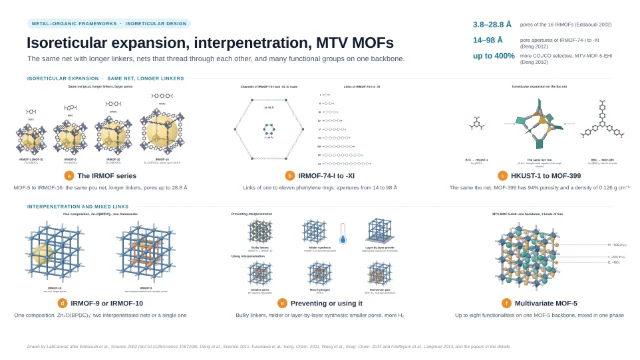
What MOFs become on one page: ZIF-62 melted under argon and quenched into a glass, the network of the crystal, the liquid and the glass, a crystal–glass composite of MIL-53 in ZIF-62, ZIF-8 carbonised in a tube furnace, the routes from MOFs to carbons, metal nanoparticles, single atoms and oxides, and MOF composites with nanoparticles, fibres and graphene. Every step and number is quoted from the cited papers.
Updated 15 cited papers45 editable layers

At a glance
- Category
- MOF guides
- Method
- Glasses, derived materials and composites
- Starting materials
- ZIF-62, ZIF-4 and MIL-53(Al) crystals; ZIF-8, ZIF-67, bimetallic Zn/Co MOFs and MOF-5 with the carbon precursor FA; nanoparticles, fibres and reduced graphene oxide
- Product
- MOF liquids and glasses, crystal–glass composites, nanoporous carbons, Co nanoparticles and single atoms in carbon, ZnO, and MOF composites
- Key result
- Crystals, networks, furnaces and particles drawn by LabCanvas from the cited papers; sizes, counts and colours that no paper fixes are settings, and no panel is a micrograph or a thermogram
- Figure
- 1920 × 1080 px (16:9), 45 editable layers, 6 generated objects
Step by step
- Melting ZIF-62ZIF-62 (imidazolate and benzimidazolate linkers) melts at about 435 °C under argon and its liquid lasts until it decomposes at about 550 °C; the glass resists crystallisation (Hou 2019). ZIF-62 has an ultrahigh glass-forming ability: fragility m = 23, Poisson’s ratio 0.45 and the highest Tg/Tm ratio reported, 0.84 (Qiao 2018). ZIF-4 collapses on heating to an amorphous phase and recrystallises to dense ZIF-zni, which melts (Tm 866 K); quenching the liquid gives a bulk glass that keeps the ligands and the tetrahedral Zn (Bennett 2015)
- Crystal, liquid, glassAt about 550 °C the imidazolate linkers of ZIF-zni, Zn(Im)₂, dissociate and re-associate rapidly around the Zn²⁺ centres, giving a viscous liquid of the same composition; the glasses formed on quenching are modelled as continuous random networks, like amorphous silica (Hou 2019). In the liquid, the chemical configuration, coordinative bonding and porosity of the parent crystal survive (Gaillac 2017); the glasses are distinct from inorganic, organic and metallic glasses and keep the basic metal–ligand connectivity of the crystalline MOF (Bennett 2016)
- Crystal–glass compositeBall-milled MIL-53(Al) and ZIF-62, heated under argon to 450 °C (above ZIF-62’s melting point) for 10 min and cooled, give MIL-53 particles of 30–300 nm evenly embedded in ZIF-62 glass. In the composite the open-pore form of MIL-53 stays open at room temperature even after a year, while pure MIL-53 takes up water and closes within an hour; CO₂ uptake at 303 K and 50 bar rose by about 30% (Hou 2019)
- Carbonising ZIF-8Direct carbonisation of commercial ZIF-8, without any added carbon source, gives nanoporous carbon with a high surface area (Chaikittisilp 2012). MOFs serve as self-sacrificing templates: as the linkers decompose the framework breaks down, volatile molecules leave pores behind, and metal or metal-oxide particles stay in a conductive carbon matrix; the higher the annealing temperature under an inert atmosphere, the more graphitic the carbon, and embedded metal particles can be removed by acid washing (Singh 2021)
- Precursors and productsOne-step carbonisation of ZIF-67 crystals gives nanoporous carbon with magnetic Co nanoparticles dispersed in it, and the crystals keep their shape (Torad 2014). Pyrolysing bimetallic Zn/Co MOFs reduces Co as the linker carbonises while Zn evaporates above 800 °C, leaving Co single atoms on N-doped porous carbon at over 4 wt% (Yin 2016). ZIF-8 grown on reduced graphene oxide turns into porous ZnO/rGO particles in air at 500 °C (Tatykayev 2017). Heating the precursor FA inside the pores of MOF-5 gave porous carbon with a BET surface area of 2872 m² g⁻¹ (Liu 2008), and with a zeolite-type MOF as template and furfuryl alcohol as a second precursor the carbon reached 3405 m² g⁻¹ (Jiang 2011)
- MOF compositesSurfactant-capped nanoparticles of various sizes, shapes and compositions can be enshrouded by ZIF-8, well dispersed and fully confined, several per crystal (Lu 2012). Yolk–shell nanocrystal@ZIF-8: the cores are coated with Cu₂O as a sacrificial template and then with ZIF-8, and the Cu₂O is etched away as the shell forms; Pd@ZIF-8 hydrogenated ethylene and cyclohexene but not cyclooctene (Kuo 2012). UiO-66-NH₂ grew on polypropylene fibres coated by ALD with Al₂O₃, ZnO or TiO₂, TiO₂ giving the best adhesion and uniformity (Lee 2017); ZIF-8 grown on reduced graphene oxide associates strongly with the sheets (Tatykayev 2017)
Strengths
- In the MOF liquid the chemical configuration, coordinative bonding and porosity of the parent crystal survive (Gaillac 2017)
- Carbonising ZIF-8 needs no added carbon source (Chaikittisilp 2012)
- Enshrouded nanoparticles combine their catalytic, magnetic and optical properties with the framework’s molecular sieving (Lu 2012)
Limitations
- ZIF-8 (sodalite topology) decomposes before it melts (Bennett 2015)
- The melt of ZIF-4 flows into a non-porous glass (Bennett 2015)
- Pure MIL-53 takes up water and closes within an hour (Hou 2019)
Papers this template follows
- Hou et al., “Metal-organic framework crystal-glass composites”, Nat. Commun. 2019. doi:10.1038/s41467-019-10470-zprimary
- Qiao et al., “A metal-organic framework with ultrahigh glass-forming ability”, Sci. Adv. 2018. doi:10.1126/sciadv.aao6827primary
- Bennett et al., “Hybrid glasses from strong and fragile metal-organic framework liquids”, Nat. Commun. 2015. doi:10.1038/ncomms9079primary
- Gaillac et al., “Liquid metal-organic frameworks”, Nat. Mater. 2017. doi:10.1038/nmat4998primary
- Bennett et al., “Melt-quenched glasses of metal-organic frameworks”, J. Am. Chem. Soc. 2016. doi:10.1021/jacs.5b13220primary
- Chaikittisilp et al., “Nanoporous carbons through direct carbonization of a zeolitic imidazolate framework for supercapacitor electrodes”, Chem. Commun. 2012. doi:10.1039/c2cc33433jprimary
- Singh, Mukhopadhyay & Hod, “Metal-organic framework derived nanomaterials for electrocatalysis: recent developments for CO₂ and N₂ reduction”, Nano Converg. 2021. doi:10.1186/s40580-020-00251-6primary
- Torad et al., “Direct synthesis of MOF-derived nanoporous carbon with magnetic Co nanoparticles toward efficient water treatment”, Small 2014. doi:10.1002/smll.201302910primary
- Yin et al., “Single cobalt atoms with precise N-coordination as superior oxygen reduction reaction catalysts”, Angew. Chem. Int. Ed. 2016. doi:10.1002/anie.201604802primary
- Tatykayev et al., “Synthesis of core/shell ZnO/rGO nanoparticles by calcination of ZIF-8/rGO composites and their photocatalytic activity”, ACS Omega 2017. doi:10.1021/acsomega.7b00673primary
- Liu et al., “Metal-organic framework as a template for porous carbon synthesis”, J. Am. Chem. Soc. 2008. doi:10.1021/ja7106146primary
- Jiang et al., “From metal-organic framework to nanoporous carbon: toward a very high surface area and hydrogen uptake”, J. Am. Chem. Soc. 2011. doi:10.1021/ja203184kprimary
- Lu et al., “Imparting functionality to a metal-organic framework material by controlled nanoparticle encapsulation”, Nat. Chem. 2012. doi:10.1038/nchem.1272primary
- Kuo et al., “Yolk-shell nanocrystal@ZIF-8 nanostructures for gas-phase heterogeneous catalysis with selectivity control”, J. Am. Chem. Soc. 2012. doi:10.1021/ja306869jprimary
- Lee et al., “UiO-66-NH₂ metal-organic framework (MOF) nucleation on TiO₂, ZnO, and Al₂O₃ atomic layer deposition-treated polymer fibers: role of metal oxide on MOF growth and catalytic hydrolysis of chemical warfare agent simulants”, ACS Appl. Mater. Interfaces 2017. doi:10.1021/acsami.7b15397primary
Drawn by LabCanvas after Hou et al., Nat. Commun. 2019 (doi:10.1038/s41467-019-10470-z), Qiao et al., Sci. Adv. 2018, Bennett et al., Nat. Commun. 2015 and Chaikittisilp et al., Chem. Commun. 2012, and the papers in the details.
How templates are written and checked: editorial guidelines.
Questions
What does the “MOF glasses, MOF-derived materials and composites” template show?
What MOFs become on one page: ZIF-62 melted under argon and quenched into a glass, the network of the crystal, the liquid and the glass, a crystal–glass composite of MIL-53 in ZIF-62, ZIF-8 carbonised in a tube furnace, the routes from MOFs to carbons, metal nanoparticles, single atoms and oxides, and MOF composites with nanoparticles, fibres and graphene. Every step and number is quoted from the cited papers.
What are the steps shown in “MOF glasses, MOF-derived materials and composites”?
1. Melting ZIF-62: ZIF-62 (imidazolate and benzimidazolate linkers) melts at about 435 °C under argon and its liquid lasts until it decomposes at about 550 °C; the glass resists crystallisation (Hou 2019). ZIF-62 has an ultrahigh glass-forming ability: fragility m = 23, Poisson’s ratio 0.45 and the highest Tg/Tm ratio reported, 0.84 (Qiao 2018). ZIF-4 collapses on heating to an amorphous phase and recrystallises to dense ZIF-zni, which melts (Tm 866 K); quenching the liquid gives a bulk glass that keeps the ligands and the tetrahedral Zn (Bennett 2015). 2. Crystal, liquid, glass: At about 550 °C the imidazolate linkers of ZIF-zni, Zn(Im)₂, dissociate and re-associate rapidly around the Zn²⁺ centres, giving a viscous liquid of the same composition; the glasses formed on quenching are modelled as continuous random networks, like amorphous silica (Hou 2019). In the liquid, the chemical configuration, coordinative bonding and porosity of the parent crystal survive (Gaillac 2017); the glasses are distinct from inorganic, organic and metallic glasses and keep the basic metal–ligand connectivity of the crystalline MOF (Bennett 2016). 3. Crystal–glass composite: Ball-milled MIL-53(Al) and ZIF-62, heated under argon to 450 °C (above ZIF-62’s melting point) for 10 min and cooled, give MIL-53 particles of 30–300 nm evenly embedded in ZIF-62 glass. In the composite the open-pore form of MIL-53 stays open at room temperature even after a year, while pure MIL-53 takes up water and closes within an hour; CO₂ uptake at 303 K and 50 bar rose by about 30% (Hou 2019). 4. Carbonising ZIF-8: Direct carbonisation of commercial ZIF-8, without any added carbon source, gives nanoporous carbon with a high surface area (Chaikittisilp 2012). MOFs serve as self-sacrificing templates: as the linkers decompose the framework breaks down, volatile molecules leave pores behind, and metal or metal-oxide particles stay in a conductive carbon matrix; the higher the annealing temperature under an inert atmosphere, the more graphitic the carbon, and embedded metal particles can be removed by acid washing (Singh 2021). 5. Precursors and products: One-step carbonisation of ZIF-67 crystals gives nanoporous carbon with magnetic Co nanoparticles dispersed in it, and the crystals keep their shape (Torad 2014). Pyrolysing bimetallic Zn/Co MOFs reduces Co as the linker carbonises while Zn evaporates above 800 °C, leaving Co single atoms on N-doped porous carbon at over 4 wt% (Yin 2016). ZIF-8 grown on reduced graphene oxide turns into porous ZnO/rGO particles in air at 500 °C (Tatykayev 2017). Heating the precursor FA inside the pores of MOF-5 gave porous carbon with a BET surface area of 2872 m² g⁻¹ (Liu 2008), and with a zeolite-type MOF as template and furfuryl alcohol as a second precursor the carbon reached 3405 m² g⁻¹ (Jiang 2011). 6. MOF composites: Surfactant-capped nanoparticles of various sizes, shapes and compositions can be enshrouded by ZIF-8, well dispersed and fully confined, several per crystal (Lu 2012). Yolk–shell nanocrystal@ZIF-8: the cores are coated with Cu₂O as a sacrificial template and then with ZIF-8, and the Cu₂O is etched away as the shell forms; Pd@ZIF-8 hydrogenated ethylene and cyclohexene but not cyclooctene (Kuo 2012). UiO-66-NH₂ grew on polypropylene fibres coated by ALD with Al₂O₃, ZnO or TiO₂, TiO₂ giving the best adhesion and uniformity (Lee 2017); ZIF-8 grown on reduced graphene oxide associates strongly with the sheets (Tatykayev 2017).
What are the starting materials and the product?
Starting materials: ZIF-62, ZIF-4 and MIL-53(Al) crystals; ZIF-8, ZIF-67, bimetallic Zn/Co MOFs and MOF-5 with the carbon precursor FA; nanoparticles, fibres and reduced graphene oxide. Product: MOF liquids and glasses, crystal–glass composites, nanoporous carbons, Co nanoparticles and single atoms in carbon, ZnO, and MOF composites.
Which papers is “MOF glasses, MOF-derived materials and composites” based on?
Hou et al., “Metal-organic framework crystal-glass composites”, Nat. Commun. 2019 (doi:10.1038/s41467-019-10470-z); Qiao et al., “A metal-organic framework with ultrahigh glass-forming ability”, Sci. Adv. 2018 (doi:10.1126/sciadv.aao6827); Bennett et al., “Hybrid glasses from strong and fragile metal-organic framework liquids”, Nat. Commun. 2015 (doi:10.1038/ncomms9079); Gaillac et al., “Liquid metal-organic frameworks”, Nat. Mater. 2017 (doi:10.1038/nmat4998); Bennett et al., “Melt-quenched glasses of metal-organic frameworks”, J. Am. Chem. Soc. 2016 (doi:10.1021/jacs.5b13220); Chaikittisilp et al., “Nanoporous carbons through direct carbonization of a zeolitic imidazolate framework for supercapacitor electrodes”, Chem. Commun. 2012 (doi:10.1039/c2cc33433j); Singh, Mukhopadhyay & Hod, “Metal-organic framework derived nanomaterials for electrocatalysis: recent developments for CO₂ and N₂ reduction”, Nano Converg. 2021 (doi:10.1186/s40580-020-00251-6); Torad et al., “Direct synthesis of MOF-derived nanoporous carbon with magnetic Co nanoparticles toward efficient water treatment”, Small 2014 (doi:10.1002/smll.201302910); Yin et al., “Single cobalt atoms with precise N-coordination as superior oxygen reduction reaction catalysts”, Angew. Chem. Int. Ed. 2016 (doi:10.1002/anie.201604802); Tatykayev et al., “Synthesis of core/shell ZnO/rGO nanoparticles by calcination of ZIF-8/rGO composites and their photocatalytic activity”, ACS Omega 2017 (doi:10.1021/acsomega.7b00673); Liu et al., “Metal-organic framework as a template for porous carbon synthesis”, J. Am. Chem. Soc. 2008 (doi:10.1021/ja7106146); Jiang et al., “From metal-organic framework to nanoporous carbon: toward a very high surface area and hydrogen uptake”, J. Am. Chem. Soc. 2011 (doi:10.1021/ja203184k); Lu et al., “Imparting functionality to a metal-organic framework material by controlled nanoparticle encapsulation”, Nat. Chem. 2012 (doi:10.1038/nchem.1272); Kuo et al., “Yolk-shell nanocrystal@ZIF-8 nanostructures for gas-phase heterogeneous catalysis with selectivity control”, J. Am. Chem. Soc. 2012 (doi:10.1021/ja306869j); Lee et al., “UiO-66-NH₂ metal-organic framework (MOF) nucleation on TiO₂, ZnO, and Al₂O₃ atomic layer deposition-treated polymer fibers: role of metal oxide on MOF growth and catalytic hydrolysis of chemical warfare agent simulants”, ACS Appl. Mater. Interfaces 2017 (doi:10.1021/acsami.7b15397).
Can I edit the “MOF glasses, MOF-derived materials and composites” template?
Yes. Open it in the LabCanvas editor: all 45 layers are editable, including 6 generated objects (structures, plots, equipment) with their own settings. Change the text, colours and layout, then export PNG, TIFF, SVG or PDF.
Do I need an account to use this template?
Not to view it here. To open and edit it, sign in to LabCanvas or create a free account (the free plan keeps up to 3 designs). Downloading the figure is part of LabCanvas Pro (US$19 a month or US$199 a year).