Graphical abstract template · MOF guides · Rapid and scalable MOF synthesis
Fast, green and scalable MOF synthesis
Rapid and scalable routes to metal–organic frameworks on one page: oven, ultrasound and microwave times compared, ZIF-8 by ball milling with a liquid and a salt, ZIF-8 by solvent-free twin-screw extrusion, HKUST-1 by anodic dissolution of copper, nanoMOF spheres by spray drying, and how a crystal forms from building units. Every step and number is quoted from the cited papers.
Updated 24 cited papers45 editable layers

At a glance
- Category
- MOF guides
- Method
- Rapid and scalable MOF synthesis
- Starting materials
- Metal salts, oxides, hydroxides and carbonates, or a metal anode; H₂BDC, H₃BTC, fumaric acid and 2-methylimidazole; little or no solvent
- Product
- MOF-5, ZIF-8, HKUST-1, UiO-66 and aluminium fumarate as crystals, powders, extrudates and hollow spheres
- Key result
- Reactors, mills, extruders, cells and crystals drawn by LabCanvas from the cited set-ups; sizes, counts and colours that no paper fixes are settings, and no panel is a micrograph, pattern or plot
- Figure
- 1920 × 1080 px (16:9), 45 editable layers, 6 generated objects
Step by step
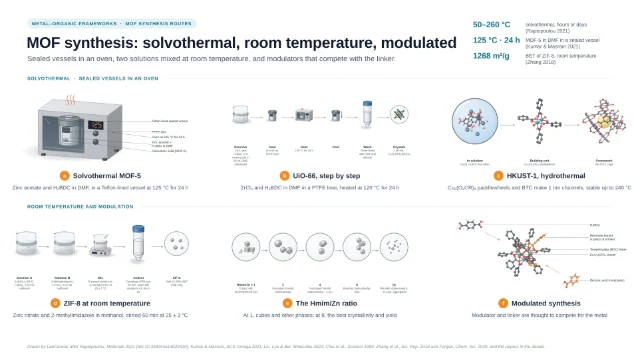
- Oven, ultrasound, microwaveConventional solvothermal synthesis of MOF-5 takes 24 h; with ultrasound, MOF-5 crystals of 5–25 µm formed in about 30 min (Son 2008). Under ultrasound (20 kHz–10 MHz) the bubbles create short-lived local hot spots of high temperature and pressure that promote the immediate formation of crystallization nuclei (Raptopoulou 2021). With a conventional microwave, a synthesis that took hours or days was done in 30 s to 2 min, the yield rose from about 30% to over 90%, and nucleation no longer depended on the walls or dust (Ni & Masel 2006). Microwaves cut synthesis times of nanoporous materials by more than an order of magnitude, but the mechanism of the faster rates is not known (Tompsett 2006); nanosized UiO-66-NH₂ was made at about 1 g scale in 30 min with a space–time yield of 1450 kg m⁻³ day⁻¹ (Guerrero 2024)
- Ball millingMechanochemical synthesis runs reactions by grinding solid reactants together with no or minimal solvent (James 2012). Liquid-assisted grinding (LAG) adds a catalytic amount of liquid, and ion- and liquid-assisted grinding (ILAG) a liquid and a salt; milling can use poorly soluble metal oxides and carbonates. Followed in situ, neat grinding of ZnO with 2-methylimidazole was incomplete after 90 min and LAG levelled off within 30 min, while ILAG gave ZIF-8 within 8 min, with the same surface area as conventionally made ZIF-8 (Mottillo & Friščić 2017). High-energy synchrotron X-rays followed mechanosynthesis in real time (Friščić 2013), and milling ZnO and 2-methylimidazole with water and acetic acid first gave ZIF-8, which amorphized and recrystallized through katsenite into a non-porous material (Katsenis 2015). UiO-66 was made by LAG on the 3 g scale in 75 min (Užarević 2016)
- Twin-screw extrusionTwo screws with alternating conveying and kneading zones in a barrel made MOFs continuously and quantitatively from solids with little or no solvent at kg h⁻¹ rates, with space–time yields up to 144 000 kg m⁻³ day⁻¹. ZIF-8 came from basic zinc carbonate and 2-methylimidazole with no solvent, the barrel at 200 °C so that the ligand (m.p. 142–143 °C) would melt; water and CO₂ are the only by-products; 1 kg h⁻¹, BET 1603 m²/g after activation, and 4 kg h⁻¹ in a single-screw extruder. HKUST-1 (32 wt% industrial alcohol) reached up to 1 kg h⁻¹ and Al(fumarate)(OH) 0.6 kg h⁻¹ (Crawford 2015)
- Anodic dissolutionAnodic dissolution releases the metal ions into a mixture of the organic ligands and electrolytes, at milder temperatures and much faster than solvothermal synthesis; HKUST-1, ZIF-8, MIL-100(Al), MIL-53(Al) and NH₂-MIL-53(Al) have been made this way (Raptopoulou 2021). It needs an anode of the metal, and controlling the dissolution rate potentiostatically or galvanostatically sets the particle size, morphology, structure type and film adherence (Wu 2021). Electroreduction of oxoanions instead gives hydroxide equivalents that deposit MOF-5 at room temperature in only 15 min under a cathodic potential (Li & Dincă 2011)
- Spray dryingSpray drying assembles nanoMOFs into spherical, hollow superstructures under 5 µm; like an emulsion it confines the synthesis, but without immiscible solvents or surfactants (Carné-Sánchez 2013). It makes MOFs continuously and delivers them dried and pure, with no purification or filtration (Carné-Sánchez 2015). In a flow reactor, aqueous aluminium sulfate and fumaric acid with KOH ran 15 min at 80 °C through a coiled Teflon tube and gave a BET area of 1000 m²/g; more tubes in parallel multiply the output (Stassin 2020). Electrochemical, microwave, mechanochemical, spray-drying and flow syntheses are the most promising new routes to MOF production at scale (Rubio-Martinez 2017); UiO-66 was made under reflux at the 0.5 kg scale (Ragon 2014)
- How a crystal formsSecondary building units direct the assembly of ordered frameworks (Yaghi 2003); trimeric iron oxide building units stayed intact from the starting materials to the product MIL-89 (Surblé 2006). MOF-5 faces grew by two-dimensional nucleation and spreading of new layers, or by spirals, and a Zn/H₂BDC ratio above 1 gave square terraces (Cubillas 2012). ZIF-8 forming at room temperature passed through nucleation, crystallization, growth and stationary periods (Venna 2010), with relatively slow nucleation and fast crystal growth (Forgan 2020)
Strengths
- Microwave heating allows short reaction times, fast nucleation and growth, and high yields with few or no by-products (Klinowski 2011)
- Extrusion space–time yields were orders of magnitude above other methods (Crawford 2015)
- Spray drying delivers MOFs dried and pure, with no purification or filtration (Carné-Sánchez 2015)
Limitations
- The mechanism of the faster microwave rates is not known (Tompsett 2006)
- Neat grinding of ZnO with 2-methylimidazole gave incomplete conversion to ZIF-8 (Mottillo & Friščić 2017)
- Anodic dissolution needs an anode of the metal (Wu 2021)
Papers this template follows
- Son et al., “Sonochemical synthesis of MOF-5”, Chem. Commun. 2008. doi:10.1039/b814740jprimary
- Raptopoulou, “Metal-Organic Frameworks: Synthetic Methods and Potential Applications”, Materials 2021. doi:10.3390/ma14020310primary
- Ni & Masel, “Rapid production of metal-organic frameworks via microwave-assisted solvothermal synthesis”, J. Am. Chem. Soc. 2006. doi:10.1021/ja0635231primary
- Tompsett, Conner & Yngvesson, “Microwave synthesis of nanoporous materials”, ChemPhysChem 2006. doi:10.1002/cphc.200500449primary
- Guerrero et al., “Scaling-Up Microwave-Assisted Synthesis of Highly Defective Pd@UiO-66-NH₂ Catalysts for Selective Olefin Hydrogenation under Ambient Conditions”, ACS Appl. Mater. Interfaces 2024. doi:10.1021/acsami.4c03106primary
- Klinowski et al., “Microwave-assisted synthesis of metal-organic frameworks”, Dalton Trans. 2011. doi:10.1039/c0dt00708kprimary
- James et al., “Mechanochemistry: opportunities for new and cleaner synthesis”, Chem. Soc. Rev. 2012. doi:10.1039/c1cs15171aprimary
- Mottillo & Friščić, “Advances in Solid-State Transformations of Coordination Bonds: From the Ball Mill to the Aging Chamber”, Molecules 2017. doi:10.3390/molecules22010144primary
- Friščić et al., “Real-time and in situ monitoring of mechanochemical milling reactions”, Nat. Chem. 2013. doi:10.1038/nchem.1505primary
- Katsenis et al., “In situ X-ray diffraction monitoring of a mechanochemical reaction reveals a unique topology metal-organic framework”, Nat. Commun. 2015. doi:10.1038/ncomms7662primary
- Užarević et al., “Mechanochemical and solvent-free assembly of zirconium-based metal-organic frameworks”, Chem. Commun. 2016. doi:10.1039/c5cc08972gprimary
- Crawford et al., “Synthesis by extrusion: continuous, large-scale preparation of MOFs using little or no solvent”, Chem. Sci. 2015. doi:10.1039/c4sc03217aprimary
- Wu et al., “Facile and Rapid Room-Temperature Electrosynthesis and Controlled Surface Growth of Fe-MIL-101 and Fe-MIL-101-NH₂”, ACS Cent. Sci. 2021. doi:10.1021/acscentsci.1c00686primary
- Li & Dincă, “Reductive electrosynthesis of crystalline metal-organic frameworks”, J. Am. Chem. Soc. 2011. doi:10.1021/ja2041546primary
- Carné-Sánchez et al., “A spray-drying strategy for synthesis of nanoscale metal-organic frameworks and their assembly into hollow superstructures”, Nat. Chem. 2013. doi:10.1038/nchem.1569primary
- Carné-Sánchez et al., “Protecting metal-organic framework crystals from hydrolytic degradation by spray-dry encapsulating them into polystyrene microspheres”, Adv. Mater. 2015. doi:10.1002/adma.201403827primary
- Stassin et al., “Aqueous Flow Reactor and Vapour-Assisted Synthesis of Aluminium Dicarboxylate Metal-Organic Frameworks with Tuneable Water Sorption Properties”, Chem. Eur. J. 2020. doi:10.1002/chem.202001661primary
- Ragon et al., “In situ energy-dispersive X-ray diffraction for the synthesis optimization and scale-up of the porous zirconium terephthalate UiO-66”, Inorg. Chem. 2014. doi:10.1021/ic402514nprimary
- Yaghi et al., “Reticular synthesis and the design of new materials”, Nature 2003. doi:10.1038/nature01650primary
- Surblé et al., “An EXAFS study of the formation of a nanoporous metal-organic framework: evidence for the retention of secondary building units during synthesis”, Chem. Commun. 2006. doi:10.1039/b600709kprimary
- Cubillas, Anderson & Attfield, “Crystal growth mechanisms and morphological control of the prototypical metal-organic framework MOF-5 revealed by atomic force microscopy”, Chem. Eur. J. 2012. doi:10.1002/chem.201202261primary
- Venna, Jasinski & Carreon, “Structural evolution of zeolitic imidazolate framework-8”, J. Am. Chem. Soc. 2010. doi:10.1021/ja109268mprimary
- Forgan, “Modulated self-assembly of metal-organic frameworks”, Chem. Sci. 2020. doi:10.1039/d0sc01356kprimary
- Rubio-Martinez et al., “New synthetic routes towards MOF production at scale”, Chem. Soc. Rev. 2017. doi:10.1039/c7cs00109ffurther reading
Drawn by LabCanvas after Ni & Masel, J. Am. Chem. Soc. 2006 (doi:10.1021/ja0635231), Son et al., Chem. Commun. 2008, Mottillo & Friščić, Molecules 2017, Crawford et al., Chem. Sci. 2015 and Raptopoulou, Materials 2021, and the papers in the details.
How templates are written and checked: editorial guidelines.
Questions
What does the “Fast, green and scalable MOF synthesis” template show?
Rapid and scalable routes to metal–organic frameworks on one page: oven, ultrasound and microwave times compared, ZIF-8 by ball milling with a liquid and a salt, ZIF-8 by solvent-free twin-screw extrusion, HKUST-1 by anodic dissolution of copper, nanoMOF spheres by spray drying, and how a crystal forms from building units. Every step and number is quoted from the cited papers.
What are the steps shown in “Fast, green and scalable MOF synthesis”?
1. Oven, ultrasound, microwave: Conventional solvothermal synthesis of MOF-5 takes 24 h; with ultrasound, MOF-5 crystals of 5–25 µm formed in about 30 min (Son 2008). Under ultrasound (20 kHz–10 MHz) the bubbles create short-lived local hot spots of high temperature and pressure that promote the immediate formation of crystallization nuclei (Raptopoulou 2021). With a conventional microwave, a synthesis that took hours or days was done in 30 s to 2 min, the yield rose from about 30% to over 90%, and nucleation no longer depended on the walls or dust (Ni & Masel 2006). Microwaves cut synthesis times of nanoporous materials by more than an order of magnitude, but the mechanism of the faster rates is not known (Tompsett 2006); nanosized UiO-66-NH₂ was made at about 1 g scale in 30 min with a space–time yield of 1450 kg m⁻³ day⁻¹ (Guerrero 2024). 2. Ball milling: Mechanochemical synthesis runs reactions by grinding solid reactants together with no or minimal solvent (James 2012). Liquid-assisted grinding (LAG) adds a catalytic amount of liquid, and ion- and liquid-assisted grinding (ILAG) a liquid and a salt; milling can use poorly soluble metal oxides and carbonates. Followed in situ, neat grinding of ZnO with 2-methylimidazole was incomplete after 90 min and LAG levelled off within 30 min, while ILAG gave ZIF-8 within 8 min, with the same surface area as conventionally made ZIF-8 (Mottillo & Friščić 2017). High-energy synchrotron X-rays followed mechanosynthesis in real time (Friščić 2013), and milling ZnO and 2-methylimidazole with water and acetic acid first gave ZIF-8, which amorphized and recrystallized through katsenite into a non-porous material (Katsenis 2015). UiO-66 was made by LAG on the 3 g scale in 75 min (Užarević 2016). 3. Twin-screw extrusion: Two screws with alternating conveying and kneading zones in a barrel made MOFs continuously and quantitatively from solids with little or no solvent at kg h⁻¹ rates, with space–time yields up to 144 000 kg m⁻³ day⁻¹. ZIF-8 came from basic zinc carbonate and 2-methylimidazole with no solvent, the barrel at 200 °C so that the ligand (m.p. 142–143 °C) would melt; water and CO₂ are the only by-products; 1 kg h⁻¹, BET 1603 m²/g after activation, and 4 kg h⁻¹ in a single-screw extruder. HKUST-1 (32 wt% industrial alcohol) reached up to 1 kg h⁻¹ and Al(fumarate)(OH) 0.6 kg h⁻¹ (Crawford 2015). 4. Anodic dissolution: Anodic dissolution releases the metal ions into a mixture of the organic ligands and electrolytes, at milder temperatures and much faster than solvothermal synthesis; HKUST-1, ZIF-8, MIL-100(Al), MIL-53(Al) and NH₂-MIL-53(Al) have been made this way (Raptopoulou 2021). It needs an anode of the metal, and controlling the dissolution rate potentiostatically or galvanostatically sets the particle size, morphology, structure type and film adherence (Wu 2021). Electroreduction of oxoanions instead gives hydroxide equivalents that deposit MOF-5 at room temperature in only 15 min under a cathodic potential (Li & Dincă 2011). 5. Spray drying: Spray drying assembles nanoMOFs into spherical, hollow superstructures under 5 µm; like an emulsion it confines the synthesis, but without immiscible solvents or surfactants (Carné-Sánchez 2013). It makes MOFs continuously and delivers them dried and pure, with no purification or filtration (Carné-Sánchez 2015). In a flow reactor, aqueous aluminium sulfate and fumaric acid with KOH ran 15 min at 80 °C through a coiled Teflon tube and gave a BET area of 1000 m²/g; more tubes in parallel multiply the output (Stassin 2020). Electrochemical, microwave, mechanochemical, spray-drying and flow syntheses are the most promising new routes to MOF production at scale (Rubio-Martinez 2017); UiO-66 was made under reflux at the 0.5 kg scale (Ragon 2014). 6. How a crystal forms: Secondary building units direct the assembly of ordered frameworks (Yaghi 2003); trimeric iron oxide building units stayed intact from the starting materials to the product MIL-89 (Surblé 2006). MOF-5 faces grew by two-dimensional nucleation and spreading of new layers, or by spirals, and a Zn/H₂BDC ratio above 1 gave square terraces (Cubillas 2012). ZIF-8 forming at room temperature passed through nucleation, crystallization, growth and stationary periods (Venna 2010), with relatively slow nucleation and fast crystal growth (Forgan 2020).
What are the starting materials and the product?
Starting materials: Metal salts, oxides, hydroxides and carbonates, or a metal anode; H₂BDC, H₃BTC, fumaric acid and 2-methylimidazole; little or no solvent. Product: MOF-5, ZIF-8, HKUST-1, UiO-66 and aluminium fumarate as crystals, powders, extrudates and hollow spheres.
Which papers is “Fast, green and scalable MOF synthesis” based on?
Son et al., “Sonochemical synthesis of MOF-5”, Chem. Commun. 2008 (doi:10.1039/b814740j); Raptopoulou, “Metal-Organic Frameworks: Synthetic Methods and Potential Applications”, Materials 2021 (doi:10.3390/ma14020310); Ni & Masel, “Rapid production of metal-organic frameworks via microwave-assisted solvothermal synthesis”, J. Am. Chem. Soc. 2006 (doi:10.1021/ja0635231); Tompsett, Conner & Yngvesson, “Microwave synthesis of nanoporous materials”, ChemPhysChem 2006 (doi:10.1002/cphc.200500449); Guerrero et al., “Scaling-Up Microwave-Assisted Synthesis of Highly Defective Pd@UiO-66-NH₂ Catalysts for Selective Olefin Hydrogenation under Ambient Conditions”, ACS Appl. Mater. Interfaces 2024 (doi:10.1021/acsami.4c03106); Klinowski et al., “Microwave-assisted synthesis of metal-organic frameworks”, Dalton Trans. 2011 (doi:10.1039/c0dt00708k); James et al., “Mechanochemistry: opportunities for new and cleaner synthesis”, Chem. Soc. Rev. 2012 (doi:10.1039/c1cs15171a); Mottillo & Friščić, “Advances in Solid-State Transformations of Coordination Bonds: From the Ball Mill to the Aging Chamber”, Molecules 2017 (doi:10.3390/molecules22010144); Friščić et al., “Real-time and in situ monitoring of mechanochemical milling reactions”, Nat. Chem. 2013 (doi:10.1038/nchem.1505); Katsenis et al., “In situ X-ray diffraction monitoring of a mechanochemical reaction reveals a unique topology metal-organic framework”, Nat. Commun. 2015 (doi:10.1038/ncomms7662); Užarević et al., “Mechanochemical and solvent-free assembly of zirconium-based metal-organic frameworks”, Chem. Commun. 2016 (doi:10.1039/c5cc08972g); Crawford et al., “Synthesis by extrusion: continuous, large-scale preparation of MOFs using little or no solvent”, Chem. Sci. 2015 (doi:10.1039/c4sc03217a); Wu et al., “Facile and Rapid Room-Temperature Electrosynthesis and Controlled Surface Growth of Fe-MIL-101 and Fe-MIL-101-NH₂”, ACS Cent. Sci. 2021 (doi:10.1021/acscentsci.1c00686); Li & Dincă, “Reductive electrosynthesis of crystalline metal-organic frameworks”, J. Am. Chem. Soc. 2011 (doi:10.1021/ja2041546); Carné-Sánchez et al., “A spray-drying strategy for synthesis of nanoscale metal-organic frameworks and their assembly into hollow superstructures”, Nat. Chem. 2013 (doi:10.1038/nchem.1569); Carné-Sánchez et al., “Protecting metal-organic framework crystals from hydrolytic degradation by spray-dry encapsulating them into polystyrene microspheres”, Adv. Mater. 2015 (doi:10.1002/adma.201403827); Stassin et al., “Aqueous Flow Reactor and Vapour-Assisted Synthesis of Aluminium Dicarboxylate Metal-Organic Frameworks with Tuneable Water Sorption Properties”, Chem. Eur. J. 2020 (doi:10.1002/chem.202001661); Ragon et al., “In situ energy-dispersive X-ray diffraction for the synthesis optimization and scale-up of the porous zirconium terephthalate UiO-66”, Inorg. Chem. 2014 (doi:10.1021/ic402514n); Yaghi et al., “Reticular synthesis and the design of new materials”, Nature 2003 (doi:10.1038/nature01650); Surblé et al., “An EXAFS study of the formation of a nanoporous metal-organic framework: evidence for the retention of secondary building units during synthesis”, Chem. Commun. 2006 (doi:10.1039/b600709k); Cubillas, Anderson & Attfield, “Crystal growth mechanisms and morphological control of the prototypical metal-organic framework MOF-5 revealed by atomic force microscopy”, Chem. Eur. J. 2012 (doi:10.1002/chem.201202261); Venna, Jasinski & Carreon, “Structural evolution of zeolitic imidazolate framework-8”, J. Am. Chem. Soc. 2010 (doi:10.1021/ja109268m); Forgan, “Modulated self-assembly of metal-organic frameworks”, Chem. Sci. 2020 (doi:10.1039/d0sc01356k); Rubio-Martinez et al., “New synthetic routes towards MOF production at scale”, Chem. Soc. Rev. 2017 (doi:10.1039/c7cs00109f).
Can I edit the “Fast, green and scalable MOF synthesis” template?
Yes. Open it in the LabCanvas editor: all 45 layers are editable, including 6 generated objects (structures, plots, equipment) with their own settings. Change the text, colours and layout, then export PNG, TIFF, SVG or PDF.
Do I need an account to use this template?
Not to view it here. To open and edit it, sign in to LabCanvas or create a free account (the free plan keeps up to 3 designs). Downloading the figure is part of LabCanvas Pro (US$19 a month or US$199 a year).