Graphical abstract template · MOF guides · Thin films and membranes
MOF thin films and membranes
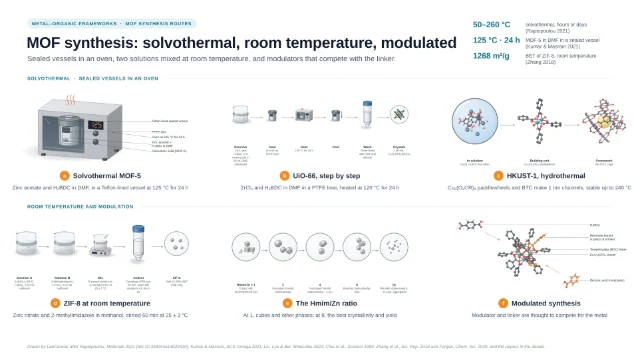
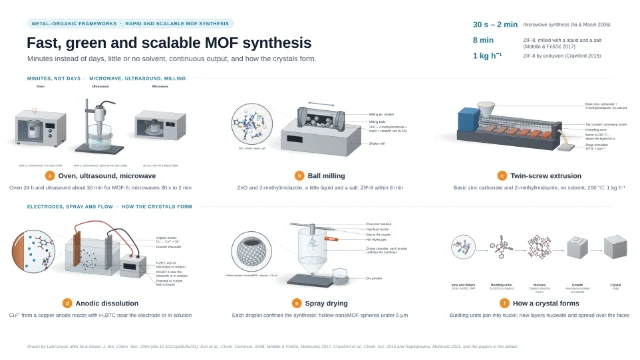
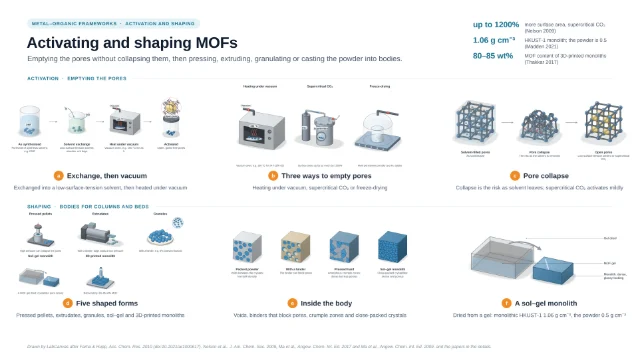
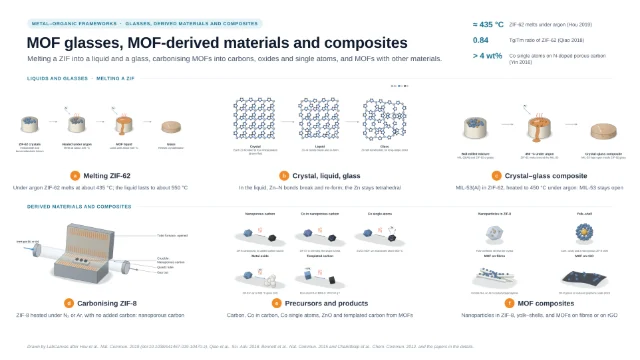
MOF films and membranes on one page: layer-by-layer growth of SURMOFs on a self-assembled monolayer, vapour-phase conversion of ZnO into ZIF-8, the six ways to make a film (with Langmuir–Blodgett and patterning), the kinds of membrane (supported, mixed-matrix, nanosheet, hollow-fibre), seeded growth of a ZIF-8 membrane and molecular sieving of propylene from propane. Every step and number is quoted from the cited papers.
Updated 16 cited papers45 editable layers

At a glance
- Category
- MOF guides
- Method
- Thin films and membranes
- Starting materials
- Thiol self-assembled monolayers on gold; copper acetate and trimesic acid in ethanol; ALD ZnO and 2-methylimidazole vapour; ZIF-8 seeds on porous supports and polymer fibres
- Product
- Oriented SURMOF films, ZIF-8 films and supported, mixed-matrix, nanosheet and hollow-fibre membranes
- Key result
- Substrates, films, supports and pores drawn by LabCanvas from the cited papers; thicknesses, crystal counts and colours that no paper fixes are settings, and no panel is a micrograph or a permeation plot
- Figure
- 1920 × 1080 px (16:9), 45 editable layers, 6 generated objects
Step by step
- Layer by layer (SURMOF)A gold substrate first gets a thiol self-assembled monolayer (SAM) ending in –OH, –COOH or pyridine, then is dipped in the metal solution, rinsed, dipped in the linker solution and rinsed again; the number of cycles sets the thickness, and nothing deposits on a CH₃-terminated SAM. In the spray method the sample is sprayed in turn with ethanolic Cu acetate (1.0 mM), ethanol, ethanolic 1,3,5-benzenetricarboxylic acid (0.1 mM) and ethanol, and the cycle is repeated 40 times; the HKUST-1 SURMOFs grow with their (111) layers parallel to the surface (Ladnorg 2013). On SAM-coated quartz crystals, HKUST-1 films of well-defined thickness gave the diffusion coefficient of pyridine (Zybaylo 2010)
- From the vapourMetal-oxide films turn into MOFs in linker vapour: ALD ZnO and native CoO become ZIF-8 and ZIF-67 in 2-methylimidazole vapour, and the volume expansion fills narrow trenches (Krishtab 2019). MOF-CVD gives ZIF-8 films of uniform, controlled thickness even on high-aspect-ratio features, avoids the corrosion and contamination risks of solvents, and allows lift-off patterning (Stassen 2016)
- Six ways to a filmIn in-situ synthesis the substrate is dipped in a solution of both metal and linker and growth starts by nucleation on it; many such methods give polycrystalline layers of randomly oriented crystals (Ladnorg 2013). HKUST-1 seed crystals nucleated growth during a later layer-by-layer deposition and templated the final film (Brower 2017). NAFS-1, a preferentially oriented nanofilm of metalloporphyrin building units, was built at ambient temperature by combining layer-by-layer growth with the Langmuir–Blodgett method (Makiura 2010). Patterning SAMs by microcontact printing or electron-beam lithography allows highly localised deposition of SURMOF films (Zhuang 2012)
- Kinds of membranePolycrystalline membranes perform according to their microstructure, above all their grain boundaries; one-step, in-situ counter-diffusion gave well-intergrown ZIF-8 membranes with exceptionally high propylene/propane separation (Kwon 2013). In mixed-matrix membranes a MOF filler is dispersed in a polymer (Hou 2019); copper 1,4-benzenedicarboxylate nanosheets in polymers separate CO₂ from CH₄: they cover the membrane cross-section better than isotropic crystals and close unselective paths (Rodenas 2015). 1-nm-thick MOF nanosheets built molecular-sieve membranes with H₂/CO₂ selectivities above 200 (Peng 2014). ZIF-8 grown in poly(amide-imide) hollow fibres where two solvents meet reached H₂/C₃H₈ and C₃H₆/C₃H₈ separation factors of 370 and 12 (Brown 2014)
- Seeded growthZIF-8 membranes made by seeded growth in aqueous solution near room temperature separated ethane/propane, ethylene/propylene and ethylene/propane with factors of about 80, 10 and 167 (Pan 2011). Propylene/propane is currently separated by energy-intensive cryogenic distillation; ZIF-67 grown heteroepitaxially on ZIF-8 seed layers, then a further ZIF-8 growth, gave propylene/propane separation factors of about 200 (Kwon 2015)
- Sieving at the apertureThe effective aperture of ZIF-8 for molecular sieving is 4.0–4.2 Å, larger than the 3.4 Å derived from XRD; from He (2.6 Å) to iso-C₄H₁₀ (5.0 Å) the corrected diffusivity drops by 14 orders of magnitude, and as the aperture is flexible, C₄ hydrocarbons larger than it still adsorb (Zhang 2012). Optimised ZIF-8 hollow-fibre membranes reached a C₃H₆/C₃H₈ separation factor of 180 at 1 bar and 25 °C, and 90 at 9.5 bar (Eum 2016)
Strengths
- Patterned SAMs allow highly localised deposition of SURMOF films (Zhuang 2012)
- MOF-CVD gives films of uniform, controlled thickness even on high-aspect-ratio features (Stassen 2016)
- Nanosheet membranes reached H₂ permeances up to several thousand GPU (Peng 2014)
Limitations
- Heterogeneous nucleation and growth of MOF crystals on porous supports is not generally favoured (Kwon 2013)
- In mixed-matrix membranes the matrix can block pores, the filler can aggregate, and the two can adhere poorly (Hou 2019)
- Many in-situ methods give polycrystalline layers of randomly oriented crystals (Ladnorg 2013)
Papers this template follows
- Ladnorg et al., “Site-selective growth of surface-anchored metal-organic frameworks on self-assembled monolayer patterns prepared by AFM nanografting”, Beilstein J. Nanotechnol. 2013. doi:10.3762/bjnano.4.71primary
- Zybaylo et al., “A novel method to measure diffusion coefficients in porous metal-organic frameworks”, Phys. Chem. Chem. Phys. 2010. doi:10.1039/b927601gprimary
- Krishtab et al., “Vapor-deposited zeolitic imidazolate frameworks as gap-filling ultra-low-k dielectrics”, Nat. Commun. 2019. doi:10.1038/s41467-019-11703-xprimary
- Stassen et al., “Chemical vapour deposition of zeolitic imidazolate framework thin films”, Nat. Mater. 2016. doi:10.1038/nmat4509primary
- Brower et al., “Tailoring the nanoscale morphology of HKUST-1 thin films via codeposition and seeded growth”, Beilstein J. Nanotechnol. 2017. doi:10.3762/bjnano.8.230primary
- Makiura et al., “Surface nano-architecture of a metal-organic framework”, Nat. Mater. 2010. doi:10.1038/nmat2769primary
- Zhuang, Friedel & Terfort, “The oriented and patterned growth of fluorescent metal-organic frameworks onto functionalized surfaces”, Beilstein J. Nanotechnol. 2012. doi:10.3762/bjnano.3.66primary
- Kwon & Jeong, “In situ synthesis of thin zeolitic-imidazolate framework ZIF-8 membranes exhibiting exceptionally high propylene/propane separation”, J. Am. Chem. Soc. 2013. doi:10.1021/ja403849cprimary
- Hou et al., “Metal-organic framework crystal-glass composites”, Nat. Commun. 2019. doi:10.1038/s41467-019-10470-zprimary
- Rodenas et al., “Metal-organic framework nanosheets in polymer composite materials for gas separation”, Nat. Mater. 2015. doi:10.1038/nmat4113primary
- Peng et al., “Metal-organic framework nanosheets as building blocks for molecular sieving membranes”, Science 2014. doi:10.1126/science.1254227primary
- Brown et al., “Interfacial microfluidic processing of metal-organic framework hollow fiber membranes”, Science 2014. doi:10.1126/science.1251181primary
- Pan & Lai, “Sharp separation of C2/C3 hydrocarbon mixtures by zeolitic imidazolate framework-8 (ZIF-8) membranes synthesized in aqueous solutions”, Chem. Commun. 2011. doi:10.1039/c1cc14051eprimary
- Kwon et al., “Heteroepitaxially grown zeolitic imidazolate framework membranes with unprecedented propylene/propane separation performances”, J. Am. Chem. Soc. 2015. doi:10.1021/jacs.5b06730primary
- Zhang et al., “Unexpected molecular sieving properties of zeolitic imidazolate framework-8”, J. Phys. Chem. Lett. 2012. doi:10.1021/jz300855aprimary
- Eum et al., “ZIF-8 membranes via interfacial microfluidic processing in polymeric hollow fibers: efficient propylene separation at elevated pressures”, ACS Appl. Mater. Interfaces 2016. doi:10.1021/acsami.6b08801primary
Drawn by LabCanvas after Ladnorg et al., Beilstein J. Nanotechnol. 2013 (doi:10.3762/bjnano.4.71), Krishtab et al., Nat. Commun. 2019, Stassen et al., Nat. Mater. 2016 and Kwon & Jeong, J. Am. Chem. Soc. 2013, and the papers in the details.
How templates are written and checked: editorial guidelines.
Questions
What does the “MOF thin films and membranes” template show?
MOF films and membranes on one page: layer-by-layer growth of SURMOFs on a self-assembled monolayer, vapour-phase conversion of ZnO into ZIF-8, the six ways to make a film (with Langmuir–Blodgett and patterning), the kinds of membrane (supported, mixed-matrix, nanosheet, hollow-fibre), seeded growth of a ZIF-8 membrane and molecular sieving of propylene from propane. Every step and number is quoted from the cited papers.
What are the steps shown in “MOF thin films and membranes”?
1. Layer by layer (SURMOF): A gold substrate first gets a thiol self-assembled monolayer (SAM) ending in –OH, –COOH or pyridine, then is dipped in the metal solution, rinsed, dipped in the linker solution and rinsed again; the number of cycles sets the thickness, and nothing deposits on a CH₃-terminated SAM. In the spray method the sample is sprayed in turn with ethanolic Cu acetate (1.0 mM), ethanol, ethanolic 1,3,5-benzenetricarboxylic acid (0.1 mM) and ethanol, and the cycle is repeated 40 times; the HKUST-1 SURMOFs grow with their (111) layers parallel to the surface (Ladnorg 2013). On SAM-coated quartz crystals, HKUST-1 films of well-defined thickness gave the diffusion coefficient of pyridine (Zybaylo 2010). 2. From the vapour: Metal-oxide films turn into MOFs in linker vapour: ALD ZnO and native CoO become ZIF-8 and ZIF-67 in 2-methylimidazole vapour, and the volume expansion fills narrow trenches (Krishtab 2019). MOF-CVD gives ZIF-8 films of uniform, controlled thickness even on high-aspect-ratio features, avoids the corrosion and contamination risks of solvents, and allows lift-off patterning (Stassen 2016). 3. Six ways to a film: In in-situ synthesis the substrate is dipped in a solution of both metal and linker and growth starts by nucleation on it; many such methods give polycrystalline layers of randomly oriented crystals (Ladnorg 2013). HKUST-1 seed crystals nucleated growth during a later layer-by-layer deposition and templated the final film (Brower 2017). NAFS-1, a preferentially oriented nanofilm of metalloporphyrin building units, was built at ambient temperature by combining layer-by-layer growth with the Langmuir–Blodgett method (Makiura 2010). Patterning SAMs by microcontact printing or electron-beam lithography allows highly localised deposition of SURMOF films (Zhuang 2012). 4. Kinds of membrane: Polycrystalline membranes perform according to their microstructure, above all their grain boundaries; one-step, in-situ counter-diffusion gave well-intergrown ZIF-8 membranes with exceptionally high propylene/propane separation (Kwon 2013). In mixed-matrix membranes a MOF filler is dispersed in a polymer (Hou 2019); copper 1,4-benzenedicarboxylate nanosheets in polymers separate CO₂ from CH₄: they cover the membrane cross-section better than isotropic crystals and close unselective paths (Rodenas 2015). 1-nm-thick MOF nanosheets built molecular-sieve membranes with H₂/CO₂ selectivities above 200 (Peng 2014). ZIF-8 grown in poly(amide-imide) hollow fibres where two solvents meet reached H₂/C₃H₈ and C₃H₆/C₃H₈ separation factors of 370 and 12 (Brown 2014). 5. Seeded growth: ZIF-8 membranes made by seeded growth in aqueous solution near room temperature separated ethane/propane, ethylene/propylene and ethylene/propane with factors of about 80, 10 and 167 (Pan 2011). Propylene/propane is currently separated by energy-intensive cryogenic distillation; ZIF-67 grown heteroepitaxially on ZIF-8 seed layers, then a further ZIF-8 growth, gave propylene/propane separation factors of about 200 (Kwon 2015). 6. Sieving at the aperture: The effective aperture of ZIF-8 for molecular sieving is 4.0–4.2 Å, larger than the 3.4 Å derived from XRD; from He (2.6 Å) to iso-C₄H₁₀ (5.0 Å) the corrected diffusivity drops by 14 orders of magnitude, and as the aperture is flexible, C₄ hydrocarbons larger than it still adsorb (Zhang 2012). Optimised ZIF-8 hollow-fibre membranes reached a C₃H₆/C₃H₈ separation factor of 180 at 1 bar and 25 °C, and 90 at 9.5 bar (Eum 2016).
What are the starting materials and the product?
Starting materials: Thiol self-assembled monolayers on gold; copper acetate and trimesic acid in ethanol; ALD ZnO and 2-methylimidazole vapour; ZIF-8 seeds on porous supports and polymer fibres. Product: Oriented SURMOF films, ZIF-8 films and supported, mixed-matrix, nanosheet and hollow-fibre membranes.
Which papers is “MOF thin films and membranes” based on?
Ladnorg et al., “Site-selective growth of surface-anchored metal-organic frameworks on self-assembled monolayer patterns prepared by AFM nanografting”, Beilstein J. Nanotechnol. 2013 (doi:10.3762/bjnano.4.71); Zybaylo et al., “A novel method to measure diffusion coefficients in porous metal-organic frameworks”, Phys. Chem. Chem. Phys. 2010 (doi:10.1039/b927601g); Krishtab et al., “Vapor-deposited zeolitic imidazolate frameworks as gap-filling ultra-low-k dielectrics”, Nat. Commun. 2019 (doi:10.1038/s41467-019-11703-x); Stassen et al., “Chemical vapour deposition of zeolitic imidazolate framework thin films”, Nat. Mater. 2016 (doi:10.1038/nmat4509); Brower et al., “Tailoring the nanoscale morphology of HKUST-1 thin films via codeposition and seeded growth”, Beilstein J. Nanotechnol. 2017 (doi:10.3762/bjnano.8.230); Makiura et al., “Surface nano-architecture of a metal-organic framework”, Nat. Mater. 2010 (doi:10.1038/nmat2769); Zhuang, Friedel & Terfort, “The oriented and patterned growth of fluorescent metal-organic frameworks onto functionalized surfaces”, Beilstein J. Nanotechnol. 2012 (doi:10.3762/bjnano.3.66); Kwon & Jeong, “In situ synthesis of thin zeolitic-imidazolate framework ZIF-8 membranes exhibiting exceptionally high propylene/propane separation”, J. Am. Chem. Soc. 2013 (doi:10.1021/ja403849c); Hou et al., “Metal-organic framework crystal-glass composites”, Nat. Commun. 2019 (doi:10.1038/s41467-019-10470-z); Rodenas et al., “Metal-organic framework nanosheets in polymer composite materials for gas separation”, Nat. Mater. 2015 (doi:10.1038/nmat4113); Peng et al., “Metal-organic framework nanosheets as building blocks for molecular sieving membranes”, Science 2014 (doi:10.1126/science.1254227); Brown et al., “Interfacial microfluidic processing of metal-organic framework hollow fiber membranes”, Science 2014 (doi:10.1126/science.1251181); Pan & Lai, “Sharp separation of C2/C3 hydrocarbon mixtures by zeolitic imidazolate framework-8 (ZIF-8) membranes synthesized in aqueous solutions”, Chem. Commun. 2011 (doi:10.1039/c1cc14051e); Kwon et al., “Heteroepitaxially grown zeolitic imidazolate framework membranes with unprecedented propylene/propane separation performances”, J. Am. Chem. Soc. 2015 (doi:10.1021/jacs.5b06730); Zhang et al., “Unexpected molecular sieving properties of zeolitic imidazolate framework-8”, J. Phys. Chem. Lett. 2012 (doi:10.1021/jz300855a); Eum et al., “ZIF-8 membranes via interfacial microfluidic processing in polymeric hollow fibers: efficient propylene separation at elevated pressures”, ACS Appl. Mater. Interfaces 2016 (doi:10.1021/acsami.6b08801).
Can I edit the “MOF thin films and membranes” template?
Yes. Open it in the LabCanvas editor: all 45 layers are editable, including 6 generated objects (structures, plots, equipment) with their own settings. Change the text, colours and layout, then export PNG, TIFF, SVG or PDF.
Do I need an account to use this template?
Not to view it here. To open and edit it, sign in to LabCanvas or create a free account (the free plan keeps up to 3 designs). Downloading the figure is part of LabCanvas Pro (US$19 a month or US$199 a year).