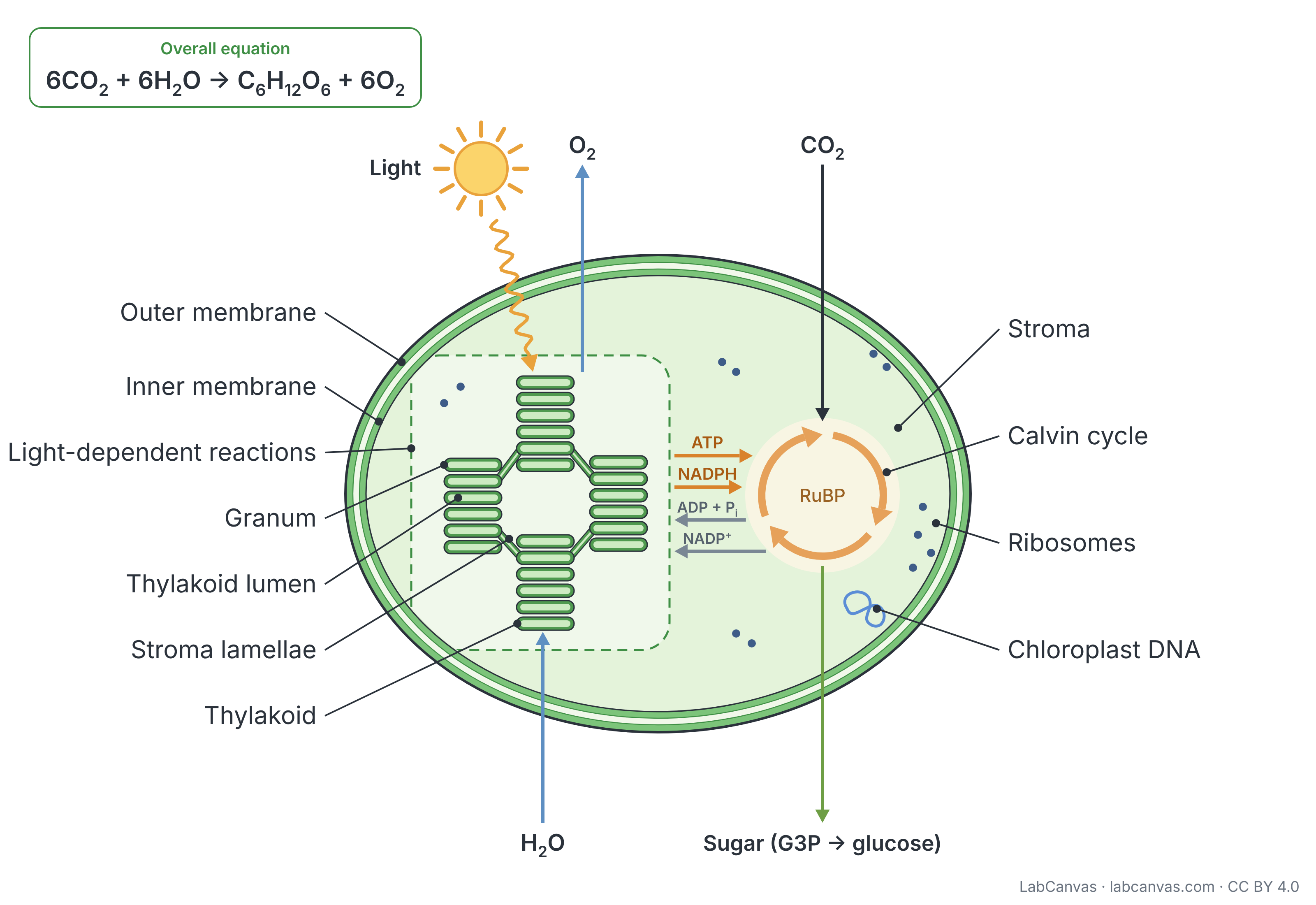
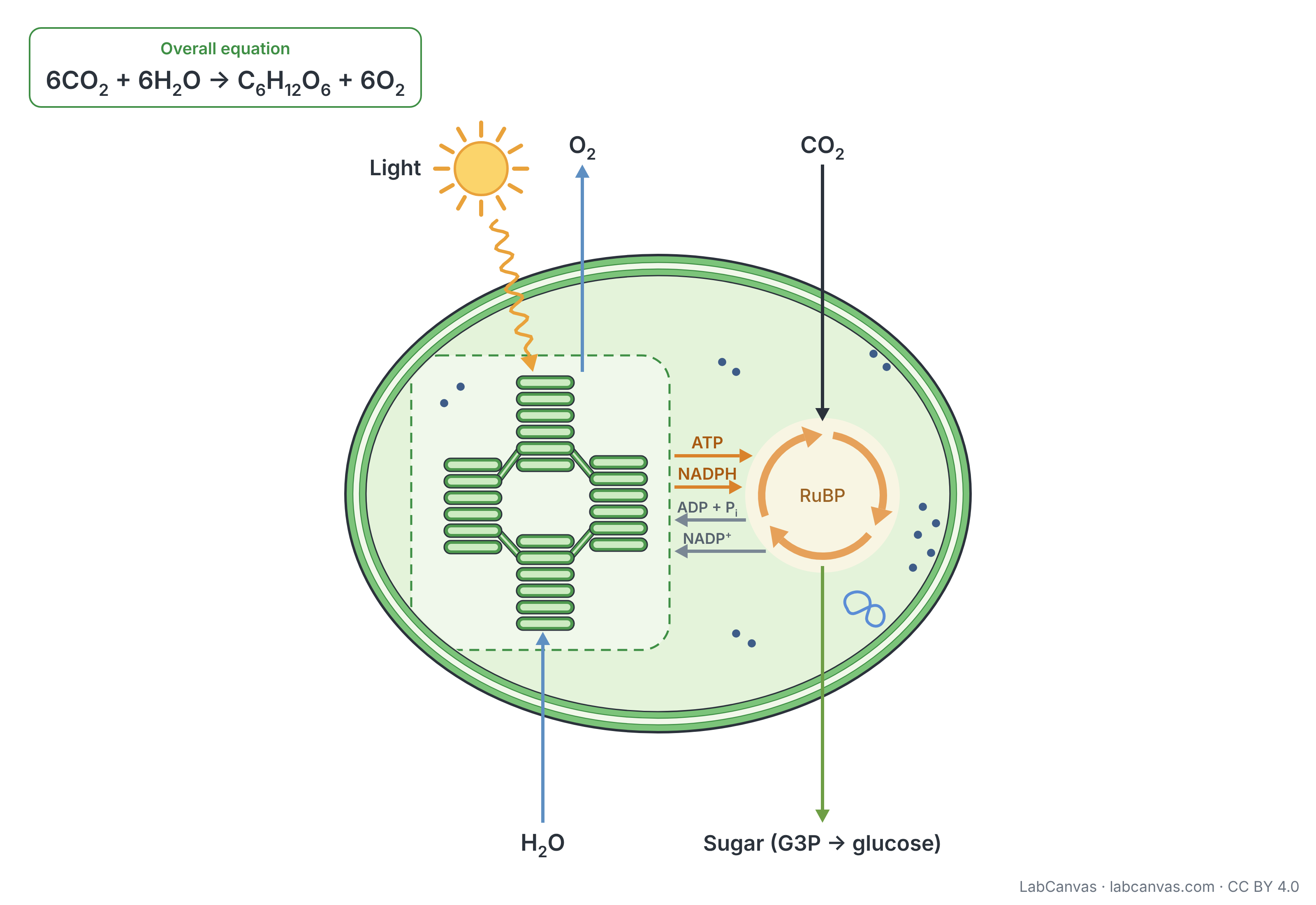
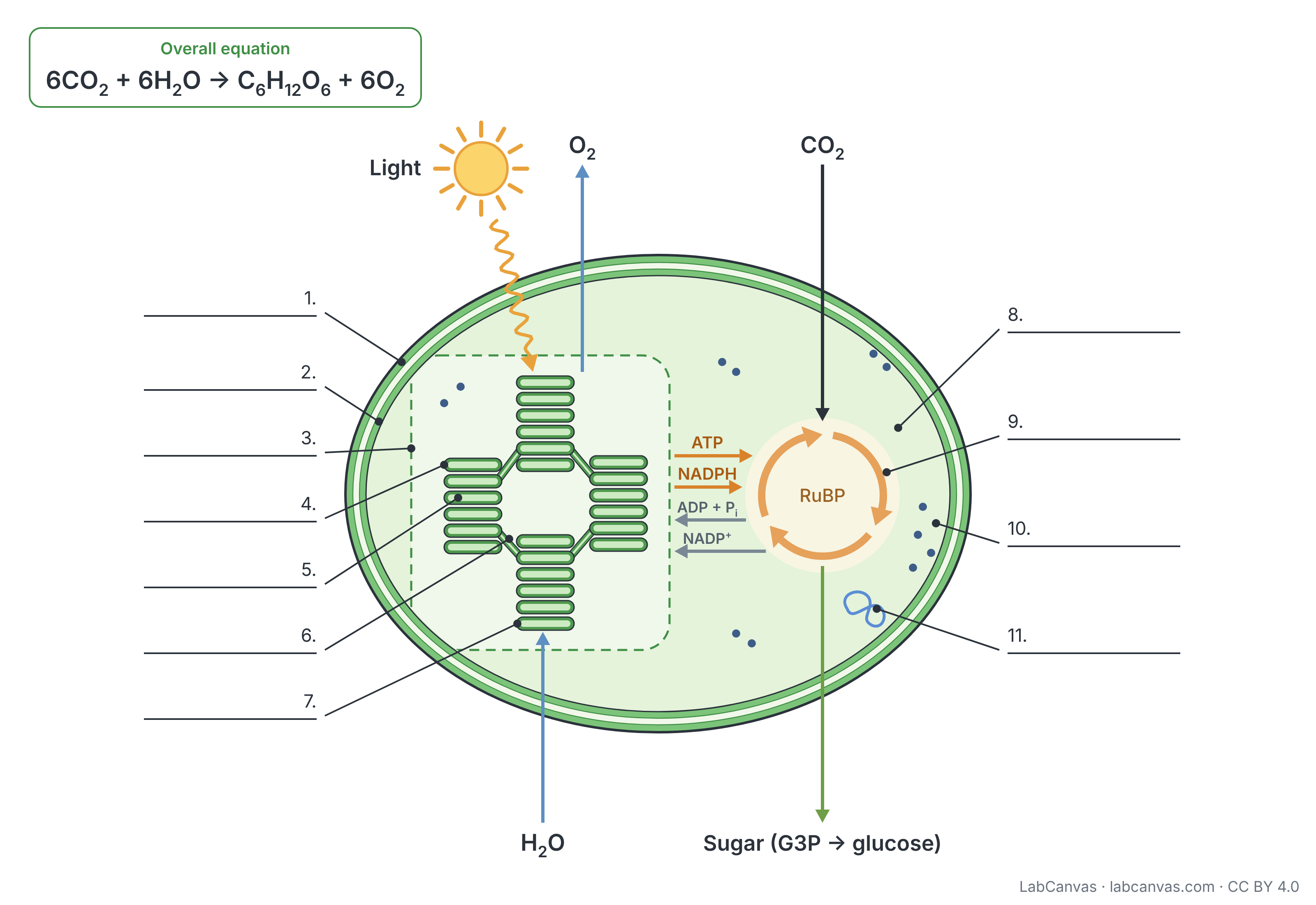
Photosynthesis diagram with labels
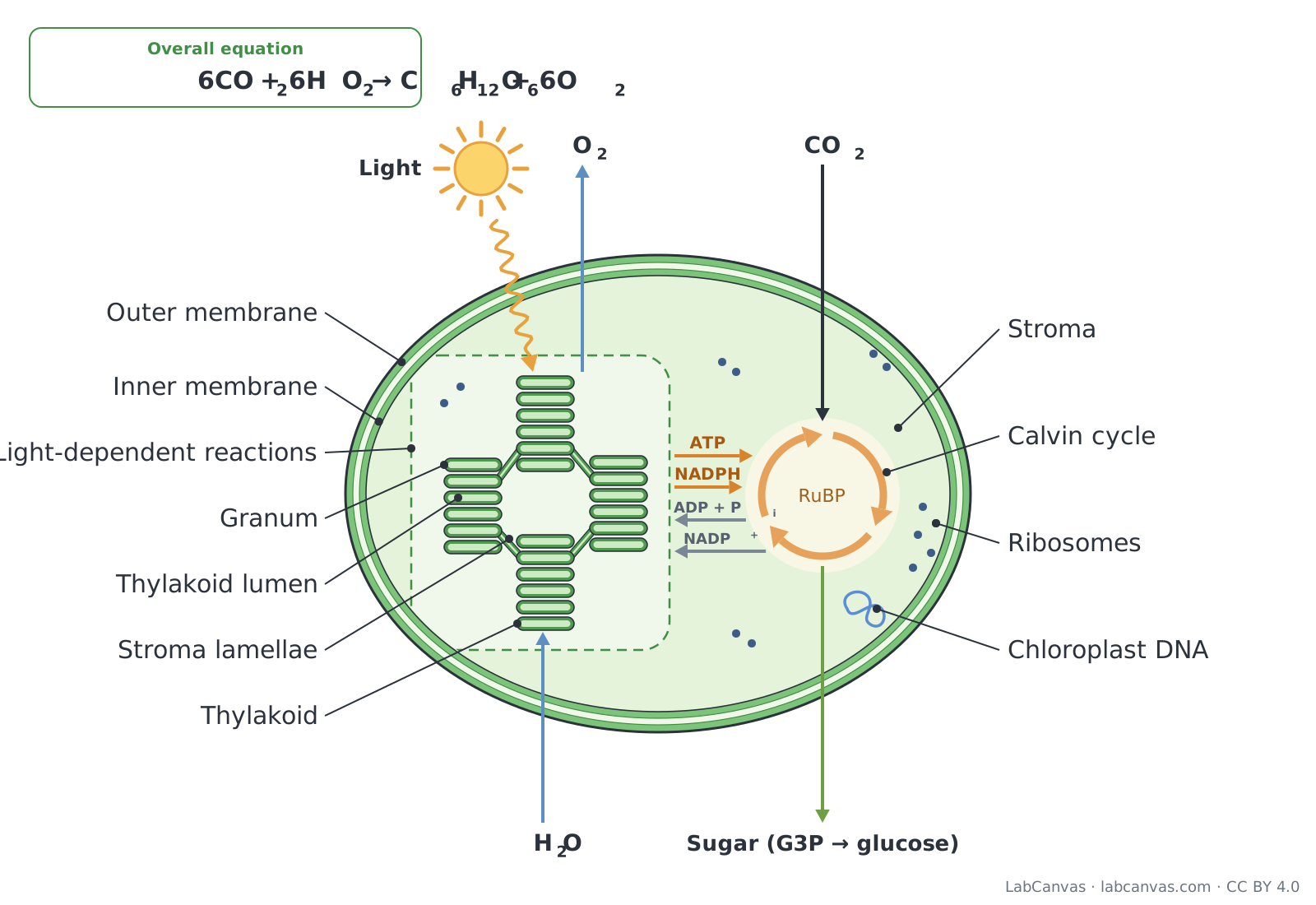
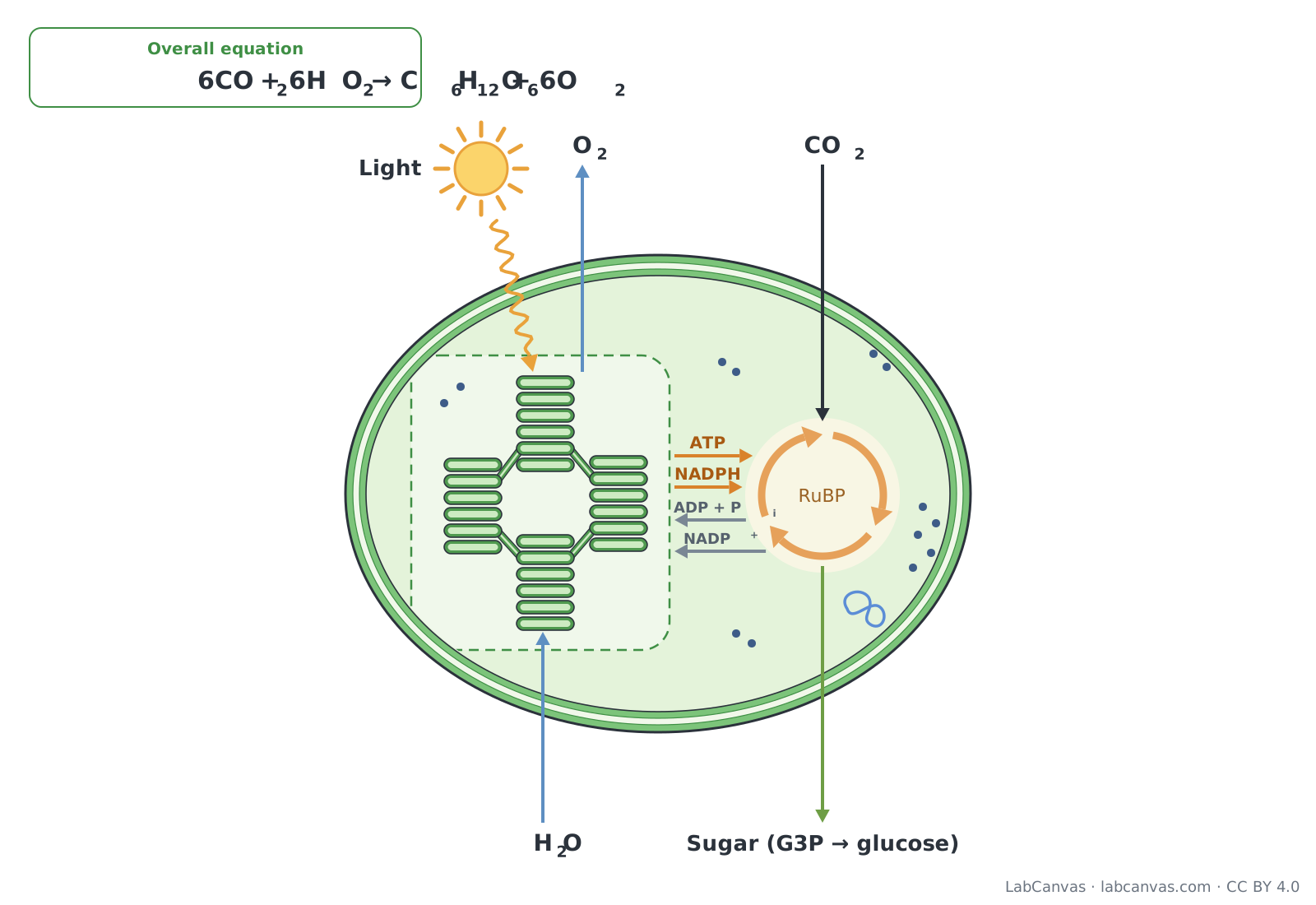
Photosynthesis happens in the chloroplast in two linked stages. The light-dependent reactions take place on the thylakoid membranes: they absorb light, split water and release oxygen, and make ATP and NADPH. The Calvin cycle takes place in the stroma: it uses that ATP and NADPH to turn carbon dioxide into sugar, sending ADP and NADP+ back to be recharged. Overall, 6CO2 + 6H2O gives C6H12O6 + 6O2.
Last updated
Download the photosynthesis diagram
Free to use in homework, teaching, slides, posters and publications under CC BY 4.0. Please credit: Photosynthesis diagram by LabCanvas (labcanvas.com), CC BY 4.0
Parts of the photosynthesis and what they do
| # | Part | What it is or does |
|---|---|---|
| 1 | Outer membrane | The outer of the two membranes of the chloroplast envelope; it surrounds the whole organelle. |
| 2 | Inner membrane | The inner envelope membrane, just inside the outer one; it encloses the stroma and controls what passes into and out of it. |
| 3 | Light-dependent reactions | First stage of photosynthesis, on the thylakoid membranes: light energy splits water, releases O2 and makes ATP and NADPH. |
| 4 | Granum | A stack of thylakoids (plural grana); stacking packs a large area of light-absorbing membrane into a small space. |
| 5 | Thylakoid lumen | The space enclosed by each thylakoid membrane; hydrogen ions build up here and flow out through ATP synthase to make ATP. |
| 6 | Stroma lamellae | Single thylakoid membranes that run through the stroma and link one granum to the next. |
| 7 | Thylakoid | A flattened, disc-shaped membrane sac; its membrane holds chlorophyll, the photosystems and the electron transport chain. |
| 8 | Stroma | The fluid inside the inner membrane that surrounds the thylakoids; it holds the enzymes of the Calvin cycle. |
| 9 | Calvin cycle | Second stage, in the stroma: the enzyme RuBisCO fixes CO2 onto RuBP, and ATP and NADPH are used to make the sugar G3P. |
| 10 | Ribosomes | Small RNA and protein particles in the stroma that make some of the chloroplast's own proteins. |
| 11 | Chloroplast DNA | The chloroplast's own small, circular DNA, a sign that chloroplasts descend from photosynthetic bacteria. |
How to label a photosynthesis diagram
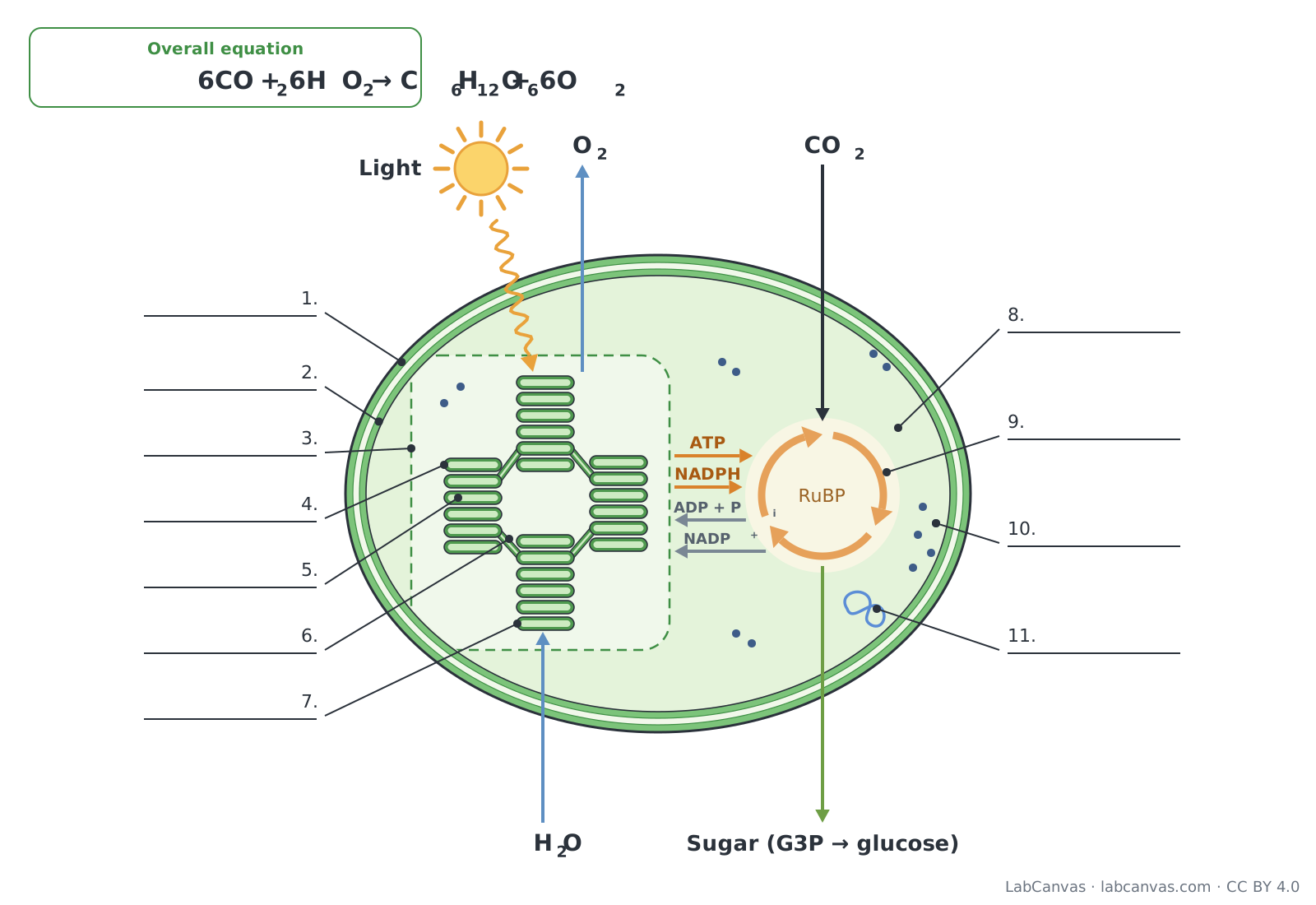
- Start with the envelopeLabel the outermost line as the outer membrane and the line just inside it as the inner membrane. Together they form the double-membrane envelope.
- Find the thylakoidsThe flattened green discs are thylakoids. Label one stack of them as a granum, the pale space inside a disc as the thylakoid lumen, and a single membrane joining two stacks as a stroma lamella.
- Fill in the space around themThe fluid that surrounds the thylakoids, inside the inner membrane, is the stroma. Find the small dots (ribosomes) and the loop of chloroplast DNA in it.
- Mark stage 1 on the thylakoidsThe panel around the grana is the light-dependent reactions: light and water go in, oxygen comes out, and ATP and NADPH are made.
- Mark stage 2 in the stromaThe circle of arrows is the Calvin cycle: carbon dioxide goes in, sugar comes out, ATP and NADPH are used, and ADP + Pi and NADP+ go back to the thylakoids.
- Check with the equationEvery input and output on your diagram should appear in the overall equation 6CO2 + 6H2O to C6H12O6 + 6O2. Then compare with the answer key.
Light-dependent reactions vs Calvin cycle
| Feature | Light-dependent reactions | Calvin cycle |
|---|---|---|
| Where in the chloroplast | Thylakoid membranes | Stroma |
| Needs light directly? | Yes | No (also called the light-independent reactions) |
| Takes in | Light energy, H2O, ADP + Pi, NADP+ | CO2, ATP, NADPH |
| Gives out | O2, ATP, NADPH | Sugar (G3P), ADP + Pi, NADP+ |
| Main job | Turn light energy into chemical energy (ATP and NADPH) | Use that energy to fix carbon dioxide into sugar |
| Key players | Chlorophyll, photosystems II and I, electron transport chain, ATP synthase | RuBisCO, RuBP |
Stage 1: the light-dependent reactions
Chlorophyll and other pigments in the thylakoid membranes absorb light. The membranes hold two photosystems, photosystem II and photosystem I. Energy absorbed by photosystem II is used to split water, which releases oxygen as a by-product and supplies electrons. As those electrons pass along an electron transport chain, hydrogen ions are pumped into the thylakoid lumen; they flow back out through ATP synthase, which makes ATP (chemiosmosis). Photosystem I absorbs more light and passes the electrons to NADP+, forming NADPH.
Stage 2: the Calvin cycle
The Calvin cycle runs in the stroma and has three stages. In fixation, the enzyme RuBisCO joins carbon dioxide to a five-carbon molecule called RuBP. In reduction, ATP and NADPH from stage 1 turn the products into a three-carbon sugar, G3P. In regeneration, most of the G3P is used, with more ATP, to rebuild RuBP so the cycle can continue. One G3P leaves the cycle for every three turns, and two G3P can be combined to make one glucose. The spent ADP and NADP+ return to the thylakoids to be recharged.
Why the two stages depend on each other
The light-dependent reactions make ATP and NADPH but cannot store energy for long, and the Calvin cycle cannot run without them. Together they convert light energy into chemical energy stored in sugar. Photosynthesis and cellular respiration form a cycle: the sugar and oxygen that photosynthesis produces are used in respiration, which releases carbon dioxide and water that photosynthesis takes in again.
Quick quiz
1. Where do the light-dependent reactions take place?
- Stroma
- Thylakoid membranes
- Outer membrane
- Cytoplasm
Answer: b) Thylakoid membranes. Pigments, photosystems and the electron transport chain are in the thylakoid membranes.
2. What is a stack of thylakoids called?
- Stroma
- Lamella
- Granum
- Lumen
Answer: c) Granum. A granum (plural grana) is a stack of thylakoids.
3. Which molecule is split to release oxygen?
- Carbon dioxide
- Glucose
- Water
- NADPH
Answer: c) Water. Water is split in the light-dependent reactions, and its oxygen is released.
4. What does the Calvin cycle use from the light-dependent reactions?
- O2 and H2O
- ATP and NADPH
- CO2 and glucose
- ADP and NADP+
Answer: b) ATP and NADPH. ATP and NADPH supply the energy and electrons needed to turn CO2 into sugar.
5. Which enzyme fixes carbon dioxide in the Calvin cycle?
- ATP synthase
- RuBisCO
- DNA polymerase
- Amylase
Answer: b) RuBisCO. RuBisCO joins CO2 to RuBP in the fixation stage.
Frequently asked questions
What are the parts of a chloroplast?
A chloroplast has a double-membrane envelope (outer and inner membrane), a fluid called the stroma, and inside it thylakoids, disc-shaped membrane sacs stacked into grana and linked by stroma lamellae. Each thylakoid encloses a space called the lumen. The stroma also contains the chloroplast's own circular DNA and ribosomes.
Where does photosynthesis take place?
In plants, photosynthesis takes place in chloroplasts, mostly in the mesophyll cells of leaves. The light-dependent reactions happen on the thylakoid membranes, and the Calvin cycle happens in the stroma.
What is the equation for photosynthesis?
The overall equation is 6CO2 + 6H2O gives C6H12O6 + 6O2: six molecules of carbon dioxide and six of water, using light energy, make one molecule of glucose and six of oxygen.
What are the two stages of photosynthesis?
The light-dependent reactions, on the thylakoid membranes, use light to make ATP and NADPH and release oxygen from water. The Calvin cycle (light-independent reactions), in the stroma, uses that ATP and NADPH to turn carbon dioxide into sugar.
Where does the oxygen from photosynthesis come from?
The oxygen comes from water. Water molecules are split during the light-dependent reactions to replace electrons lost by photosystem II, and oxygen is released as a by-product.
What is the difference between a thylakoid and a granum?
A thylakoid is a single flattened membrane sac. A granum is a stack of thylakoids. Grana are linked to one another by stroma lamellae.
Does the Calvin cycle need light?
Not directly, which is why it is also called the light-independent reactions. It does depend on the ATP and NADPH made by the light-dependent reactions, so in practice it runs while light is available.
Sources
- OpenStax Biology 2e, 8.1 Overview of Photosynthesis (CC BY 4.0)
- OpenStax Biology 2e, 8.2 The Light-Dependent Reactions of Photosynthesis (CC BY 4.0)
- OpenStax Biology 2e, 8.3 Using Light Energy to Make Organic Molecules (CC BY 4.0)
Facts on this page follow these introductory textbooks (OpenStax, CC BY 4.0). The diagram is a simplified illustration; organelles are not drawn to scale.
More free diagrams
Make your own science diagrams
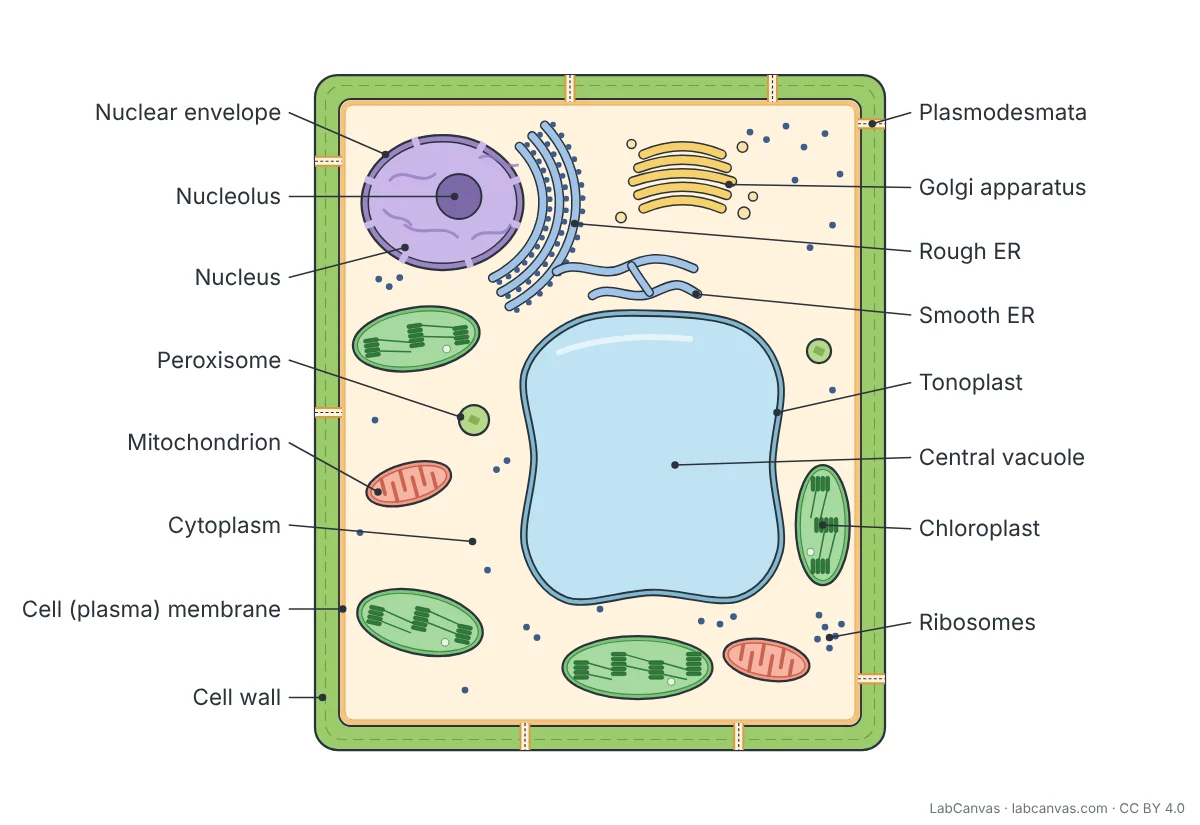
LabCanvas is a browser workspace for scientific figures, slides and posters, with adjustable cells, organelles and molecules.
Edit this diagram