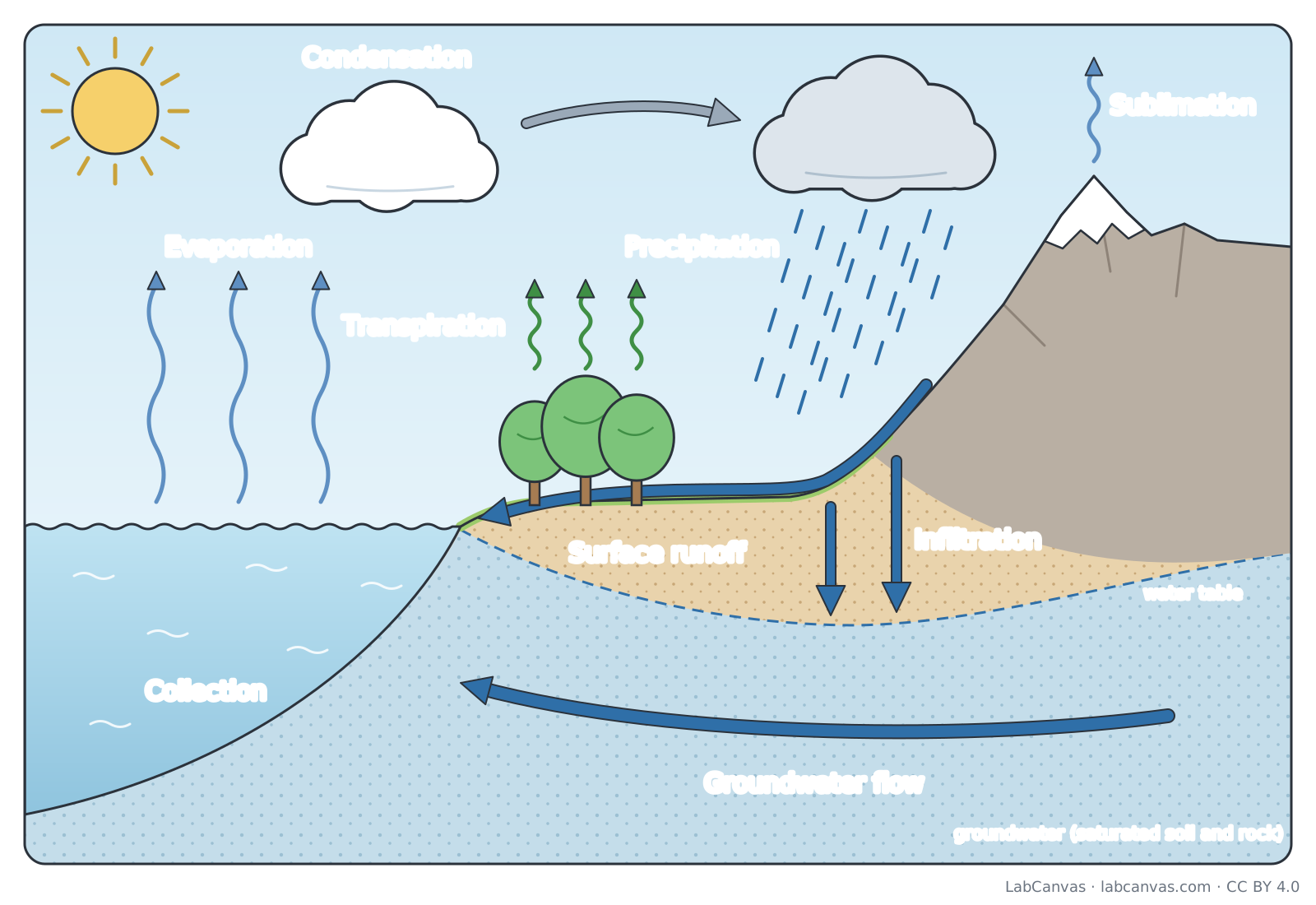
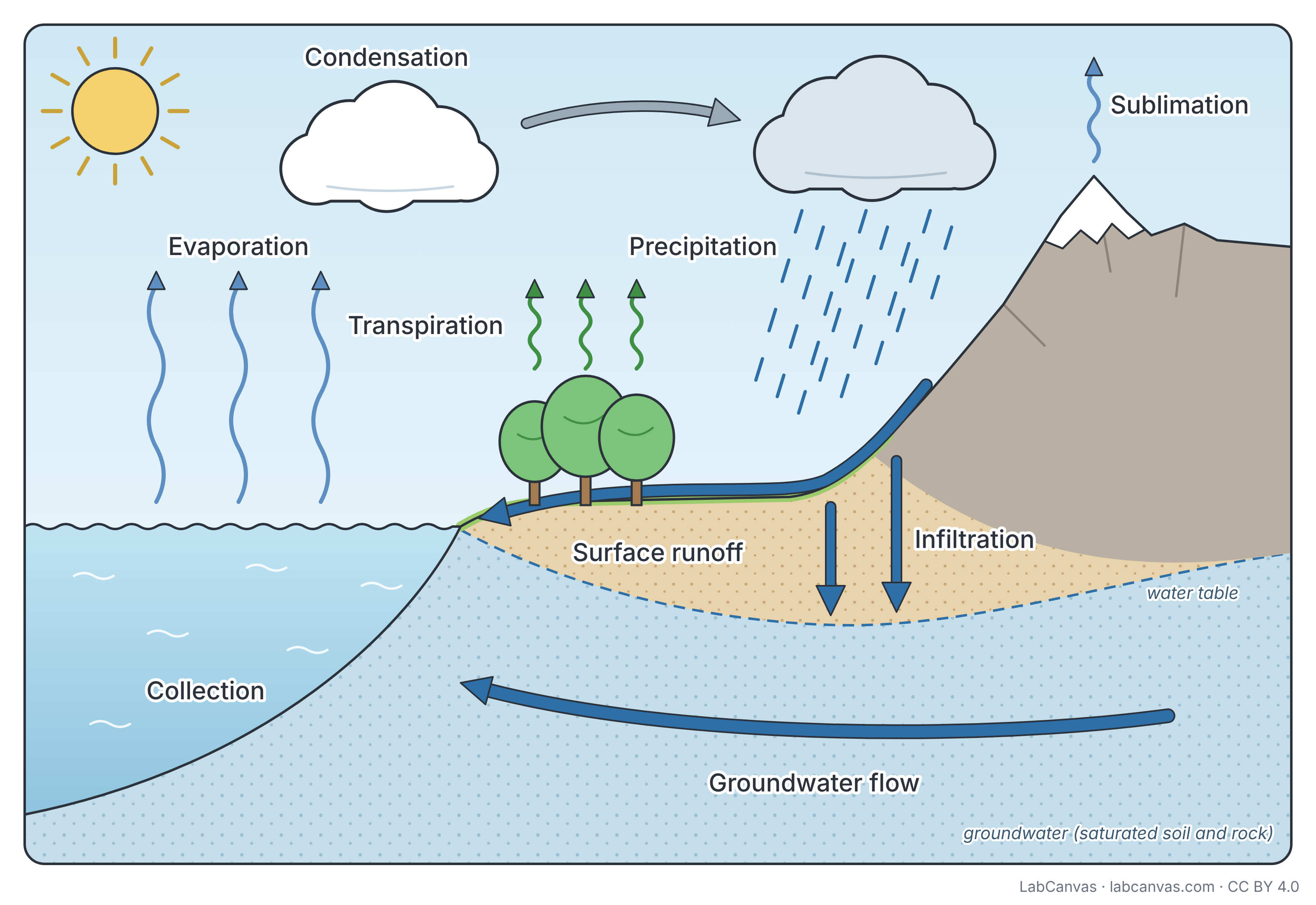
The water cycle labeled diagram
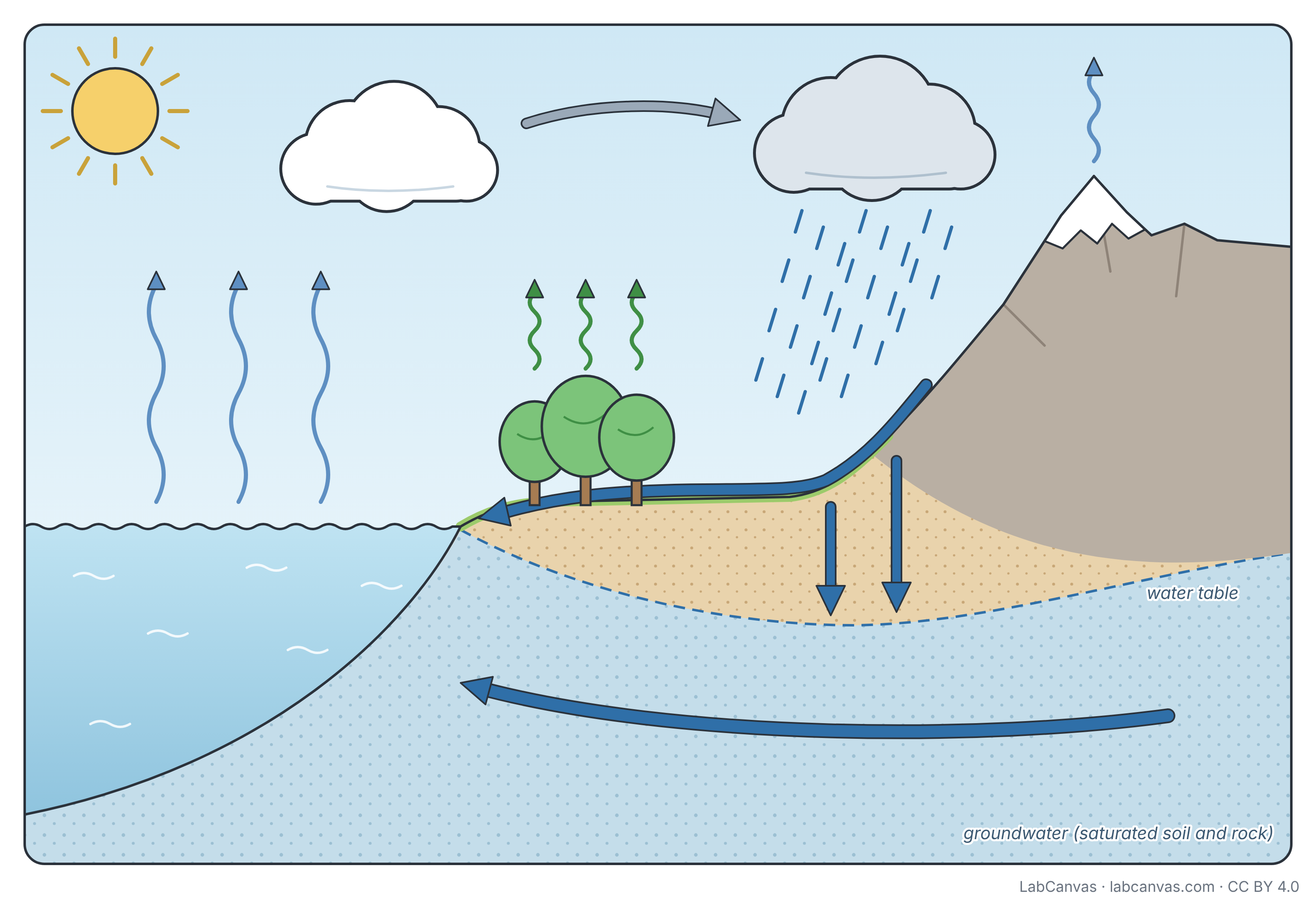
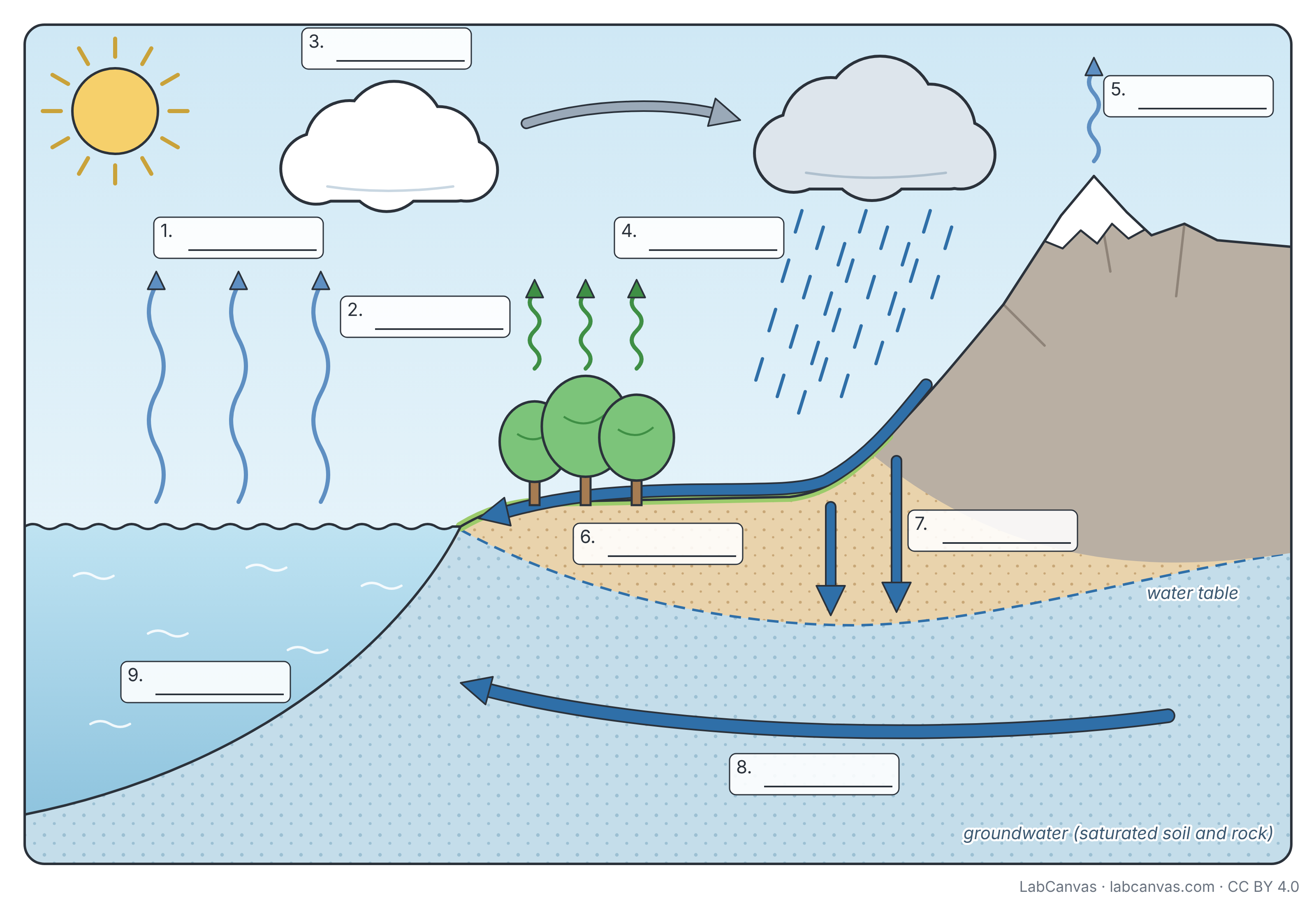
The water cycle (hydrologic cycle) is the continuous movement of water between the oceans, the air and the land, powered by energy from the sun. Water evaporates from the ocean, transpires from plants and sublimates from snow and ice; the vapour condenses into clouds and falls as precipitation, then runs off the surface or infiltrates the ground and flows back to the ocean, where it collects. This free diagram labels 9 processes and comes unlabelled and as a numbered worksheet with an answer key.
Last updated
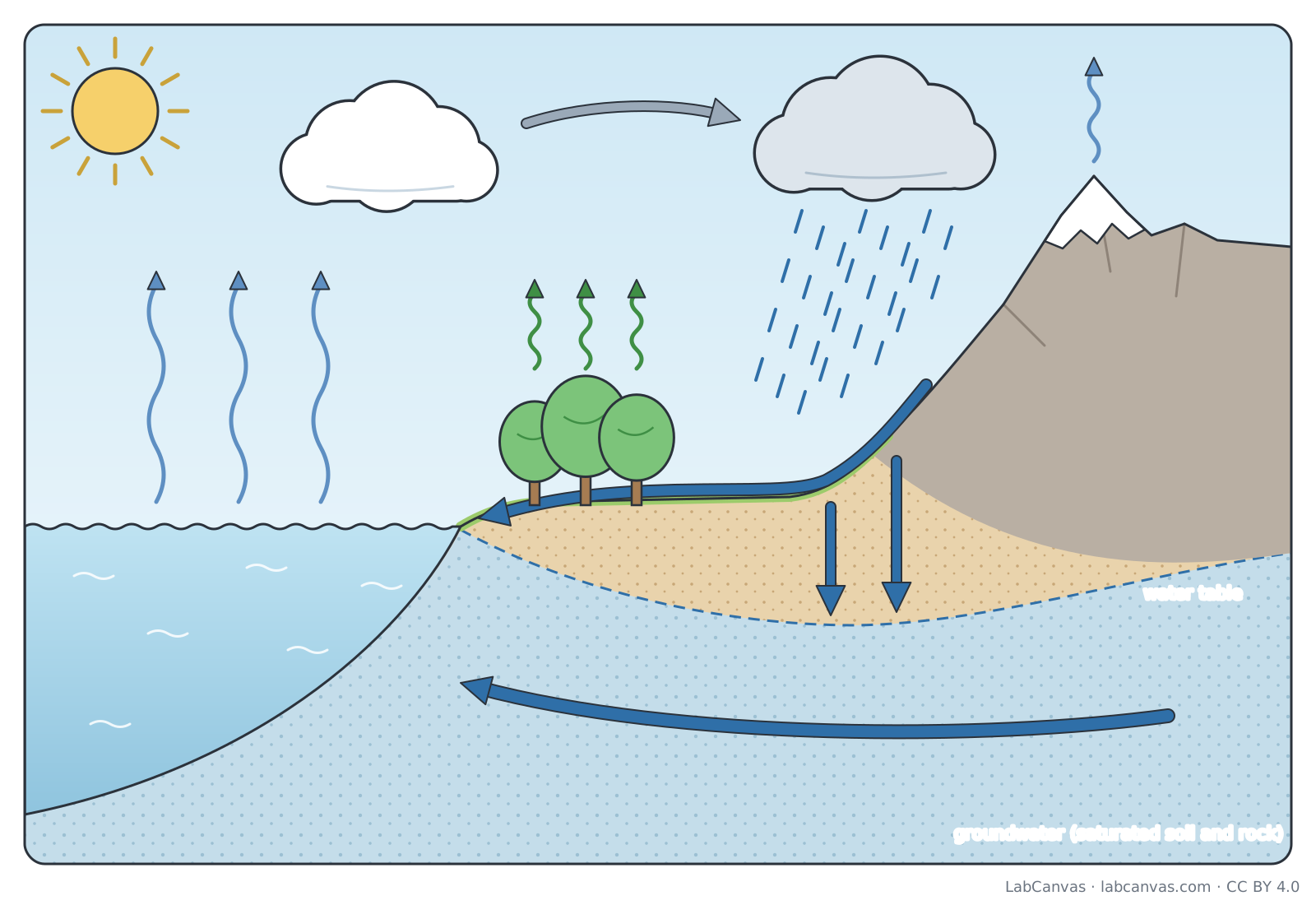
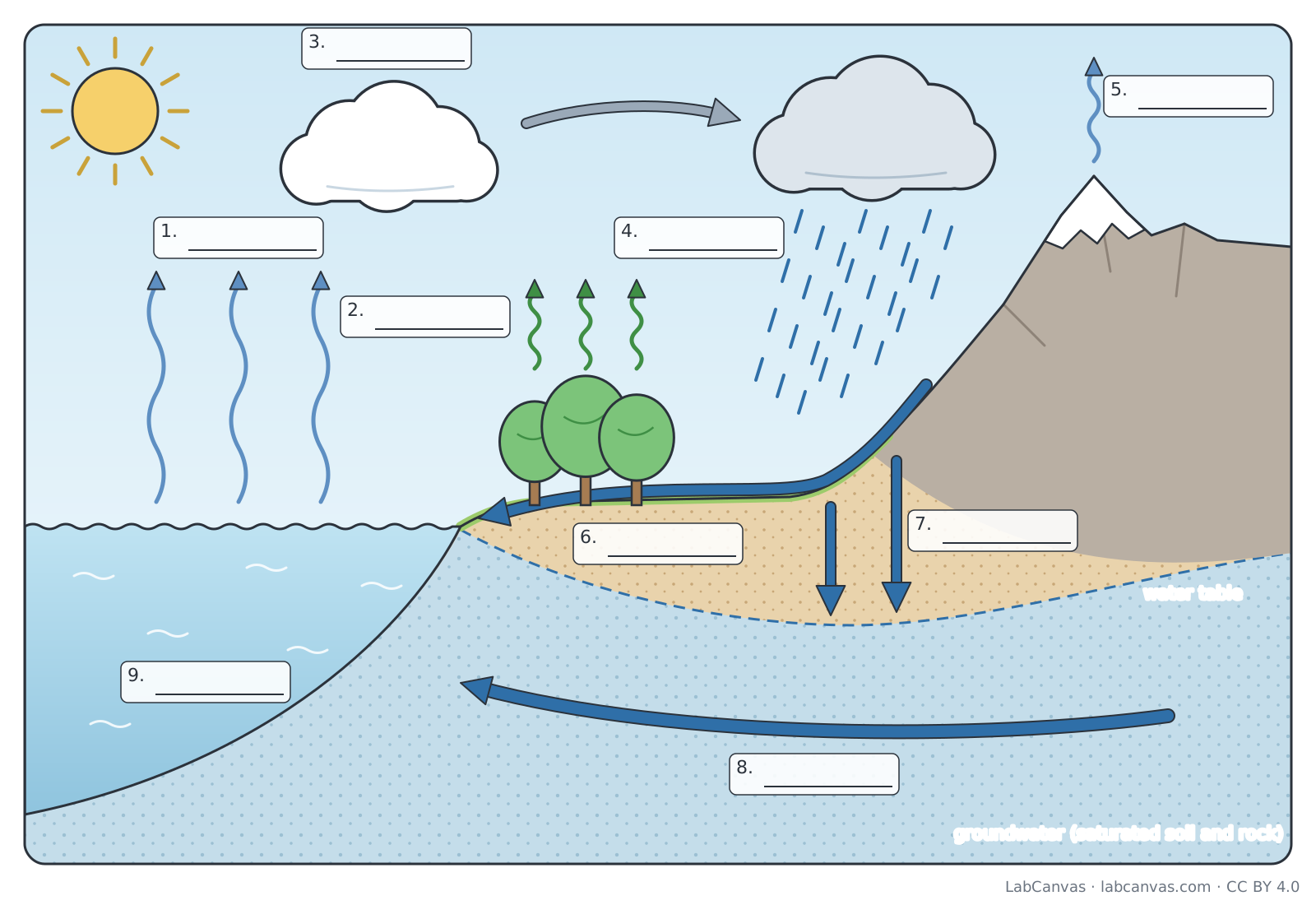
Download the water cycle diagram
Free to use in homework, teaching, slides, posters and publications under CC BY 4.0. Please credit: Water cycle diagram by LabCanvas (labcanvas.com), CC BY 4.0
Parts of the water cycle and what they do
| # | Part | What it is or does |
|---|---|---|
| 1 | Evaporation | The sun heats liquid water in the ocean, lakes and rivers and turns it into water vapour that rises into the air. |
| 2 | Transpiration | Plants take up water through their roots and release it as water vapour from their leaves. |
| 3 | Condensation | Rising water vapour cools and turns back into tiny liquid droplets or ice crystals, which form clouds. |
| 4 | Precipitation | Water falls from clouds to the ground as rain, snow, sleet or hail when the droplets or crystals grow heavy enough. |
| 5 | Sublimation | Ice and snow turn straight into water vapour without melting first. |
| 6 | Surface runoff | Water that does not soak in flows over the land surface into streams and rivers and back to the ocean. |
| 7 | Infiltration | Water soaks down into the soil and through rock until it reaches the water table. |
| 8 | Groundwater flow | Water stored underground in soil and rock (aquifers) moves slowly through the ground and eventually seeps into rivers, lakes and the ocean. |
| 9 | Collection | Water gathers in oceans, lakes and other bodies of water (and as ice and groundwater) before it evaporates again. |
How to label a water cycle diagram
- Start with the sun and the oceanThe sun drives the cycle. Label the wavy arrows rising from the ocean as evaporation and the ocean itself as collection.
- Find the other sources of vapourGreen wavy arrows rising from the trees show transpiration; the arrow rising straight from the snow cap shows sublimation.
- Label the skyThe cloud forming over the ocean shows condensation, and the rain falling from the cloud over the mountains is precipitation.
- Follow the water over the landThe arrow running downhill and across the land to the sea is surface runoff; the arrows pointing down into the soil show infiltration.
- Finish undergroundBelow the dashed water table, the arrow carrying water back towards the ocean is groundwater flow. Check your answers against the key.
Water cycle processes at a glance
| Process | Change of state or movement | Where it happens |
|---|---|---|
| Evaporation | Liquid to gas (water vapour) | Oceans, lakes, rivers, wet ground |
| Transpiration | Liquid to gas, through plant leaves | Plants |
| Sublimation | Solid (ice) straight to gas | Snow, glaciers and ice caps |
| Condensation | Gas to liquid droplets or ice crystals | In the atmosphere, forming clouds |
| Precipitation | Water falls as rain, snow, sleet or hail | From clouds to land and sea |
| Surface runoff | Liquid water flows over the surface | Slopes, streams and rivers |
| Infiltration | Liquid water soaks into the ground | Soil and porous rock |
| Groundwater flow | Liquid water moves slowly underground | Aquifers below the water table |
What drives the water cycle?
Energy from the sun powers the water cycle. Solar energy heats surface water so that it evaporates, and ice and snow can sublimate straight into water vapour. Plants add more vapour through transpiration; together, evaporation from land and transpiration are often called evapotranspiration. As moist air rises and cools, the vapour condenses into clouds, and gravity then brings the water back down as precipitation and pulls it downhill as runoff and groundwater flow.
Where is Earth's water stored?
Most of Earth's water is salt water in the oceans. Most of the fresh water is locked up as ice in glaciers and polar ice caps or stored underground as groundwater, so only a very small share is in lakes and rivers that are easy to reach. Water can stay in a store for very different lengths of time: it may stay in the deep ocean or in ice for a very long time, but in the atmosphere only for days.
Groundwater and the water table
When water infiltrates the ground it moves down through the soil until it reaches the water table, the top of the zone where every space in the soil and rock is filled with water. Layers of porous rock that hold and transmit this groundwater are called aquifers. Groundwater moves slowly and eventually feeds springs, streams, lakes and the ocean, which is why rivers keep flowing between rainstorms.
Quick quiz
1. Which process turns liquid water into water vapour using energy from the sun?
- Condensation
- Evaporation
- Precipitation
- Infiltration
Answer: b) Evaporation. Evaporation changes liquid water into water vapour.
2. How do clouds form?
- Evaporation
- Sublimation
- Condensation
- Runoff
Answer: c) Condensation. Clouds form when water vapour cools and condenses into tiny droplets or ice crystals.
3. Which process releases water vapour from the leaves of plants?
- Transpiration
- Collection
- Groundwater flow
- Precipitation
Answer: a) Transpiration. Transpiration is the loss of water vapour from plant leaves.
4. Snow turning directly into water vapour is called...
- Melting
- Condensation
- Infiltration
- Sublimation
Answer: d) Sublimation. Sublimation is a change from solid straight to gas.
5. Water soaking down into the soil is called...
- Runoff
- Infiltration
- Evaporation
- Condensation
Answer: b) Infiltration. Infiltration is the movement of water down into the ground.
Frequently asked questions
What are the stages of the water cycle?
The main stages are evaporation (with transpiration and sublimation), condensation, precipitation and collection. Water that reaches the land returns to the ocean by surface runoff, or by infiltration followed by groundwater flow.
What is the difference between evaporation and transpiration?
Evaporation turns liquid water from oceans, lakes and soil into water vapour. Transpiration is water vapour released from the leaves of plants after the roots have taken the water up from the soil.
What is condensation in the water cycle?
Condensation happens when rising water vapour cools and changes back into tiny liquid droplets or ice crystals. Billions of these droplets together form clouds.
What is sublimation in the water cycle?
Sublimation is when ice or snow turns directly into water vapour without melting into liquid water first. It happens on glaciers, ice caps and snow-covered mountains.
What is the difference between runoff and infiltration?
Runoff is water that flows over the surface of the land into streams and rivers. Infiltration is water that soaks into the soil and moves down towards the groundwater.
What powers the water cycle?
The sun provides the energy for evaporation, transpiration and sublimation, and gravity brings water back down as precipitation and moves it downhill over and under the land.
Why is the water cycle important?
The water cycle delivers fresh water to land as precipitation, which living things depend on, and it moves water and dissolved substances between the oceans, the atmosphere, the land and living organisms.
Sources
- OpenStax Biology 2e, 46.3 Biogeochemical Cycles: The Water (Hydrologic) Cycle (CC BY 4.0)
- OpenStax Concepts of Biology, 20.2 Biogeochemical Cycles (CC BY 4.0)
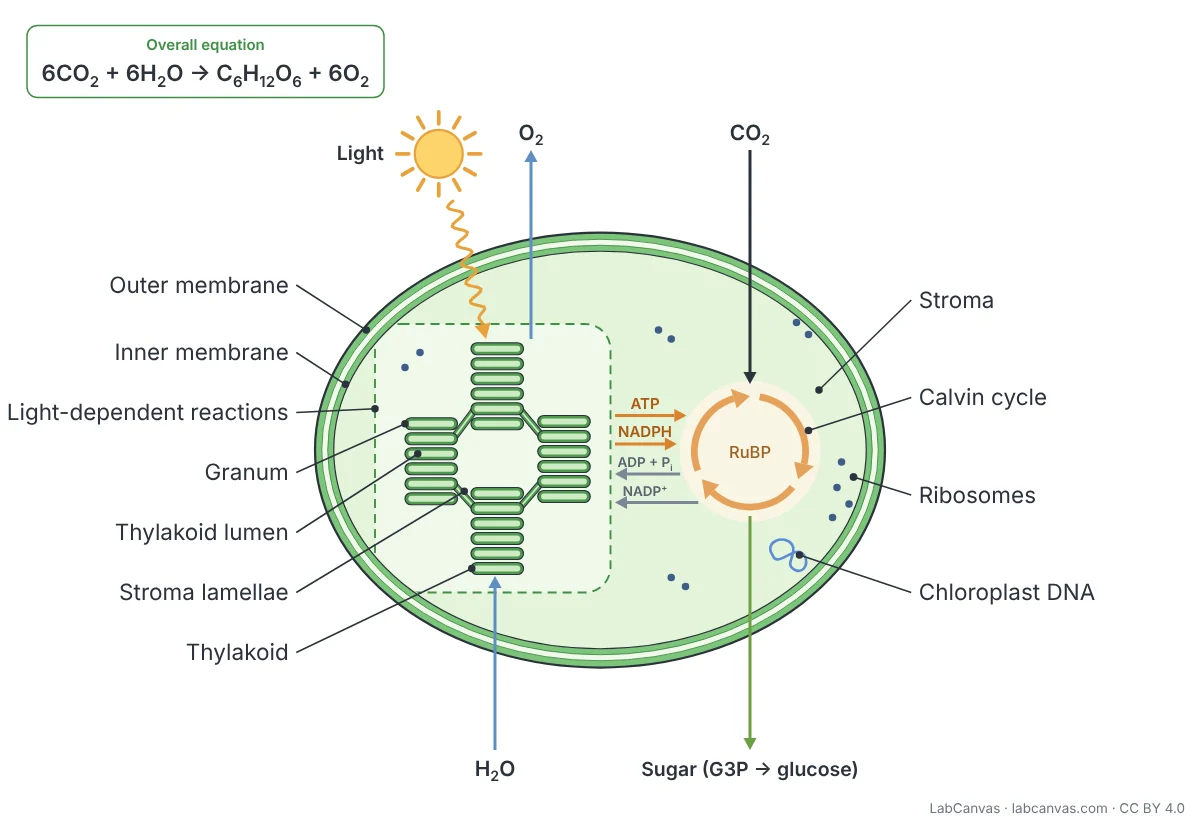
Facts on this page follow these introductory textbooks (OpenStax, CC BY 4.0). The diagram is a simplified illustration; organelles are not drawn to scale.
More free diagrams
Make your own science diagrams
LabCanvas is a browser workspace for scientific figures, slides and posters, with adjustable cells, organelles and molecules.
Edit this diagram