Graphical abstract template · Graphene synthesis · Chemical vapour deposition · Bottom-up
CVD growth of graphene on copper and nickel
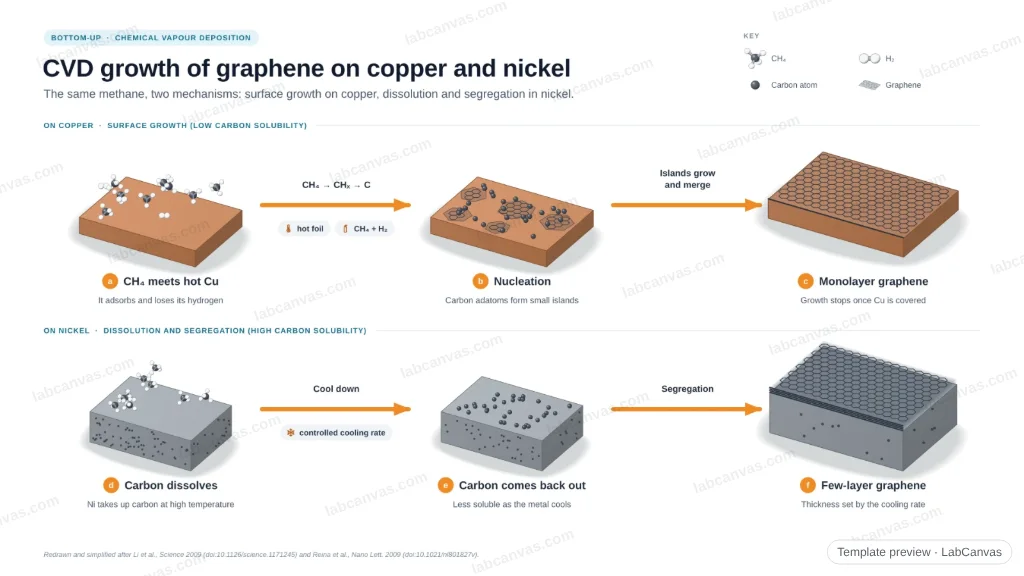
In chemical vapour deposition, methane breaks down on a hot metal foil and its carbon assembles into graphene. Copper dissolves almost no carbon, so growth happens on the surface and stops once one layer covers the foil. Nickel dissolves carbon at the growth temperature and releases it as it cools, giving few-layer graphene whose thickness depends on the cooling rate.
Updated 5 cited papers65 editable layers
At a glance
- Category
- Graphene synthesis
- Method
- Chemical vapour deposition
- Approach
- Bottom-up
- Starting materials
- Methane (CH₄), with hydrogen, over hot Cu or Ni
- Product
- Monolayer graphene on Cu; few-layer graphene on Ni
- Typical size
- Continuous films over centimetre-scale foils
- Key result
- High: mostly monolayer on Cu (under 5 % few-layer areas); 1 to about 12 layers on Ni
- Scalability
- High: large-area films, compatible with roll-to-roll growth
- Figure
- 1920 × 1080 px (16:9), 65 editable layers, 13 generated objects
Step by step
- Cu · Adsorption and dehydrogenationCH₄ breaks down on the hot surface into CHₓ species and carbon adatoms
- Cu · NucleationAdatoms meet and form graphene islands
- Cu · Growth and coalescenceIslands grow and merge; growth stops once the copper is covered
- Ni · DissolutionCarbon dissolves into the nickel at the growth temperature
- Ni · Segregation on coolingDissolved carbon comes back out at the surface as the metal cools
- Ni · Few-layer grapheneThe number of layers depends on the cooling rate
Strengths
- Large, continuous films
- Self-limiting monolayer growth on Cu
- Films can be transferred to any substrate
Limitations
- High temperature, gas handling and often low pressure
- Grain boundaries and wrinkles; transfer adds defects
- Layer number is hard to control on Ni
Uses
- Transparent electrodes
- Electronics and sensors
- Barrier films and membranes
Papers this template follows
- Li et al., “Large-area synthesis of high-quality and uniform graphene films on copper foils”, Science 2009. doi:10.1126/science.1171245primary
- Reina et al., “Large area, few-layer graphene films on arbitrary substrates by chemical vapor deposition”, Nano Lett. 2009. doi:10.1021/nl801827vprimary
- Yu et al., “Graphene segregated on Ni surfaces and transferred to insulators”, Appl. Phys. Lett. 2008. doi:10.1063/1.2982585further reading
- Hu et al., “On the nucleation of graphene by chemical vapor deposition”, New J. Chem. 2012. doi:10.1039/C1NJ20695Hfurther reading
- Fujita et al., “Near room temperature chemical vapor deposition of graphene with diluted methane and molten gallium catalyst”, Sci. Rep. 2017. doi:10.1038/s41598-017-12380-wfurther reading
Redrawn and simplified after Li et al., Science 2009 (doi:10.1126/science.1171245) and Reina et al., Nano Lett. 2009 (doi:10.1021/nl801827v).
How templates are written and checked: editorial guidelines.
Questions
What does the “CVD growth of graphene on copper and nickel” template show?
In chemical vapour deposition, methane breaks down on a hot metal foil and its carbon assembles into graphene. Copper dissolves almost no carbon, so growth happens on the surface and stops once one layer covers the foil. Nickel dissolves carbon at the growth temperature and releases it as it cools, giving few-layer graphene whose thickness depends on the cooling rate.
What are the steps shown in “CVD growth of graphene on copper and nickel”?
1. Cu · Adsorption and dehydrogenation: CH₄ breaks down on the hot surface into CHₓ species and carbon adatoms. 2. Cu · Nucleation: Adatoms meet and form graphene islands. 3. Cu · Growth and coalescence: Islands grow and merge; growth stops once the copper is covered. 4. Ni · Dissolution: Carbon dissolves into the nickel at the growth temperature. 5. Ni · Segregation on cooling: Dissolved carbon comes back out at the surface as the metal cools. 6. Ni · Few-layer graphene: The number of layers depends on the cooling rate.
What are the starting materials and the product?
Starting materials: Methane (CH₄), with hydrogen, over hot Cu or Ni. Product: Monolayer graphene on Cu; few-layer graphene on Ni.
Which papers is “CVD growth of graphene on copper and nickel” based on?
Li et al., “Large-area synthesis of high-quality and uniform graphene films on copper foils”, Science 2009 (doi:10.1126/science.1171245); Reina et al., “Large area, few-layer graphene films on arbitrary substrates by chemical vapor deposition”, Nano Lett. 2009 (doi:10.1021/nl801827v); Yu et al., “Graphene segregated on Ni surfaces and transferred to insulators”, Appl. Phys. Lett. 2008 (doi:10.1063/1.2982585); Hu et al., “On the nucleation of graphene by chemical vapor deposition”, New J. Chem. 2012 (doi:10.1039/C1NJ20695H); Fujita et al., “Near room temperature chemical vapor deposition of graphene with diluted methane and molten gallium catalyst”, Sci. Rep. 2017 (doi:10.1038/s41598-017-12380-w).
Can I edit the “CVD growth of graphene on copper and nickel” template?
Yes. Open it in the LabCanvas editor: all 65 layers are editable, including 13 generated objects (structures, plots, equipment) with their own settings. Change the text, colours and layout, then export PNG, TIFF, SVG or PDF.
Do I need an account to use this template?
Not to view it here. To open and edit it, sign in to LabCanvas or create a free account (the free plan keeps one design of each kind). Downloading the figure is part of LabCanvas Pro (US$19 a month or US$199 a year).