Graphical abstract template · Graphene synthesis · Electrochemical exfoliation · Top-down
Electrochemical exfoliation of graphite
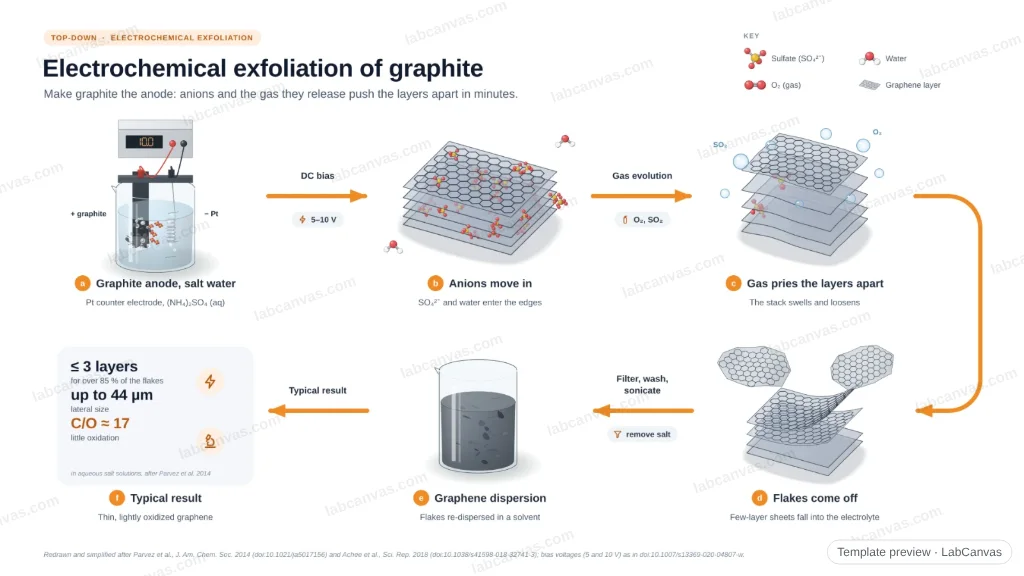
A graphite electrode is made the anode in an aqueous salt solution such as ammonium sulfate. Under a DC bias, sulfate anions and water enter the graphite edges and the gases they produce force the layers apart, so few-layer graphene flakes detach into the electrolyte. The flakes are filtered, washed and re-dispersed.
Updated 3 cited papers95 editable layers
At a glance
- Category
- Graphene synthesis
- Method
- Electrochemical exfoliation
- Approach
- Top-down
- Starting materials
- Graphite foil, rod or compressed graphite powder (the anode)
- Product
- Few-layer graphene flakes with little oxidation
- Typical size
- Flakes of several to tens of micrometres, mostly 1–3 layers
- Key result
- Good: mild oxidation (high C/O ratio), some defects
- Scalability
- High: fast, cheap and run at room temperature
- Figure
- 1920 × 1080 px (16:9), 95 editable layers, 18 generated objects
Step by step
- Set up the cellGraphite anode and Pt counter electrode in an aqueous sulfate electrolyte, e.g. (NH₄)₂SO₄
- Apply a DC biasA few volts (5–10 V reported) drive anions and water into the graphite edges
- Gas evolution and expansionO₂ and SO₂ formed between the layers pry them apart
- ExfoliationFew-layer flakes detach and collect in the electrolyte
- Filter, wash and disperseRemove the salt, then re-disperse the flakes by brief sonication
Strengths
- Fast, at room temperature and pressure
- Mild oxidation compared with Hummers-type routes
- Simple setup with cheap, non-toxic salts
Limitations
- Flake thickness and size are not uniform
- The anode breaks apart as it expands, which can stop the process
- Some oxygen groups and defects remain
Uses
- Conductive inks and coatings
- Polymer composites and strain sensors
- Battery and supercapacitor electrodes
Papers this template follows
- Achee et al., “High-yield scalable graphene nanosheet production from compressed graphite using electrochemical exfoliation”, Sci. Rep. 2018. doi:10.1038/s41598-018-32741-3primary
- Parvez et al., “Exfoliation of graphite into graphene in aqueous solutions of inorganic salts”, J. Am. Chem. Soc. 2014. doi:10.1021/ja5017156primary
- “Fabrication of graphene by electrochemical intercalation method and performance of graphene/PVA composites as stretchable strain sensor”, Arab. J. Sci. Eng.. doi:10.1007/s13369-020-04807-wfurther reading
Redrawn and simplified after Parvez et al., J. Am. Chem. Soc. 2014 (doi:10.1021/ja5017156) and Achee et al., Sci. Rep. 2018 (doi:10.1038/s41598-018-32741-3); bias voltages (5 and 10 V) as in doi:10.1007/s13369-020-04807-w.
How templates are written and checked: editorial guidelines.
Questions
What does the “Electrochemical exfoliation of graphite” template show?
A graphite electrode is made the anode in an aqueous salt solution such as ammonium sulfate. Under a DC bias, sulfate anions and water enter the graphite edges and the gases they produce force the layers apart, so few-layer graphene flakes detach into the electrolyte. The flakes are filtered, washed and re-dispersed.
What are the steps shown in “Electrochemical exfoliation of graphite”?
1. Set up the cell: Graphite anode and Pt counter electrode in an aqueous sulfate electrolyte, e.g. (NH₄)₂SO₄. 2. Apply a DC bias: A few volts (5–10 V reported) drive anions and water into the graphite edges. 3. Gas evolution and expansion: O₂ and SO₂ formed between the layers pry them apart. 4. Exfoliation: Few-layer flakes detach and collect in the electrolyte. 5. Filter, wash and disperse: Remove the salt, then re-disperse the flakes by brief sonication.
What are the starting materials and the product?
Starting materials: Graphite foil, rod or compressed graphite powder (the anode). Product: Few-layer graphene flakes with little oxidation.
Which papers is “Electrochemical exfoliation of graphite” based on?
Achee et al., “High-yield scalable graphene nanosheet production from compressed graphite using electrochemical exfoliation”, Sci. Rep. 2018 (doi:10.1038/s41598-018-32741-3); Parvez et al., “Exfoliation of graphite into graphene in aqueous solutions of inorganic salts”, J. Am. Chem. Soc. 2014 (doi:10.1021/ja5017156); “Fabrication of graphene by electrochemical intercalation method and performance of graphene/PVA composites as stretchable strain sensor”, Arab. J. Sci. Eng. (doi:10.1007/s13369-020-04807-w).
Can I edit the “Electrochemical exfoliation of graphite” template?
Yes. Open it in the LabCanvas editor: all 95 layers are editable, including 18 generated objects (structures, plots, equipment) with their own settings. Change the text, colours and layout, then export PNG, TIFF, SVG or PDF.
Do I need an account to use this template?
Not to view it here. To open and edit it, sign in to LabCanvas or create a free account (the free plan keeps one design of each kind). Downloading the figure is part of LabCanvas Pro (US$19 a month or US$199 a year).