Graphical abstract template · Graphene synthesis · Liquid-phase exfoliation · Top-down
Doped carbon nanosheets from layered biochar
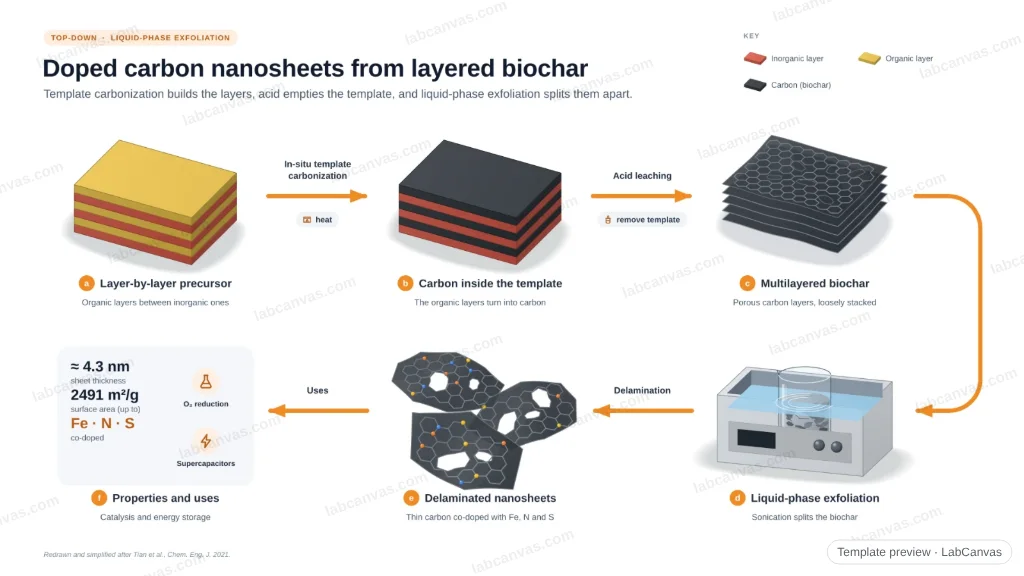
A layer-by-layer precursor of alternating inorganic and organic layers is carbonized in place, and the inorganic template is then leached out with acid. Liquid-phase exfoliation splits the resulting multilayered biochar into thin, porous carbon nanosheets co-doped with Fe, N and S, used as oxygen-reduction catalysts and supercapacitor electrodes.
Updated 3 cited papers69 editable layers
At a glance
- Category
- Graphene synthesis
- Method
- Liquid-phase exfoliation
- Approach
- Top-down
- Starting materials
- Layer-by-layer precursor: organic layers between inorganic template layers
- Product
- Fe, N and S co-doped graphene-like carbon nanosheets
- Typical size
- Nanosheets about 4.3 nm thick
- Key result
- Porous and doped by design; specific surface area up to 2491 m²/g
- Scalability
- Medium: batch carbonization and liquid processing
- Figure
- 1920 × 1080 px (16:9), 69 editable layers, 14 generated objects
Step by step
- Layer-by-layer precursorOrganic layers sandwiched between inorganic template layers
- In-situ template carbonizationHeating turns the organic layers into carbon inside the template
- Acid leachingAcid dissolves the inorganic template, leaving multilayered biochar
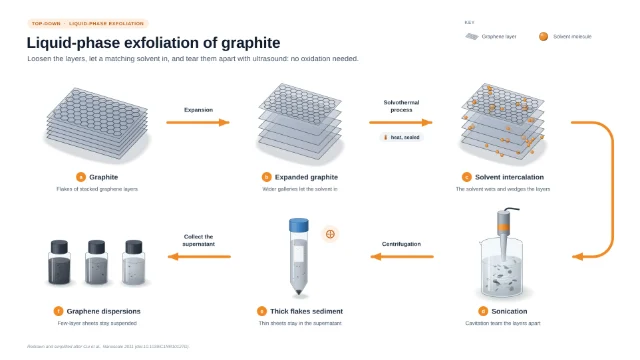
- Liquid-phase exfoliationSonication in a liquid delaminates the biochar
- Delaminated nanosheetsThin, porous carbon sheets carrying Fe, N and S
Strengths
- Fe, N and S doping and high porosity built in
- Carbon from renewable, biomass-type precursors
- Thin sheets with a very large surface area
Limitations
- Several steps, including carbonization and acid leaching
- Defect-rich, doped carbon rather than pristine graphene
- Acid waste from removing the template
Uses
- Oxygen-reduction electrocatalysts (an alternative to Pt/C)
- Supercapacitor electrodes
- Catalyst supports and sorbents
Papers this template follows
- Tian et al., “Liquid-phase exfoliation of layered biochars into multifunctional heteroatom (Fe, N, S) co-doped graphene-like carbon nanosheets”, Chem. Eng. J. 2021. https://www.sciencedirect.com/science/article/abs/pii/S1385894720337232primary
- Hernandez et al., “High-yield production of graphene by liquid-phase exfoliation of graphite”, Nat. Nanotechnol. 2008. doi:10.1038/nnano.2008.215method origin
- Cui et al., “Liquid-phase exfoliation, functionalization and applications of graphene”, Nanoscale 2011. doi:10.1039/C1NR10127Greview
Redrawn and simplified after Tian et al., Chem. Eng. J. 2021.
How templates are written and checked: editorial guidelines.
Questions
What does the “Doped carbon nanosheets from layered biochar” template show?
A layer-by-layer precursor of alternating inorganic and organic layers is carbonized in place, and the inorganic template is then leached out with acid. Liquid-phase exfoliation splits the resulting multilayered biochar into thin, porous carbon nanosheets co-doped with Fe, N and S, used as oxygen-reduction catalysts and supercapacitor electrodes.
What are the steps shown in “Doped carbon nanosheets from layered biochar”?
1. Layer-by-layer precursor: Organic layers sandwiched between inorganic template layers. 2. In-situ template carbonization: Heating turns the organic layers into carbon inside the template. 3. Acid leaching: Acid dissolves the inorganic template, leaving multilayered biochar. 4. Liquid-phase exfoliation: Sonication in a liquid delaminates the biochar. 5. Delaminated nanosheets: Thin, porous carbon sheets carrying Fe, N and S.
What are the starting materials and the product?
Starting materials: Layer-by-layer precursor: organic layers between inorganic template layers. Product: Fe, N and S co-doped graphene-like carbon nanosheets.
Which papers is “Doped carbon nanosheets from layered biochar” based on?
Tian et al., “Liquid-phase exfoliation of layered biochars into multifunctional heteroatom (Fe, N, S) co-doped graphene-like carbon nanosheets”, Chem. Eng. J. 2021; Hernandez et al., “High-yield production of graphene by liquid-phase exfoliation of graphite”, Nat. Nanotechnol. 2008 (doi:10.1038/nnano.2008.215); Cui et al., “Liquid-phase exfoliation, functionalization and applications of graphene”, Nanoscale 2011 (doi:10.1039/C1NR10127G).
Can I edit the “Doped carbon nanosheets from layered biochar” template?
Yes. Open it in the LabCanvas editor: all 69 layers are editable, including 14 generated objects (structures, plots, equipment) with their own settings. Change the text, colours and layout, then export PNG, TIFF, SVG or PDF.
Do I need an account to use this template?
Not to view it here. To open and edit it, sign in to LabCanvas or create a free account (the free plan keeps one design of each kind). Downloading the figure is part of LabCanvas Pro (US$19 a month or US$199 a year).