Graphical abstract template · Graphene synthesis · Hummers method · Top-down
Improved Hummers method with K₂FeO₄
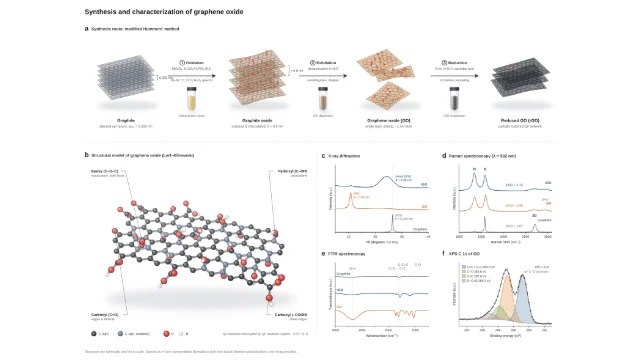
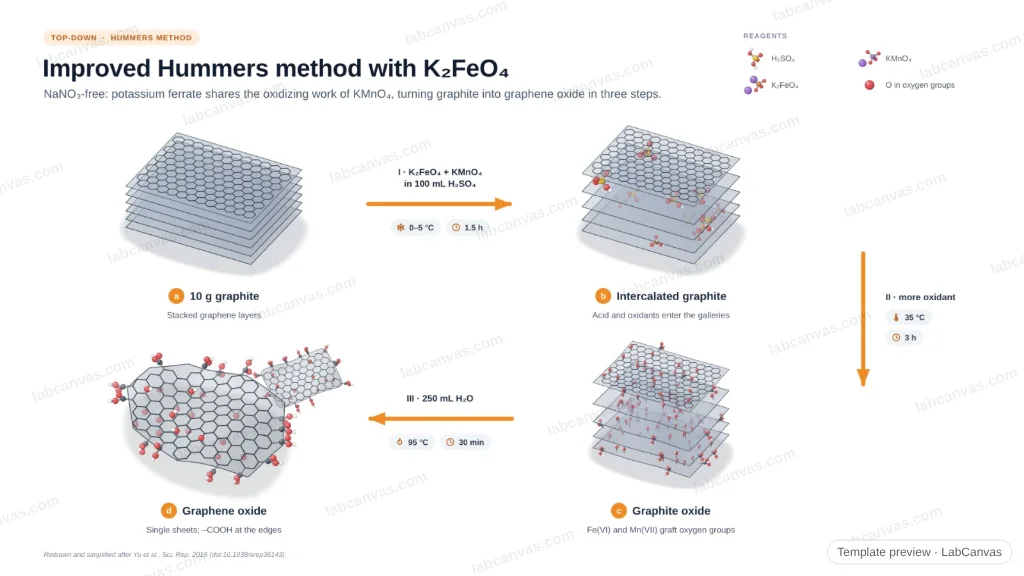
A NaNO₃-free variant of the Hummers method in which potassium ferrate (K₂FeO₄) takes over part of the oxidizing work of KMnO₄. Graphite is intercalated and oxidized in sulfuric acid in two stages, then diluted with hot water to give graphene oxide.
Updated 3 cited papers59 editable layers
At a glance
- Category
- Graphene synthesis
- Method
- Hummers method
- Approach
- Top-down
- Starting materials
- Natural graphite flakes (10 g)
- Product
- Graphene oxide (GO) sheets with epoxide, hydroxyl and carboxyl groups
- Typical size
- nm–µm sheets (lateral size depends on the graphite)
- Key result
- Highly oxidized GO; insulating until reduced
- Scalability
- High: batch wet chemistry
- Figure
- 1920 × 1080 px (16:9), 59 editable layers, 15 generated objects
Step by step
- I · Intercalation and first oxidationK₂FeO₄ and KMnO₄ in 100 mL H₂SO₄, 0–5 °C, 1.5 h
- II · Deep oxidationA second oxidant feed, 35 °C, 3 h
- III · Dilution and exfoliation250 mL H₂O, 95 °C, 30 min
Strengths
- No NaNO₃, so no toxic NOₓ fumes
- Less KMnO₄ than the classic recipe
- Three steps in one vessel
Limitations
- Strong oxidants and concentrated acid: exothermic, needs cooling
- GO is defective and insulating until reduced
- Acid and metal-salt waste to treat
Uses
- Precursor to reduced graphene oxide
- Membranes and coatings
- Composites and printed electrodes
Papers this template follows
- Yu et al., “High-efficient synthesis of graphene oxide based on improved Hummers method”, Sci. Rep. 2016. doi:10.1038/srep36143primary
- Hummers & Offeman, “Preparation of graphitic oxide”, J. Am. Chem. Soc. 1958. doi:10.1021/ja01539a017method origin
- Marcano et al., “Improved synthesis of graphene oxide”, ACS Nano 2010. doi:10.1021/nn1006368further reading
Redrawn and simplified after Yu et al., Sci. Rep. 2016 (doi:10.1038/srep36143).
How templates are written and checked: editorial guidelines.
Questions
What does the “Improved Hummers method with K₂FeO₄” template show?
A NaNO₃-free variant of the Hummers method in which potassium ferrate (K₂FeO₄) takes over part of the oxidizing work of KMnO₄. Graphite is intercalated and oxidized in sulfuric acid in two stages, then diluted with hot water to give graphene oxide.
What are the steps shown in “Improved Hummers method with K₂FeO₄”?
1. I · Intercalation and first oxidation: K₂FeO₄ and KMnO₄ in 100 mL H₂SO₄, 0–5 °C, 1.5 h. 2. II · Deep oxidation: A second oxidant feed, 35 °C, 3 h. 3. III · Dilution and exfoliation: 250 mL H₂O, 95 °C, 30 min.
What are the starting materials and the product?
Starting materials: Natural graphite flakes (10 g). Product: Graphene oxide (GO) sheets with epoxide, hydroxyl and carboxyl groups.
Which papers is “Improved Hummers method with K₂FeO₄” based on?
Yu et al., “High-efficient synthesis of graphene oxide based on improved Hummers method”, Sci. Rep. 2016 (doi:10.1038/srep36143); Hummers & Offeman, “Preparation of graphitic oxide”, J. Am. Chem. Soc. 1958 (doi:10.1021/ja01539a017); Marcano et al., “Improved synthesis of graphene oxide”, ACS Nano 2010 (doi:10.1021/nn1006368).
Can I edit the “Improved Hummers method with K₂FeO₄” template?
Yes. Open it in the LabCanvas editor: all 59 layers are editable, including 15 generated objects (structures, plots, equipment) with their own settings. Change the text, colours and layout, then export PNG, TIFF, SVG or PDF.
Do I need an account to use this template?
Not to view it here. To open and edit it, sign in to LabCanvas or create a free account (the free plan keeps one design of each kind). Downloading the figure is part of LabCanvas Pro (US$19 a month or US$199 a year).