Graphical abstract template · Graphene synthesis · Epitaxial growth on SiC · Bottom-up
Epitaxial graphene on SiC
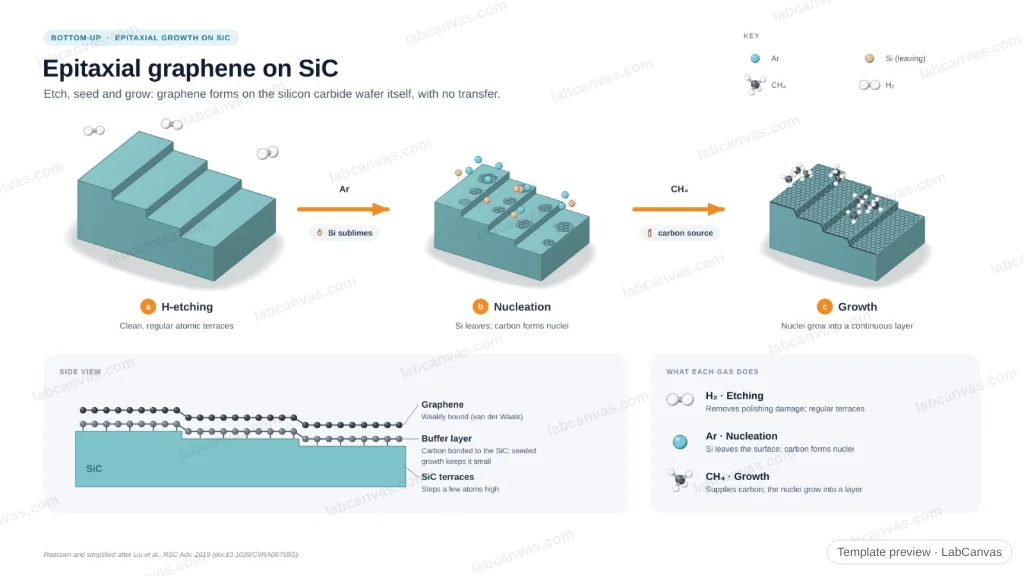
Graphene can be grown directly on a silicon carbide wafer, with no transfer. Hydrogen etching first leaves clean, regular atomic terraces. Heating in argon then drives silicon off the surface so that the carbon left behind forms graphene nuclei, and adding methane lets these nuclei grow into a continuous layer.
Updated 3 cited papers191 editable layers
At a glance
- Category
- Graphene synthesis
- Method
- Epitaxial growth on SiC
- Approach
- Bottom-up
- Starting materials
- Single-crystal SiC wafer; H₂, Ar and CH₄
- Product
- Quasi-free-standing epitaxial graphene on SiC
- Typical size
- Wafer-scale films that follow the substrate terraces
- Key result
- High; graphitizing in argon gives much larger domains than in vacuum
- Scalability
- Medium: wafer-scale, but SiC wafers are expensive
- Figure
- 1920 × 1080 px (16:9), 191 editable layers, 15 generated objects
Step by step
- H-etchingHot hydrogen removes polishing damage and leaves regular atomic terraces
- NucleationIn argon, silicon sublimes from the surface; the carbon left behind forms graphene nuclei
- GrowthCH₄ is added as the carbon source and graphene grows from the nuclei across the terraces
Strengths
- No transfer: graphene sits on a semi-insulating wafer
- Wafer-scale, uniform films
- Seeded growth gives a much smaller buffer layer
Limitations
- Costly SiC wafers
- Very high process temperatures
- Step edges and the interface layer affect the electronic properties
Uses
- High-frequency transistors
- Quantum Hall resistance standards
- Templates for van der Waals and remote epitaxy
Papers this template follows
- Liu et al., “Induced growth of quasi-free-standing graphene on SiC substrates”, RSC Adv. 2019. doi:10.1039/C9RA05758Gprimary
- Emtsev et al., “Towards wafer-size graphene layers by atmospheric pressure graphitization of silicon carbide”, Nat. Mater. 2009. doi:10.1038/nmat2382further reading
- Singh et al., “Graphene based materials: past, present and future”, Prog. Mater. Sci. 2011. doi:10.1016/j.pmatsci.2011.03.003review
Redrawn and simplified after Liu et al., RSC Adv. 2019 (doi:10.1039/C9RA05758G).
How templates are written and checked: editorial guidelines.
Questions
What does the “Epitaxial graphene on SiC” template show?
Graphene can be grown directly on a silicon carbide wafer, with no transfer. Hydrogen etching first leaves clean, regular atomic terraces. Heating in argon then drives silicon off the surface so that the carbon left behind forms graphene nuclei, and adding methane lets these nuclei grow into a continuous layer.
What are the steps shown in “Epitaxial graphene on SiC”?
1. H-etching: Hot hydrogen removes polishing damage and leaves regular atomic terraces. 2. Nucleation: In argon, silicon sublimes from the surface; the carbon left behind forms graphene nuclei. 3. Growth: CH₄ is added as the carbon source and graphene grows from the nuclei across the terraces.
What are the starting materials and the product?
Starting materials: Single-crystal SiC wafer; H₂, Ar and CH₄. Product: Quasi-free-standing epitaxial graphene on SiC.
Which papers is “Epitaxial graphene on SiC” based on?
Liu et al., “Induced growth of quasi-free-standing graphene on SiC substrates”, RSC Adv. 2019 (doi:10.1039/C9RA05758G); Emtsev et al., “Towards wafer-size graphene layers by atmospheric pressure graphitization of silicon carbide”, Nat. Mater. 2009 (doi:10.1038/nmat2382); Singh et al., “Graphene based materials: past, present and future”, Prog. Mater. Sci. 2011 (doi:10.1016/j.pmatsci.2011.03.003).
Can I edit the “Epitaxial graphene on SiC” template?
Yes. Open it in the LabCanvas editor: all 191 layers are editable, including 15 generated objects (structures, plots, equipment) with their own settings. Change the text, colours and layout, then export PNG, TIFF, SVG or PDF.
Do I need an account to use this template?
Not to view it here. To open and edit it, sign in to LabCanvas or create a free account (the free plan keeps one design of each kind). Downloading the figure is part of LabCanvas Pro (US$19 a month or US$199 a year).