Graphical abstract template · Graphical abstracts · Graphical abstract
Aqueous zinc-ion batteries: taming the zinc anode, from electrolyte to cathode
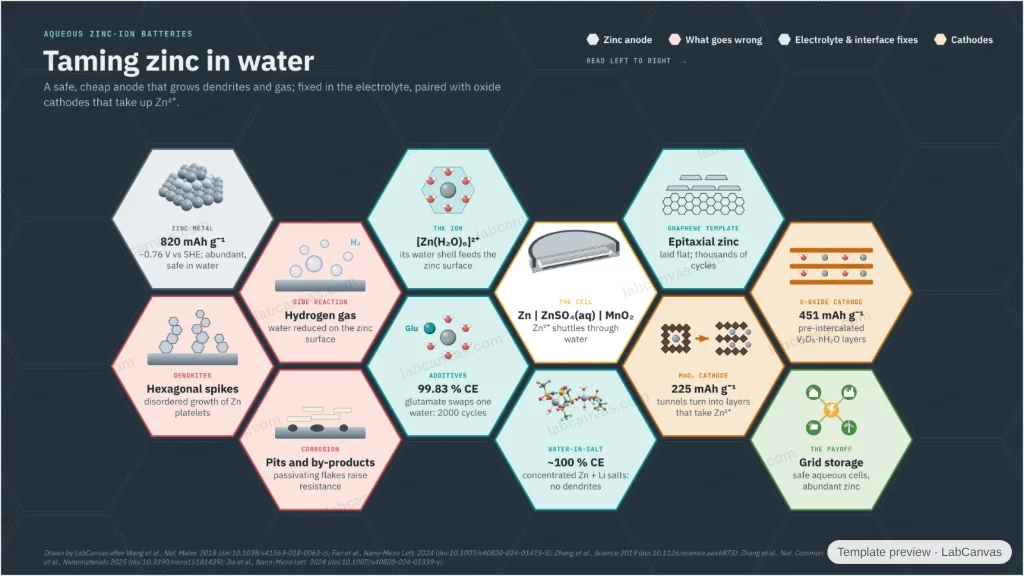
A honeycomb of twelve tiles on aqueous zinc-ion batteries: why zinc is an attractive anode in water (820 mAh g⁻¹, −0.76 V, safe), what goes wrong on it (hexagonal dendrites, hydrogen gas, corrosion and by-products), how electrolytes and interfaces fix it (additives that rebuild the Zn²⁺ water shell, water-in-salt electrolytes, a graphene template), and the MnO₂ and vanadium-oxide cathodes that host Zn²⁺.
Updated 7 cited papers215 editable layers
At a glance
- Category
- Graphical abstracts
- Method
- Graphical abstract
- Starting materials
- Zinc foil, a mild aqueous zinc-salt electrolyte and an oxide cathode
- Product
- A safe, low-cost aqueous zinc-ion cell for stationary storage
- Key result
- 820 mAh g⁻¹ and −0.762 V (Wang et al. 2018); 99.83% CE over 2000 cycles (Fan et al. 2024); MnO₂ 225 mAh g⁻¹, 94% over 2000 cycles (Zhang et al. 2017); MnO₂ theoretical ≈308 mAh g⁻¹ (Zhao et al. 2025); VOH 451 mAh g⁻¹ (Jia et al. 2024)
- Figure
- 1920 × 1080 px (16:9), 215 editable layers, 2 generated objects
Step by step
- Why zinc820 mAh g⁻¹, −0.762 V vs SHE, abundant, low toxicity, intrinsically safe in water (Wang et al. 2018)
- What goes wrongDendrites of hexagonal Zn crystals, hydrogen evolution with passivating by-products and self-corrosion, each worsening the others (Fan et al. 2024; Wang et al. 2026)
- Fix the electrolyte and the interfaceAdditives that replace water in the [Zn(H₂O)₆]²⁺ shell: 99.83% CE for 2000 cycles (Fan et al. 2024); concentrated Zn + Li salts (water-in-salt): dendrite-free at nearly 100% CE (Wang et al. 2018); graphene for epitaxial Zn (Zheng et al. 2019)
- Host Zn²⁺ in the cathodeTunnel MnO₂ turns into layered zinc-buserite and takes Zn²⁺: 225 mAh g⁻¹, 94% over 2000 cycles (Zhang et al. 2017); layered V₂O₅·nH₂O, 451 mAh g⁻¹ (Jia et al. 2024)
Uses
- Graphical abstracts on aqueous zinc-ion batteries
- Talks on zinc anode protection and electrolyte design
- Teaching post-lithium grid storage
Papers this template follows
- Wang et al., “Highly reversible zinc metal anode for aqueous batteries”, Nat. Mater. 2018. doi:10.1038/s41563-018-0063-zprimary
- Fan et al., “Selection of negative charged acidic polar additives to regulate electric double layer for stable zinc ion battery”, Nano-Micro Lett. 2024. doi:10.1007/s40820-024-01475-5primary
- Zheng et al., “Reversible epitaxial electrodeposition of metals in battery anodes”, Science 2019. doi:10.1126/science.aax6873primary
- Zhang et al., “Rechargeable aqueous zinc-manganese dioxide batteries with high energy and power densities”, Nat. Commun. 2017. doi:10.1038/s41467-017-00467-xprimary
- Zhao et al., “Advancing zinc-manganese oxide batteries: mechanistic insights, anode engineering, and cathode regulation”, Nanomaterials 2025. doi:10.3390/nano15181439review
- Jia et al., “Weakly polarized organic cation-modified hydrated vanadium oxides for high-energy efficiency aqueous zinc-ion batteries”, Nano-Micro Lett. 2024. doi:10.1007/s40820-024-01339-yprimary
- Wang et al., “Polymer engineering for stable zinc metal anodes: from molecular design to integrated strategy”, Small 2026. doi:10.1002/smll.74911review
Drawn by LabCanvas after Wang et al., Nat. Mater. 2018 (doi:10.1038/s41563-018-0063-z); Fan et al., Nano-Micro Lett. 2024 (doi:10.1007/s40820-024-01475-5); Zheng et al., Science 2019 (doi:10.1126/science.aax6873); Zhang et al., Nat. Commun. 2017 (doi:10.1038/s41467-017-00467-x); Zhao et al., Nanomaterials 2025 (doi:10.3390/nano15181439); Jia et al., Nano-Micro Lett. 2024 (doi:10.1007/s40820-024-01339-y).
How templates are written and checked: editorial guidelines.
Questions
What does the “Aqueous zinc-ion batteries: taming the zinc anode, from electrolyte to cathode” template show?
A honeycomb of twelve tiles on aqueous zinc-ion batteries: why zinc is an attractive anode in water (820 mAh g⁻¹, −0.76 V, safe), what goes wrong on it (hexagonal dendrites, hydrogen gas, corrosion and by-products), how electrolytes and interfaces fix it (additives that rebuild the Zn²⁺ water shell, water-in-salt electrolytes, a graphene template), and the MnO₂ and vanadium-oxide cathodes that host Zn²⁺.
What are the steps shown in “Aqueous zinc-ion batteries: taming the zinc anode, from electrolyte to cathode”?
1. Why zinc: 820 mAh g⁻¹, −0.762 V vs SHE, abundant, low toxicity, intrinsically safe in water (Wang et al. 2018). 2. What goes wrong: Dendrites of hexagonal Zn crystals, hydrogen evolution with passivating by-products and self-corrosion, each worsening the others (Fan et al. 2024; Wang et al. 2026). 3. Fix the electrolyte and the interface: Additives that replace water in the [Zn(H₂O)₆]²⁺ shell: 99.83% CE for 2000 cycles (Fan et al. 2024); concentrated Zn + Li salts (water-in-salt): dendrite-free at nearly 100% CE (Wang et al. 2018); graphene for epitaxial Zn (Zheng et al. 2019). 4. Host Zn²⁺ in the cathode: Tunnel MnO₂ turns into layered zinc-buserite and takes Zn²⁺: 225 mAh g⁻¹, 94% over 2000 cycles (Zhang et al. 2017); layered V₂O₅·nH₂O, 451 mAh g⁻¹ (Jia et al. 2024).
What are the starting materials and the product?
Starting materials: Zinc foil, a mild aqueous zinc-salt electrolyte and an oxide cathode. Product: A safe, low-cost aqueous zinc-ion cell for stationary storage.
Which papers is “Aqueous zinc-ion batteries: taming the zinc anode, from electrolyte to cathode” based on?
Wang et al., “Highly reversible zinc metal anode for aqueous batteries”, Nat. Mater. 2018 (doi:10.1038/s41563-018-0063-z); Fan et al., “Selection of negative charged acidic polar additives to regulate electric double layer for stable zinc ion battery”, Nano-Micro Lett. 2024 (doi:10.1007/s40820-024-01475-5); Zheng et al., “Reversible epitaxial electrodeposition of metals in battery anodes”, Science 2019 (doi:10.1126/science.aax6873); Zhang et al., “Rechargeable aqueous zinc-manganese dioxide batteries with high energy and power densities”, Nat. Commun. 2017 (doi:10.1038/s41467-017-00467-x); Zhao et al., “Advancing zinc-manganese oxide batteries: mechanistic insights, anode engineering, and cathode regulation”, Nanomaterials 2025 (doi:10.3390/nano15181439); Jia et al., “Weakly polarized organic cation-modified hydrated vanadium oxides for high-energy efficiency aqueous zinc-ion batteries”, Nano-Micro Lett. 2024 (doi:10.1007/s40820-024-01339-y); Wang et al., “Polymer engineering for stable zinc metal anodes: from molecular design to integrated strategy”, Small 2026 (doi:10.1002/smll.74911).
Can I edit the “Aqueous zinc-ion batteries: taming the zinc anode, from electrolyte to cathode” template?
Yes. Open it in the LabCanvas editor: all 215 layers are editable, including 2 generated objects (structures, plots, equipment) with their own settings. Change the text, colours and layout, then export PNG, TIFF, SVG or PDF.
Do I need an account to use this template?
Not to view it here. To open and edit it, sign in to LabCanvas or create a free account (the free plan keeps up to 3 designs). Downloading the figure is part of LabCanvas Pro (US$19 a month or US$199 a year).