Graphical abstract template · Graphical abstracts · Graphical abstract
Atomic layer deposition: building a film one layer per cycle
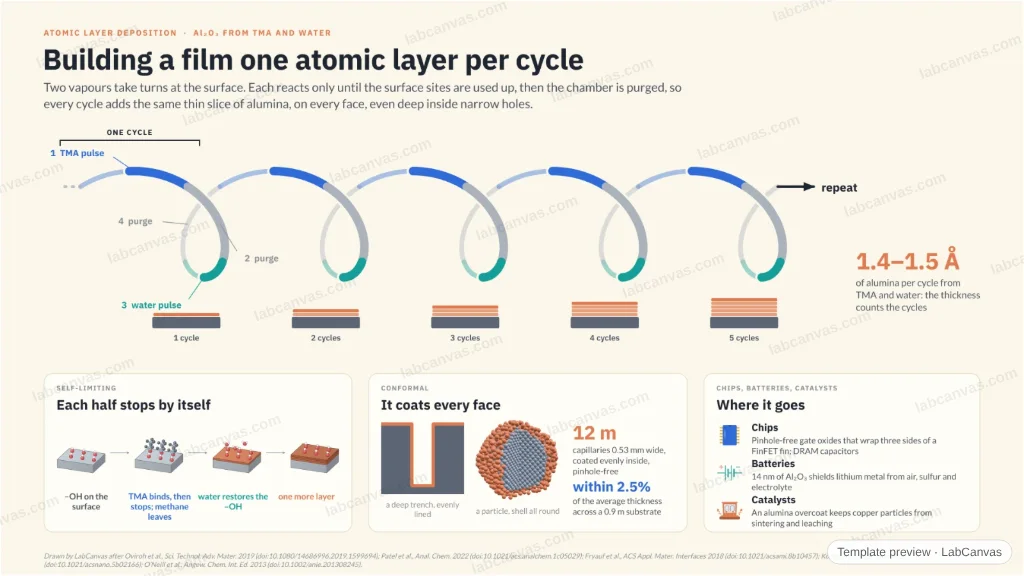
Atomic layer deposition of alumina drawn as a coil, one turn per cycle: a trimethylaluminium pulse, a purge, a water pulse and a purge, each half-reaction stopping by itself, so every cycle adds the same sub-monolayer. Below, the self-limiting chemistry, conformal coating of deep trenches and particles, and uses in chips, batteries and catalysts.
Updated 8 cited papers122 editable layers
At a glance
- Category
- Graphical abstracts
- Method
- Graphical abstract
- Starting materials
- Trimethylaluminium (TMA) and water vapour, pulsed in turn with purges between
- Product
- A conformal amorphous Al₂O₃ film whose thickness is set by the number of cycles
- Key result
- 1.4–1.5 Å/cycle inside 12 m × 0.53 mm capillaries (Patel et al. 2022); within 2.5% over 0.9 m (Fryauf et al. 2018); 14 nm Al₂O₃ on Li (Kozen et al. 2015)
- Figure
- 1920 × 1080 px (16:9), 122 editable layers, 4 generated objects
Step by step
- TMA pulseThe precursor reacts with the surface until the reactive sites are used up: self-limiting chemisorption (Oviroh et al. 2019)
- PurgePurge gas clears the excess precursor and by-products (methane, in the TMA reaction) before the next pulse (Oviroh et al. 2019)
- Water pulse and purgeThe second half-reaction completes the layer; TMA and water is the most widely used ALD chemistry and gives amorphous Al₂O₃ (Young et al. 2020)
- RepeatEach cycle adds the same (sub)monolayer: 1.4–1.5 Å per cycle for TMA/water alumina in long capillaries (Patel et al. 2022)
- UsesConformal gate oxides and DRAM capacitors (Oviroh et al. 2019), 14 nm Al₂O₃ protecting lithium metal (Kozen et al. 2015), overcoats that stop copper catalysts sintering (O’Neill et al. 2013)
Uses
- Graphical abstracts on atomic layer deposition and thin films
- Talks on conformal coatings in microelectronics and batteries
- Teaching self-limiting surface chemistry
Papers this template follows
- Oviroh et al., “New development of atomic layer deposition: processes, methods and applications”, Sci. Technol. Adv. Mater. 2019. doi:10.1080/14686996.2019.1599694review
- Patel et al., “Flow-Through Atmospheric Pressure-Atomic Layer Deposition Reactor for Thin-Film Deposition in Capillary Columns”, Anal. Chem. 2022. doi:10.1021/acs.analchem.1c05029primary
- Young et al., “Probing the Atomic-Scale Structure of Amorphous Aluminum Oxide Grown by Atomic Layer Deposition”, ACS Appl. Mater. Interfaces 2020. doi:10.1021/acsami.0c01905primary
- Fryauf et al., “Scaling Atomic Layer Deposition to Astronomical Optic Sizes: Low-Temperature Aluminum Oxide in a Meter-Sized Chamber”, ACS Appl. Mater. Interfaces 2018. doi:10.1021/acsami.8b10457primary
- Kozen et al., “Next-Generation Lithium Metal Anode Engineering via Atomic Layer Deposition”, ACS Nano 2015. doi:10.1021/acsnano.5b02166primary
- O'Neill et al., “Stabilization of copper catalysts for liquid-phase reactions by atomic layer deposition”, Angew. Chem. Int. Ed. 2013. doi:10.1002/anie.201308245primary
- Madadi et al., “Atomic and Molecular Layer Deposition of Alkali Metal Based Thin Films”, ACS Appl. Mater. Interfaces 2021. doi:10.1021/acsami.1c17519review
- George, Yoon & Dameron, “Surface chemistry for molecular layer deposition of organic and hybrid organic-inorganic polymers”, Acc. Chem. Res. 2009. doi:10.1021/ar800105qfurther reading
Drawn by LabCanvas after Oviroh et al., Sci. Technol. Adv. Mater. 2019 (doi:10.1080/14686996.2019.1599694); Patel et al., Anal. Chem. 2022 (doi:10.1021/acs.analchem.1c05029); Fryauf et al., ACS Appl. Mater. Interfaces 2018 (doi:10.1021/acsami.8b10457); Kozen et al., ACS Nano 2015 (doi:10.1021/acsnano.5b02166); O’Neill et al., Angew. Chem. Int. Ed. 2013 (doi:10.1002/anie.201308245).
How templates are written and checked: editorial guidelines.
Questions
What does the “Atomic layer deposition: building a film one layer per cycle” template show?
Atomic layer deposition of alumina drawn as a coil, one turn per cycle: a trimethylaluminium pulse, a purge, a water pulse and a purge, each half-reaction stopping by itself, so every cycle adds the same sub-monolayer. Below, the self-limiting chemistry, conformal coating of deep trenches and particles, and uses in chips, batteries and catalysts.
What are the steps shown in “Atomic layer deposition: building a film one layer per cycle”?
1. TMA pulse: The precursor reacts with the surface until the reactive sites are used up: self-limiting chemisorption (Oviroh et al. 2019). 2. Purge: Purge gas clears the excess precursor and by-products (methane, in the TMA reaction) before the next pulse (Oviroh et al. 2019). 3. Water pulse and purge: The second half-reaction completes the layer; TMA and water is the most widely used ALD chemistry and gives amorphous Al₂O₃ (Young et al. 2020). 4. Repeat: Each cycle adds the same (sub)monolayer: 1.4–1.5 Å per cycle for TMA/water alumina in long capillaries (Patel et al. 2022). 5. Uses: Conformal gate oxides and DRAM capacitors (Oviroh et al. 2019), 14 nm Al₂O₃ protecting lithium metal (Kozen et al. 2015), overcoats that stop copper catalysts sintering (O’Neill et al. 2013).
What are the starting materials and the product?
Starting materials: Trimethylaluminium (TMA) and water vapour, pulsed in turn with purges between. Product: A conformal amorphous Al₂O₃ film whose thickness is set by the number of cycles.
Which papers is “Atomic layer deposition: building a film one layer per cycle” based on?
Oviroh et al., “New development of atomic layer deposition: processes, methods and applications”, Sci. Technol. Adv. Mater. 2019 (doi:10.1080/14686996.2019.1599694); Patel et al., “Flow-Through Atmospheric Pressure-Atomic Layer Deposition Reactor for Thin-Film Deposition in Capillary Columns”, Anal. Chem. 2022 (doi:10.1021/acs.analchem.1c05029); Young et al., “Probing the Atomic-Scale Structure of Amorphous Aluminum Oxide Grown by Atomic Layer Deposition”, ACS Appl. Mater. Interfaces 2020 (doi:10.1021/acsami.0c01905); Fryauf et al., “Scaling Atomic Layer Deposition to Astronomical Optic Sizes: Low-Temperature Aluminum Oxide in a Meter-Sized Chamber”, ACS Appl. Mater. Interfaces 2018 (doi:10.1021/acsami.8b10457); Kozen et al., “Next-Generation Lithium Metal Anode Engineering via Atomic Layer Deposition”, ACS Nano 2015 (doi:10.1021/acsnano.5b02166); O'Neill et al., “Stabilization of copper catalysts for liquid-phase reactions by atomic layer deposition”, Angew. Chem. Int. Ed. 2013 (doi:10.1002/anie.201308245); Madadi et al., “Atomic and Molecular Layer Deposition of Alkali Metal Based Thin Films”, ACS Appl. Mater. Interfaces 2021 (doi:10.1021/acsami.1c17519); George, Yoon & Dameron, “Surface chemistry for molecular layer deposition of organic and hybrid organic-inorganic polymers”, Acc. Chem. Res. 2009 (doi:10.1021/ar800105q).
Can I edit the “Atomic layer deposition: building a film one layer per cycle” template?
Yes. Open it in the LabCanvas editor: all 122 layers are editable, including 4 generated objects (structures, plots, equipment) with their own settings. Change the text, colours and layout, then export PNG, TIFF, SVG or PDF.
Do I need an account to use this template?
Not to view it here. To open and edit it, sign in to LabCanvas or create a free account (the free plan keeps up to 3 designs). Downloading the figure is part of LabCanvas Pro (US$19 a month or US$199 a year).