Graphical abstract template · Graphical abstracts · Graphical abstract
Bacteriophages against biofilms
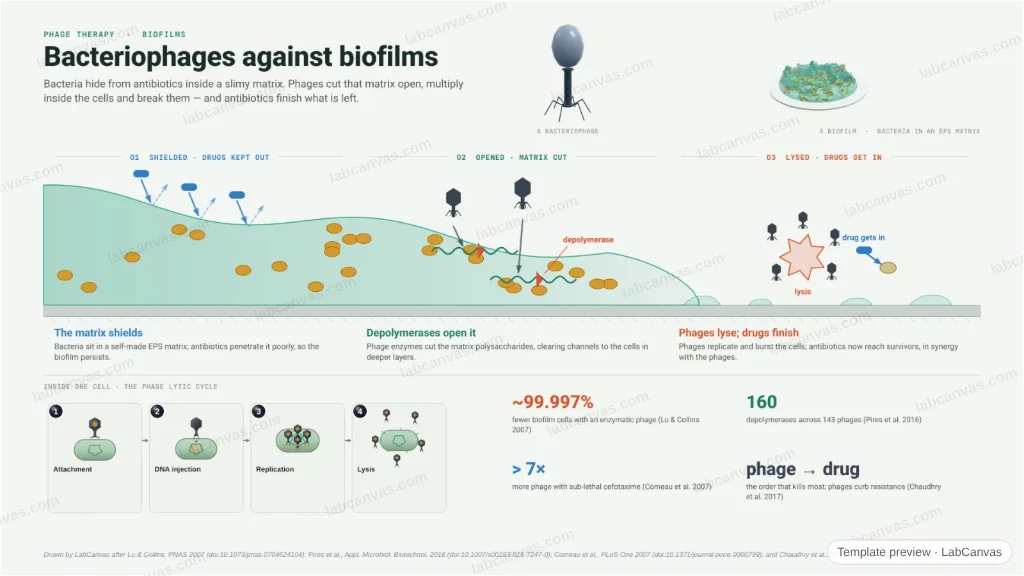
A cutaway graphical abstract: a biofilm in cross-section, read left to right as phages break a bacterial stronghold. The EPS matrix shields the bacteria from antibiotics; phage depolymerases cut the matrix open and let the phages in; the phages replicate and lyse the cells, and antibiotics then finish the survivors — phage–antibiotic synergy.
Updated 4 cited papers206 editable layers
At a glance
- Category
- Graphical abstracts
- Method
- Graphical abstract
- Starting materials
- A bacterial biofilm: cells in a self-made EPS matrix, hard for antibiotics to clear
- Product
- The biofilm broken open and the cells cleared by phages, with antibiotics in synergy
- Key result
- ~4.5 orders of magnitude (~99.997%) fewer biofilm cells with an enzymatic phage (Lu & Collins 2007); 160 depolymerases across 143 phages (Pires et al. 2016); >7-fold more phage with sub-lethal cefotaxime (Comeau et al. 2007)
- Figure
- 1920 × 1080 px (16:9), 206 editable layers, 1 generated objects
Step by step
- ShieldedBacteria in the EPS matrix are protected; antibiotics penetrate poorly and the biofilm persists (Pires et al. 2016)
- OpenedPhage depolymerases degrade the matrix polysaccharides, clearing channels the phages follow to cells in deeper layers; 160 depolymerases are known across 143 phages (Pires et al. 2016)
- LysedPhages attach, inject, replicate and lyse the cells; an enzymatic phage cut biofilm cell counts ~4.5 orders of magnitude (Lu & Collins 2007)
- SynergyAntibiotics that could not get through before now reach the cells; sub-lethal antibiotics also boost phage growth (>7-fold), and phage-before-antibiotic kills most (Comeau et al. 2007; Chaudhry et al. 2017)
Uses
- Graphical abstracts on phage therapy and biofilm infections
- Talks on depolymerases and phage–antibiotic synergy
- Teaching why biofilms resist antibiotics and how phages get in
Papers this template follows
- Lu & Collins, “Dispersing biofilms with engineered enzymatic bacteriophage”, PNAS 2007. doi:10.1073/pnas.0704624104primary
- Pires et al., “Bacteriophage-encoded depolymerases: their diversity and biotechnological applications”, Appl. Microbiol. Biotechnol. 2016. doi:10.1007/s00253-015-7247-0review
- Comeau et al., “Phage-Antibiotic Synergy (PAS): β-lactam and quinolone antibiotics stimulate virulent phage growth”, PLoS One 2007. doi:10.1371/journal.pone.0000799primary
- Chaudhry et al., “Synergy and order effects of antibiotics and phages in killing Pseudomonas aeruginosa biofilms”, PLoS One 2017. doi:10.1371/journal.pone.0168615primary
Drawn by LabCanvas after Lu & Collins, PNAS 2007 (doi:10.1073/pnas.0704624104); Pires et al., Appl. Microbiol. Biotechnol. 2016 (doi:10.1007/s00253-015-7247-0); Comeau et al., PLoS One 2007 (doi:10.1371/journal.pone.0000799); and Chaudhry et al., PLoS One 2017 (doi:10.1371/journal.pone.0168615).
How templates are written and checked: editorial guidelines.
Questions
What does the “Bacteriophages against biofilms” template show?
A cutaway graphical abstract: a biofilm in cross-section, read left to right as phages break a bacterial stronghold. The EPS matrix shields the bacteria from antibiotics; phage depolymerases cut the matrix open and let the phages in; the phages replicate and lyse the cells, and antibiotics then finish the survivors — phage–antibiotic synergy.
What are the steps shown in “Bacteriophages against biofilms”?
1. Shielded: Bacteria in the EPS matrix are protected; antibiotics penetrate poorly and the biofilm persists (Pires et al. 2016). 2. Opened: Phage depolymerases degrade the matrix polysaccharides, clearing channels the phages follow to cells in deeper layers; 160 depolymerases are known across 143 phages (Pires et al. 2016). 3. Lysed: Phages attach, inject, replicate and lyse the cells; an enzymatic phage cut biofilm cell counts ~4.5 orders of magnitude (Lu & Collins 2007). 4. Synergy: Antibiotics that could not get through before now reach the cells; sub-lethal antibiotics also boost phage growth (>7-fold), and phage-before-antibiotic kills most (Comeau et al. 2007; Chaudhry et al. 2017).
What are the starting materials and the product?
Starting materials: A bacterial biofilm: cells in a self-made EPS matrix, hard for antibiotics to clear. Product: The biofilm broken open and the cells cleared by phages, with antibiotics in synergy.
Which papers is “Bacteriophages against biofilms” based on?
Lu & Collins, “Dispersing biofilms with engineered enzymatic bacteriophage”, PNAS 2007 (doi:10.1073/pnas.0704624104); Pires et al., “Bacteriophage-encoded depolymerases: their diversity and biotechnological applications”, Appl. Microbiol. Biotechnol. 2016 (doi:10.1007/s00253-015-7247-0); Comeau et al., “Phage-Antibiotic Synergy (PAS): β-lactam and quinolone antibiotics stimulate virulent phage growth”, PLoS One 2007 (doi:10.1371/journal.pone.0000799); Chaudhry et al., “Synergy and order effects of antibiotics and phages in killing Pseudomonas aeruginosa biofilms”, PLoS One 2017 (doi:10.1371/journal.pone.0168615).
Can I edit the “Bacteriophages against biofilms” template?
Yes. Open it in the LabCanvas editor: all 206 layers are editable, including 1 generated objects (structures, plots, equipment) with their own settings. Change the text, colours and layout, then export PNG, TIFF, SVG or PDF.
Do I need an account to use this template?
Not to view it here. To open and edit it, sign in to LabCanvas or create a free account (the free plan keeps up to 3 designs). Downloading the figure is part of LabCanvas Pro (US$19 a month or US$199 a year).





