Graphical abstract template · Graphical abstracts · Graphical abstract
Breaking forever chemicals: four ways to cleave the C–F bond
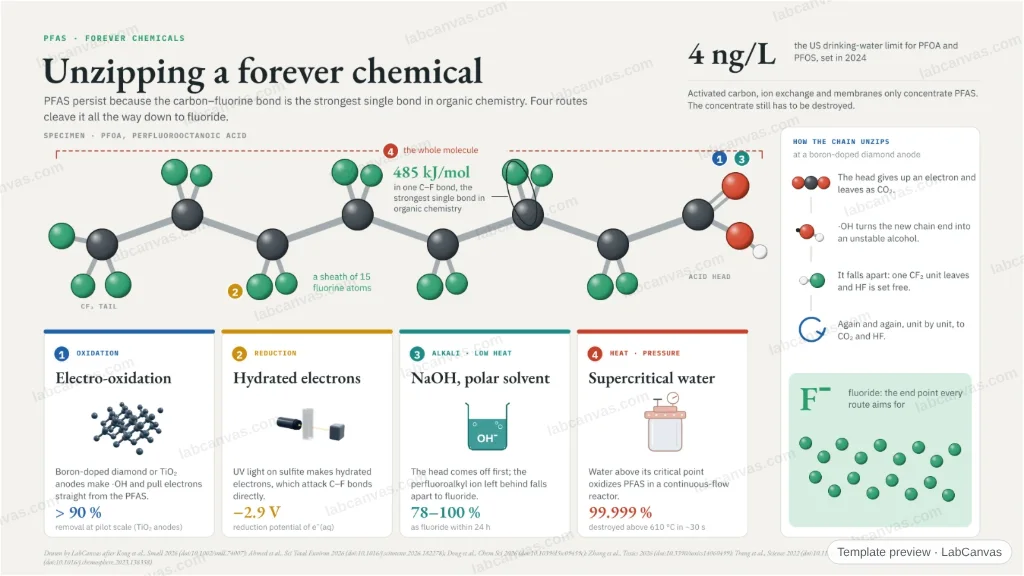
A PFOA molecule laid out like a labelled specimen: the strongest single bond in organic chemistry in a sheath of fluorine. Four numbered routes cleave it, electro-oxidation, hydrated electrons, alkali at low temperature and supercritical water, and on the right the chain unzips one CF₂ unit at a time into fluoride.
Updated 6 cited papers165 editable layers
At a glance
- Category
- Graphical abstracts
- Method
- Graphical abstract
- Starting materials
- PFOA and related PFAS, concentrated from water by activated carbon, ion exchange or membranes
- Product
- Fluoride and CO₂
- Key result
- C–F 485 kJ/mol (Kong et al. 2026); US limit 4 ng/L for PFOA and PFOS (Ahmed et al. 2026); e⁻(aq) −2.9 V, > 90 % pilot removal (Zhang et al. 2026); 78–~100 % fluoride in 24 h (Trang et al. 2022); 99.999 % above 610 °C, ~30 s (Austin et al. 2023)
- Figure
- 1920 × 1080 px (16:9), 165 editable layers, 2 generated objects
Step by step
- Why they lastThe C–F bond (485 kJ/mol) is the strongest single bond in organic chemistry (Kong et al. 2026; Ahmed et al. 2026); the fluorine atoms also shield the chain (Zhang et al. 2026)
- 1 · Electro-oxidationBoron-doped diamond or TiO₂ anodes make ·OH or take electrons directly; the head leaves as CO₂ and the chain unzips one CF₂ unit at a time to CO₂ and HF (Dong et al. 2026); > 90 % removal at pilot scale with TiO₂ anodes (Zhang et al. 2026)
- 2 · Hydrated electronsUV/sulfite makes hydrated electrons (−2.9 V) that attack C–F bonds directly (Zhang et al. 2026; Ahmed et al. 2026)
- 3 · Alkali at low temperatureNaOH in a polar aprotic solvent decarboxylates PFCAs; the perfluoroalkyl ions degrade to fluoride, 78 to ~100 % within 24 h (Trang et al. 2022)
- 4 · Supercritical water99.999 % destruction above 610 °C at ~30 s residence time in continuous flow (Austin et al. 2023)
Uses
- Graphical abstracts on PFAS remediation and defluorination
- Talks on water treatment and forever chemicals
- Teaching why the C–F bond resists breaking
Papers this template follows
- Kong et al., “Understanding the defluorination mechanism of per- and polyfluoroalkyl substances in wastewater: from microscopic process to practical application”, Small 2026. doi:10.1002/smll.74007review
- Ahmed et al., “From forever to fluoride: a critical review of PFAS occurrence, fate, and the transition from sequestration to destruction-based remediation in groundwater”, Science of the Total Environment 2026. doi:10.1016/j.scitotenv.2026.182278review
- Dong et al., “Advances in electrochemical technologies for PFAS destruction”, Chemical Science 2026. doi:10.1039/d5sc09459creview
- Zhang et al., “Advanced degradation and remediation strategies for per- and polyfluoroalkyl substances (PFASs): challenges and future perspectives”, Toxics 2026. doi:10.3390/toxics14060499review
- Trang et al., “Low-temperature mineralization of perfluorocarboxylic acids”, Science 2022. doi:10.1126/science.abm8868primary
- Austin et al., “Destruction and defluorination of PFAS matrix in continuous-flow supercritical water oxidation reactor: effect of operating temperature”, Chemosphere 2023. doi:10.1016/j.chemosphere.2023.138358primary
Drawn by LabCanvas after Kong et al., Small 2026 (doi:10.1002/smll.74007); Ahmed et al., Sci Total Environ 2026 (doi:10.1016/j.scitotenv.2026.182278); Dong et al., Chem Sci 2026 (doi:10.1039/d5sc09459c); Zhang et al., Toxics 2026 (doi:10.3390/toxics14060499); Trang et al., Science 2022 (doi:10.1126/science.abm8868) and Austin et al., Chemosphere 2023 (doi:10.1016/j.chemosphere.2023.138358).
How templates are written and checked: editorial guidelines.
Questions
What does the “Breaking forever chemicals: four ways to cleave the C–F bond” template show?
A PFOA molecule laid out like a labelled specimen: the strongest single bond in organic chemistry in a sheath of fluorine. Four numbered routes cleave it, electro-oxidation, hydrated electrons, alkali at low temperature and supercritical water, and on the right the chain unzips one CF₂ unit at a time into fluoride.
What are the steps shown in “Breaking forever chemicals: four ways to cleave the C–F bond”?
1. Why they last: The C–F bond (485 kJ/mol) is the strongest single bond in organic chemistry (Kong et al. 2026; Ahmed et al. 2026); the fluorine atoms also shield the chain (Zhang et al. 2026). 2. 1 · Electro-oxidation: Boron-doped diamond or TiO₂ anodes make ·OH or take electrons directly; the head leaves as CO₂ and the chain unzips one CF₂ unit at a time to CO₂ and HF (Dong et al. 2026); > 90 % removal at pilot scale with TiO₂ anodes (Zhang et al. 2026). 3. 2 · Hydrated electrons: UV/sulfite makes hydrated electrons (−2.9 V) that attack C–F bonds directly (Zhang et al. 2026; Ahmed et al. 2026). 4. 3 · Alkali at low temperature: NaOH in a polar aprotic solvent decarboxylates PFCAs; the perfluoroalkyl ions degrade to fluoride, 78 to ~100 % within 24 h (Trang et al. 2022). 5. 4 · Supercritical water: 99.999 % destruction above 610 °C at ~30 s residence time in continuous flow (Austin et al. 2023).
What are the starting materials and the product?
Starting materials: PFOA and related PFAS, concentrated from water by activated carbon, ion exchange or membranes. Product: Fluoride and CO₂.
Which papers is “Breaking forever chemicals: four ways to cleave the C–F bond” based on?
Kong et al., “Understanding the defluorination mechanism of per- and polyfluoroalkyl substances in wastewater: from microscopic process to practical application”, Small 2026 (doi:10.1002/smll.74007); Ahmed et al., “From forever to fluoride: a critical review of PFAS occurrence, fate, and the transition from sequestration to destruction-based remediation in groundwater”, Science of the Total Environment 2026 (doi:10.1016/j.scitotenv.2026.182278); Dong et al., “Advances in electrochemical technologies for PFAS destruction”, Chemical Science 2026 (doi:10.1039/d5sc09459c); Zhang et al., “Advanced degradation and remediation strategies for per- and polyfluoroalkyl substances (PFASs): challenges and future perspectives”, Toxics 2026 (doi:10.3390/toxics14060499); Trang et al., “Low-temperature mineralization of perfluorocarboxylic acids”, Science 2022 (doi:10.1126/science.abm8868); Austin et al., “Destruction and defluorination of PFAS matrix in continuous-flow supercritical water oxidation reactor: effect of operating temperature”, Chemosphere 2023 (doi:10.1016/j.chemosphere.2023.138358).
Can I edit the “Breaking forever chemicals: four ways to cleave the C–F bond” template?
Yes. Open it in the LabCanvas editor: all 165 layers are editable, including 2 generated objects (structures, plots, equipment) with their own settings. Change the text, colours and layout, then export PNG, TIFF, SVG or PDF.
Do I need an account to use this template?
Not to view it here. To open and edit it, sign in to LabCanvas or create a free account (the free plan keeps up to 3 designs). Downloading the figure is part of LabCanvas Pro (US$19 a month or US$199 a year).