Graphical abstract template · Graphical abstracts · Graphical abstract
Bulk metallic glasses: outrun the crystal
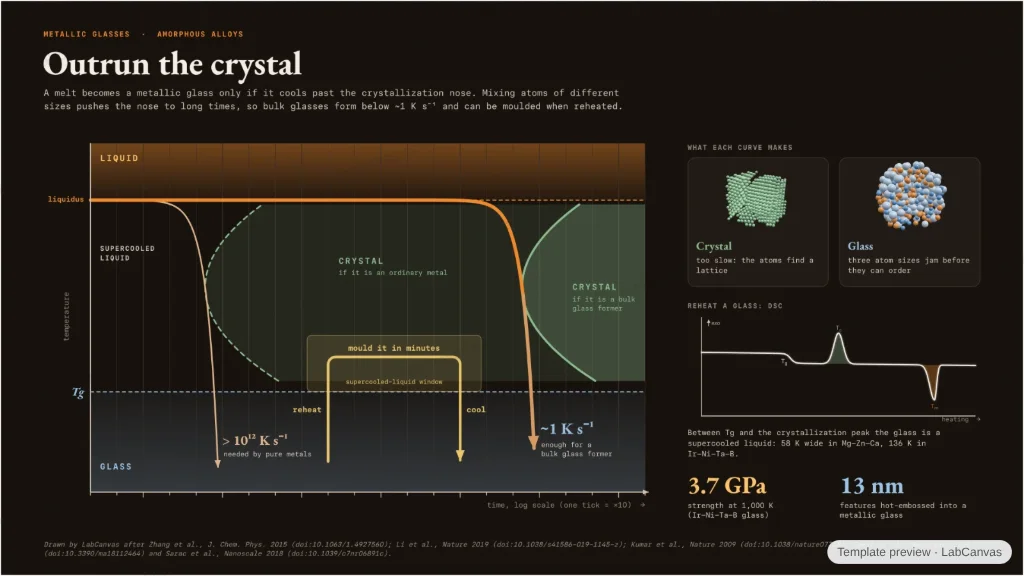
A time–temperature–transformation chart as the whole figure: a metal melt becomes a glass only if its cooling curve misses the crystallization nose. Pure metals need more than 10¹² K/s; multicomponent alloys of mismatched atoms push the nose to long times, so bulk metallic glasses form below about 1 K/s. Reheated above the glass transition, they can be moulded like polymers; a side column shows the two products, a DSC trace and the numbers.
Updated 8 cited papers112 editable layers
At a glance
- Category
- Graphical abstracts
- Method
- Graphical abstract
- Starting materials
- A multicomponent metal melt of atoms with different sizes
- Product
- A bulk amorphous alloy, shaped by thermoplastic forming
- Key result
- Rc > 10¹² K/s (pure metals) vs below ~1 K/s (BMGs) (Zhang et al. 2015); supercooled liquid region 136 K, 3.7 GPa at 1,000 K, 3 mm critical casting thickness (Li et al. 2019); 58 K (Saksl et al. 2025); 13 nm features (Kumar et al. 2009)
- Figure
- 1920 × 1080 px (16:9), 112 editable layers, 1 generated objects
Step by step
- Outrun the noseCooled faster than the critical rate Rc, a melt bypasses crystallization and freezes as a glass; the TTT diagram gives Rc (Zhang et al. 2015; Sato et al. 2017)
- Pure metal vs bulk glass formerPure metals need Rc > 10¹² K/s; specific multicomponent alloys form bulk metallic glasses below ~1 K/s; alloys of three or more components, smallest-to-largest size ratio mostly below 0.8, glass more easily (Zhang et al. 2015)
- Reheat and mouldBetween the glass transition and crystallization lies the supercooled liquid region: 58 K for Mg–Zn–Ca, 136 K for Ir–Ni–Ta–(B); there the glass is shaped like a polymer in minutes (Saksl et al. 2025; Li et al. 2019; Sarac et al. 2018)
- What it buysStrength and elasticity beyond conventional alloys (3.7 GPa at 1,000 K for Ir–Ni–Ta–(B)), no grain-size limit (13 nm embossed features), at the price of brittleness (Li et al. 2019; Kumar et al. 2009; Yang et al. 2026)
Uses
- Graphical abstracts on metallic glasses and amorphous alloys
- Talks on glass-forming ability and thermoplastic forming
- Teaching TTT diagrams and critical cooling rates
Papers this template follows
- Zhang et al., “On the origin of multi-component bulk metallic glasses: Atomic size mismatches and de-mixing”, The Journal of Chemical Physics 2015. doi:10.1063/1.4927560primary
- Zhang et al., “Beyond packing of hard spheres: The effects of core softness, non-additivity, intermediate-range repulsion, and many-body interactions on the glass-forming ability of bulk metallic glasses”, The Journal of Chemical Physics 2015. doi:10.1063/1.4935002primary
- Li et al., “High-temperature bulk metallic glasses developed by combinatorial methods”, Nature 2019. doi:10.1038/s41586-019-1145-zprimary
- Kumar et al., “Nanomoulding with amorphous metals”, Nature 2009. doi:10.1038/nature07718primary
- Saksl et al., “Relaxation and Devitrification of MgZnCa Metallic Glass”, Materials 2025. doi:10.3390/ma18112464primary
- Sarac et al., “Elastostatic reversibility in thermally formed bulk metallic glasses: nanobeam diffraction fluctuation electron microscopy”, Nanoscale 2018. doi:10.1039/c7nr06891cprimary
- Sato et al., “Predictive modeling of Time-Temperature-Transformation diagram of metallic glasses based on atomistically-informed classical nucleation theory”, Scientific Reports 2017. doi:10.1038/s41598-017-06482-8method origin
- Yang et al., “Rejuvenated Amorphous Alloys: Processing Methods, Microstructures and Mechanical Properties”, Advanced Science 2026. doi:10.1002/advs.75703review
Drawn by LabCanvas after Zhang et al., J. Chem. Phys. 2015 (doi:10.1063/1.4927560); Li et al., Nature 2019 (doi:10.1038/s41586-019-1145-z); Kumar et al., Nature 2009 (doi:10.1038/nature07718); Saksl et al., Materials 2025 (doi:10.3390/ma18112464) and Sarac et al., Nanoscale 2018 (doi:10.1039/c7nr06891c).
How templates are written and checked: editorial guidelines.
Questions
What does the “Bulk metallic glasses: outrun the crystal” template show?
A time–temperature–transformation chart as the whole figure: a metal melt becomes a glass only if its cooling curve misses the crystallization nose. Pure metals need more than 10¹² K/s; multicomponent alloys of mismatched atoms push the nose to long times, so bulk metallic glasses form below about 1 K/s. Reheated above the glass transition, they can be moulded like polymers; a side column shows the two products, a DSC trace and the numbers.
What are the steps shown in “Bulk metallic glasses: outrun the crystal”?
1. Outrun the nose: Cooled faster than the critical rate Rc, a melt bypasses crystallization and freezes as a glass; the TTT diagram gives Rc (Zhang et al. 2015; Sato et al. 2017). 2. Pure metal vs bulk glass former: Pure metals need Rc > 10¹² K/s; specific multicomponent alloys form bulk metallic glasses below ~1 K/s; alloys of three or more components, smallest-to-largest size ratio mostly below 0.8, glass more easily (Zhang et al. 2015). 3. Reheat and mould: Between the glass transition and crystallization lies the supercooled liquid region: 58 K for Mg–Zn–Ca, 136 K for Ir–Ni–Ta–(B); there the glass is shaped like a polymer in minutes (Saksl et al. 2025; Li et al. 2019; Sarac et al. 2018). 4. What it buys: Strength and elasticity beyond conventional alloys (3.7 GPa at 1,000 K for Ir–Ni–Ta–(B)), no grain-size limit (13 nm embossed features), at the price of brittleness (Li et al. 2019; Kumar et al. 2009; Yang et al. 2026).
What are the starting materials and the product?
Starting materials: A multicomponent metal melt of atoms with different sizes. Product: A bulk amorphous alloy, shaped by thermoplastic forming.
Which papers is “Bulk metallic glasses: outrun the crystal” based on?
Zhang et al., “On the origin of multi-component bulk metallic glasses: Atomic size mismatches and de-mixing”, The Journal of Chemical Physics 2015 (doi:10.1063/1.4927560); Zhang et al., “Beyond packing of hard spheres: The effects of core softness, non-additivity, intermediate-range repulsion, and many-body interactions on the glass-forming ability of bulk metallic glasses”, The Journal of Chemical Physics 2015 (doi:10.1063/1.4935002); Li et al., “High-temperature bulk metallic glasses developed by combinatorial methods”, Nature 2019 (doi:10.1038/s41586-019-1145-z); Kumar et al., “Nanomoulding with amorphous metals”, Nature 2009 (doi:10.1038/nature07718); Saksl et al., “Relaxation and Devitrification of MgZnCa Metallic Glass”, Materials 2025 (doi:10.3390/ma18112464); Sarac et al., “Elastostatic reversibility in thermally formed bulk metallic glasses: nanobeam diffraction fluctuation electron microscopy”, Nanoscale 2018 (doi:10.1039/c7nr06891c); Sato et al., “Predictive modeling of Time-Temperature-Transformation diagram of metallic glasses based on atomistically-informed classical nucleation theory”, Scientific Reports 2017 (doi:10.1038/s41598-017-06482-8); Yang et al., “Rejuvenated Amorphous Alloys: Processing Methods, Microstructures and Mechanical Properties”, Advanced Science 2026 (doi:10.1002/advs.75703).
Can I edit the “Bulk metallic glasses: outrun the crystal” template?
Yes. Open it in the LabCanvas editor: all 112 layers are editable, including 1 generated objects (structures, plots, equipment) with their own settings. Change the text, colours and layout, then export PNG, TIFF, SVG or PDF.
Do I need an account to use this template?
Not to view it here. To open and edit it, sign in to LabCanvas or create a free account (the free plan keeps up to 3 designs). Downloading the figure is part of LabCanvas Pro (US$19 a month or US$199 a year).