Graphical abstract template · Graphical abstracts · Graphical abstract
Cell-free protein synthesis: DNA in, protein out
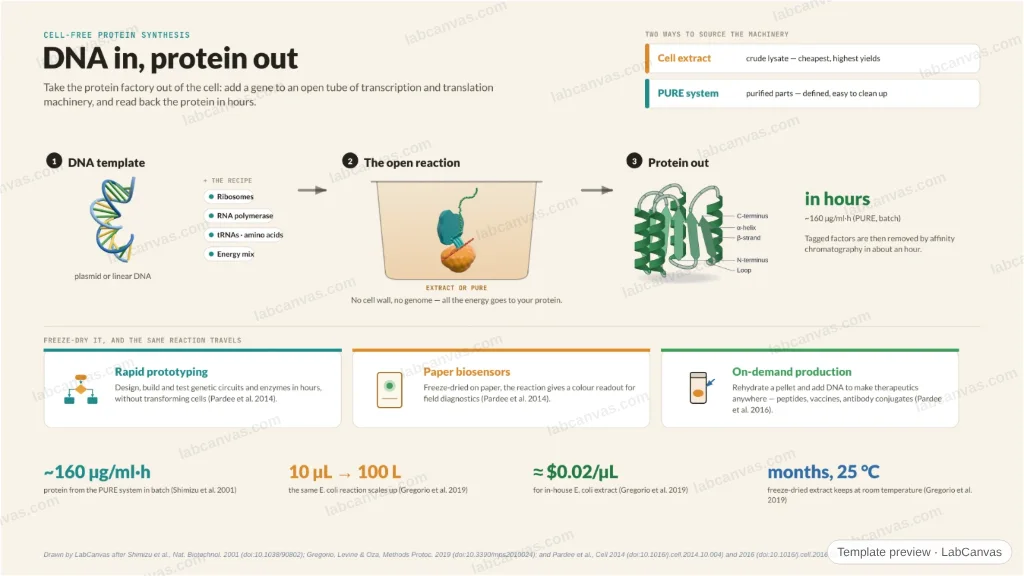
A pipeline graphical abstract of cell-free protein synthesis. A DNA template goes into an open reaction — a cell extract or the reconstituted PURE system — which transcribes and translates it in one tube, with no cell wall or genome in the way, and a protein comes out within hours. Freeze-dried, the same reaction becomes portable for rapid prototyping, paper biosensors and on-demand production.
Updated 4 cited papers83 editable layers
At a glance
- Category
- Graphical abstracts
- Method
- Graphical abstract
- Starting materials
- A DNA template (plasmid or linear) plus a cell extract or the PURE system
- Product
- A finished protein in hours, in an open tube — no living cell
- Key result
- ~160 µg/ml/h in PURE batch (Shimizu et al. 2001); E. coli reactions scale 10 µL → 100 L, in-house extract ~$0.019/µL, freeze-dried extract keeps for months at room temperature (Gregorio et al. 2019)
- Figure
- 1920 × 1080 px (16:9), 83 editable layers, 2 generated objects
Step by step
- DNA inA plasmid or linear DNA template encoding the protein of interest goes into the reaction (Gregorio et al. 2019)
- Open reactionA cell extract or the reconstituted PURE system (T7 RNA polymerase, 20 aminoacyl-tRNA synthetases, ribosomes, tRNAs, amino acids, energy) transcribes and translates it; no membrane or genome, so all the energy goes to the protein (Shimizu et al. 2001; Gregorio et al. 2019)
- Protein outProtein appears within hours — the PURE system makes ~160 µg/ml/h — and tagged factors are removed by affinity chromatography in ~1 h (Shimizu et al. 2001)
- UsesFreeze-dried and rehydrated, the reaction is portable: rapid prototyping of genetic circuits, paper biosensors with colour readouts, and on-demand therapeutics (Pardee et al. 2014, 2016)
Uses
- Graphical abstracts on cell-free synthetic biology
- Talks on PURE vs extract-based CFPS
- Teaching in vitro transcription–translation and on-demand biomanufacturing
Papers this template follows
- Shimizu et al., “Cell-free translation reconstituted with purified components”, Nat. Biotechnol. 2001. doi:10.1038/90802method origin
- Gregorio, Levine & Oza, “A User's Guide to Cell-Free Protein Synthesis”, Methods Protoc. 2019. doi:10.3390/mps2010024review
- Pardee et al., “Paper-based synthetic gene networks”, Cell 2014. doi:10.1016/j.cell.2014.10.004primary
- Pardee et al., “Portable, on-demand biomolecular manufacturing”, Cell 2016. doi:10.1016/j.cell.2016.09.013primary
Drawn by LabCanvas after Shimizu et al., Nat. Biotechnol. 2001 (doi:10.1038/90802); Gregorio, Levine & Oza, Methods Protoc. 2019 (doi:10.3390/mps2010024); and Pardee et al., Cell 2014 (doi:10.1016/j.cell.2014.10.004) and 2016 (doi:10.1016/j.cell.2016.09.013).
How templates are written and checked: editorial guidelines.
Questions
What does the “Cell-free protein synthesis: DNA in, protein out” template show?
A pipeline graphical abstract of cell-free protein synthesis. A DNA template goes into an open reaction — a cell extract or the reconstituted PURE system — which transcribes and translates it in one tube, with no cell wall or genome in the way, and a protein comes out within hours. Freeze-dried, the same reaction becomes portable for rapid prototyping, paper biosensors and on-demand production.
What are the steps shown in “Cell-free protein synthesis: DNA in, protein out”?
1. DNA in: A plasmid or linear DNA template encoding the protein of interest goes into the reaction (Gregorio et al. 2019). 2. Open reaction: A cell extract or the reconstituted PURE system (T7 RNA polymerase, 20 aminoacyl-tRNA synthetases, ribosomes, tRNAs, amino acids, energy) transcribes and translates it; no membrane or genome, so all the energy goes to the protein (Shimizu et al. 2001; Gregorio et al. 2019). 3. Protein out: Protein appears within hours — the PURE system makes ~160 µg/ml/h — and tagged factors are removed by affinity chromatography in ~1 h (Shimizu et al. 2001). 4. Uses: Freeze-dried and rehydrated, the reaction is portable: rapid prototyping of genetic circuits, paper biosensors with colour readouts, and on-demand therapeutics (Pardee et al. 2014, 2016).
What are the starting materials and the product?
Starting materials: A DNA template (plasmid or linear) plus a cell extract or the PURE system. Product: A finished protein in hours, in an open tube — no living cell.
Which papers is “Cell-free protein synthesis: DNA in, protein out” based on?
Shimizu et al., “Cell-free translation reconstituted with purified components”, Nat. Biotechnol. 2001 (doi:10.1038/90802); Gregorio, Levine & Oza, “A User's Guide to Cell-Free Protein Synthesis”, Methods Protoc. 2019 (doi:10.3390/mps2010024); Pardee et al., “Paper-based synthetic gene networks”, Cell 2014 (doi:10.1016/j.cell.2014.10.004); Pardee et al., “Portable, on-demand biomolecular manufacturing”, Cell 2016 (doi:10.1016/j.cell.2016.09.013).
Can I edit the “Cell-free protein synthesis: DNA in, protein out” template?
Yes. Open it in the LabCanvas editor: all 83 layers are editable, including 2 generated objects (structures, plots, equipment) with their own settings. Change the text, colours and layout, then export PNG, TIFF, SVG or PDF.
Do I need an account to use this template?
Not to view it here. To open and edit it, sign in to LabCanvas or create a free account (the free plan keeps up to 3 designs). Downloading the figure is part of LabCanvas Pro (US$19 a month or US$199 a year).