Graphical abstract template · Graphical abstracts · Graphical abstract
Chemically strengthened glass: a log of the ion-exchanged surface
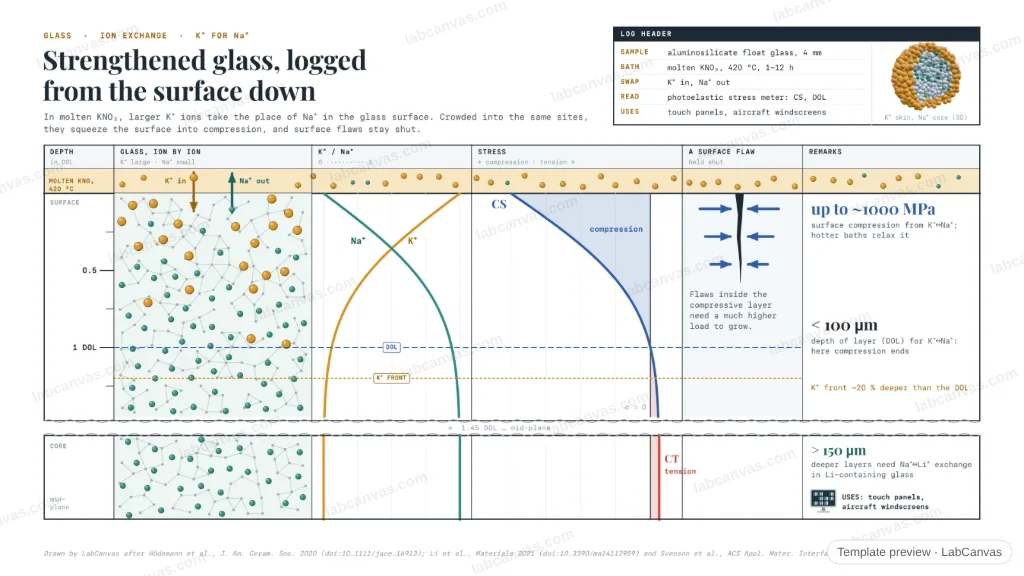
A well log of an ion-exchanged glass, read from the surface down: in molten KNO₃, larger K⁺ ions replace Na⁺, so the surface is squeezed into compression (up to about 1000 MPa) that falls to zero at the depth of layer, balanced by a small tension in the core. Tracks for the ions, the K⁺ fraction, the stress, a surface flaw held shut and the remarks share one depth axis.
Updated 3 cited papers783 editable layers
At a glance
- Category
- Graphical abstracts
- Method
- Graphical abstract
- Starting materials
- An alkali aluminosilicate glass containing Na⁺
- Product
- Glass with a compressive surface layer and a balancing tension in its core
- Key result
- Surface compression up to ~1000 MPa and case depth generally < 100 µm for K⁺↔Na⁺, > 150 µm with Na⁺↔Li⁺; K⁺ diffusion depth ~20 % deeper than DOL (Hödemann et al. 2020); KNO₃ at 420 °C, 1 and 12 h, 4 mm aluminosilicate float glass (Li et al. 2021)
- Figure
- 1920 × 1080 px (16:9), 783 editable layers, 1 generated objects
Step by step
- BathThe glass is suspended in molten KNO₃ (420 °C, 1–12 h in one study); K⁺ from the salt replaces Na⁺ in the glass surface (Li et al. 2021; Svenson et al. 2014)
- StuffingK⁺ is physically larger than the Na⁺ it replaces, so the exchanged layer is put into compression, up to about 1000 MPa for K⁺↔Na⁺ (Hödemann et al. 2020)
- Depth of layerCompression falls to zero at the depth of layer (DOL), generally below 100 µm for K⁺↔Na⁺; the K⁺ front lies about 20 % deeper; longer exchange lowers CS and deepens DOL (Hödemann et al. 2020; Li et al. 2021)
- BalanceCompression at the surfaces and tension in the core balance through the thickness; the tension is only the result of that balance (Hödemann et al. 2020)
- CracksSurface flaws sit in compression, so much higher external forces are needed to grow them, and abrasion resistance rises; depths above 150 µm need Na⁺↔Li⁺ exchange in Li-containing glass (Hödemann et al. 2020)
Uses
- Graphical abstracts on chemically strengthened and ion-exchanged glass
- Talks on cover glass for touch panels and aircraft windscreens
- Teaching residual stress profiles and ion exchange
Papers this template follows
- Hödemann et al., “Measurement of stress build-up of ion-exchange strengthened lithium aluminosilicate glass”, Journal of the American Ceramic Society 2020. doi:10.1111/jace.16913primary
- Li et al., “Insight into the Interaction between Water and Ion-Exchanged Aluminosilicate Glass by Nanoindentation”, Materials 2021. doi:10.3390/ma14112959primary
- Svenson et al., “Pressure-induced changes in interdiffusivity and compressive stress in chemically strengthened glass”, ACS Applied Materials & Interfaces 2014. doi:10.1021/am5019868primary
Drawn by LabCanvas after Hödemann et al., J. Am. Ceram. Soc. 2020 (doi:10.1111/jace.16913); Li et al., Materials 2021 (doi:10.3390/ma14112959) and Svenson et al., ACS Appl. Mater. Interfaces 2014 (doi:10.1021/am5019868).
How templates are written and checked: editorial guidelines.
Questions
What does the “Chemically strengthened glass: a log of the ion-exchanged surface” template show?
A well log of an ion-exchanged glass, read from the surface down: in molten KNO₃, larger K⁺ ions replace Na⁺, so the surface is squeezed into compression (up to about 1000 MPa) that falls to zero at the depth of layer, balanced by a small tension in the core. Tracks for the ions, the K⁺ fraction, the stress, a surface flaw held shut and the remarks share one depth axis.
What are the steps shown in “Chemically strengthened glass: a log of the ion-exchanged surface”?
1. Bath: The glass is suspended in molten KNO₃ (420 °C, 1–12 h in one study); K⁺ from the salt replaces Na⁺ in the glass surface (Li et al. 2021; Svenson et al. 2014). 2. Stuffing: K⁺ is physically larger than the Na⁺ it replaces, so the exchanged layer is put into compression, up to about 1000 MPa for K⁺↔Na⁺ (Hödemann et al. 2020). 3. Depth of layer: Compression falls to zero at the depth of layer (DOL), generally below 100 µm for K⁺↔Na⁺; the K⁺ front lies about 20 % deeper; longer exchange lowers CS and deepens DOL (Hödemann et al. 2020; Li et al. 2021). 4. Balance: Compression at the surfaces and tension in the core balance through the thickness; the tension is only the result of that balance (Hödemann et al. 2020). 5. Cracks: Surface flaws sit in compression, so much higher external forces are needed to grow them, and abrasion resistance rises; depths above 150 µm need Na⁺↔Li⁺ exchange in Li-containing glass (Hödemann et al. 2020).
What are the starting materials and the product?
Starting materials: An alkali aluminosilicate glass containing Na⁺. Product: Glass with a compressive surface layer and a balancing tension in its core.
Which papers is “Chemically strengthened glass: a log of the ion-exchanged surface” based on?
Hödemann et al., “Measurement of stress build-up of ion-exchange strengthened lithium aluminosilicate glass”, Journal of the American Ceramic Society 2020 (doi:10.1111/jace.16913); Li et al., “Insight into the Interaction between Water and Ion-Exchanged Aluminosilicate Glass by Nanoindentation”, Materials 2021 (doi:10.3390/ma14112959); Svenson et al., “Pressure-induced changes in interdiffusivity and compressive stress in chemically strengthened glass”, ACS Applied Materials & Interfaces 2014 (doi:10.1021/am5019868).
Can I edit the “Chemically strengthened glass: a log of the ion-exchanged surface” template?
Yes. Open it in the LabCanvas editor: all 783 layers are editable, including 1 generated objects (structures, plots, equipment) with their own settings. Change the text, colours and layout, then export PNG, TIFF, SVG or PDF.
Do I need an account to use this template?
Not to view it here. To open and edit it, sign in to LabCanvas or create a free account (the free plan keeps up to 3 designs). Downloading the figure is part of LabCanvas Pro (US$19 a month or US$199 a year).





