Graphical abstract template · Graphical abstracts · Graphical abstract
CRISPR diagnostics: find a sequence, light a signal
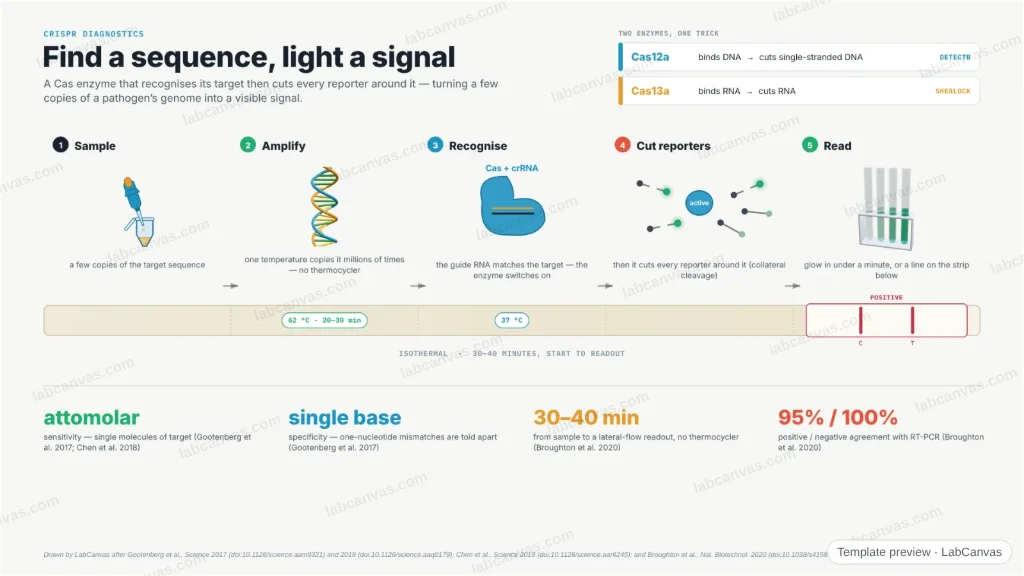
A test-strip graphical abstract of CRISPR diagnostics. A sample is amplified at one temperature, a Cas enzyme guided by its crRNA recognises the target sequence and then cuts reporter molecules at random — Cas12 cuts single-stranded DNA (DETECTR), Cas13 cuts RNA (SHERLOCK) — and the freed reporter is read as fluorescence or as a line on a lateral-flow strip, in well under an hour.
Updated 4 cited papers95 editable layers
At a glance
- Category
- Graphical abstracts
- Method
- Graphical abstract
- Starting materials
- A sample with a few copies of a target DNA or RNA sequence
- Product
- A yes/no (or quantitative) readout: fluorescence or a test line on a strip
- Key result
- Attomolar sensitivity and single-base specificity (Gootenberg et al. 2017; Chen et al. 2018); input as low as 2 aM, four-plex, lateral flow (Gootenberg et al. 2018); SARS-CoV-2 in 30–40 min, 95% / 100% agreement with RT-PCR (Broughton et al. 2020)
- Figure
- 1920 × 1080 px (16:9), 95 editable layers, 1 generated objects
Step by step
- AmplifyIsothermal amplification — RPA plus T7 transcription (SHERLOCK) or RT-LAMP at 62 °C for 20–30 min (DETECTR) — needs no thermocycler (Gootenberg et al. 2017; Broughton et al. 2020)
- RecogniseThe Cas enzyme, guided by its crRNA, binds the target: Cas12a a DNA target, Cas13a an RNA target (Chen et al. 2018; Gootenberg et al. 2017)
- Cut reportersOnce activated it cuts nearby reporters indiscriminately — single-stranded DNA for Cas12a, RNA for Cas13a — freeing a quenched fluorophore (collateral cleavage)
- ReadFluorescence appears in < 1 min; on a lateral-flow strip uncleaved FAM–biotin reporter stays at the control line and cleavage gives a test line in ~2 min; Cas12 step 37 °C, 10 min (Broughton et al. 2020)
Uses
- Graphical abstracts on CRISPR-based diagnostics
- Talks on point-of-care nucleic-acid testing
- Teaching collateral (trans) cleavage and reporter readouts
Papers this template follows
- Gootenberg et al., “Nucleic acid detection with CRISPR-Cas13a/C2c2”, Science 2017. doi:10.1126/science.aam9321method origin
- Chen et al., “CRISPR-Cas12a target binding unleashes indiscriminate single-stranded DNase activity”, Science 2018. doi:10.1126/science.aar6245primary
- Gootenberg et al., “Multiplexed and portable nucleic acid detection platform with Cas13, Cas12a, and Csm6”, Science 2018. doi:10.1126/science.aaq0179primary
- Broughton et al., “CRISPR-Cas12-based detection of SARS-CoV-2”, Nat. Biotechnol. 2020. doi:10.1038/s41587-020-0513-4primary
Drawn by LabCanvas after Gootenberg et al., Science 2017 (doi:10.1126/science.aam9321) and 2018 (doi:10.1126/science.aaq0179); Chen et al., Science 2018 (doi:10.1126/science.aar6245); and Broughton et al., Nat. Biotechnol. 2020 (doi:10.1038/s41587-020-0513-4).
How templates are written and checked: editorial guidelines.
Questions
What does the “CRISPR diagnostics: find a sequence, light a signal” template show?
A test-strip graphical abstract of CRISPR diagnostics. A sample is amplified at one temperature, a Cas enzyme guided by its crRNA recognises the target sequence and then cuts reporter molecules at random — Cas12 cuts single-stranded DNA (DETECTR), Cas13 cuts RNA (SHERLOCK) — and the freed reporter is read as fluorescence or as a line on a lateral-flow strip, in well under an hour.
What are the steps shown in “CRISPR diagnostics: find a sequence, light a signal”?
1. Amplify: Isothermal amplification — RPA plus T7 transcription (SHERLOCK) or RT-LAMP at 62 °C for 20–30 min (DETECTR) — needs no thermocycler (Gootenberg et al. 2017; Broughton et al. 2020). 2. Recognise: The Cas enzyme, guided by its crRNA, binds the target: Cas12a a DNA target, Cas13a an RNA target (Chen et al. 2018; Gootenberg et al. 2017). 3. Cut reporters: Once activated it cuts nearby reporters indiscriminately — single-stranded DNA for Cas12a, RNA for Cas13a — freeing a quenched fluorophore (collateral cleavage). 4. Read: Fluorescence appears in < 1 min; on a lateral-flow strip uncleaved FAM–biotin reporter stays at the control line and cleavage gives a test line in ~2 min; Cas12 step 37 °C, 10 min (Broughton et al. 2020).
What are the starting materials and the product?
Starting materials: A sample with a few copies of a target DNA or RNA sequence. Product: A yes/no (or quantitative) readout: fluorescence or a test line on a strip.
Which papers is “CRISPR diagnostics: find a sequence, light a signal” based on?
Gootenberg et al., “Nucleic acid detection with CRISPR-Cas13a/C2c2”, Science 2017 (doi:10.1126/science.aam9321); Chen et al., “CRISPR-Cas12a target binding unleashes indiscriminate single-stranded DNase activity”, Science 2018 (doi:10.1126/science.aar6245); Gootenberg et al., “Multiplexed and portable nucleic acid detection platform with Cas13, Cas12a, and Csm6”, Science 2018 (doi:10.1126/science.aaq0179); Broughton et al., “CRISPR-Cas12-based detection of SARS-CoV-2”, Nat. Biotechnol. 2020 (doi:10.1038/s41587-020-0513-4).
Can I edit the “CRISPR diagnostics: find a sequence, light a signal” template?
Yes. Open it in the LabCanvas editor: all 95 layers are editable, including 1 generated objects (structures, plots, equipment) with their own settings. Change the text, colours and layout, then export PNG, TIFF, SVG or PDF.
Do I need an account to use this template?
Not to view it here. To open and edit it, sign in to LabCanvas or create a free account (the free plan keeps up to 3 designs). Downloading the figure is part of LabCanvas Pro (US$19 a month or US$199 a year).





