Graphical abstract template · Materials graphical abstracts · Graphical abstract
Crystal defects that shape materials
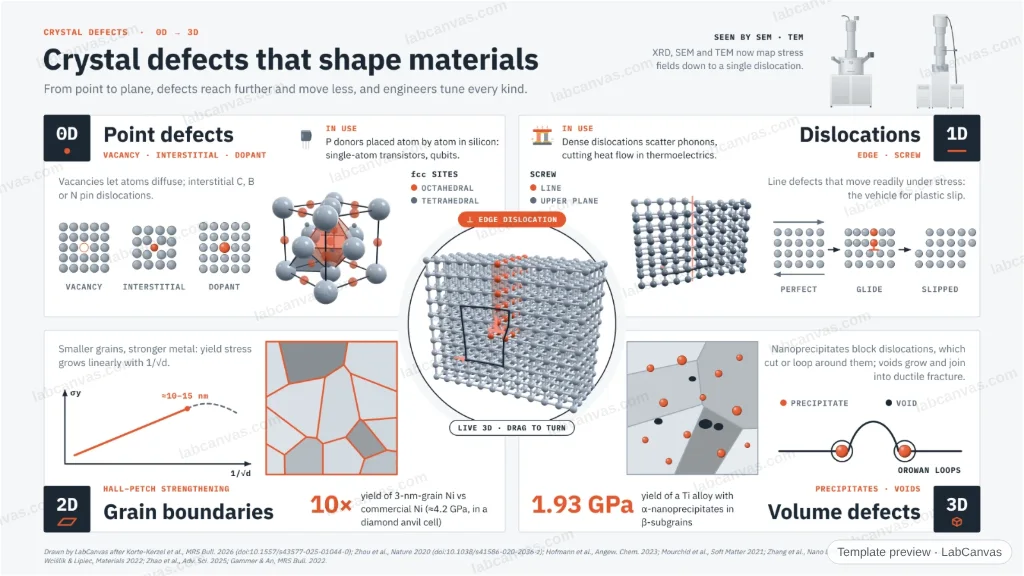
A quadrant graphical abstract of crystal defects by dimension around a live 3D edge dislocation: point defects that let atoms diffuse and dope semiconductors, dislocations that carry plastic flow, grain boundaries that strengthen by Hall–Petch, and precipitates and voids that harden alloys or start fracture. Every statement and number is taken from the cited papers.
Updated 9 cited papers203 editable layers
At a glance
- Category
- Materials graphical abstracts
- Method
- Graphical abstract
- Key result
- 3-nm-grain nickel yields at ≈4.2 GPa in a diamond anvil cell, ten times commercial nickel (Zhou et al. 2020); a Ti-4Al-5Mo-3V-5Cr-1Fe alloy with α-nanoprecipitates in ultrafine β-subgrains yields at ≈1929 MPa (Zhao et al. 2025)
- Figure
- 1920 × 1080 px (16:9), 203 editable layers, 8 generated objects
Step by step
- 0D · Point defectsVacancies enable diffusion; interstitial C, B or N gather at dislocations and pin them (Cottrell atmospheres) (Korte-Kerzel et al. 2026). Substitutional phosphorus donors in silicon, placed atom by atom, make single-atom transistors and qubits (Hofmann et al. 2023)
- 1D · DislocationsLine defects that move readily under applied stress: the vehicle for plastic slip; in thermoelectrics they scatter phonons and lower the lattice thermal conductivity (Korte-Kerzel et al. 2026)
- 2D · Grain boundariesYield stress rises linearly with the inverse square root of grain size (Hall–Petch) (Mourchid et al. 2021); the relation has been reported to break down near 10–15 nm grains (Zhou et al. 2020)
- 3D · Precipitates and voidsNanoprecipitates impede dislocations (sheared or bypassed by Orowan looping) but often cost ductility (Zhang et al. 2025; Akçakale et al. 2026); voids nucleate at particles and lattice defects, grow and coalesce into ductile fracture (Wciślik & Lipiec 2022)
Uses
- Semiconductor doping and donor qubits
- Grain refinement of structural metals
- Precipitation-strengthened alloys
- Thermoelectrics
- Teaching crystal defects
Papers this template follows
- Korte-Kerzel, Rupert, Gianola, Sandlöbes-Haut & Xie, “Defect phases beyond grain boundaries”, MRS Bull. 2026. doi:10.1557/s43577-025-01044-0review
- Zhou et al., “High-pressure strengthening in ultrafine-grained metals”, Nature 2020. doi:10.1038/s41586-020-2036-zprimary
- Hofmann, Stock, Warschkow, Conybeare, Curson & Schofield, “Room temperature incorporation of arsenic atoms into the germanium (001) surface”, Angew. Chem. Int. Ed. 2023. doi:10.1002/anie.202213982primary
- Mourchid, Boucenna & Carn, “Mechanical strength enhancement by grain size reduction in a soft colloidal polycrystal”, Soft Matter 2021. doi:10.1039/d1sm01486bprimary
- Zhang et al., “Chemical short-range ordering in nanoprecipitates modulates planar faults to enhance mechanical properties”, Nano Lett. 2025. doi:10.1021/acs.nanolett.5c01602primary
- Akçakale, Ishtiaq, Varol & Rizi, “Nanodefect-mediated strengthening and deformation mechanisms in magnesium alloys: a critical review”, Nanomaterials 2026. doi:10.3390/nano16110699review
- Wciślik & Lipiec, “Void-induced ductile fracture of metals: experimental observations”, Materials 2022. doi:10.3390/ma15186473review
- Zhao et al., “Designing ductile 2-GPa yielding titanium alloys via multifunctional subgrain boundaries and nanoprecipitates”, Adv. Sci. 2025. doi:10.1002/advs.202519918primary
- Gammer & An, “Conditions near a crack tip: advanced experiments for dislocation analysis and local strain measurement”, MRS Bull. 2022. doi:10.1557/s43577-022-00377-4further reading
Drawn by LabCanvas after Korte-Kerzel et al., MRS Bull. 2026 (doi:10.1557/s43577-025-01044-0); Zhou et al., Nature 2020 (doi:10.1038/s41586-020-2036-z); Hofmann et al., Angew. Chem. 2023 (doi:10.1002/anie.202213982); Mourchid et al., Soft Matter 2021 (doi:10.1039/d1sm01486b); Zhang et al., Nano Lett. 2025 (doi:10.1021/acs.nanolett.5c01602); Akçakale et al., Nanomaterials 2026 (doi:10.3390/nano16110699); Wciślik & Lipiec, Materials 2022 (doi:10.3390/ma15186473); Zhao et al., Adv. Sci. 2025 (doi:10.1002/advs.202519918); Gammer & An, MRS Bull. 2022 (doi:10.1557/s43577-022-00377-4).
How templates are written and checked: editorial guidelines.
Questions
What does the “Crystal defects that shape materials” template show?
A quadrant graphical abstract of crystal defects by dimension around a live 3D edge dislocation: point defects that let atoms diffuse and dope semiconductors, dislocations that carry plastic flow, grain boundaries that strengthen by Hall–Petch, and precipitates and voids that harden alloys or start fracture. Every statement and number is taken from the cited papers.
What are the steps shown in “Crystal defects that shape materials”?
1. 0D · Point defects: Vacancies enable diffusion; interstitial C, B or N gather at dislocations and pin them (Cottrell atmospheres) (Korte-Kerzel et al. 2026). Substitutional phosphorus donors in silicon, placed atom by atom, make single-atom transistors and qubits (Hofmann et al. 2023). 2. 1D · Dislocations: Line defects that move readily under applied stress: the vehicle for plastic slip; in thermoelectrics they scatter phonons and lower the lattice thermal conductivity (Korte-Kerzel et al. 2026). 3. 2D · Grain boundaries: Yield stress rises linearly with the inverse square root of grain size (Hall–Petch) (Mourchid et al. 2021); the relation has been reported to break down near 10–15 nm grains (Zhou et al. 2020). 4. 3D · Precipitates and voids: Nanoprecipitates impede dislocations (sheared or bypassed by Orowan looping) but often cost ductility (Zhang et al. 2025; Akçakale et al. 2026); voids nucleate at particles and lattice defects, grow and coalesce into ductile fracture (Wciślik & Lipiec 2022).
Which papers is “Crystal defects that shape materials” based on?
Korte-Kerzel, Rupert, Gianola, Sandlöbes-Haut & Xie, “Defect phases beyond grain boundaries”, MRS Bull. 2026 (doi:10.1557/s43577-025-01044-0); Zhou et al., “High-pressure strengthening in ultrafine-grained metals”, Nature 2020 (doi:10.1038/s41586-020-2036-z); Hofmann, Stock, Warschkow, Conybeare, Curson & Schofield, “Room temperature incorporation of arsenic atoms into the germanium (001) surface”, Angew. Chem. Int. Ed. 2023 (doi:10.1002/anie.202213982); Mourchid, Boucenna & Carn, “Mechanical strength enhancement by grain size reduction in a soft colloidal polycrystal”, Soft Matter 2021 (doi:10.1039/d1sm01486b); Zhang et al., “Chemical short-range ordering in nanoprecipitates modulates planar faults to enhance mechanical properties”, Nano Lett. 2025 (doi:10.1021/acs.nanolett.5c01602); Akçakale, Ishtiaq, Varol & Rizi, “Nanodefect-mediated strengthening and deformation mechanisms in magnesium alloys: a critical review”, Nanomaterials 2026 (doi:10.3390/nano16110699); Wciślik & Lipiec, “Void-induced ductile fracture of metals: experimental observations”, Materials 2022 (doi:10.3390/ma15186473); Zhao et al., “Designing ductile 2-GPa yielding titanium alloys via multifunctional subgrain boundaries and nanoprecipitates”, Adv. Sci. 2025 (doi:10.1002/advs.202519918); Gammer & An, “Conditions near a crack tip: advanced experiments for dislocation analysis and local strain measurement”, MRS Bull. 2022 (doi:10.1557/s43577-022-00377-4).
Can I edit the “Crystal defects that shape materials” template?
Yes. Open it in the LabCanvas editor: all 203 layers are editable, including 8 generated objects (structures, plots, equipment) with their own settings. Change the text, colours and layout, then export PNG, TIFF, SVG or PDF.
Do I need an account to use this template?
Not to view it here. To open and edit it, sign in to LabCanvas or create a free account (the free plan keeps up to 3 designs). Downloading the figure is part of LabCanvas Pro (US$19 a month or US$199 a year).