Graphical abstract template · Materials graphical abstracts · Graphical abstract
Silica aerogel: from sol to superinsulator
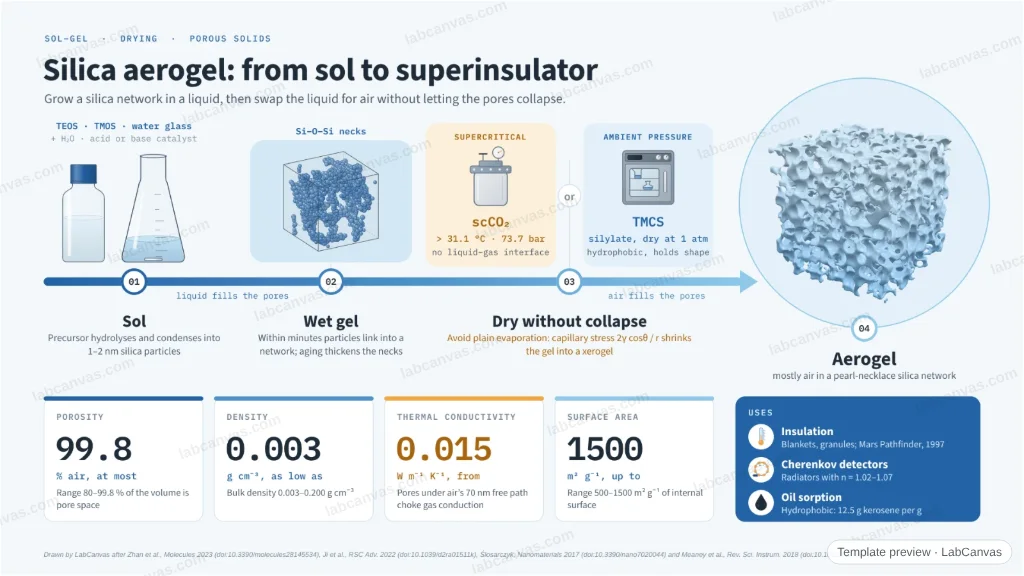
A timeline of how silica aerogel is made: a silica sol gels into a wet particle network, ages, and is dried without letting its pores collapse, by supercritical CO₂ or by ambient-pressure drying after silylation. The result is a solid that is mostly air, with very low density and thermal conductivity, used for insulation, Cherenkov detectors and oil sorption.
Updated 5 cited papers89 editable layers
At a glance
- Category
- Materials graphical abstracts
- Method
- Graphical abstract
- Starting materials
- A silicon alkoxide (TEOS, TMOS) or sodium silicate (water glass) with water and an acid or base catalyst
- Product
- Silica aerogel: a pearl-necklace network of silica nanoparticles holding mostly air
- Key result
- Bulk density 0.003–0.200 g cm⁻³, porosity 80–99.8 %, surface area 500–1500 m² g⁻¹, thermal conductivity 0.015–0.030 W m⁻¹ K⁻¹ (Zhan et al. 2023); Cherenkov radiators n = 1.02–1.07 (Meaney et al. 2018); 12.5 g g⁻¹ kerosene for TMCS-modified aerogel (Ji et al. 2022)
- Figure
- 1920 × 1080 px (16:9), 89 editable layers, 8 generated objects
Step by step
- SolThe precursor hydrolyses and condenses; 1–2 nm primary particles form and join into 5–10 nm particles
- Wet gelWithin minutes the particles link into a network with liquid in its pores; aging strengthens the necks
- Drying without collapseSupercritical CO₂ (above 31.1 °C and 73.7 bar) leaves no liquid–gas interface; or the gel is silylated (TMCS) and dried at ambient pressure. Plain evaporation shrinks it into a xerogel (capillary stress 2γ cosθ / r)
- AerogelPorosity 80–99.8 %, density down to 0.003 g cm⁻³, thermal conductivity from 0.015 W m⁻¹ K⁻¹
Uses
- Thermal insulation (blankets, granules, space hardware)
- Cherenkov detector radiators
- Oil and pollutant sorption
Papers this template follows
- Zhan et al., “The Synthesis and Polymer-Reinforced Mechanical Properties of SiO2 Aerogels: A Review”, Molecules 2023. doi:10.3390/molecules28145534review
- Ji et al., “Research progress and applications of silica-based aerogels – a bibliometric analysis”, RSC Adv. 2022. doi:10.1039/d2ra01511kreview
- Ślosarczyk, “Recent Advances in Research on the Synthetic Fiber Based Silica Aerogel Nanocomposites”, Nanomaterials 2017. doi:10.3390/nano7020044review
- Meaney et al., “Characterization of the Mercury pulsed power x-ray source spectrum using multichannel density aerogel Cherenkov detectors”, Rev. Sci. Instrum. 2018. doi:10.1063/1.5038745primary
- Hu et al., “Sol-Gel Process Optimization of Transparent Silica Aerogels: Regulating Nanostructure to Enhance Optical Transmittance”, Nanomaterials 2026. doi:10.3390/nano16181137further reading
Drawn by LabCanvas after Zhan et al., Molecules 2023 (doi:10.3390/molecules28145534), Ji et al., RSC Adv. 2022 (doi:10.1039/d2ra01511k), Ślosarczyk, Nanomaterials 2017 (doi:10.3390/nano7020044) and Meaney et al., Rev. Sci. Instrum. 2018 (doi:10.1063/1.5038745).
How templates are written and checked: editorial guidelines.
Questions
What does the “Silica aerogel: from sol to superinsulator” template show?
A timeline of how silica aerogel is made: a silica sol gels into a wet particle network, ages, and is dried without letting its pores collapse, by supercritical CO₂ or by ambient-pressure drying after silylation. The result is a solid that is mostly air, with very low density and thermal conductivity, used for insulation, Cherenkov detectors and oil sorption.
What are the steps shown in “Silica aerogel: from sol to superinsulator”?
1. Sol: The precursor hydrolyses and condenses; 1–2 nm primary particles form and join into 5–10 nm particles. 2. Wet gel: Within minutes the particles link into a network with liquid in its pores; aging strengthens the necks. 3. Drying without collapse: Supercritical CO₂ (above 31.1 °C and 73.7 bar) leaves no liquid–gas interface; or the gel is silylated (TMCS) and dried at ambient pressure. Plain evaporation shrinks it into a xerogel (capillary stress 2γ cosθ / r). 4. Aerogel: Porosity 80–99.8 %, density down to 0.003 g cm⁻³, thermal conductivity from 0.015 W m⁻¹ K⁻¹.
What are the starting materials and the product?
Starting materials: A silicon alkoxide (TEOS, TMOS) or sodium silicate (water glass) with water and an acid or base catalyst. Product: Silica aerogel: a pearl-necklace network of silica nanoparticles holding mostly air.
Which papers is “Silica aerogel: from sol to superinsulator” based on?
Zhan et al., “The Synthesis and Polymer-Reinforced Mechanical Properties of SiO2 Aerogels: A Review”, Molecules 2023 (doi:10.3390/molecules28145534); Ji et al., “Research progress and applications of silica-based aerogels – a bibliometric analysis”, RSC Adv. 2022 (doi:10.1039/d2ra01511k); Ślosarczyk, “Recent Advances in Research on the Synthetic Fiber Based Silica Aerogel Nanocomposites”, Nanomaterials 2017 (doi:10.3390/nano7020044); Meaney et al., “Characterization of the Mercury pulsed power x-ray source spectrum using multichannel density aerogel Cherenkov detectors”, Rev. Sci. Instrum. 2018 (doi:10.1063/1.5038745); Hu et al., “Sol-Gel Process Optimization of Transparent Silica Aerogels: Regulating Nanostructure to Enhance Optical Transmittance”, Nanomaterials 2026 (doi:10.3390/nano16181137).
Can I edit the “Silica aerogel: from sol to superinsulator” template?
Yes. Open it in the LabCanvas editor: all 89 layers are editable, including 8 generated objects (structures, plots, equipment) with their own settings. Change the text, colours and layout, then export PNG, TIFF, SVG or PDF.
Do I need an account to use this template?
Not to view it here. To open and edit it, sign in to LabCanvas or create a free account (the free plan keeps up to 3 designs). Downloading the figure is part of LabCanvas Pro (US$19 a month or US$199 a year).