Graphical abstract template · Materials graphical abstracts · Graphical abstract
Shape-selective catalysis in zeolites: from pellet to pore window
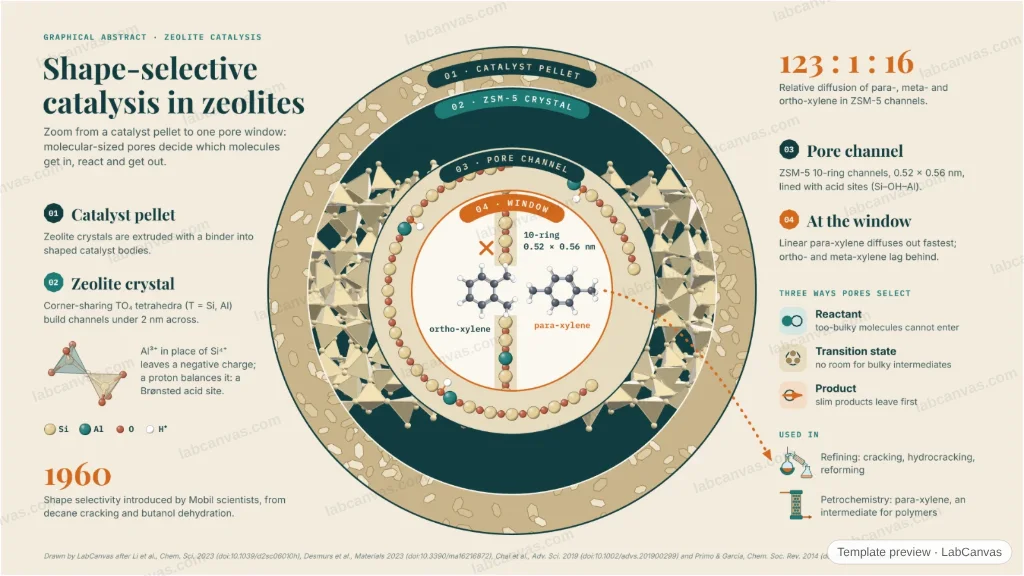
A concentric zoom into a zeolite catalyst: a shaped pellet of crystals, the ZSM-5 framework of corner-sharing TO₄ tetrahedra (a live 3D model), a pore channel lined with Brønsted acid sites, and a 10-ring window where slim para-xylene slips out while bulkier ortho-xylene is held back. Side captions explain each level, the three kinds of shape selectivity and where zeolites are used in refining and petrochemistry.
Updated 9 cited papers413 editable layers
At a glance
- Category
- Materials graphical abstracts
- Method
- Graphical abstract
- Starting materials
- Zeolite crystals (ZSM-5) shaped with a binder into catalyst pellets
- Product
- para-Xylene, favoured because it diffuses out of the 10-ring channels fastest
- Key result
- para : meta : ortho-xylene relative diffusion coefficients 123 : 1 : 16 in ZSM-5 (quoted by Desmurs et al. 2023); shape selectivity first described in 1960 by Mobil scientists (Chai et al. 2019)
- Figure
- 1920 × 1080 px (16:9), 413 editable layers, 5 generated objects
Step by step
- Catalyst pelletZeolite crystals extruded with a binder into shaped catalyst bodies
- Zeolite crystalCorner-sharing TO₄ tetrahedra (T = Si, Al) build channels under 2 nm across; Al³⁺ for Si⁴⁺ leaves a charge balanced by H⁺, a Brønsted acid site
- Pore channelZSM-5 10-ring channels, 0.52 × 0.56 nm (straight) and 0.54 × 0.56 nm (sinusoidal), lined with acid sites
- At the windowLinear para-xylene diffuses out faster than ortho- and meta-xylene (relative diffusion coefficients para : meta : ortho = 123 : 1 : 16)
Uses
- Oil refining: cracking, hydrocracking, reforming, light naphtha isomerization, olefin alkylation
- Petrochemistry: para-xylene by toluene alkylation with methanol
- Teaching shape selectivity and zeolite acidity
Papers this template follows
- Li, Gao, Yan & Yu, “Regulation of the Si/Al ratios and Al distributions of zeolites and their impact on properties”, Chem. Sci. 2023. doi:10.1039/d2sc06010hreview
- Desmurs et al., “Influence of the Mesoporosity of Hierarchical ZSM-5 in Toluene Alkylation by Methanol”, Materials 2023. doi:10.3390/ma16216872primary
- Chai et al., “Noble Metal Particles Confined in Zeolites: Synthesis, Characterization, and Applications”, Adv. Sci. 2019. doi:10.1002/advs.201900299review
- Stavitski, Kox & Weckhuysen, “Revealing shape selectivity and catalytic activity trends within the pores of H-ZSM-5 crystals by time- and space-resolved optical and fluorescence microspectroscopy”, Chem. Eur. J. 2007. doi:10.1002/chem.200700568primary
- Zhang et al., “Cavity-controlled methanol conversion over zeolite catalysts”, Natl. Sci. Rev. 2023. doi:10.1093/nsr/nwad120review
- Wang et al., “A Facile Strategy to Prepare Shaped ZSM-5 Catalysts with Enhanced Para-Xylene Selectivity and Stability for Toluene Methylation: The Effect of In Situ Modification by Attapulgite”, Molecules 2019. doi:10.3390/molecules24193462primary
- Hijazi et al., “Chemical engineering of zeolites: alleviating transport limitations through hierarchical design and shaping”, Chem. Soc. Rev. 2025. doi:10.1039/d5cs00169breview
- Primo & Garcia, “Zeolites as catalysts in oil refining”, Chem. Soc. Rev. 2014. doi:10.1039/c3cs60394freview
- Guo et al., “Discrimination of the Synergistic Effect of Different Zinc Active Sites with a Brønsted Acid in Zeolite for Dehydrogenation Cracking of n-Octane and Ethane Dehydroaromatization”, Langmuir 2024. doi:10.1021/acs.langmuir.4c03769further reading
Drawn by LabCanvas after Li et al., Chem. Sci. 2023 (doi:10.1039/d2sc06010h), Desmurs et al., Materials 2023 (doi:10.3390/ma16216872), Chai et al., Adv. Sci. 2019 (doi:10.1002/advs.201900299) and Primo & Garcia, Chem. Soc. Rev. 2014 (doi:10.1039/c3cs60394f).
How templates are written and checked: editorial guidelines.
Questions
What does the “Shape-selective catalysis in zeolites: from pellet to pore window” template show?
A concentric zoom into a zeolite catalyst: a shaped pellet of crystals, the ZSM-5 framework of corner-sharing TO₄ tetrahedra (a live 3D model), a pore channel lined with Brønsted acid sites, and a 10-ring window where slim para-xylene slips out while bulkier ortho-xylene is held back. Side captions explain each level, the three kinds of shape selectivity and where zeolites are used in refining and petrochemistry.
What are the steps shown in “Shape-selective catalysis in zeolites: from pellet to pore window”?
1. Catalyst pellet: Zeolite crystals extruded with a binder into shaped catalyst bodies. 2. Zeolite crystal: Corner-sharing TO₄ tetrahedra (T = Si, Al) build channels under 2 nm across; Al³⁺ for Si⁴⁺ leaves a charge balanced by H⁺, a Brønsted acid site. 3. Pore channel: ZSM-5 10-ring channels, 0.52 × 0.56 nm (straight) and 0.54 × 0.56 nm (sinusoidal), lined with acid sites. 4. At the window: Linear para-xylene diffuses out faster than ortho- and meta-xylene (relative diffusion coefficients para : meta : ortho = 123 : 1 : 16).
What are the starting materials and the product?
Starting materials: Zeolite crystals (ZSM-5) shaped with a binder into catalyst pellets. Product: para-Xylene, favoured because it diffuses out of the 10-ring channels fastest.
Which papers is “Shape-selective catalysis in zeolites: from pellet to pore window” based on?
Li, Gao, Yan & Yu, “Regulation of the Si/Al ratios and Al distributions of zeolites and their impact on properties”, Chem. Sci. 2023 (doi:10.1039/d2sc06010h); Desmurs et al., “Influence of the Mesoporosity of Hierarchical ZSM-5 in Toluene Alkylation by Methanol”, Materials 2023 (doi:10.3390/ma16216872); Chai et al., “Noble Metal Particles Confined in Zeolites: Synthesis, Characterization, and Applications”, Adv. Sci. 2019 (doi:10.1002/advs.201900299); Stavitski, Kox & Weckhuysen, “Revealing shape selectivity and catalytic activity trends within the pores of H-ZSM-5 crystals by time- and space-resolved optical and fluorescence microspectroscopy”, Chem. Eur. J. 2007 (doi:10.1002/chem.200700568); Zhang et al., “Cavity-controlled methanol conversion over zeolite catalysts”, Natl. Sci. Rev. 2023 (doi:10.1093/nsr/nwad120); Wang et al., “A Facile Strategy to Prepare Shaped ZSM-5 Catalysts with Enhanced Para-Xylene Selectivity and Stability for Toluene Methylation: The Effect of In Situ Modification by Attapulgite”, Molecules 2019 (doi:10.3390/molecules24193462); Hijazi et al., “Chemical engineering of zeolites: alleviating transport limitations through hierarchical design and shaping”, Chem. Soc. Rev. 2025 (doi:10.1039/d5cs00169b); Primo & Garcia, “Zeolites as catalysts in oil refining”, Chem. Soc. Rev. 2014 (doi:10.1039/c3cs60394f); Guo et al., “Discrimination of the Synergistic Effect of Different Zinc Active Sites with a Brønsted Acid in Zeolite for Dehydrogenation Cracking of n-Octane and Ethane Dehydroaromatization”, Langmuir 2024 (doi:10.1021/acs.langmuir.4c03769).
Can I edit the “Shape-selective catalysis in zeolites: from pellet to pore window” template?
Yes. Open it in the LabCanvas editor: all 413 layers are editable, including 5 generated objects (structures, plots, equipment) with their own settings. Change the text, colours and layout, then export PNG, TIFF, SVG or PDF.
Do I need an account to use this template?
Not to view it here. To open and edit it, sign in to LabCanvas or create a free account (the free plan keeps up to 3 designs). Downloading the figure is part of LabCanvas Pro (US$19 a month or US$199 a year).