Graphical abstract template · Materials graphical abstracts · Graphical abstract
Daytime radiative cooling: cooling under the sun with the cold of space
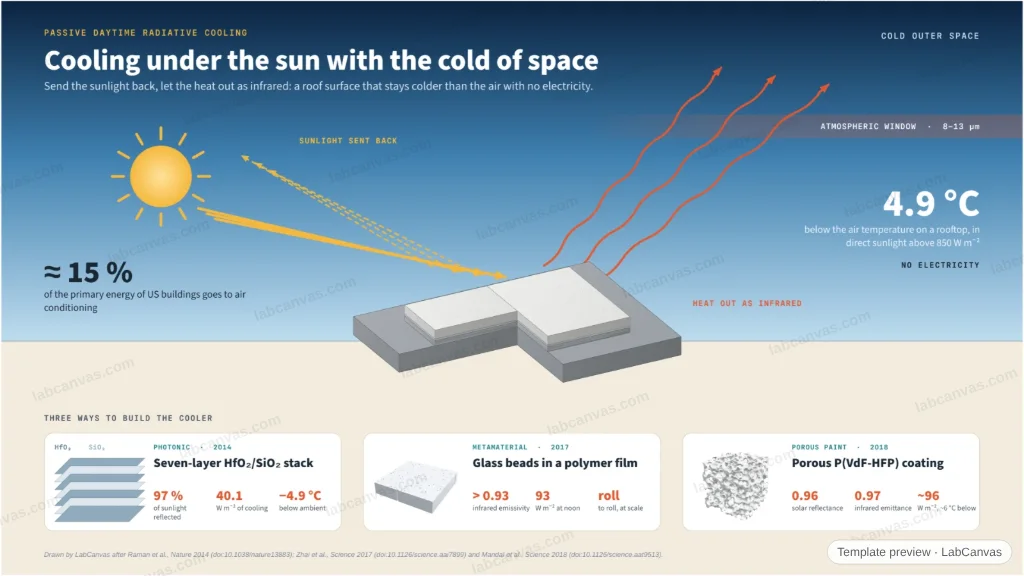
A sky-and-ground graphical abstract: a cooler on a rooftop sends sunlight back and radiates heat to space through the 8–13 µm atmospheric window, staying below the air temperature in full sun with no electricity. Three ways to build it sit on the ground: a seven-layer photonic stack, a glass–polymer metamaterial and a porous polymer paint.
Updated 3 cited papers82 editable layers
At a glance
- Category
- Materials graphical abstracts
- Method
- Graphical abstract
- Starting materials
- A surface that reflects sunlight and emits strongly between 8 and 13 µm
- Product
- A passive cooler that stays below air temperature in direct sunlight
- Key result
- Cooling powers 40.1 W m⁻² (Raman et al. 2014), 93 W m⁻² (Zhai et al. 2017) and ~96 W m⁻² (Mandal et al. 2018); 4.9 °C below ambient in direct sunlight (Raman et al. 2014)
- Figure
- 1920 × 1080 px (16:9), 82 editable layers, 1 generated objects
Step by step
- Send the sunlight backA seven-layer HfO₂/SiO₂ photonic stack reflects 97% of incident sunlight (Raman et al. 2014); porous P(VdF-HFP) coatings reflect 0.96 of it (Mandal et al. 2018)
- Radiate heat to spaceEmit strongly in the 8–13 µm atmospheric transparency window (Raman et al. 2014): emissivity above 0.93 for a glass–polymer metamaterial (Zhai et al. 2017), 0.97 for porous coatings (Mandal et al. 2018)
- Cool below the air in full sun4.9 °C below ambient under more than 850 W m⁻² of sun, 40.1 W m⁻² of cooling (Raman et al. 2014); 93 W m⁻² at noon (Zhai et al. 2017); ~6 °C and ~96 W m⁻² (Mandal et al. 2018)
Uses
- Graphical abstracts on radiative cooling and thermal photonics
- Talks on passive cooling of buildings
- Teaching the atmospheric window and solar reflectance
Papers this template follows
- Raman, Anoma, Zhu, Rephaeli & Fan, “Passive radiative cooling below ambient air temperature under direct sunlight”, Nature 2014. doi:10.1038/nature13883method origin
- Zhai et al., “Scalable-manufactured randomized glass-polymer hybrid metamaterial for daytime radiative cooling”, Science 2017. doi:10.1126/science.aai7899primary
- Mandal et al., “Hierarchically porous polymer coatings for highly efficient passive daytime radiative cooling”, Science 2018. doi:10.1126/science.aat9513primary
Drawn by LabCanvas after Raman et al., Nature 2014 (doi:10.1038/nature13883); Zhai et al., Science 2017 (doi:10.1126/science.aai7899) and Mandal et al., Science 2018 (doi:10.1126/science.aat9513).
How templates are written and checked: editorial guidelines.
Questions
What does the “Daytime radiative cooling: cooling under the sun with the cold of space” template show?
A sky-and-ground graphical abstract: a cooler on a rooftop sends sunlight back and radiates heat to space through the 8–13 µm atmospheric window, staying below the air temperature in full sun with no electricity. Three ways to build it sit on the ground: a seven-layer photonic stack, a glass–polymer metamaterial and a porous polymer paint.
What are the steps shown in “Daytime radiative cooling: cooling under the sun with the cold of space”?
1. Send the sunlight back: A seven-layer HfO₂/SiO₂ photonic stack reflects 97% of incident sunlight (Raman et al. 2014); porous P(VdF-HFP) coatings reflect 0.96 of it (Mandal et al. 2018). 2. Radiate heat to space: Emit strongly in the 8–13 µm atmospheric transparency window (Raman et al. 2014): emissivity above 0.93 for a glass–polymer metamaterial (Zhai et al. 2017), 0.97 for porous coatings (Mandal et al. 2018). 3. Cool below the air in full sun: 4.9 °C below ambient under more than 850 W m⁻² of sun, 40.1 W m⁻² of cooling (Raman et al. 2014); 93 W m⁻² at noon (Zhai et al. 2017); ~6 °C and ~96 W m⁻² (Mandal et al. 2018).
What are the starting materials and the product?
Starting materials: A surface that reflects sunlight and emits strongly between 8 and 13 µm. Product: A passive cooler that stays below air temperature in direct sunlight.
Which papers is “Daytime radiative cooling: cooling under the sun with the cold of space” based on?
Raman, Anoma, Zhu, Rephaeli & Fan, “Passive radiative cooling below ambient air temperature under direct sunlight”, Nature 2014 (doi:10.1038/nature13883); Zhai et al., “Scalable-manufactured randomized glass-polymer hybrid metamaterial for daytime radiative cooling”, Science 2017 (doi:10.1126/science.aai7899); Mandal et al., “Hierarchically porous polymer coatings for highly efficient passive daytime radiative cooling”, Science 2018 (doi:10.1126/science.aat9513).
Can I edit the “Daytime radiative cooling: cooling under the sun with the cold of space” template?
Yes. Open it in the LabCanvas editor: all 82 layers are editable, including 1 generated objects (structures, plots, equipment) with their own settings. Change the text, colours and layout, then export PNG, TIFF, SVG or PDF.
Do I need an account to use this template?
Not to view it here. To open and edit it, sign in to LabCanvas or create a free account (the free plan keeps up to 3 designs). Downloading the figure is part of LabCanvas Pro (US$19 a month or US$199 a year).