Graphical abstract template · Graphical abstracts · Graphical abstract
Electrochromic smart windows: glass that tints on demand
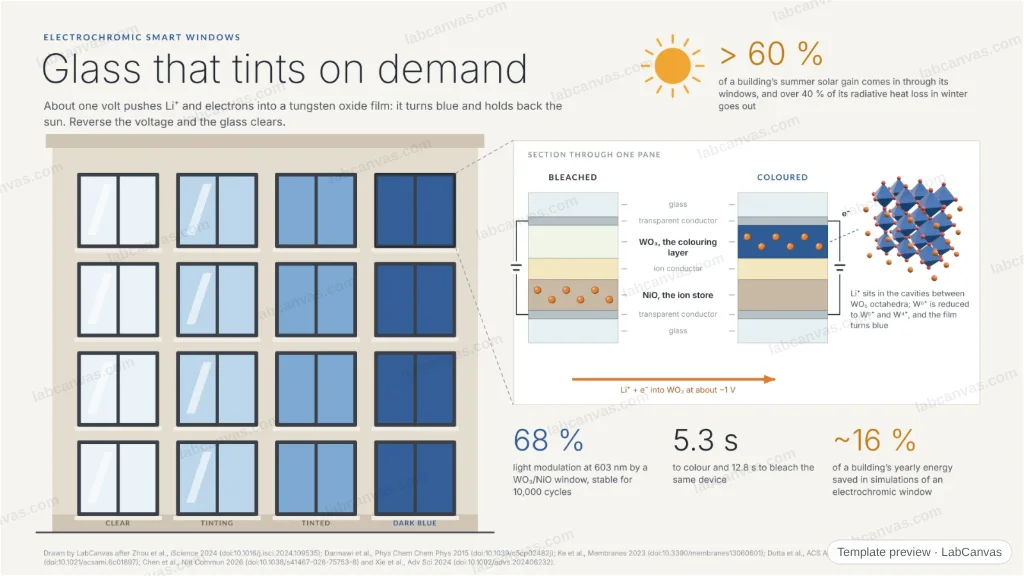
An architect’s elevation: a facade whose windows tint from clear to tungsten-bronze blue, and a section through one pane, bleached and coloured, where Li⁺ and electrons move from a nickel oxide counter electrode into tungsten oxide and turn it blue. Three numbers give the stakes: windows let in most of a building’s summer solar gain, a WO₃/NiO device switches thousands of times, and simulations save about a sixth of a building’s energy.
Updated 6 cited papers178 editable layers
At a glance
- Category
- Graphical abstracts
- Method
- Graphical abstract
- Starting materials
- Glass coated with a transparent conductor, WO₃, an ion conductor and NiO
- Product
- A window that switches between clear and blue
- Key result
- > 60 % of summer solar gain via windows (Chen et al. 2026); 37 % of CO₂ from construction (Zhou et al. 2024); 68.2 % at 603 nm, 5.3 / 12.8 s, 10,000 cycles (Ke et al. 2023); ~16 % energy saved (Xie et al. 2024)
- Figure
- 1920 × 1080 px (16:9), 178 editable layers
Step by step
- Why windowsWindows let in over 60 % of a building’s solar gain in summer and lose over 40 % of its radiated heat in winter (Chen et al. 2026); buildings account for 37 % of global CO₂ emissions (Zhou et al. 2024)
- The stackAn electrochromic layer (WO₃), an ion conductor and an ion-storage layer (NiO) between two transparent conductors, working like a thin-film battery (Zhou et al. 2024; Ke et al. 2023)
- ColouringLi⁺ (or H⁺) and electrons enter WO₃ together; W⁶⁺ is reduced to W⁵⁺ and W⁴⁺ and the film turns blue (Darmawi et al. 2015); about −1 V switches a WO₃ film from clear to blue (Dutta et al. 2026)
- Performance68.2 % optical modulation at 603 nm, 5.3 s to colour, 12.8 s to bleach, 10,000 cycles for a WO₃/NiO device (Ke et al. 2023)
- SavingsSimulated: 366 MJ m⁻² a year, about 16 % of a building’s energy, for a dual-band electrochromic window (Xie et al. 2024)
Uses
- Graphical abstracts on electrochromic materials and smart windows
- Talks on energy-efficient buildings
- Teaching ion insertion and colour change in WO₃
Papers this template follows
- Zhou et al., “The frontier of tungsten oxide nanostructures in electronic applications”, iScience 2024. doi:10.1016/j.isci.2024.109535review
- Darmawi et al., “Correlation of electrochromic properties and oxidation states in nanocrystalline tungsten trioxide”, Physical Chemistry Chemical Physics 2015. doi:10.1039/c5cp02482jprimary
- Ke et al., “Long-term stable complementary electrochromic device based on WO₃ working electrode and NiO-Pt counter electrode”, Membranes 2023. doi:10.3390/membranes13060601primary
- Dutta et al., “Spray-coated indium tin hydroxide-WO₃ nanocomposites for dual-band electrochromic smart windows”, ACS Applied Materials & Interfaces 2026. doi:10.1021/acsami.6c01897primary
- Chen et al., “Solar and thermal dual-band electrochromic windows for energy-efficient buildings”, Nature Communications 2026. doi:10.1038/s41467-026-75753-8primary
- Xie et al., “Reusing the wasted energy of electrochromic smart window for near-zero energy building”, Advanced Science 2024. doi:10.1002/advs.202406232primary
Drawn by LabCanvas after Zhou et al., iScience 2024 (doi:10.1016/j.isci.2024.109535); Darmawi et al., Phys Chem Chem Phys 2015 (doi:10.1039/c5cp02482j); Ke et al., Membranes 2023 (doi:10.3390/membranes13060601); Dutta et al., ACS Appl Mater Interfaces 2026 (doi:10.1021/acsami.6c01897); Chen et al., Nat Commun 2026 (doi:10.1038/s41467-026-75753-8) and Xie et al., Adv Sci 2024 (doi:10.1002/advs.202406232).
How templates are written and checked: editorial guidelines.
Questions
What does the “Electrochromic smart windows: glass that tints on demand” template show?
An architect’s elevation: a facade whose windows tint from clear to tungsten-bronze blue, and a section through one pane, bleached and coloured, where Li⁺ and electrons move from a nickel oxide counter electrode into tungsten oxide and turn it blue. Three numbers give the stakes: windows let in most of a building’s summer solar gain, a WO₃/NiO device switches thousands of times, and simulations save about a sixth of a building’s energy.
What are the steps shown in “Electrochromic smart windows: glass that tints on demand”?
1. Why windows: Windows let in over 60 % of a building’s solar gain in summer and lose over 40 % of its radiated heat in winter (Chen et al. 2026); buildings account for 37 % of global CO₂ emissions (Zhou et al. 2024). 2. The stack: An electrochromic layer (WO₃), an ion conductor and an ion-storage layer (NiO) between two transparent conductors, working like a thin-film battery (Zhou et al. 2024; Ke et al. 2023). 3. Colouring: Li⁺ (or H⁺) and electrons enter WO₃ together; W⁶⁺ is reduced to W⁵⁺ and W⁴⁺ and the film turns blue (Darmawi et al. 2015); about −1 V switches a WO₃ film from clear to blue (Dutta et al. 2026). 4. Performance: 68.2 % optical modulation at 603 nm, 5.3 s to colour, 12.8 s to bleach, 10,000 cycles for a WO₃/NiO device (Ke et al. 2023). 5. Savings: Simulated: 366 MJ m⁻² a year, about 16 % of a building’s energy, for a dual-band electrochromic window (Xie et al. 2024).
What are the starting materials and the product?
Starting materials: Glass coated with a transparent conductor, WO₃, an ion conductor and NiO. Product: A window that switches between clear and blue.
Which papers is “Electrochromic smart windows: glass that tints on demand” based on?
Zhou et al., “The frontier of tungsten oxide nanostructures in electronic applications”, iScience 2024 (doi:10.1016/j.isci.2024.109535); Darmawi et al., “Correlation of electrochromic properties and oxidation states in nanocrystalline tungsten trioxide”, Physical Chemistry Chemical Physics 2015 (doi:10.1039/c5cp02482j); Ke et al., “Long-term stable complementary electrochromic device based on WO₃ working electrode and NiO-Pt counter electrode”, Membranes 2023 (doi:10.3390/membranes13060601); Dutta et al., “Spray-coated indium tin hydroxide-WO₃ nanocomposites for dual-band electrochromic smart windows”, ACS Applied Materials & Interfaces 2026 (doi:10.1021/acsami.6c01897); Chen et al., “Solar and thermal dual-band electrochromic windows for energy-efficient buildings”, Nature Communications 2026 (doi:10.1038/s41467-026-75753-8); Xie et al., “Reusing the wasted energy of electrochromic smart window for near-zero energy building”, Advanced Science 2024 (doi:10.1002/advs.202406232).
Can I edit the “Electrochromic smart windows: glass that tints on demand” template?
Yes. Open it in the LabCanvas editor: all 178 layers are editable. Change the text, colours and layout, then export PNG, TIFF, SVG or PDF.
Do I need an account to use this template?
Not to view it here. To open and edit it, sign in to LabCanvas or create a free account (the free plan keeps up to 3 designs). Downloading the figure is part of LabCanvas Pro (US$19 a month or US$199 a year).