Graphical abstract template · Graphical abstracts · Graphical abstract
Electronic skin: soft sensors that stretch, press and feel
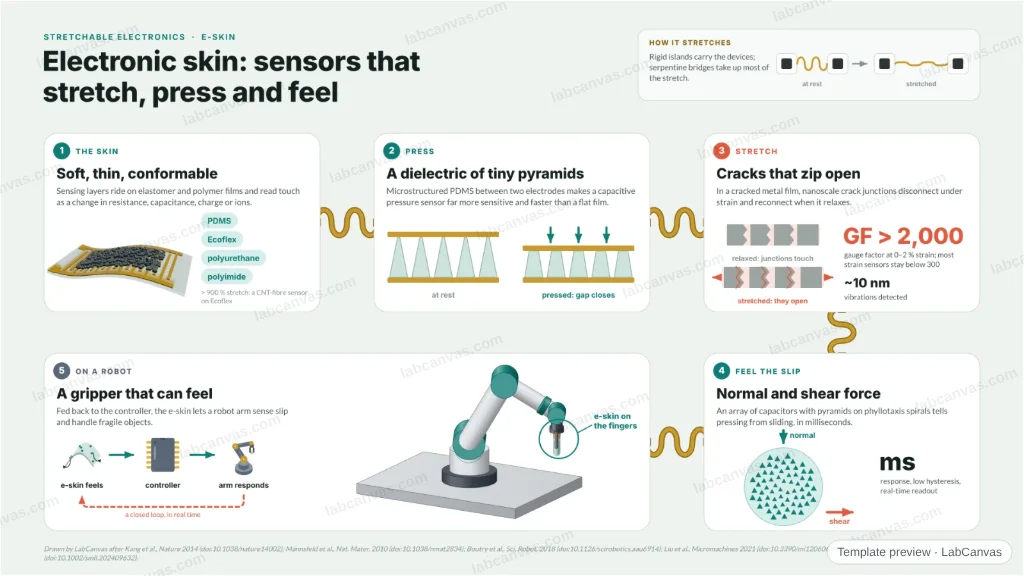
Stretchable electronic skin drawn as its own circuit: rigid islands joined by gold serpentine bridges, read in order. A soft elastomer skin, pressure sensing with a microstructured dielectric, strain sensing with nanoscale crack junctions (gauge factor above 2,000), an array that tells normal from shear force, and a robot gripper that uses it to feel slip.
Updated 5 cited papers201 editable layers
At a glance
- Category
- Graphical abstracts
- Method
- Graphical abstract
- Starting materials
- Elastomer films (PDMS, Ecoflex, polyurethane, polyimide) and thin conductive layers
- Product
- A stretchable sensor skin that gives a robot gripper touch feedback
- Key result
- Gauge factor > 2,000 at 0–2 % strain, ~10 nm vibration amplitude (Kang et al. 2014); most strain sensors < 300, CNT-fibre sensor > 900 % stretch (Liu et al. 2021); millisecond response (Boutry et al. 2018)
- Figure
- 1920 × 1080 px (16:9), 201 editable layers, 4 generated objects
Step by step
- Soft skinSkin-like sensors sit on PDMS, PET, polyurethane, polyimide or Ecoflex and sense by resistance, capacitance, piezoelectric charge or ions; a CNT-fibre strain sensor on Ecoflex stretches over 900 % (Liu et al. 2021)
- PressA microstructured PDMS dielectric makes capacitive pressure sensors far more sensitive than flat films, with very short response times; the microstructure tunes the sensitivity (Mannsfeld et al. 2010)
- StretchNanoscale crack junctions that disconnect and reconnect under strain give a gauge factor above 2,000 at 0–2 % strain and detect ~10 nm vibrations (Kang et al. 2014); most strain sensors stay below 300 (Liu et al. 2021)
- Normal and shearAn array of capacitors with pyramids along phyllotaxis spirals measures normal and shear force in real time, with low hysteresis and millisecond response (Boutry et al. 2018)
- On a robotThe e-skin’s feedback controlled a robot arm, which must detect slip and handle fragile objects (Boutry et al. 2018); serpentine bridges take up the stretch between rigid device islands (Ma et al. 2025)
Uses
- Graphical abstracts on electronic skin and stretchable sensors
- Talks on tactile sensing for robotics
- Teaching island–bridge stretchable electronics
Papers this template follows
- Kang et al., “Ultrasensitive mechanical crack-based sensor inspired by the spider sensory system”, Nature 2014. doi:10.1038/nature14002primary
- Mannsfeld et al., “Highly sensitive flexible pressure sensors with microstructured rubber dielectric layers”, Nature Materials 2010. doi:10.1038/nmat2834primary
- Boutry et al., “A hierarchically patterned, bioinspired e-skin able to detect the direction of applied pressure for robotics”, Science Robotics 2018. doi:10.1126/scirobotics.aau6914primary
- Liu et al., “Advanced Flexible Skin-Like Pressure and Strain Sensors for Human Health Monitoring”, Micromachines 2021. doi:10.3390/mi12060695review
- Ma et al., “Theoretical Model of the Island Effect in Flexible Electronics under Equal Biaxial Stretching”, Small 2025. doi:10.1002/smll.202409632further reading
Drawn by LabCanvas after Kang et al., Nature 2014 (doi:10.1038/nature14002); Mannsfeld et al., Nat. Mater. 2010 (doi:10.1038/nmat2834); Boutry et al., Sci. Robot. 2018 (doi:10.1126/scirobotics.aau6914); Liu et al., Micromachines 2021 (doi:10.3390/mi12060695) and Ma et al., Small 2025 (doi:10.1002/smll.202409632).
How templates are written and checked: editorial guidelines.
Questions
What does the “Electronic skin: soft sensors that stretch, press and feel” template show?
Stretchable electronic skin drawn as its own circuit: rigid islands joined by gold serpentine bridges, read in order. A soft elastomer skin, pressure sensing with a microstructured dielectric, strain sensing with nanoscale crack junctions (gauge factor above 2,000), an array that tells normal from shear force, and a robot gripper that uses it to feel slip.
What are the steps shown in “Electronic skin: soft sensors that stretch, press and feel”?
1. Soft skin: Skin-like sensors sit on PDMS, PET, polyurethane, polyimide or Ecoflex and sense by resistance, capacitance, piezoelectric charge or ions; a CNT-fibre strain sensor on Ecoflex stretches over 900 % (Liu et al. 2021). 2. Press: A microstructured PDMS dielectric makes capacitive pressure sensors far more sensitive than flat films, with very short response times; the microstructure tunes the sensitivity (Mannsfeld et al. 2010). 3. Stretch: Nanoscale crack junctions that disconnect and reconnect under strain give a gauge factor above 2,000 at 0–2 % strain and detect ~10 nm vibrations (Kang et al. 2014); most strain sensors stay below 300 (Liu et al. 2021). 4. Normal and shear: An array of capacitors with pyramids along phyllotaxis spirals measures normal and shear force in real time, with low hysteresis and millisecond response (Boutry et al. 2018). 5. On a robot: The e-skin’s feedback controlled a robot arm, which must detect slip and handle fragile objects (Boutry et al. 2018); serpentine bridges take up the stretch between rigid device islands (Ma et al. 2025).
What are the starting materials and the product?
Starting materials: Elastomer films (PDMS, Ecoflex, polyurethane, polyimide) and thin conductive layers. Product: A stretchable sensor skin that gives a robot gripper touch feedback.
Which papers is “Electronic skin: soft sensors that stretch, press and feel” based on?
Kang et al., “Ultrasensitive mechanical crack-based sensor inspired by the spider sensory system”, Nature 2014 (doi:10.1038/nature14002); Mannsfeld et al., “Highly sensitive flexible pressure sensors with microstructured rubber dielectric layers”, Nature Materials 2010 (doi:10.1038/nmat2834); Boutry et al., “A hierarchically patterned, bioinspired e-skin able to detect the direction of applied pressure for robotics”, Science Robotics 2018 (doi:10.1126/scirobotics.aau6914); Liu et al., “Advanced Flexible Skin-Like Pressure and Strain Sensors for Human Health Monitoring”, Micromachines 2021 (doi:10.3390/mi12060695); Ma et al., “Theoretical Model of the Island Effect in Flexible Electronics under Equal Biaxial Stretching”, Small 2025 (doi:10.1002/smll.202409632).
Can I edit the “Electronic skin: soft sensors that stretch, press and feel” template?
Yes. Open it in the LabCanvas editor: all 201 layers are editable, including 4 generated objects (structures, plots, equipment) with their own settings. Change the text, colours and layout, then export PNG, TIFF, SVG or PDF.
Do I need an account to use this template?
Not to view it here. To open and edit it, sign in to LabCanvas or create a free account (the free plan keeps up to 3 designs). Downloading the figure is part of LabCanvas Pro (US$19 a month or US$199 a year).