Graphical abstract template · Graphical abstracts · Graphical abstract
Enzymatic PET recycling: the right enzyme at the right temperature
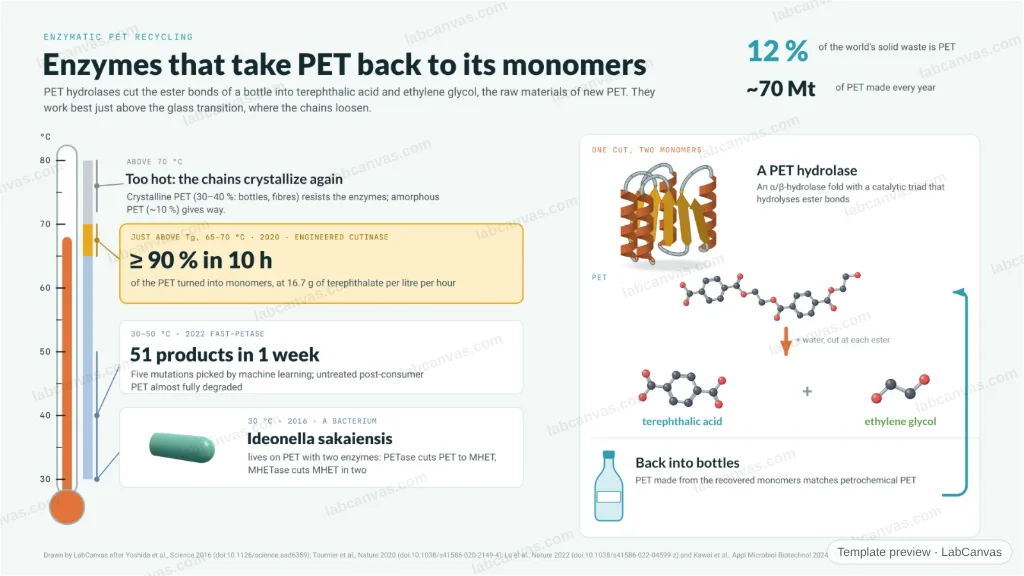
A thermometer from 30 to 80 °C is the spine: PET hydrolases hang off it at the temperatures they work at, from the bacterium that lives on PET at 30 °C to an engineered cutinase in the narrow window just above the glass transition. On the right, the enzyme cuts PET’s ester bonds into terephthalic acid and ethylene glycol, which go back into new bottles.
Updated 4 cited papers81 editable layers
At a glance
- Category
- Graphical abstracts
- Method
- Graphical abstract
- Starting materials
- Post-consumer PET, micronized and amorphous
- Product
- Terephthalic acid and ethylene glycol, repolymerized into new PET
- Key result
- Tg ≈ 65–70 °C, operate below 70 °C (Kawai et al. 2024); ≥ 90 % in 10 h, 16.7 g/L/h (Tournier et al. 2020); 51 products in 1 week, 30–50 °C (Lu et al. 2022)
- Figure
- 1920 × 1080 px (16:9), 81 editable layers, 4 generated objects
Step by step
- Why temperatureBelow the glass transition (≈ 65–70 °C in water) PET is glassy; above it the chains loosen, but above 70 °C PET recrystallizes; amorphous PET (~10 % crystalline) yields, crystalline PET (30–40 %) resists (Kawai et al. 2024)
- 30 °C · a bacteriumIdeonella sakaiensis lives on PET with two enzymes: PETase to MHET, MHETase to terephthalic acid and ethylene glycol (Yoshida et al. 2016)
- 30–50 °C · FAST-PETaseFive machine-learning-guided mutations; untreated PET from 51 products almost fully degraded in 1 week (Lu et al. 2022)
- The window · an engineered cutinase≥ 90 % of PET to monomers in 10 h, 16.7 g of terephthalate per litre per hour (Tournier et al. 2020)
- Back to bottlesPET made from the enzymatic monomers has the properties of petrochemical PET and was made into bottles (Tournier et al. 2020; Lu et al. 2022)
Uses
- Graphical abstracts on enzymatic plastic recycling and PET hydrolases
- Talks on circular plastics and biocatalysis
- Teaching why the glass transition matters for enzymes
Papers this template follows
- Yoshida et al., “A bacterium that degrades and assimilates poly(ethylene terephthalate)”, Science 2016. doi:10.1126/science.aad6359primary
- Tournier et al., “An engineered PET depolymerase to break down and recycle plastic bottles”, Nature 2020. doi:10.1038/s41586-020-2149-4primary
- Lu et al., “Machine learning-aided engineering of hydrolases for PET depolymerization”, Nature 2022. doi:10.1038/s41586-022-04599-zprimary
- Kawai et al., “Engineered polyethylene terephthalate hydrolases: perspectives and limits”, Applied Microbiology and Biotechnology 2024. doi:10.1007/s00253-024-13222-2review
Drawn by LabCanvas after Yoshida et al., Science 2016 (doi:10.1126/science.aad6359); Tournier et al., Nature 2020 (doi:10.1038/s41586-020-2149-4); Lu et al., Nature 2022 (doi:10.1038/s41586-022-04599-z) and Kawai et al., Appl Microbiol Biotechnol 2024 (doi:10.1007/s00253-024-13222-2).
How templates are written and checked: editorial guidelines.
Questions
What does the “Enzymatic PET recycling: the right enzyme at the right temperature” template show?
A thermometer from 30 to 80 °C is the spine: PET hydrolases hang off it at the temperatures they work at, from the bacterium that lives on PET at 30 °C to an engineered cutinase in the narrow window just above the glass transition. On the right, the enzyme cuts PET’s ester bonds into terephthalic acid and ethylene glycol, which go back into new bottles.
What are the steps shown in “Enzymatic PET recycling: the right enzyme at the right temperature”?
1. Why temperature: Below the glass transition (≈ 65–70 °C in water) PET is glassy; above it the chains loosen, but above 70 °C PET recrystallizes; amorphous PET (~10 % crystalline) yields, crystalline PET (30–40 %) resists (Kawai et al. 2024). 2. 30 °C · a bacterium: Ideonella sakaiensis lives on PET with two enzymes: PETase to MHET, MHETase to terephthalic acid and ethylene glycol (Yoshida et al. 2016). 3. 30–50 °C · FAST-PETase: Five machine-learning-guided mutations; untreated PET from 51 products almost fully degraded in 1 week (Lu et al. 2022). 4. The window · an engineered cutinase: ≥ 90 % of PET to monomers in 10 h, 16.7 g of terephthalate per litre per hour (Tournier et al. 2020). 5. Back to bottles: PET made from the enzymatic monomers has the properties of petrochemical PET and was made into bottles (Tournier et al. 2020; Lu et al. 2022).
What are the starting materials and the product?
Starting materials: Post-consumer PET, micronized and amorphous. Product: Terephthalic acid and ethylene glycol, repolymerized into new PET.
Which papers is “Enzymatic PET recycling: the right enzyme at the right temperature” based on?
Yoshida et al., “A bacterium that degrades and assimilates poly(ethylene terephthalate)”, Science 2016 (doi:10.1126/science.aad6359); Tournier et al., “An engineered PET depolymerase to break down and recycle plastic bottles”, Nature 2020 (doi:10.1038/s41586-020-2149-4); Lu et al., “Machine learning-aided engineering of hydrolases for PET depolymerization”, Nature 2022 (doi:10.1038/s41586-022-04599-z); Kawai et al., “Engineered polyethylene terephthalate hydrolases: perspectives and limits”, Applied Microbiology and Biotechnology 2024 (doi:10.1007/s00253-024-13222-2).
Can I edit the “Enzymatic PET recycling: the right enzyme at the right temperature” template?
Yes. Open it in the LabCanvas editor: all 81 layers are editable, including 4 generated objects (structures, plots, equipment) with their own settings. Change the text, colours and layout, then export PNG, TIFF, SVG or PDF.
Do I need an account to use this template?
Not to view it here. To open and edit it, sign in to LabCanvas or create a free account (the free plan keeps up to 3 designs). Downloading the figure is part of LabCanvas Pro (US$19 a month or US$199 a year).