Graphical abstract template · Materials graphical abstracts · Graphical abstract
Liquid crystals: order between solid and liquid
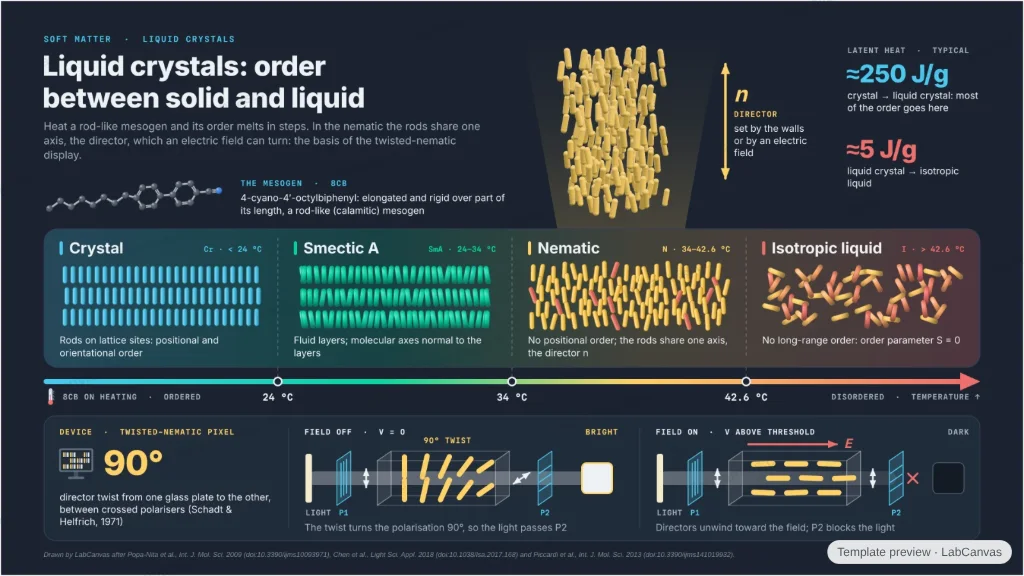
A phase spectrum of a rod-like liquid crystal: on heating, 8CB goes from crystal to smectic A, nematic and isotropic liquid, losing positional order before orientational order. A live 3D nematic shows the director, the shared axis that walls or an electric field can turn, and a twisted-nematic pixel between crossed polarisers shows how that becomes bright and dark in a display.
Updated 4 cited papers307 editable layers
At a glance
- Category
- Materials graphical abstracts
- Method
- Graphical abstract
- Starting materials
- A rod-like mesogen: 8CB (4-cyano-4′-octylbiphenyl)
- Product
- A nematic liquid crystal whose director an electric field can turn: the twisted-nematic display pixel
- Key result
- 8CB: smectic A 24–34 °C, nematic 34–42.6 °C; latent heat ≈ 250 J/g (crystal → LC) vs ≈ 5 J/g (LC → isotropic), typical values (Popa-Nita et al. 2009). TN director twist 90°, published 1971 by Schadt and Helfrich (Chen et al. 2018)
- Figure
- 1920 × 1080 px (16:9), 307 editable layers, 5 generated objects
Step by step
- The mesogenElongated molecules, rigid over part of their length, such as 8CB (4-cyano-4′-octylbiphenyl), form calamitic liquid crystals
- CrystalPositional and orientational order; melting into the mesophase costs about 250 J/g, so most of the order goes here
- Smectic A (8CB, 24–34 °C)Fluid layers about one molecule thick, the molecular axes normal to the layers
- Nematic (8CB, 34–42.6 °C)No positional order; the molecules share one axis, the director n, set by the walls or an electric field
- Isotropic liquid (8CB, above 42.6 °C)Orientational order is gone too (S = 0); this last step costs only about 5 J/g
- Twisted-nematic pixelBetween crossed polarisers the 90° twist guides the light through (bright); above a threshold voltage the directors unwind and the light is blocked (dark)
Uses
- Liquid crystal displays (TN mode: wristwatches, signage, laptops)
- Teaching phases and phase transitions of soft matter
- Electro-optic switching
Papers this template follows
- Popa-Nita, Gerlič & Kralj, “The Influence of Disorder on Thermotropic Nematic Liquid Crystals Phase Behavior”, Int. J. Mol. Sci. 2009. doi:10.3390/ijms10093971review
- Chen et al., “Liquid crystal display and organic light-emitting diode display: present status and future perspectives”, Light Sci. Appl. 2018. doi:10.1038/lsa.2017.168review
- Piccardi, Alberucci & Assanto, “Nematicons and their electro-optic control: light localization and signal readdressing via reorientation in liquid crystals”, Int. J. Mol. Sci. 2013. doi:10.3390/ijms141019932review
- Schinas et al., “Influence of Carbon Quantum Dots on the Orientational Order and Rotational Viscosity of 8CB”, Nanomaterials 2025. doi:10.3390/nano15161278further reading
Drawn by LabCanvas after Popa-Nita et al., Int. J. Mol. Sci. 2009 (doi:10.3390/ijms10093971), Chen et al., Light Sci. Appl. 2018 (doi:10.1038/lsa.2017.168) and Piccardi et al., Int. J. Mol. Sci. 2013 (doi:10.3390/ijms141019932).
How templates are written and checked: editorial guidelines.
Questions
What does the “Liquid crystals: order between solid and liquid” template show?
A phase spectrum of a rod-like liquid crystal: on heating, 8CB goes from crystal to smectic A, nematic and isotropic liquid, losing positional order before orientational order. A live 3D nematic shows the director, the shared axis that walls or an electric field can turn, and a twisted-nematic pixel between crossed polarisers shows how that becomes bright and dark in a display.
What are the steps shown in “Liquid crystals: order between solid and liquid”?
1. The mesogen: Elongated molecules, rigid over part of their length, such as 8CB (4-cyano-4′-octylbiphenyl), form calamitic liquid crystals. 2. Crystal: Positional and orientational order; melting into the mesophase costs about 250 J/g, so most of the order goes here. 3. Smectic A (8CB, 24–34 °C): Fluid layers about one molecule thick, the molecular axes normal to the layers. 4. Nematic (8CB, 34–42.6 °C): No positional order; the molecules share one axis, the director n, set by the walls or an electric field. 5. Isotropic liquid (8CB, above 42.6 °C): Orientational order is gone too (S = 0); this last step costs only about 5 J/g. 6. Twisted-nematic pixel: Between crossed polarisers the 90° twist guides the light through (bright); above a threshold voltage the directors unwind and the light is blocked (dark).
What are the starting materials and the product?
Starting materials: A rod-like mesogen: 8CB (4-cyano-4′-octylbiphenyl). Product: A nematic liquid crystal whose director an electric field can turn: the twisted-nematic display pixel.
Which papers is “Liquid crystals: order between solid and liquid” based on?
Popa-Nita, Gerlič & Kralj, “The Influence of Disorder on Thermotropic Nematic Liquid Crystals Phase Behavior”, Int. J. Mol. Sci. 2009 (doi:10.3390/ijms10093971); Chen et al., “Liquid crystal display and organic light-emitting diode display: present status and future perspectives”, Light Sci. Appl. 2018 (doi:10.1038/lsa.2017.168); Piccardi, Alberucci & Assanto, “Nematicons and their electro-optic control: light localization and signal readdressing via reorientation in liquid crystals”, Int. J. Mol. Sci. 2013 (doi:10.3390/ijms141019932); Schinas et al., “Influence of Carbon Quantum Dots on the Orientational Order and Rotational Viscosity of 8CB”, Nanomaterials 2025 (doi:10.3390/nano15161278).
Can I edit the “Liquid crystals: order between solid and liquid” template?
Yes. Open it in the LabCanvas editor: all 307 layers are editable, including 5 generated objects (structures, plots, equipment) with their own settings. Change the text, colours and layout, then export PNG, TIFF, SVG or PDF.
Do I need an account to use this template?
Not to view it here. To open and edit it, sign in to LabCanvas or create a free account (the free plan keeps up to 3 designs). Downloading the figure is part of LabCanvas Pro (US$19 a month or US$199 a year).