Graphical abstract template · Materials graphical abstracts · Graphical abstract
High-entropy alloys: five metals, one phase
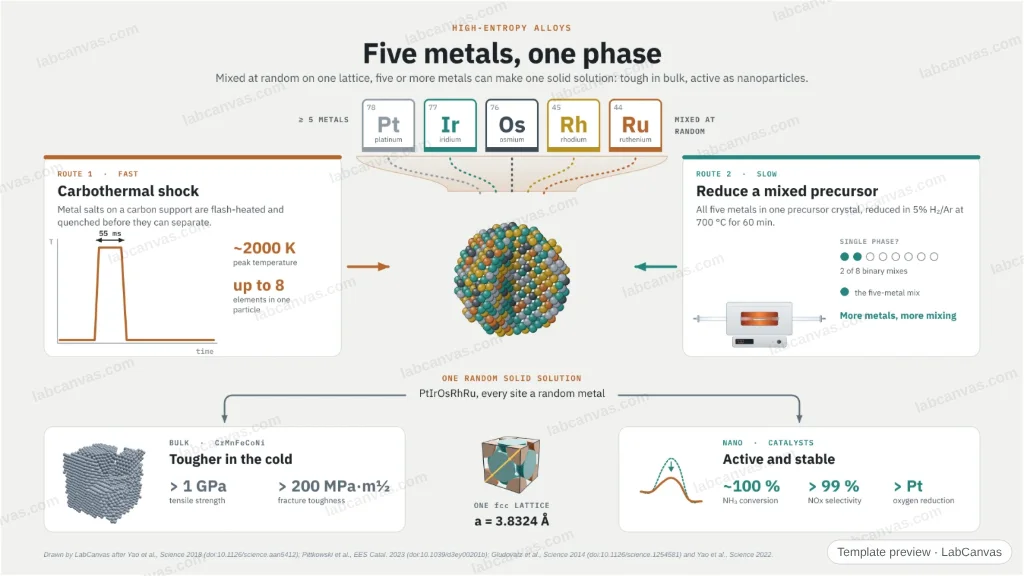
A funnel-shaped graphical abstract: five metals pour into one high-entropy alloy nanoparticle, made either by a 55 ms carbothermal shock or by slowly reducing a mixed precursor. Below, what a single random solid solution buys: a bulk alloy that gets tougher in the cold, one shared fcc lattice and nanoparticle catalysts.
Updated 4 cited papers103 editable layers
At a glance
- Category
- Materials graphical abstracts
- Method
- Graphical abstract
- Starting materials
- Salts or a single-source precursor of five or more metals
- Product
- Single-phase high-entropy alloy nanoparticles (and bulk alloys) in which the metals share one lattice at random
- Key result
- Shock: ~2000 K for 55 ms, up to eight elements (Yao et al. 2018); fcc PtIrOsRhRu, a = 3.8324 Å (Pittkowski et al. 2023); CrMnFeCoNi > 1 GPa, > 200 MPa·m½ (Gludovatz et al. 2014)
- Figure
- 1920 × 1080 px (16:9), 103 editable layers, 3 generated objects
Step by step
- Five metalsHEAs are alloys of at least five elements (Pittkowski et al. 2023); configurational entropy in alloys of five or more major elements may stabilize a single solid solution (Gludovatz et al. 2014)
- Route 1 · carbothermal shockMetal salts on a carbon support shocked to ~2000 K for 55 ms alloy up to eight dissimilar elements into single-phase nanoparticles (Yao et al. 2018)
- Route 2 · mixed precursorA single-source precursor reduced in 5% H₂/Ar at 700 °C for 60 min gives single-phase PtIrOsRhRu particles; only two of eight binary mixes did (Pittkowski et al. 2023)
- What one phase buysCrMnFeCoNi: fcc, > 1 GPa and > 200 MPa·m½, tougher at cryogenic temperatures (Gludovatz et al. 2014); quinary HEA nanoparticles oxidize ammonia with ~100% conversion and > 99% NOx selectivity (Yao et al. 2018); PtIrOsRhRu beats Pt for oxygen reduction (Pittkowski et al. 2023)
Uses
- Graphical abstracts on high-entropy alloys and high-entropy nanoparticles
- Talks on multi-element catalysts
- Teaching configurational entropy and solid solutions
Papers this template follows
- Yao et al., “Carbothermal shock synthesis of high-entropy-alloy nanoparticles”, Science 2018. doi:10.1126/science.aan5412method origin
- Pittkowski et al., “The more the better: on the formation of single-phase high entropy alloy nanoparticles as catalysts for the oxygen reduction reaction”, EES Catal. 2023. doi:10.1039/d3ey00201bprimary
- Gludovatz et al., “A fracture-resistant high-entropy alloy for cryogenic applications”, Science 2014. doi:10.1126/science.1254581primary
- Yao et al., “High-entropy nanoparticles: synthesis-structure-property relationships and data-driven discovery”, Science 2022. doi:10.1126/science.abn3103review
Drawn by LabCanvas after Yao et al., Science 2018 (doi:10.1126/science.aan5412); Pittkowski et al., EES Catal. 2023 (doi:10.1039/d3ey00201b); Gludovatz et al., Science 2014 (doi:10.1126/science.1254581) and Yao et al., Science 2022.
How templates are written and checked: editorial guidelines.
Questions
What does the “High-entropy alloys: five metals, one phase” template show?
A funnel-shaped graphical abstract: five metals pour into one high-entropy alloy nanoparticle, made either by a 55 ms carbothermal shock or by slowly reducing a mixed precursor. Below, what a single random solid solution buys: a bulk alloy that gets tougher in the cold, one shared fcc lattice and nanoparticle catalysts.
What are the steps shown in “High-entropy alloys: five metals, one phase”?
1. Five metals: HEAs are alloys of at least five elements (Pittkowski et al. 2023); configurational entropy in alloys of five or more major elements may stabilize a single solid solution (Gludovatz et al. 2014). 2. Route 1 · carbothermal shock: Metal salts on a carbon support shocked to ~2000 K for 55 ms alloy up to eight dissimilar elements into single-phase nanoparticles (Yao et al. 2018). 3. Route 2 · mixed precursor: A single-source precursor reduced in 5% H₂/Ar at 700 °C for 60 min gives single-phase PtIrOsRhRu particles; only two of eight binary mixes did (Pittkowski et al. 2023). 4. What one phase buys: CrMnFeCoNi: fcc, > 1 GPa and > 200 MPa·m½, tougher at cryogenic temperatures (Gludovatz et al. 2014); quinary HEA nanoparticles oxidize ammonia with ~100% conversion and > 99% NOx selectivity (Yao et al. 2018); PtIrOsRhRu beats Pt for oxygen reduction (Pittkowski et al. 2023).
What are the starting materials and the product?
Starting materials: Salts or a single-source precursor of five or more metals. Product: Single-phase high-entropy alloy nanoparticles (and bulk alloys) in which the metals share one lattice at random.
Which papers is “High-entropy alloys: five metals, one phase” based on?
Yao et al., “Carbothermal shock synthesis of high-entropy-alloy nanoparticles”, Science 2018 (doi:10.1126/science.aan5412); Pittkowski et al., “The more the better: on the formation of single-phase high entropy alloy nanoparticles as catalysts for the oxygen reduction reaction”, EES Catal. 2023 (doi:10.1039/d3ey00201b); Gludovatz et al., “A fracture-resistant high-entropy alloy for cryogenic applications”, Science 2014 (doi:10.1126/science.1254581); Yao et al., “High-entropy nanoparticles: synthesis-structure-property relationships and data-driven discovery”, Science 2022 (doi:10.1126/science.abn3103).
Can I edit the “High-entropy alloys: five metals, one phase” template?
Yes. Open it in the LabCanvas editor: all 103 layers are editable, including 3 generated objects (structures, plots, equipment) with their own settings. Change the text, colours and layout, then export PNG, TIFF, SVG or PDF.
Do I need an account to use this template?
Not to view it here. To open and edit it, sign in to LabCanvas or create a free account (the free plan keeps up to 3 designs). Downloading the figure is part of LabCanvas Pro (US$19 a month or US$199 a year).